
G-code programming, often referred to as the “language of machines,” is the foundational instruction set that directs the movement and operation of computer-controlled manufacturing equipment. At its core, it’s a series of alphanumeric codes that tell machines, such as CNC (Computer Numerical Control) mills, lathes, 3D printers, and laser cutters, precisely what to do, where to do it, and how to do it. Understanding G-code is crucial for anyone involved in digital fabrication, additive manufacturing, and automated production, bridging the gap between digital design and physical creation.
The power of G-code lies in its simplicity and universality. While specific commands and dialects might vary slightly between different machine manufacturers and software, the fundamental principles remain consistent. This allows for a degree of interoperability and a common understanding across a vast range of automated manufacturing processes. From crafting intricate prototypes to mass-producing complex parts, G-code is the silent orchestrator, translating design intentions into tangible realities.
The Evolution and Importance of G-Code
The genesis of G-code programming can be traced back to the early days of numerical control in the mid-20th century. Initially developed for large-scale industrial machinery, its purpose was to automate repetitive and precise tasks, thereby increasing efficiency and accuracy. As computing power grew and manufacturing technologies advanced, G-code evolved, becoming more sophisticated and adaptable to a wider array of machines and applications.
Today, G-code is indispensable in modern manufacturing. It empowers engineers, designers, and technicians to achieve levels of precision and repeatability that would be impossible with manual methods. For industries ranging from aerospace and automotive to medical devices and consumer electronics, G-code is the backbone of their production lines. The ability to program complex toolpaths and operations allows for the creation of intricate geometries, tight tolerances, and customized components, driving innovation and enabling the production of increasingly sophisticated products.
The accessibility of 3D printing has also brought G-code programming to a broader audience. Hobbyists, educators, and small businesses can now leverage G-code to bring their digital creations to life. This democratization of manufacturing has opened up new avenues for innovation and personalized production, highlighting the enduring relevance and expanding influence of G-code in the technological landscape.
Understanding the Anatomy of G-Code Commands
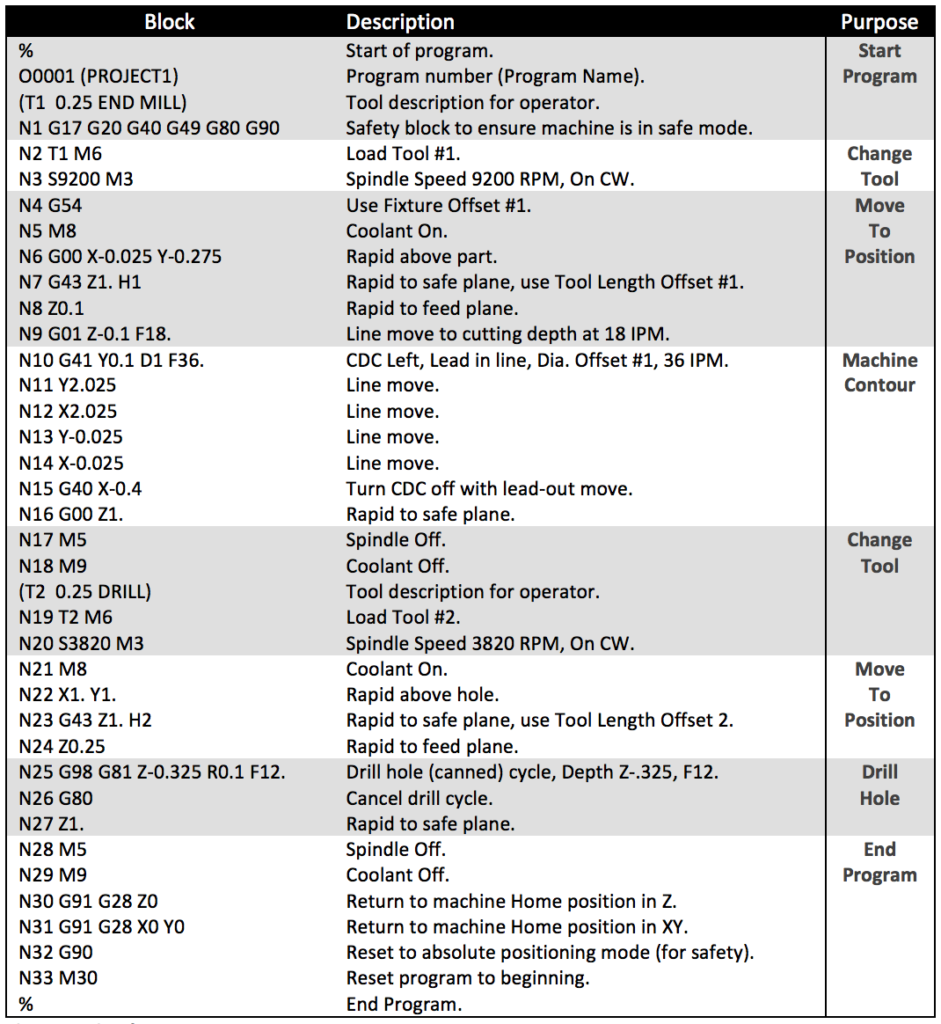
G-code commands are not arbitrary strings of characters; they are structured sequences that convey specific instructions to a CNC machine. Each command typically consists of an “address” (a letter) followed by a “numerical value” (a number). These address letters represent specific functions or parameters, while the numerical values quantify those functions. Understanding these fundamental components is key to deciphering and writing G-code.
The “G” Codes: Preparatory Commands
The “G” codes are arguably the most fundamental and widely recognized commands in G-code programming. They are known as “preparatory commands” because they set the stage for the machine’s actions, defining the type of motion or operation that will occur. These codes dictate how the machine’s tool will move through space.
Common G-Code Commands and Their Functions
-
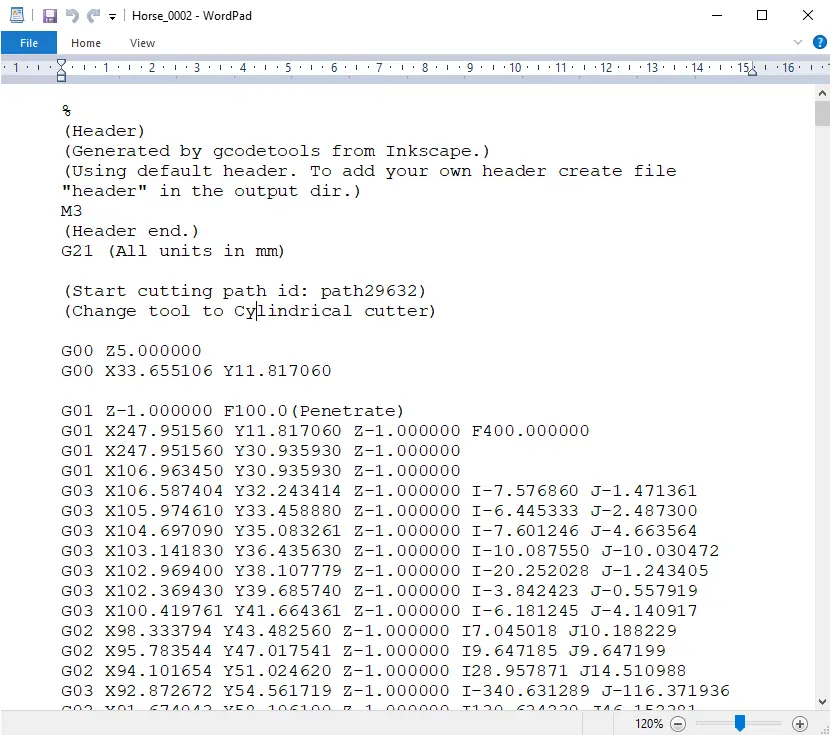
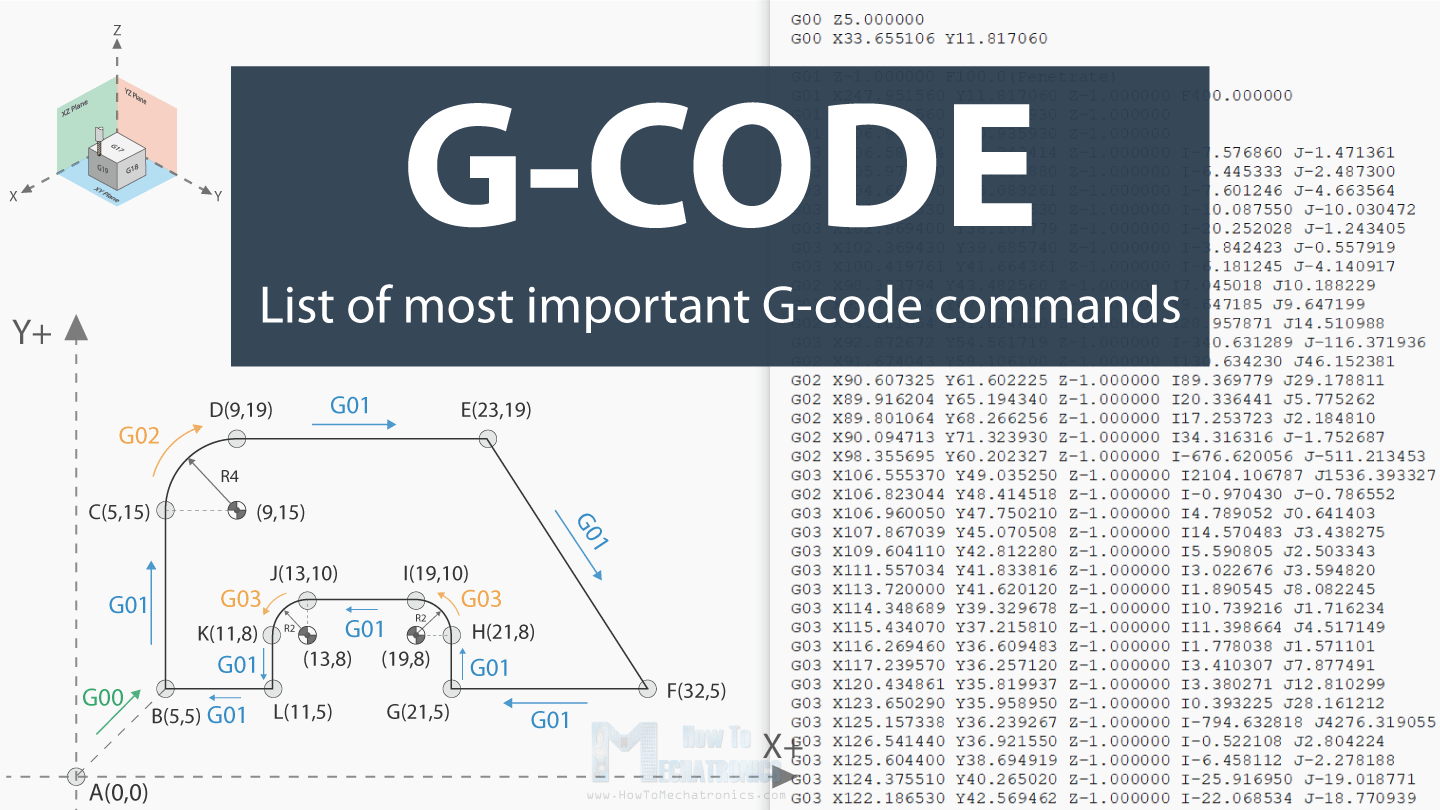
G00 (Rapid Traverse): This command instructs the machine to move the tool at its maximum possible speed from its current position to a specified coordinate. G00 is used for non-cutting movements, such as positioning the tool over the workpiece before starting a cut or moving between different cutting paths. Precision is not critical during G00 moves, as their primary purpose is speed and efficiency.
-
G01 (Linear Interpolation): This is the most common cutting command. G01 tells the machine to move the tool in a straight line from its current position to a specified coordinate at a defined feed rate. The feed rate is the speed at which the tool cuts into the material, and it’s crucial for achieving the desired surface finish and preventing tool damage.
-
G02 (Circular Interpolation, Clockwise) and G03 (Circular Interpolation, Counter-Clockwise): These commands enable the creation of arcs and circles. G02 and G03 instruct the machine to move the tool along a circular path to a specified endpoint. They require additional parameters to define the radius or the center point of the arc, along with the feed rate.
-
G04 (Dwell): This command causes the machine to pause its movement for a specified amount of time. Dwell commands are often used after a drilling operation to allow chips to clear from the hole or to ensure a clean exit from the material.
-
G17, G18, G19 (Plane Selection): These commands select the active plane for circular interpolation (G02/G03). G17 selects the XY plane, G18 selects the XZ plane, and G19 selects the YZ plane. This is important for defining the orientation of arcs and other 2D profiles in 3D space.
-
G20 and G21 (Units Selection): G20 sets the machine to operate in inches, while G21 sets it to operate in millimeters. This is a critical setting to ensure accurate dimensions are maintained throughout the programming process.
-
G28 (Return to Home Position): This command directs the machine’s tool to move to its “home” or reference position. This is often a safe parking spot for the tool.
-
G90 and G91 (Absolute and Incremental Positioning): These commands determine how coordinates are interpreted. G90 (Absolute Positioning) means that all coordinate values are measured from the machine’s origin (0,0,0). G91 (Incremental Positioning) means that coordinate values are measured relative to the tool’s current position.
The “M” Codes: Miscellaneous Commands
While G-codes primarily control motion, M-codes, or “miscellaneous commands,” handle other machine functions that are not directly related to movement. These commands control auxiliary operations that are essential for the manufacturing process.
Essential M-Code Functions
-
M03 (Spindle On, Clockwise) and M04 (Spindle On, Counter-Clockwise): These commands start the machine’s spindle rotating in either a clockwise or counter-clockwise direction. The spindle’s rotation is what drives the cutting tool or the print nozzle.
-
M05 (Spindle Off): This command stops the spindle’s rotation.
-
M06 (Tool Change): This command initiates an automatic tool change, if the machine is equipped with a tool changer. It signals the machine to retract the current tool and load a new one.
-
M07 (Mist Coolant On) and M08 (Flood Coolant On): These commands activate the coolant systems. Coolant is essential for lubricating the cutting tool, dissipating heat, and flushing away chips during machining operations, which extends tool life and improves surface finish.
-
M09 (Coolant Off): This command deactivates the coolant systems.
-
M30 (Program End and Rewind): This command signals the end of a G-code program. It typically stops the spindle and coolant, resets the machine to the beginning of the program, and prepares it for the next cycle.
-
M00 (Program Stop): This command halts program execution, requiring manual intervention to restart. It’s often used for tasks that require human oversight, such as inspection or manual adjustments.
Other Important G-Code Elements
Beyond G and M codes, several other elements are crucial for a complete G-code program:
-
Coordinate Systems (X, Y, Z): These are the axes of movement for the machine. In 3D printing, X and Y typically represent the horizontal plane, and Z represents the vertical axis. In milling or turning, these can be more complex, involving rotational axes as well.
-
Feed Rate (F): This numerical value, often paired with G01, specifies the speed at which the tool moves during a cutting operation. It’s measured in units per minute (e.g., inches per minute or millimeters per minute).
-
Spindle Speed (S): This numerical value, paired with M03 or M04, defines the rotational speed of the spindle, typically measured in revolutions per minute (RPM).
-
Tool Number (T): This numerical value, often used with M06, identifies the specific tool to be loaded or used.
-
Comments (Parentheses): Text enclosed in parentheses
()is ignored by the machine. This is vital for adding explanations, notes, or identifying sections of the code for human readability.
Generating G-Code: From Design to Machine
G-code is not typically written from scratch for complex designs. Instead, it’s generated by specialized software that translates digital models into machine instructions. This process involves several stages, ensuring that the generated G-code is accurate, efficient, and safe for the machine and the operation.
Computer-Aided Design (CAD) and Computer-Aided Manufacturing (CAM)
The journey of G-code generation begins with a digital design.
Designing the Object
- CAD Software: Computer-Aided Design (CAD) software is used to create 2D drawings or 3D models of the desired object. Programs like SolidWorks, AutoCAD, Fusion 360, SketchUp, and TinkerCAD are used for this purpose. The design phase focuses on the geometry, dimensions, and features of the part.
Preparing for Manufacturing
- CAM Software: Once the design is finalized, it’s imported into Computer-Aided Manufacturing (CAM) software. CAM software takes the CAD model and uses it to determine the toolpaths, cutting strategies, and machining operations required to produce the part. This involves selecting tools, defining machining parameters (like depth of cut, feed rate, spindle speed), and simulating the manufacturing process.
CAM software is where the intelligence of the manufacturing process is applied. It ensures that the tool can reach all necessary areas, avoids collisions, and optimizes the machining sequence for efficiency and quality. For 3D printing, the equivalent process involves slicing software (e.g., Cura, PrusaSlicer) which takes a 3D model (usually in STL or 3MF format) and “slices” it into many thin layers, generating the G-code instructions for the printer to build the object layer by layer.
The Role of Post-Processors
A critical component in the G-code generation workflow is the “post-processor.”
Tailoring G-Code for Specific Machines
-
Machine Specificity: Every CNC machine, even those from the same manufacturer, can have unique control systems and configurations. A post-processor is a software module that translates the generic toolpath data generated by the CAM software into the specific G-code dialect required by a particular machine controller. This ensures that the generated code is compatible with the machine’s firmware and can be interpreted correctly.
-
Customization and Optimization: Post-processors can also be customized to incorporate specific machine features, safety protocols, or optimal operational sequences. For example, a post-processor might add specific M-codes for a particular brand of tool changer or optimize the rapid traverse moves based on the machine’s kinematics.
The output of the CAM software, after being processed by the appropriate post-processor, is the final G-code file. This file is then loaded onto the CNC machine (often via USB, network, or direct connection) and executed by the machine’s controller.
Applications and Future of G-Code Programming
G-code programming’s impact is far-reaching, permeating numerous industries and continuing to evolve with technological advancements. Its versatility makes it an essential tool for modern manufacturing and digital fabrication.
Current Applications Across Industries
The applications of G-code programming are vast and diverse:
-
Manufacturing and Machining: This is the most traditional domain. CNC mills, lathes, routers, and plasma cutters use G-code to create everything from small precision components for electronics to large structural parts for automotive and aerospace industries.
-
3D Printing (Additive Manufacturing): As mentioned earlier, G-code is the primary language for most FDM (Fused Deposition Modeling) 3D printers. It dictates the movement of the print head, the extrusion of material, and the temperature control, enabling the creation of complex prototypes, custom tooling, and even end-use parts.
-
Laser Cutting and Engraving: G-code is used to control the precise path of laser beams for cutting materials like wood, acrylic, metal, and for engraving intricate designs.
-
CNC Woodworking: CNC routers use G-code for intricate woodworking projects, from furniture to decorative pieces, allowing for complex joinery and detailed carvings.
-
Robotics and Automation: While not always exclusively G-code, similar command structures are used in programming industrial robots for assembly, welding, and material handling.
The Future Trajectory
The future of G-code programming is tied to the broader trends in manufacturing and technology:
-
AI and Machine Learning Integration: AI is beginning to play a role in optimizing CAM processes, potentially leading to more efficient and intelligent G-code generation. This could include predictive maintenance suggestions embedded within the code or dynamic path adjustments based on real-time sensor feedback.
-
Increased Automation and Connectivity: As the Industrial Internet of Things (IIoT) grows, G-code will be part of a more interconnected manufacturing ecosystem. Machines will communicate and coordinate more effectively, with G-code acting as a key enabler of this communication.
-
Advanced Materials and Processes: As new materials and manufacturing techniques emerge, G-code will need to adapt. This could involve new commands for controlling multi-material printing, advanced robotic manipulation, or novel finishing processes.
-
Simplified Programming Interfaces: While understanding the fundamentals of G-code is beneficial, there’s a push towards more intuitive graphical interfaces in CAM and slicing software, which abstract away much of the direct G-code manipulation for less experienced users. However, the underlying G-code will remain the direct instruction set for the machine.
In conclusion, G-code programming is a fundamental pillar of modern digital fabrication and automated manufacturing. Its structured commands, enabling precise control over machines, are indispensable for producing everything from simple prototypes to complex industrial components. As technology advances, G-code will continue to evolve, remaining at the forefront of turning digital designs into tangible realities, solidifying its place as the essential language of machines.
aViewFromTheCave is a participant in the Amazon Services LLC Associates Program, an affiliate advertising program designed to provide a means for sites to earn advertising fees by advertising and linking to Amazon.com. Amazon, the Amazon logo, AmazonSupply, and the AmazonSupply logo are trademarks of Amazon.com, Inc. or its affiliates. As an Amazon Associate we earn affiliate commissions from qualifying purchases.