
The landscape of personal finance has undergone a seismic shift over the last decade. The days of mailing paper checks or visiting a physical bank branch to fill out a deposit slip for a friend are rapidly fading. Today, the question of “how can I send money to someone” is met with an array of digital, institutional, and international options, each tailored to specific needs, speeds, and cost structures. Navigating these choices requires an understanding of the underlying financial mechanisms to ensure your funds arrive safely, quickly, and at the lowest possible cost.

Peer-to-Peer (P2P) Payment Apps: The New Standard for Local Transfers
Peer-to-peer (P2P) payment applications have revolutionized the way we handle small, everyday transactions. Whether you are splitting a dinner bill, paying a roommate for utilities, or sending a birthday gift to a relative, these platforms have turned complex bank transfers into simple clicks on a smartphone.
The Rise of Venmo and Cash App
Venmo and Cash App have become household names by blending social networking with financial utility. Venmo, owned by PayPal, popularized the “social feed” aspect of payments, making it the go-to for casual, social transactions within the United States. Its primary advantage lies in its ubiquity; almost everyone with a smartphone has it.
Cash App, developed by Block (formerly Square), offers a slightly different value proposition. While it functions as a P2P tool, it also bridges the gap between traditional banking and modern investing, allowing users to purchase stocks or Bitcoin within the same interface. For many unbanked or underbanked individuals, Cash App serves as a primary financial hub, offering a “Cash Card” that functions like a debit card.
Zelle: The Bank-Integrated Solution
Unlike Venmo or Cash App, which act as “digital wallets” holding a balance outside of your bank account, Zelle is integrated directly into the infrastructure of over 1,000 banking institutions. When you send money via Zelle, it moves from one bank account to another almost instantaneously, often within minutes.
The primary benefit of Zelle is security and speed. Because it is backed by major financial institutions, there is no intermediate “holding” period where you must wait to “cash out” to your bank. However, the caveat is that Zelle transactions are generally irreversible. Once the money is sent, it is gone, making it essential to only use this method with people you know and trust implicitly.
PayPal: The Veteran of Online Payments
PayPal remains the global giant of digital transfers. While it is often associated with e-commerce, its “Friends and Family” feature allows for fee-free transfers within the same country when funded by a bank account or existing balance. PayPal’s strength lies in its international reach and its robust dispute resolution system for commercial transactions, though users should be wary of the fees associated with credit card funding or currency conversion.
Crossing Borders: Mastering International Money Transfers
When you need to send money across international lines, the complexity increases significantly. You are no longer just moving currency; you are engaging in the foreign exchange (FX) market. Traditional banks have historically dominated this space, often charging high flat fees and hiding additional costs within poor exchange rates.
Understanding Exchange Rates and Hidden Margins
Most people look at the “upfront fee” when sending money abroad, but the “hidden fee” is often more expensive. This is the difference between the mid-market rate (the real exchange rate seen on Google or Reuters) and the rate the provider offers you. A provider might claim to have “zero fees” but then offer an exchange rate that is 3% to 5% worse than the actual market rate. When sending $1,000, that “free” transfer just cost you $50.
Specialized Platforms: Wise and Revolut
Modern fintech companies like Wise (formerly TransferWise) and Revolut have disrupted the international transfer market by offering the mid-market exchange rate. Wise, in particular, uses a unique “peer-to-peer” routing system. Instead of moving money across borders—which is expensive—they maintain pools of currency in different countries. When you send USD to someone in the UK, you pay USD into Wise’s American account, and Wise pays the recipient out of their UK-based GBP account. This avoids costly international banking fees and allows them to pass the savings to the consumer.
Revolut offers a similar advantage but focuses more on a “neobank” experience. It allows users to hold multiple currencies simultaneously in their account, making it an excellent tool for frequent travelers or expatriates who need to time the market and convert currency when rates are favorable.
Traditional Remittance: Western Union and MoneyGram
For sending money to regions with less developed digital banking infrastructure, traditional remittance services like Western Union and MoneyGram remain vital. Their greatest asset is their physical footprint. If you need to send money to someone who does not have a bank account, these services allow the recipient to pick up physical cash at a local agent. While often more expensive than digital-only platforms, they provide a level of accessibility that fintech apps cannot yet match.
Institutional Methods: Wire Transfers and ACH
For large-scale transactions, such as a down payment on a home, a business settlement, or a high-value investment, P2P apps are often insufficient due to low transaction limits and security protocols. In these cases, institutional banking methods are the gold standard.
Domestic ACH: The Backbone of US Finance
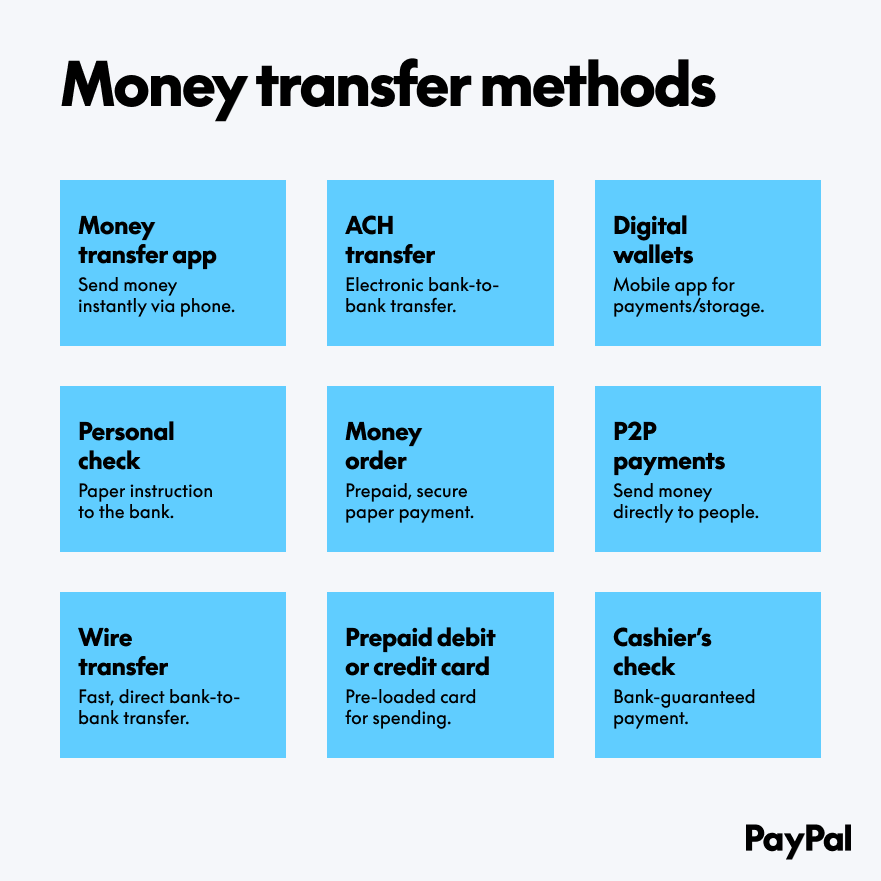
Automated Clearing House (ACH) transfers are the primary method for moving money between US bank accounts. These are typically used for payroll, bill payments, and transfers between your own accounts at different banks. While ACH transfers used to take 3 to 5 business days, “Same Day ACH” has become more common. The primary benefit of ACH is that it is often free or very low-cost, making it the most efficient way to move large sums of money domestically when speed is not the absolute priority.
International Wire Transfers (SWIFT)
The Society for Worldwide Interbank Financial Telecommunication (SWIFT) is the network that allows banks to communicate and execute international wire transfers. A SWIFT transfer is highly secure and can move massive amounts of capital. However, it is also the most expensive and slowest method. A single wire can cost between $25 and $50 in outgoing fees, plus potential incoming fees at the receiving bank and intermediary bank fees. These are best reserved for business-critical transactions where the security of the banking network is paramount.
Protecting Your Assets: Security and Fraud Prevention
The ease of digital money transfers has unfortunately opened the door for sophisticated financial scams. Unlike a credit card transaction, which often comes with robust consumer protection and the ability to “charge back” a fraudulent purchase, many P2P and wire transfers are treated like cash. Once the recipient receives the funds, they are virtually impossible to recover.
Common Red Flags in Digital Transfers
Financial literacy involves recognizing the psychological tactics used by scammers. Common red flags include:
- Urgency: Scammers often create a sense of crisis, claiming a utility will be shut off or a relative is in jail.
- Overpayment Scams: Someone sends you a “check” for more than an agreed amount and asks you to send the difference back via a P2P app. The original check eventually bounces, leaving you out of the money you sent.
- Accidental Transfers: A stranger sends you money “by mistake” and asks for it back. Often, the initial funds were from a stolen account and will be reversed, while the money you send back is your own legitimate capital.
Verification and Two-Factor Authentication
To secure your financial tools, always enable Two-Factor Authentication (2FA) using an authenticator app rather than SMS, which can be vulnerable to SIM-swapping. Before hitting “send” on a large transfer, perform a “test transfer” of a small amount (like $1) to ensure the recipient receives it. For wire transfers, always verify wiring instructions over the phone with a known contact to prevent “Man-in-the-Middle” attacks where a hacker intercepts an email and changes the account numbers.
Strategic Selection: How to Choose the Right Transfer Method
Choosing the right way to send money is a balance of three factors: cost, speed, and the relationship between the sender and receiver.
Evaluating Cost vs. Speed
If you need the money to arrive instantly and cost is no object, a wire transfer or Zelle is your best bet. If you are looking for the lowest cost and can wait a few days, an ACH transfer or a platform like Wise is superior. For international transfers, always calculate the “total cost,” which includes the upfront fee plus the exchange rate margin.

Sending Large Sums for Business or Real Estate
When dealing with five or six-figure sums, the convenience of a mobile app is outweighed by the need for a paper trail and institutional security. In these scenarios, traditional bank wires are the only recommended path. They provide a federal reference number that allows the transaction to be tracked through the banking system, providing peace of mind for both the sender and the receiver during significant life events.
By understanding the nuances of these financial tools, you can move your money with confidence, ensuring that your capital reaches its destination efficiently while keeping your hard-earned wealth protected from unnecessary fees and security risks.
aViewFromTheCave is a participant in the Amazon Services LLC Associates Program, an affiliate advertising program designed to provide a means for sites to earn advertising fees by advertising and linking to Amazon.com. Amazon, the Amazon logo, AmazonSupply, and the AmazonSupply logo are trademarks of Amazon.com, Inc. or its affiliates. As an Amazon Associate we earn affiliate commissions from qualifying purchases.