
Associative multiplication, often referred to as the associative property of multiplication, is a fundamental concept in mathematics that underpins many operations within computing and financial modeling. While seemingly abstract, its implications are deeply embedded in the digital tools and financial systems we interact with daily. Understanding associative multiplication is not just about mastering mathematical rules; it’s about appreciating the efficiency and reliability of the technological and financial frameworks that govern our modern world.
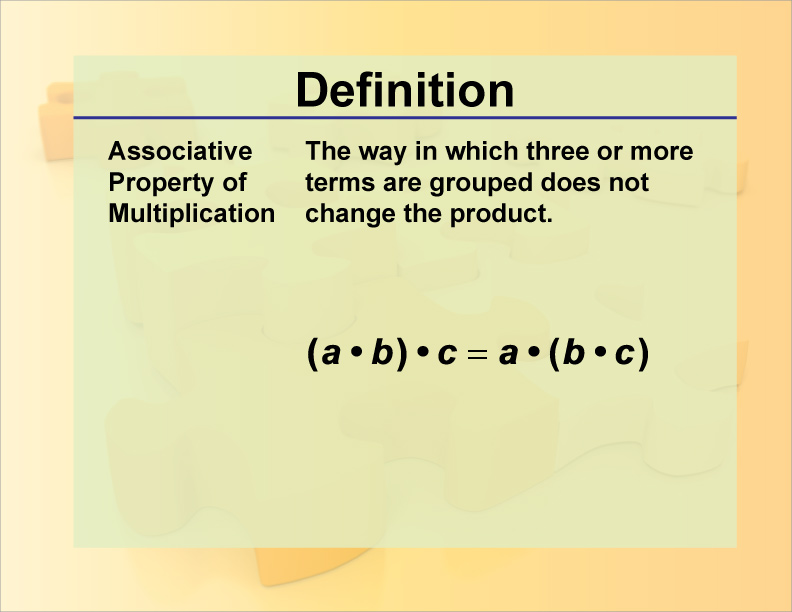
At its core, the associative property states that the way in which numbers are grouped in a multiplication problem does not change the product. In simpler terms, when you are multiplying three or more numbers, you can group them in any order, and the final answer will remain the same. Mathematically, this is expressed as:
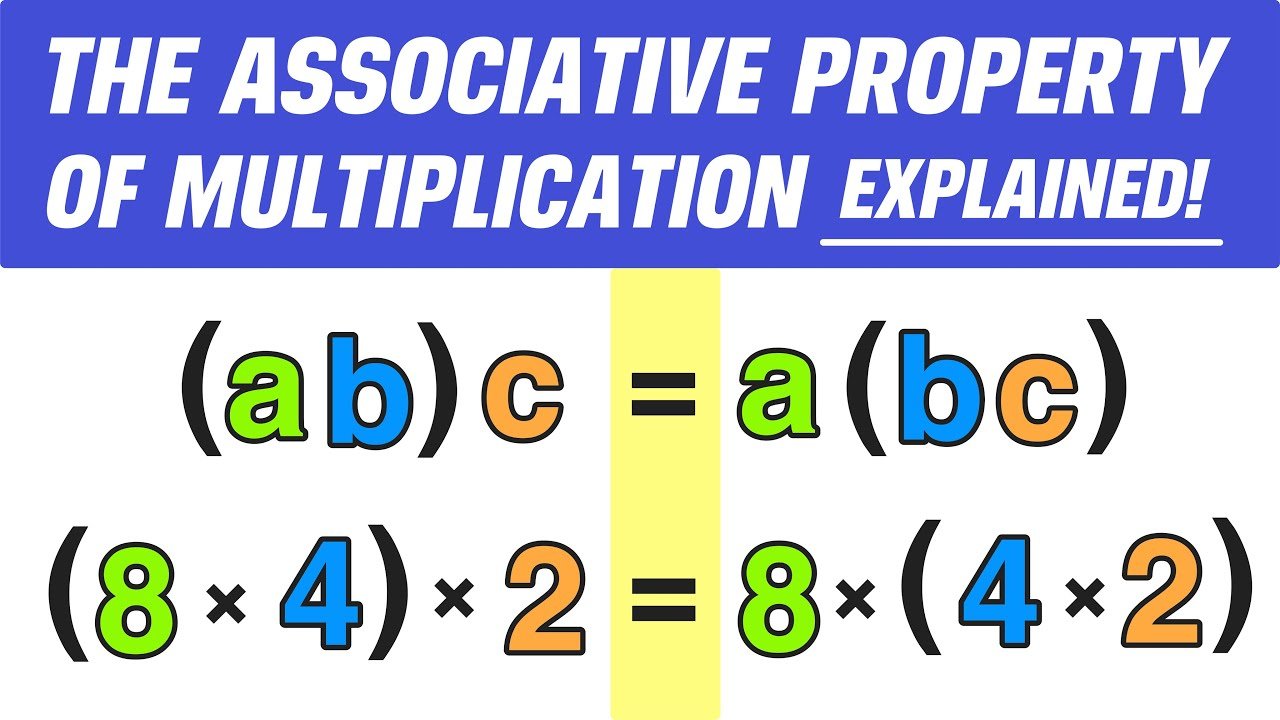
(a × b) × c = a × (b × c)
Where ‘a’, ‘b’, and ‘c’ represent any numbers. For example, if we have the numbers 2, 3, and 4, we can calculate the product as follows:
- Grouping (2 × 3) × 4: First, multiply 2 by 3, which equals 6. Then, multiply 6 by 4, resulting in 24.
- Grouping 2 × (3 × 4): First, multiply 3 by 4, which equals 12. Then, multiply 2 by 12, also resulting in 24.
The result is identical, irrespective of which pair of numbers we multiplied first. This property, while straightforward for simple arithmetic, becomes incredibly powerful and essential when scaled up in complex computational environments and intricate financial calculations.
The Underpinnings of Computational Efficiency
The associative property of multiplication is not merely a theoretical curiosity; it’s a cornerstone of computational efficiency, especially within the realm of technology. Modern software and hardware rely heavily on this principle to perform calculations rapidly and accurately.
Algorithmic Optimization and Data Processing
Algorithms, the step-by-step instructions that computers follow to perform tasks, often involve sequences of multiplications. The associative property allows programmers and compiler designers to optimize these algorithms without compromising the accuracy of the final result. For instance, consider a scenario where a program needs to calculate the product of several variables, say x * y * z. Without the associative property, the order of operations might be fixed, potentially leading to intermediate results that are either too large or too small to be represented accurately by the computer’s data types, a phenomenon known as overflow or underflow.
By leveraging associativity, the system can dynamically reorder these multiplications to minimize the risk of such precision errors. This is particularly crucial in scientific computing, simulations, and graphics rendering, where massive datasets and complex calculations are the norm. For example, in 3D graphics, transforming a point involves multiplying its coordinates by a series of matrices. Each matrix multiplication can be seen as a sequence of scalar multiplications. The associative property allows these matrix multiplications to be chained together and performed in an order that might be computationally more efficient or numerically stable.
Parallel Processing and Distributed Computing
The associative property is also vital for enabling parallel processing and distributed computing. In parallel processing, multiple calculations are performed simultaneously on different processors. If a large multiplication task can be broken down into smaller, independent sub-tasks, the associative property ensures that the order in which these sub-tasks are computed and their results combined does not affect the final outcome.
Imagine multiplying a large array of numbers. This can be split among several processors. Each processor might compute the product of a subset of the numbers. The associative property guarantees that if Processor A computes (a × b) and Processor B computes (c × d), and then we multiply their results (a × b) × (c × d), it will be the same as if we had grouped them differently initially, say a × (b × c × d), as long as all numbers are accounted for. This modularity is essential for scaling computational power across clusters of computers, enabling them to tackle problems that would be intractable for a single machine.
In distributed computing, where computations are spread across a network of interconnected computers, the associative property simplifies the coordination and aggregation of results. Intermediate products can be computed and stored independently, and later combined in any order to yield the final aggregate product. This robustness is fundamental to building fault-tolerant systems where individual nodes might fail.
Data Structures and Memory Management
The efficient manipulation of data structures, such as arrays and matrices, also benefits from associative multiplication. Many algorithms operating on these structures involve repeated multiplications. The ability to reorder these operations can lead to more efficient memory access patterns and reduced computational overhead. For example, when performing matrix multiplication, the order in which elements are accessed and multiplied can significantly impact performance due to cache locality. Associativity provides the flexibility to choose an order that optimizes data retrieval.
Furthermore, in the context of numerical libraries and optimized math functions, the associative property is implicitly used to ensure that calculations are performed in a way that maintains the highest possible precision for floating-point numbers. While floating-point arithmetic can sometimes exhibit slight deviations from true mathematical associativity due to rounding errors, the underlying principles of numerical analysis often aim to leverage associativity where possible to minimize these deviations.
Implications in Financial Modeling and Analysis
Beyond the silicon and code, associative multiplication plays a crucial role in the intricate world of finance, underpinning the calculations that drive investment decisions, risk assessment, and economic forecasting.
Compound Interest and Growth Projections
One of the most direct applications of associative multiplication in finance is in the calculation of compound interest. When an investment grows over multiple periods, the interest earned in each period is added to the principal, and the next period’s interest is calculated on this new, larger principal. This process can be represented as a series of multiplications.

For example, if an initial investment of $P$ grows at an annual rate $r$ for $n$ years, the final amount $A$ can be calculated as:
$A = P times (1 + r) times (1 + r) times dots times (1 + r)$ (n times)
$A = P times (1 + r)^n$
The associative property allows us to group these $(1+r)$ terms in any way. However, more practically, when dealing with multiple investments or varying interest rates over different periods, the associative property of multiplication simplifies the calculation of the overall growth factor. If an investment grows by a factor of $g1$ in the first year, $g2$ in the second, and $g3$ in the third, the total growth factor is $g1 times g2 times g3$. Using associativity, we can calculate this as $(g1 times g2) times g3$ or $g1 times (g2 times g3)$, which is crucial when dealing with complex cash flow projections or portfolio performance analysis. Financial models often involve chaining multiple growth rates together, and associativity ensures that the order in which these growth factors are applied does not alter the final projected value.
Risk Management and Portfolio Diversification
In risk management, especially in portfolio theory, associative multiplication is fundamental to calculating the overall risk and expected return of a diversified portfolio. The covariance between different assets, a key measure of how their prices move together, is used extensively. When calculating portfolio variance or standard deviation, which quantify risk, formulas often involve sums of products of asset weights and covariances. While the sums might not directly benefit from associativity, the underlying multiplicative components do.
For instance, if you are calculating the contribution of several pairs of assets to the overall portfolio risk, and each contribution involves a product of several factors (e.g., weight of asset A, weight of asset B, and their covariance), the associative property ensures that the way these factors are grouped and multiplied will yield a consistent result. This is vital for creating robust risk models that accurately reflect the interplay between different investments.
Economic Modeling and Forecasting
Economic models, used by governments and financial institutions to predict future economic trends, rely heavily on multiplicative relationships. For example, the GDP (Gross Domestic Product) can be viewed as a product of several economic indicators. Changes in inflation, interest rates, and consumer spending can be modeled as multiplicative factors affecting various sectors of the economy.
When forecasting, economists often chain these multiplicative effects together. The associative property ensures that the order in which they apply these various economic multipliers does not influence the final projected economic output. This consistency is crucial for making informed policy decisions and financial strategies. Whether projecting the impact of a new trade policy or the effect of interest rate hikes on inflation, the underlying multiplicative calculations will be consistent due to associativity.
Algorithmic Trading and High-Frequency Trading (HFT)
In the high-stakes world of algorithmic trading, where decisions are made and executed in fractions of a second, computational efficiency is paramount. Associative multiplication is a silent enabler of many trading algorithms. These algorithms often involve complex calculations of price movements, order book dynamics, and statistical probabilities, many of which are expressed through multiplications.
The ability to reorder multiplications allows HFT systems to optimize calculations for speed and minimal latency. For example, calculating the cumulative effect of a series of price adjustments or the combined impact of multiple trading signals might involve multiplying several intermediate values. Associativity allows these calculations to be performed in an order that is most efficient for the underlying hardware, potentially shaving off microseconds that can make the difference between profit and loss in HFT.
Associative Multiplication in Practice: Beyond the Abstract
The abstract mathematical concept of associative multiplication finds concrete expression in numerous technological and financial tools we use every day, often without realizing its fundamental contribution.
Spreadsheet Software and Financial Calculators
Spreadsheet software, like Microsoft Excel or Google Sheets, is a ubiquitous tool for both personal and professional finance. When you enter a formula involving multiple multiplications, such as =A1*B1*C1, the software’s calculation engine relies on associative multiplication to compute the result accurately. The order in which these cells are multiplied is optimized by the software, and associativity guarantees that the final figure will be correct, regardless of the internal processing order. Similarly, financial calculators and online tools that perform compound interest calculations, loan amortizations, or investment growth projections are all implicitly leveraging associative multiplication.
Programming Languages and Software Development Kits (SDKs)
Every programming language and its associated Software Development Kits (SDKs) are built upon a foundation that respects mathematical properties like associativity. When developers write code that involves multiplying multiple variables or performing vector and matrix operations, the compiler translates these operations into machine code that respects associativity. This ensures that the software behaves predictably and accurately across different platforms and under various computational loads. Libraries for scientific computing, financial analysis, and data science, such as NumPy in Python or MATLAB, are heavily optimized and rely on the associative property to deliver high performance for complex calculations.
Business Analytics and Reporting Tools
Business analytics platforms and enterprise resource planning (ERP) systems are designed to process vast amounts of business data to provide insights into performance, profitability, and operational efficiency. These systems frequently involve multiplying metrics, such as sales volume by price to determine revenue, or cost per unit by the number of units to calculate total cost. When these calculations are aggregated across different departments, regions, or time periods, the associative property of multiplication ensures that the final reports are consistent and reliable, irrespective of the order in which the data is processed.
Cryptography and Data Security
While not always the most obvious application, associative multiplication plays a role in certain cryptographic algorithms. The security of modern encryption often relies on complex mathematical operations, including multiplications, performed on large numbers. The efficiency and correctness of these operations, especially in hardware-accelerated cryptographic modules, are often facilitated by the principles of associative multiplication, allowing for rapid and secure encryption and decryption of sensitive data.
In essence, associative multiplication, while a simple mathematical rule, is a critical enabler of much of the technological sophistication and financial precision that characterizes our modern world. It allows for efficient computation, reliable data processing, and accurate financial modeling, forming an indispensable part of the digital infrastructure we depend upon.
aViewFromTheCave is a participant in the Amazon Services LLC Associates Program, an affiliate advertising program designed to provide a means for sites to earn advertising fees by advertising and linking to Amazon.com. Amazon, the Amazon logo, AmazonSupply, and the AmazonSupply logo are trademarks of Amazon.com, Inc. or its affiliates. As an Amazon Associate we earn affiliate commissions from qualifying purchases.