
Euclidean distance is a fundamental concept in mathematics, particularly in geometry, but its practical applications extend far beyond abstract theory. At its core, it represents the straight-line distance between two points in a multi-dimensional space. While the name might sound intimidating, the underlying principle is remarkably intuitive, mirroring how we perceive distance in our everyday three-dimensional world. Understanding Euclidean distance is crucial in numerous fields, especially within technology, where it serves as a cornerstone for algorithms powering everything from recommendation systems to advanced image processing and artificial intelligence.
The Mathematical Foundation: From 2D to N-D
The elegance of Euclidean distance lies in its generalization from simple two-dimensional planes to complex, high-dimensional spaces. This adaptability makes it a versatile tool for quantifying similarity and difference between data points, which is paramount in computational tasks.
The Pythagorean Theorem in Two Dimensions
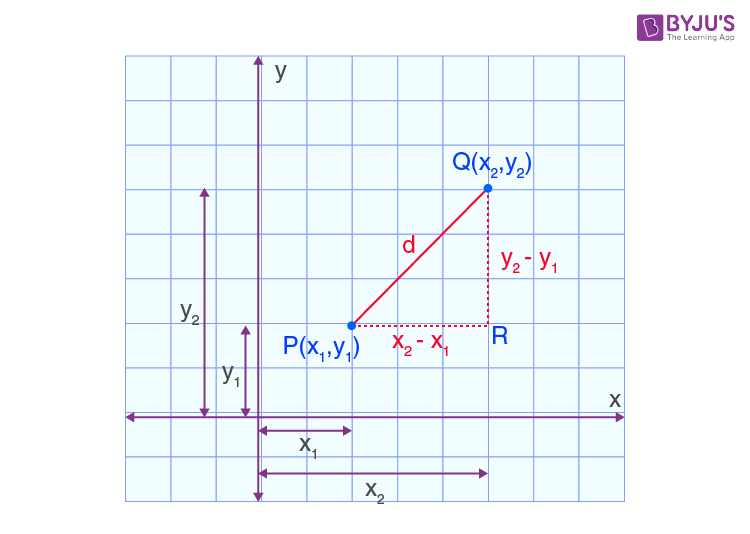
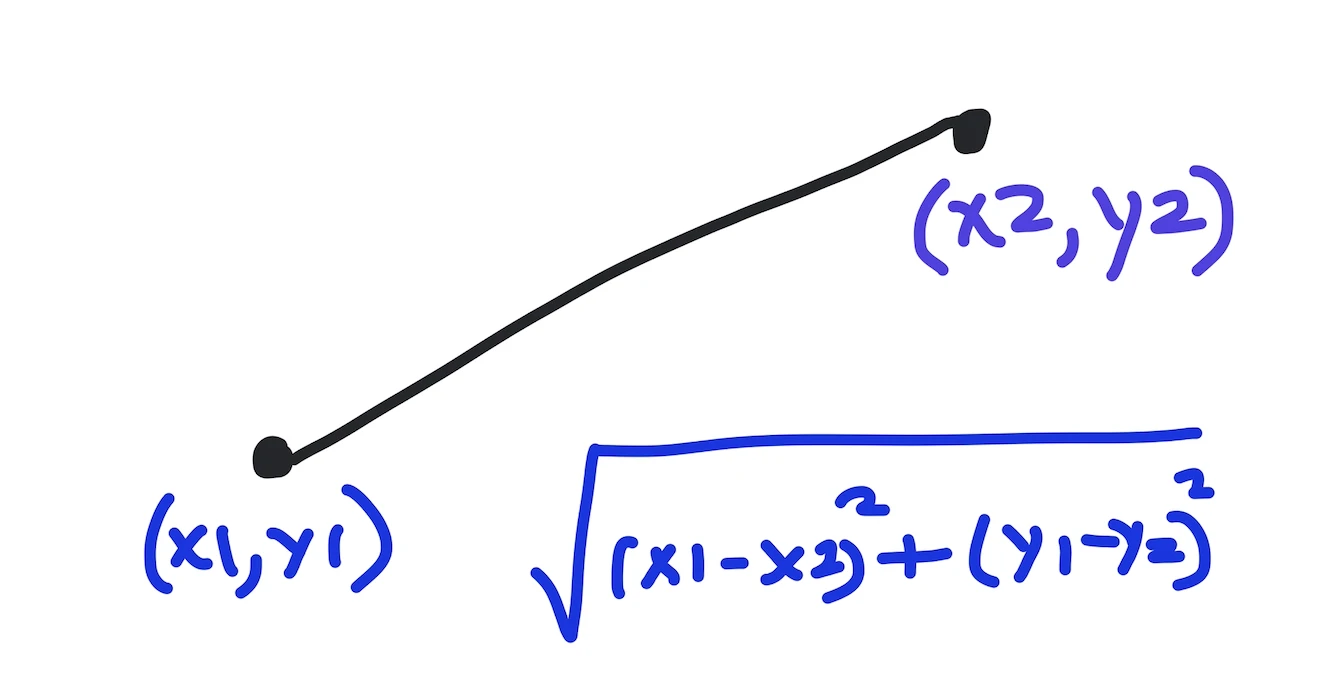
The most familiar manifestation of Euclidean distance is found in a 2D Cartesian coordinate system. Imagine two points, A and B, with coordinates $(x1, y1)$ and $(x2, y2)$ respectively. The Euclidean distance between them is calculated using a direct application of the Pythagorean theorem. We can visualize this as the hypotenuse of a right-angled triangle, where the other two sides are the differences in the x-coordinates ($Delta x = x2 – x1$) and the y-coordinates ($Delta y = y2 – y1$).
The formula, therefore, becomes:
$d(A, B) = sqrt{(Delta x)^2 + (Delta y)^2}$
$d(A, B) = sqrt{(x2 – x1)^2 + (y2 – y1)^2}$
This formula, deeply ingrained in our understanding of geometry, provides the shortest possible path between two points on a flat surface.
Generalizing to Higher Dimensions
The power of Euclidean distance truly shines when we extend it to more than two dimensions. Consider three points in a 3D space: A ($(x1, y1, z1)$) and B ($(x2, y2, z2)$). The distance calculation naturally extends by adding the squared difference in the z-coordinate to the previous formula:
$d(A, B) = sqrt{(x2 – x1)^2 + (y2 – y1)^2 + (z2 – z1)^2}$
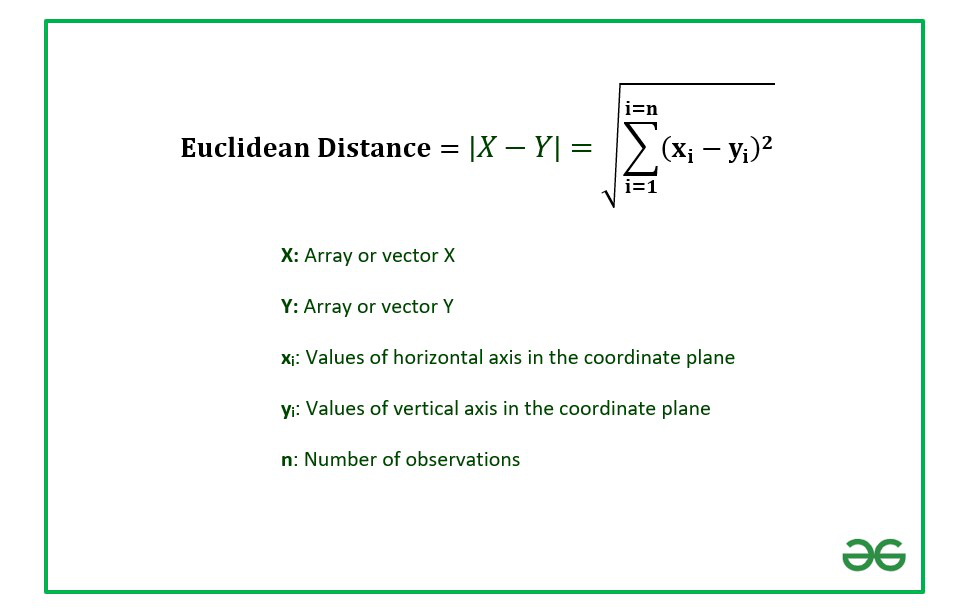
This principle continues for any number of dimensions, often referred to as “n-dimensional” space. For two points P and Q in an n-dimensional space, with coordinates $P = (p1, p2, …, pn)$ and $Q = (q1, q2, …, qn)$, the Euclidean distance is given by:
$d(P, Q) = sqrt{sum{i=1}^{n} (pi – q_i)^2}$
This generalized formula is a cornerstone of many data science and machine learning algorithms, where data is often represented as vectors in high-dimensional spaces. For instance, a customer’s purchasing history might be represented as a vector with hundreds or thousands of dimensions, each corresponding to a different product.
Applications in Technology: Quantifying Similarity and Difference
The ability to quantify the “distance” or “difference” between data points is fundamental to many technological advancements. Euclidean distance provides a straightforward and interpretable metric for this purpose, making it a go-to choice in a wide array of applications.
Machine Learning: Clustering and Classification
In machine learning, data is often represented as numerical vectors. Euclidean distance is frequently used to measure the similarity between these data points, which is crucial for tasks like clustering and classification.
-
Clustering: Algorithms like K-Means rely heavily on Euclidean distance to group similar data points together. In K-Means, the algorithm iteratively assigns data points to the nearest cluster centroid (the mean of points in a cluster) based on Euclidean distance. The goal is to minimize the sum of squared distances between data points and their assigned centroids. This helps in identifying natural groupings within datasets, whether it’s segmenting customers based on behavior or grouping similar documents.
-
Classification: For supervised learning algorithms like K-Nearest Neighbors (KNN), Euclidean distance is used to find the “neighbors” of a new, unclassified data point. Once the k nearest neighbors are identified, the new data point is classified based on the majority class among these neighbors. This approach is effective for tasks such as image recognition, where images are represented by feature vectors, and we want to classify a new image based on its similarity to known images.
Information Retrieval and Recommendation Systems
Euclidean distance plays a significant role in how we find information and receive personalized recommendations.
-
Content-Based Filtering: In recommendation systems, if items (e.g., movies, products, articles) are represented by feature vectors describing their attributes (genre, keywords, price range), Euclidean distance can be used to find items that are similar to those a user has liked in the past. A smaller Euclidean distance between two item vectors indicates greater similarity.
-
Search Engines: While more sophisticated techniques are often employed, basic keyword-based search can also leverage distance metrics. Documents can be represented as vectors based on the frequency of certain keywords. Euclidean distance can then be used to find documents that are “closest” to a user’s query vector, signifying relevance.
Image Processing and Computer Vision
The visual world, when digitized, becomes a high-dimensional data space, making Euclidean distance a valuable tool for analysis.
- Image Similarity: To determine how similar two images are, they can be represented as vectors of pixel values. The Euclidean distance between these vectors provides a quantitative measure of their visual difference. This is useful for tasks like duplicate image detection or finding visually similar images for content moderation.
- Object Recognition: In more advanced computer vision tasks, images are processed to extract features (e.g., edges, textures, shapes). These features are then represented as vectors. Euclidean distance can be used to compare the feature vectors of an unknown object with a database of known object features, aiding in recognition. For instance, facial recognition systems often employ distance metrics to compare facial features.
Beyond Distance: Euclidean Norm and Vector Spaces
The concept of Euclidean distance is intimately tied to the idea of the Euclidean norm, often referred to as the L2 norm. This norm quantifies the “length” or magnitude of a vector.
The Euclidean Norm (L2 Norm)
For a vector $mathbf{v} = (v1, v2, …, vn)$, its Euclidean norm, denoted as $||mathbf{v}||2$ or simply $||mathbf{v}||$, is defined as:
$||mathbf{v}|| = sqrt{v1^2 + v2^2 + … + vn^2} = sqrt{sum{i=1}^{n} v_i^2}$
Notice the striking similarity to the Euclidean distance formula. The Euclidean distance between two points P and Q is precisely the Euclidean norm of the difference vector between them:
$d(P, Q) = ||P – Q|| = sqrt{sum{i=1}^{n} (pi – q_i)^2}$
This connection highlights that Euclidean distance is essentially measuring the length of the vector that connects two points.
Vector Spaces and Geometric Interpretation
Euclidean distance is defined within the framework of Euclidean vector spaces. These are vector spaces equipped with an inner product (specifically, the dot product in the standard case) that allows for the definition of length and angle. The standard n-dimensional Euclidean space, denoted as $mathbb{R}^n$, is the most common context.
The geometric interpretation is key: in $mathbb{R}^n$, points are treated as vectors originating from the origin. The Euclidean distance provides a metric that preserves the geometric intuition of “straight lines” and “straight-line measurements” we are accustomed to in our physical world, regardless of the number of dimensions involved. This makes it a powerful tool for visualizing and understanding relationships between abstract data points that might not have an immediate geometric analogue.
Limitations and Alternatives in Data Analysis
While incredibly useful, Euclidean distance is not a universal solution for all data analysis problems. Its effectiveness can be diminished by certain data characteristics, leading to the exploration of alternative distance metrics.
The Curse of Dimensionality
One of the primary limitations of Euclidean distance, especially in very high-dimensional spaces, is the “curse of dimensionality.” As the number of dimensions increases, the data points tend to become more uniformly distributed, and the concept of “nearest” neighbors becomes less meaningful. Distances between points tend to become very similar, making it difficult to distinguish between truly close and relatively distant points. This can degrade the performance of algorithms that rely on Euclidean distance for tasks like clustering and nearest neighbor searches.
Sensitivity to Feature Scaling
Euclidean distance is sensitive to the scale of the features. Features with larger ranges of values can disproportionately influence the distance calculation, potentially overshadowing features with smaller ranges. For example, if one feature represents age (e.g., 0-100) and another represents income (e.g., 0-1,000,000), the income difference will dominate the distance calculation, even if the age difference is more significant for the problem at hand. This necessitates feature scaling (e.g., normalization or standardization) before applying Euclidean distance in many practical scenarios.
Suitability for Different Data Types
Euclidean distance is inherently designed for continuous numerical data. It doesn’t directly apply to categorical or ordinal data without significant transformation. For instance, calculating the Euclidean distance between two words based on their alphabetical order is nonsensical.
Exploring Alternative Distance Metrics
When Euclidean distance falls short, several alternative metrics can be employed, each suited to different data characteristics and problem types:
-
Manhattan Distance (L1 Norm): Also known as city block distance, it calculates the sum of the absolute differences of their Cartesian coordinates. It’s less sensitive to outliers than Euclidean distance and can be more appropriate in grid-like environments or when features are on different scales that cannot be easily normalized.
$d1(P, Q) = sum{i=1}^{n} |pi – qi|$ -
Cosine Similarity: This metric measures the cosine of the angle between two non-zero vectors, effectively measuring the orientation rather than the magnitude. It’s widely used in text analysis and recommendation systems because it’s insensitive to the length of the vectors (e.g., document length). A cosine similarity of 1 means the vectors are identical in direction, 0 means they are orthogonal, and -1 means they are diametrically opposite.
$similarity = frac{P cdot Q}{||P|| ||Q||}$ -
Jaccard Distance: Used for comparing the similarity and diversity of sets. It’s calculated as 1 minus the Jaccard Index, which is the size of the intersection divided by the size of the union of two sets. It’s ideal for binary data or comparing feature sets.
$J(A, B) = frac{|A cap B|}{|A cup B|}$
$d_J(A, B) = 1 – J(A, B)$
The choice of distance metric is a critical decision in data analysis and machine learning, significantly impacting the outcome of algorithms. While Euclidean distance remains a foundational and widely applicable metric, understanding its limitations and the strengths of alternatives empowers practitioners to select the most appropriate tool for their specific task.
Conclusion: A Foundational Metric for the Digital Age
Euclidean distance, born from the elegant geometry of ancient Greece, has transcended its origins to become an indispensable tool in the digital realm. Its intuitive grasp of straight-line separation, generalized across any number of dimensions, makes it a fundamental metric for quantifying relationships within data. From the intricate workings of artificial intelligence and machine learning algorithms that power our everyday technologies, to the sophisticated systems that sift through vast oceans of information for us, Euclidean distance provides a crucial bridge between abstract data points and tangible understanding.
Its role in clustering, classification, recommendation systems, and image processing underscores its versatility and power. By providing a quantifiable measure of similarity or dissimilarity, it enables machines to learn, adapt, and make informed decisions. While challenges like the curse of dimensionality and sensitivity to feature scaling require careful consideration and often the use of complementary techniques or alternative metrics, the foundational principles of Euclidean distance remain a cornerstone of data science. As technology continues to evolve and data becomes ever more complex and multi-dimensional, a solid understanding of Euclidean distance will remain essential for anyone seeking to navigate and harness the power of the digital world.
aViewFromTheCave is a participant in the Amazon Services LLC Associates Program, an affiliate advertising program designed to provide a means for sites to earn advertising fees by advertising and linking to Amazon.com. Amazon, the Amazon logo, AmazonSupply, and the AmazonSupply logo are trademarks of Amazon.com, Inc. or its affiliates. As an Amazon Associate we earn affiliate commissions from qualifying purchases.