
Solubility, the ability of a substance to dissolve in a solvent to form a homogeneous solution, is a fundamental concept with profound implications across various scientific disciplines. While seemingly straightforward, the seemingly simple act of dissolving is influenced by a complex interplay of factors. Understanding these determinants is not merely an academic exercise; it is crucial for optimizing chemical processes, developing effective pharmaceuticals, designing efficient industrial applications, and even comprehending natural phenomena. This article delves into the key factors that dictate the solubility of a solute in a solvent, providing an insightful exploration of the underlying principles.
The Interplay of Intermolecular Forces
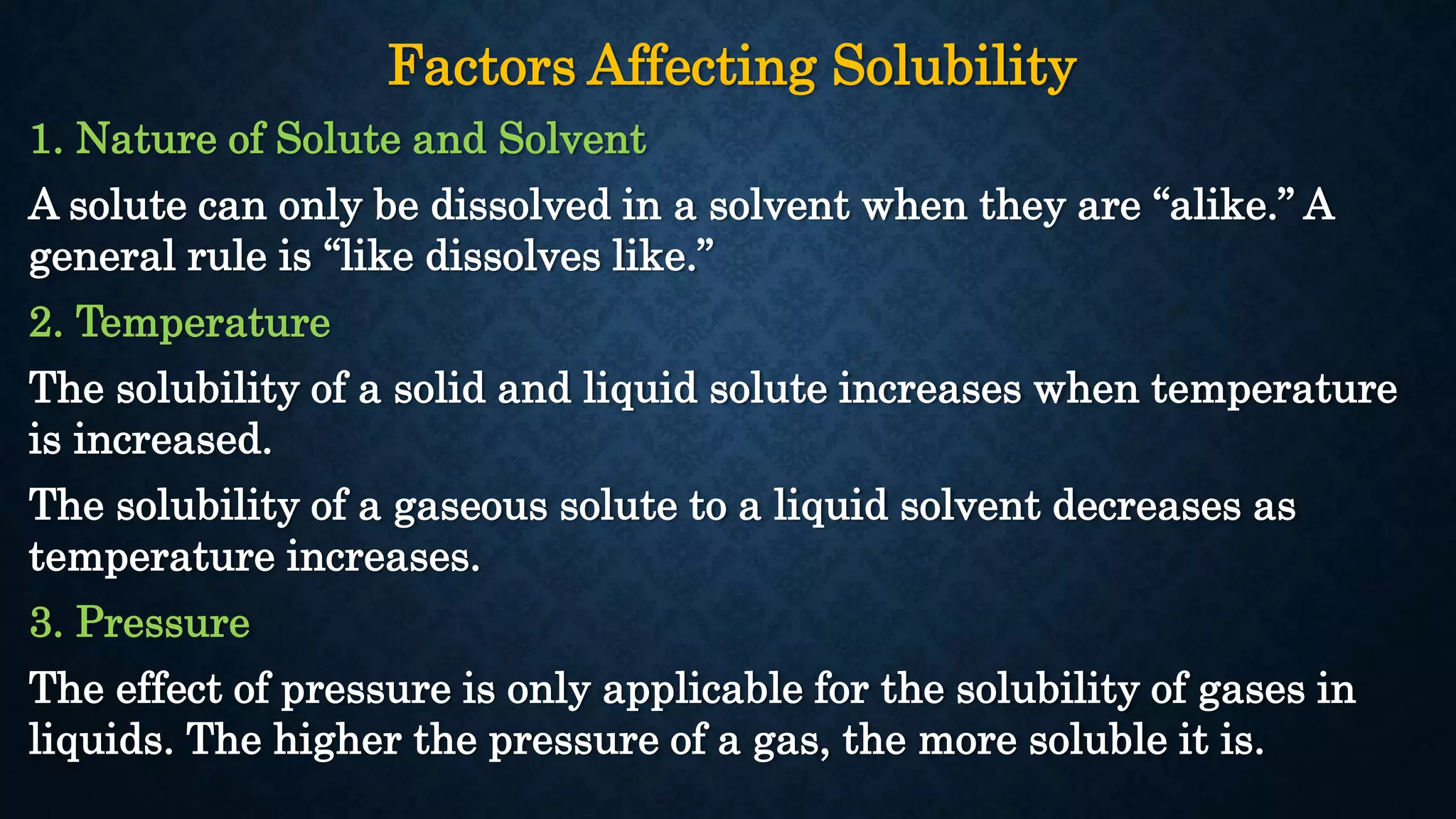
At the heart of solubility lies the principle of “like dissolves like.” This adage, while simplistic, points to the critical role of intermolecular forces. For a solute to dissolve in a solvent, the attractive forces between the solute molecules and between the solvent molecules must be overcome, and new attractive forces between the solute and solvent molecules must form. The relative strengths of these forces dictate whether dissolution will occur.
Polarity: The Foundation of Attraction
Polarity refers to the uneven distribution of electron density within a molecule, creating partial positive and negative charges. Polar molecules, such as water, have a significant dipole moment due to differences in electronegativity between bonded atoms. These polar molecules exhibit strong dipole-dipole interactions and, in the case of water and other protic solvents, hydrogen bonding. Nonpolar molecules, like hexane, have a symmetrical distribution of electron density, resulting in weak van der Waals forces (specifically London dispersion forces).
When a polar solute is introduced into a polar solvent, the positive ends of the solute molecules are attracted to the negative ends of the solvent molecules, and vice versa. These attractions, often stronger than the solute-solute and solvent-solvent attractions, facilitate the separation of solute particles and their integration into the solvent structure. Conversely, a nonpolar solute in a polar solvent will find the solvent-solvent attractions too strong to overcome, and the solute molecules will tend to aggregate together, remaining undissolved. The same logic applies to nonpolar solutes dissolving in nonpolar solvents.
Hydrogen Bonding: A Powerful Influence
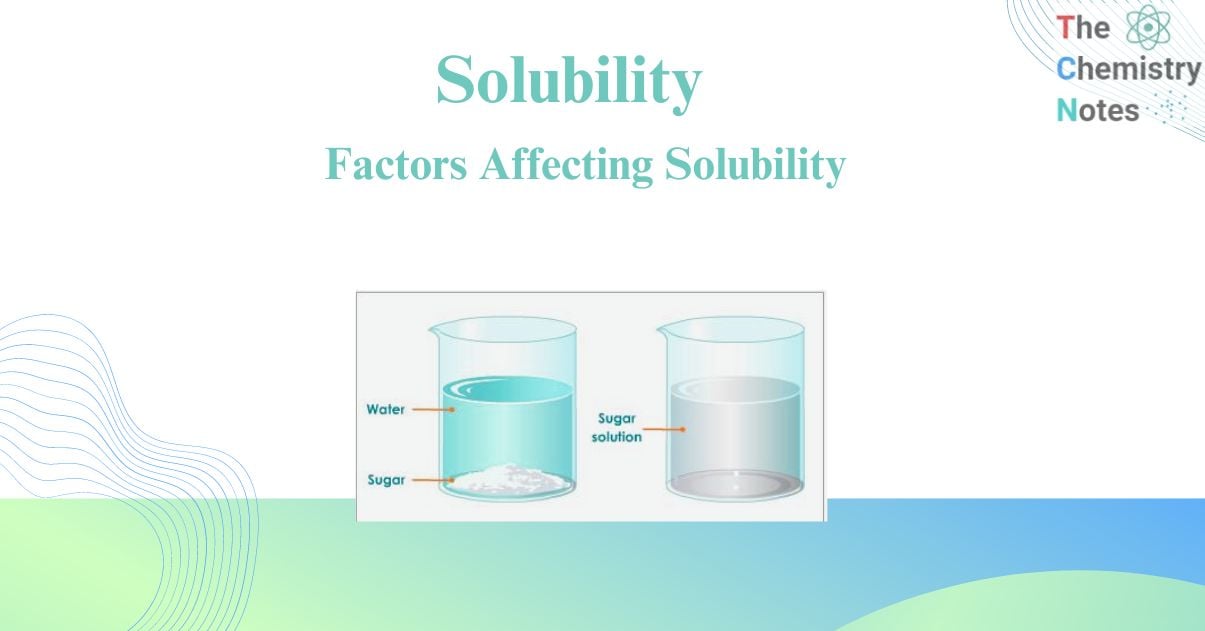
Hydrogen bonding is a particularly strong type of dipole-dipole interaction that occurs when a hydrogen atom bonded to a highly electronegative atom (like oxygen, nitrogen, or fluorine) is attracted to a lone pair of electrons on another electronegative atom. This force is paramount in determining the solubility of many organic compounds and biological molecules. For instance, sugars, with their numerous hydroxyl (-OH) groups, readily dissolve in water due to extensive hydrogen bonding. Alcohols, similarly, exhibit increasing solubility in water as the number of hydroxyl groups increases relative to the nonpolar hydrocarbon chain. Conversely, substances incapable of forming hydrogen bonds with water, or with very large nonpolar portions, will have limited solubility.
Ion-Dipole Interactions: Dissolving Ionic Compounds
Ionic compounds, such as salts, are composed of positively charged cations and negatively charged anions held together by strong electrostatic forces. When an ionic compound dissolves in a polar solvent like water, the polar solvent molecules surround the individual ions. The positive ends of the solvent molecules are attracted to the anions, and the negative ends are attracted to the cations. These ion-dipole interactions, coupled with the dielectric constant of the solvent, are strong enough to overcome the lattice energy of the ionic compound, leading to dissolution. The greater the polarity of the solvent and its ability to stabilize ions, the higher the solubility of ionic compounds.
The Impact of Temperature
Temperature is a significant thermodynamic factor that influences solubility. The effect of temperature depends on whether the dissolution process is endothermic (absorbs heat) or exothermic (releases heat).
Endothermic Dissolution: Favoring Higher Temperatures
Many solid solutes in liquid solvents undergo an endothermic dissolution process. According to Le Chatelier’s principle, if a process absorbs heat, increasing the temperature will shift the equilibrium to favor the products, meaning more solute will dissolve. This is because the added thermal energy provides the activation energy needed to break apart the solute’s crystal lattice and overcome solvent-solvent interactions. For most ionic solids and many molecular solids, solubility increases with increasing temperature. For example, sugar dissolves much more readily in hot tea than in iced tea.
Exothermic Dissolution: Favoring Lower Temperatures

Conversely, some dissolution processes are exothermic, releasing heat. In such cases, increasing the temperature will shift the equilibrium to favor the reactants, resulting in decreased solubility. This is less common for solid solutes but is frequently observed for gases dissolving in liquids. For instance, carbon dioxide is less soluble in warm soda than in cold soda, which is why carbonated beverages go flat faster when left at room temperature.
The Gas Factor: Temperature and Pressure
The solubility of gases in liquids is generally inversely proportional to temperature. As temperature increases, the kinetic energy of gas molecules increases, making them more likely to escape from the solution and return to the gaseous phase. Furthermore, pressure plays a crucial role in gas solubility.
The Influence of Pressure
Pressure has a negligible effect on the solubility of solids and liquids in liquid solvents. However, it is a critical factor in the solubility of gases in liquid solvents.
Henry’s Law: Quantifying Gas Solubility
Henry’s Law states that the solubility of a gas in a liquid at a constant temperature is directly proportional to the partial pressure of the gas above the liquid. Mathematically, this is expressed as $C = kP$, where $C$ is the concentration of the dissolved gas, $P$ is the partial pressure of the gas, and $k$ is Henry’s Law constant, which is specific to the gas and the solvent. This principle explains why a carbonated beverage, under high pressure of carbon dioxide, contains a significant amount of dissolved gas. When the bottle is opened, the pressure above the liquid decreases, and the gas escapes, causing effervescence. This law has significant implications in fields like diving, where changes in pressure can affect the amount of dissolved gases in a diver’s blood.
Other Contributing Factors
Beyond the primary influences of intermolecular forces, temperature, and pressure, several other factors can subtly or significantly impact solubility.
Particle Size and Surface Area
For solid solutes, smaller particle sizes and larger surface areas can lead to faster dissolution rates, although they do not affect the ultimate equilibrium solubility. This is because a greater surface area allows for more contact between the solute and the solvent, facilitating the dissolution process. Think of dissolving a sugar cube versus granulated sugar; the granulated sugar dissolves much more quickly due to its increased surface area. However, the total amount of sugar that can dissolve in a given volume of solvent remains the same.
Presence of Other Solutes
The solubility of a substance can be affected by the presence of other solutes in the solution. This can occur through several mechanisms:
- Common Ion Effect: If a solution already contains one of the ions of a sparingly soluble salt, the solubility of that salt will be reduced. For example, if silver chloride (AgCl) is added to a solution already containing sodium chloride (NaCl), the presence of chloride ions (from NaCl) will shift the equilibrium of AgCl dissolution to the left, reducing the solubility of AgCl.
- Complex Ion Formation: In some cases, the presence of another solute can increase the solubility of a sparingly soluble compound by forming a soluble complex ion. For instance, silver chloride is sparingly soluble in water, but it dissolves readily in aqueous ammonia because ammonia forms a soluble complex ion with silver ions.
- Salt Effect: The presence of a highly soluble, inert salt can sometimes increase the solubility of a sparingly soluble salt that does not share any common ions. This is due to changes in the activity coefficients of the ions in the solution.
pH of the Solution
The solubility of compounds containing acidic or basic functional groups is significantly influenced by the pH of the solvent. For instance, a weak acid will be more soluble in a basic solution because the base will deprotonate the acid, forming its conjugate base, which is often more water-soluble. Conversely, a weak base will be more soluble in an acidic solution, where it can be protonated to form a charged species that interacts favorably with polar solvents. This pH-dependent solubility is a critical consideration in drug formulation and delivery, as the ionization state of a drug molecule directly affects its absorption and distribution in the body.
In conclusion, solubility is a multifaceted property governed by a delicate balance of intermolecular forces, thermodynamic conditions, and chemical environment. A thorough understanding of these factors is indispensable for chemists, engineers, pharmacists, and researchers across a broad spectrum of disciplines, enabling them to predict, control, and optimize dissolution processes for a myriad of applications.
aViewFromTheCave is a participant in the Amazon Services LLC Associates Program, an affiliate advertising program designed to provide a means for sites to earn advertising fees by advertising and linking to Amazon.com. Amazon, the Amazon logo, AmazonSupply, and the AmazonSupply logo are trademarks of Amazon.com, Inc. or its affiliates. As an Amazon Associate we earn affiliate commissions from qualifying purchases.