
In the realm of finance and business, understanding the language of numbers is paramount. While abstract mathematical concepts might seem distant from the everyday realities of budgets and investments, they form the bedrock of sophisticated financial analysis and decision-making. Among these concepts, the “coefficient” stands out as a versatile and powerful tool. Its meaning, however, can vary depending on the specific context within which it’s applied. This article will delve into the various interpretations and applications of coefficients within the domain of money, exploring how they inform our understanding of financial relationships, risk, and potential returns.
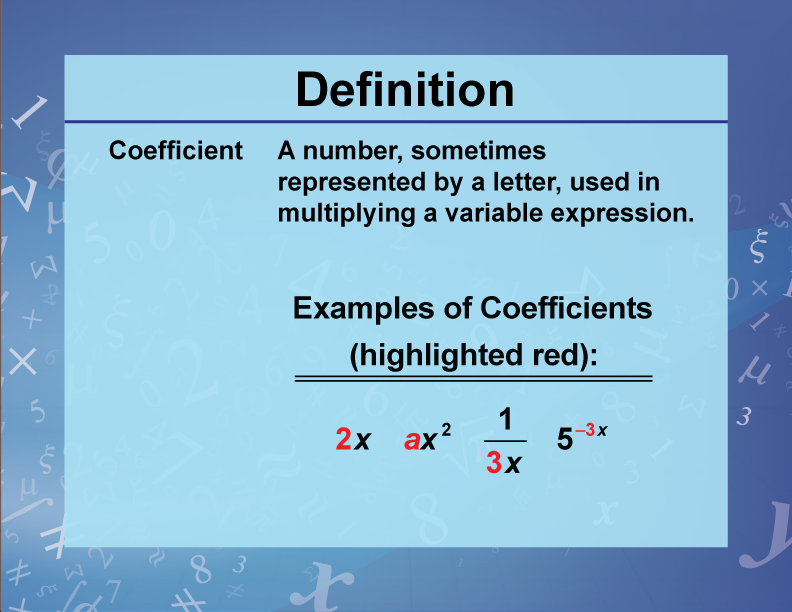
Coefficients in Financial Modeling and Analysis
Coefficients are not merely abstract mathematical constructs; they are tangible representations of relationships within financial data. They quantify the strength and direction of association between different variables, enabling analysts to build predictive models, assess risk, and forecast future outcomes.
Regression Coefficients: Unveiling Relationships
Perhaps the most common and impactful application of coefficients in finance is within regression analysis. Regression models aim to understand how one or more independent variables influence a dependent variable. The coefficients generated by these models are the stars of the show.
The Coefficient of Determination ($R^2$): Measuring Model Fit
While not a direct coefficient in the same vein as those in regression equations, the coefficient of determination ($R^2$) is intrinsically linked. It quantifies the proportion of the variance in the dependent variable that is predictable from the independent variable(s). A higher $R^2$ suggests that the model explains a greater portion of the variability, indicating a better fit. For example, if a regression model predicts stock prices based on interest rates, an $R^2$ of 0.75 would mean that 75% of the variation in stock prices can be explained by the variation in interest rates, according to the model. This helps investors gauge the reliability of the model’s predictions.
Beta Coefficients: Quantifying Market Risk
In the world of investing, the beta coefficient is a cornerstone for understanding systematic risk. Beta measures the volatility, or systematic risk, of a security or portfolio in comparison to the market as a whole.
- Beta = 1: The security’s price tends to move with the market. If the market goes up by 10%, the security is expected to go up by 10%.
- Beta > 1: The security is more volatile than the market. If the market goes up by 10%, the security is expected to go up by more than 10%. This implies higher potential returns but also higher risk.
- Beta < 1: The security is less volatile than the market. If the market goes up by 10%, the security is expected to go up by less than 10%. This suggests lower risk but also potentially lower returns.
- Beta = 0: The security’s movement is uncorrelated with the market. This is rare for individual stocks but can be observed in certain asset classes.
- Beta < 0: The security tends to move in the opposite direction of the market. This is also uncommon but can occur with assets like gold during certain economic downturns.
The beta coefficient is crucial for portfolio construction and risk management. Investors can use beta to diversify their portfolios, balancing high-beta (riskier) assets with low-beta (less risky) assets to achieve their desired risk-return profile. The Capital Asset Pricing Model (CAPM), a fundamental tool in finance, relies heavily on beta to estimate the expected return of an asset.
Other Regression Coefficients: Understanding Specific Impacts
Beyond beta, other regression coefficients provide granular insights. For instance, in a model predicting a company’s sales based on advertising spend and economic growth, individual coefficients would tell us the specific impact of each factor. A positive coefficient for advertising spend would indicate that increased advertising leads to increased sales, and its magnitude would quantify “how much” sales increase for each additional dollar spent on advertising. Similarly, a coefficient for economic growth would reveal its impact on sales. These coefficients allow businesses to make data-driven decisions about resource allocation.
Coefficients in Financial Instruments and Pricing
Coefficients also play a critical role in the valuation and understanding of various financial instruments, particularly derivatives and structured products.
Option Pricing Models: The Greeks
In the realm of options trading, a specialized set of coefficients known as “the Greeks” are essential for managing risk and understanding how option prices are affected by changes in underlying variables.
Delta: Sensitivity to Underlying Price
Delta measures the rate of change of an option’s price with respect to a $1 change in the price of the underlying asset. For example, a call option with a delta of 0.60 means that for every $1 increase in the underlying asset’s price, the option’s price is expected to increase by $0.60. This is a crucial metric for delta hedging, a strategy employed to offset the risk of price movements in the underlying asset.
Gamma: Sensitivity of Delta

Gamma measures the rate of change of an option’s delta with respect to a $1 change in the price of the underlying asset. It tells you how much your delta will change as the underlying asset’s price moves. A high gamma means that the delta will change rapidly, making delta hedging more complex and requiring more frequent adjustments.
Theta: Time Decay
Theta measures the rate of change of an option’s price with respect to the passage of time, assuming all other factors remain constant. It essentially quantifies the “time decay” of an option’s value as its expiration date approaches. For long option positions, theta is typically negative, meaning the option loses value each day. For short option positions, theta is positive, meaning the option seller gains value each day.
Vega: Sensitivity to Volatility
Vega measures the rate of change of an option’s price with respect to a 1% change in implied volatility. Implied volatility is the market’s expectation of future price swings in the underlying asset. An option with a positive vega will increase in value as implied volatility rises and decrease in value as implied volatility falls. This is vital for traders who speculate on changes in market uncertainty.
Rho: Sensitivity to Interest Rates
Rho measures the rate of change of an option’s price with respect to a 1% change in the risk-free interest rate. While often less significant than the other Greeks for short-dated options, rho can become important for longer-term options or in environments with rapidly changing interest rates.
Understanding these Greek coefficients allows options traders to form a comprehensive view of the risks and potential rewards associated with their positions, enabling them to make more informed trading decisions.
Structured Products: Embedded Coefficients
Structured products, which are complex financial instruments often designed to offer specific payout profiles, frequently embed coefficients that define their performance. These coefficients can dictate how returns are calculated, how capital is protected, or how participation rates are determined.
For instance, a principal-protected note might offer a participation rate of 80% in the upside of an equity index. This 80% is a coefficient. It means that for every 1% gain in the index, the investor receives 0.80% of that gain, up to certain caps or conditions. Another example is a capped equity-linked note where the return is capped at a certain percentage, which is also a coefficient defining the maximum achievable return. These embedded coefficients are critical for investors to understand before investing, as they directly influence the potential outcomes.
Coefficients in Economic Indicators and Forecasting
Coefficients are also vital in economic analysis and forecasting, helping policymakers and businesses understand the drivers of economic activity and predict future trends.
Economic Multipliers: Quantifying Impact
In macroeconomics, coefficients are used to represent economic multipliers. A multiplier coefficient quantifies the total change in aggregate output or income resulting from an initial change in an autonomous expenditure, such as government spending or investment.
For example, the government spending multiplier indicates how much GDP will increase for every dollar increase in government spending. If the multiplier is 1.5, it means that an initial $1 billion increase in government spending will lead to a $1.5 billion increase in overall economic output. This coefficient is crucial for fiscal policy decisions. Similarly, the investment multiplier and the tax multiplier provide insights into the broader economic effects of changes in private investment and taxation, respectively.
Inflation and Interest Rate Models: Forecasting Tools
Coefficients are integral to econometric models used to forecast inflation and interest rates. These models often relate inflation to variables like unemployment, money supply, and commodity prices, with coefficients quantifying the impact of each variable. For example, a coefficient might indicate how much inflation is expected to rise for every 1% increase in the unemployment rate (Phillips Curve relationship).
Similarly, central banks use sophisticated models with coefficients to forecast interest rate movements based on inflation expectations, economic growth, and other monetary policy targets. Understanding these coefficients allows for more accurate economic forecasting, which is essential for businesses planning investments, individuals managing their finances, and governments setting economic policy.

Conclusion
The “coefficient” is far more than just a number; it’s a fundamental building block in the financial world, providing a precise and quantifiable way to understand relationships, measure risk, and predict outcomes. From the intricate calculations within financial models and option pricing to the broader implications of economic indicators, coefficients empower us to navigate the complexities of money with greater clarity and confidence. Whether you are an investor assessing market risk, a trader managing option positions, a business owner allocating resources, or a policymaker shaping economic strategy, a solid understanding of what coefficients mean in these various financial contexts is indispensable for informed decision-making and ultimately, for achieving financial success. Their consistent and rigorous application allows for the transformation of raw data into actionable intelligence, driving better financial strategies and fostering greater economic stability.
aViewFromTheCave is a participant in the Amazon Services LLC Associates Program, an affiliate advertising program designed to provide a means for sites to earn advertising fees by advertising and linking to Amazon.com. Amazon, the Amazon logo, AmazonSupply, and the AmazonSupply logo are trademarks of Amazon.com, Inc. or its affiliates. As an Amazon Associate we earn affiliate commissions from qualifying purchases.