
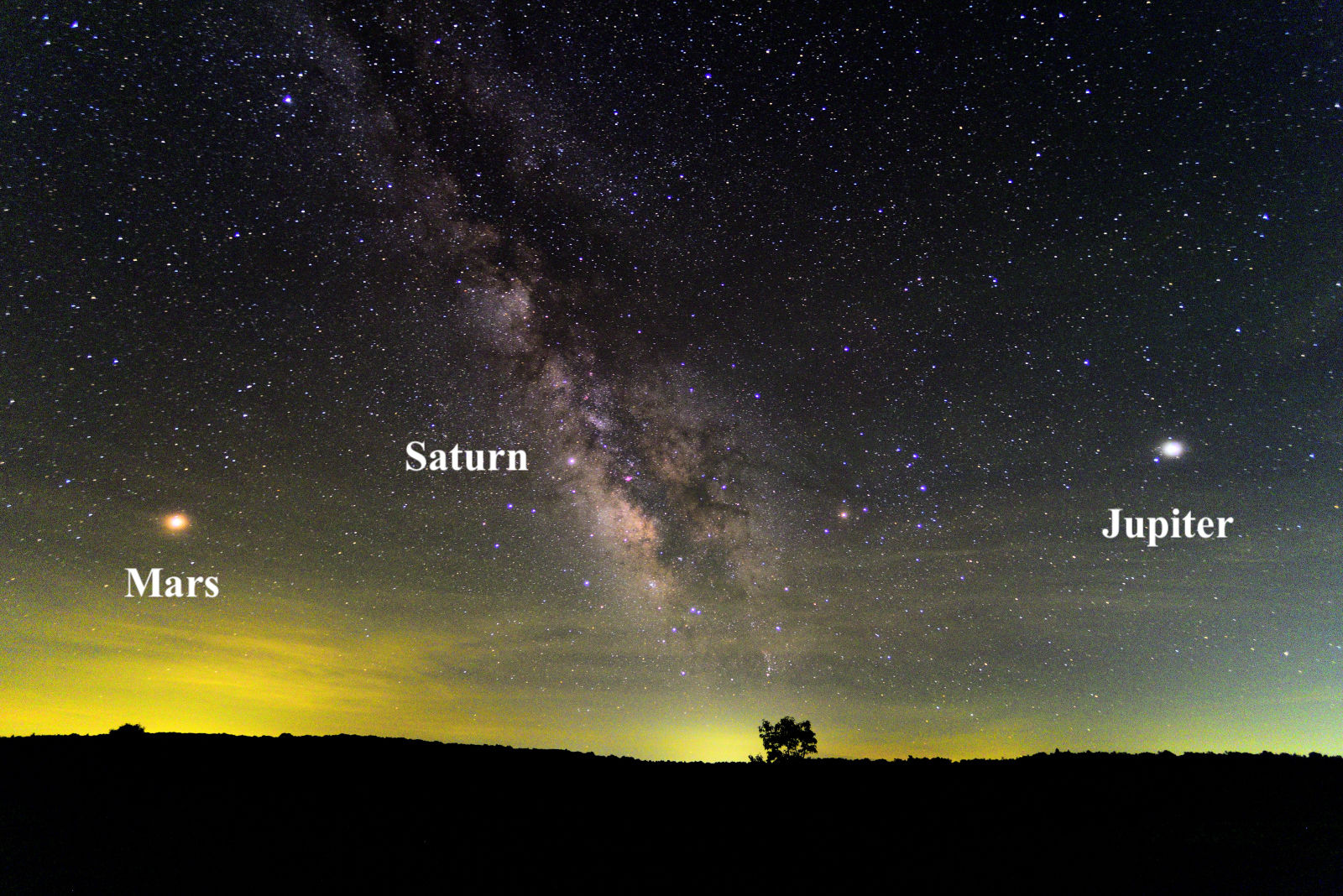
To the naked eye, Jupiter appears as a brilliant, steady point of light in the night sky—often the brightest object after the Moon and Venus. However, the answer to “what does Jupiter look like from Earth” has changed dramatically over the last decade, not because the planet itself has shifted, but because the technology we use to observe it has undergone a digital revolution. From high-specification consumer optics to AI-driven post-processing software, the “view” of Jupiter is now a sophisticated intersection of hardware and data science.

The Optical Foundation: From Glass Lenses to High-End Consumer Tech
The journey of seeing Jupiter begins with the physics of light collection. While Galileo first spotted the planet’s four largest moons with a rudimentary tube of glass, modern tech has democratized views that were once the exclusive domain of professional observatories.
The Evolution of Refractors and Reflectors
At the heart of planetary observation are two primary technologies: Refractors (using lenses) and Reflectors (using mirrors). For a tech-savvy observer, the choice of hardware dictates the resolution and contrast of the Jovian disk. Modern Apochromatic (APO) refractors utilize extra-low dispersion (ED) glass to eliminate chromatic aberration, ensuring that the bands of Jupiter do not have a purple “halo.” On the other hand, the rise of large-aperture Schmidt-Cassegrain telescopes (SCTs) has enabled users to pack massive light-gathering power into a portable form factor, using folded optical paths to achieve the long focal lengths necessary to resolve Jupiter’s atmospheric turbulence.
Why Aperture and Focal Length Matter for Planetary Observation
In the world of optics, aperture is the ultimate “spec.” A larger aperture allows for a higher theoretical resolution (the Dawes’ Limit). When viewing Jupiter, this translates to the ability to see the intricate swirls within the Great Red Spot or the festoons in the Equatorial Belts. However, aperture alone isn’t enough; it must be paired with high focal ratios (f/10 to f/20). Modern Barlow lenses—essentially high-tech teleconverters—use multi-coated glass elements to multiply focal length without introducing distortion, allowing tech-equipped backyard astronomers to magnify the planet hundreds of times.
The Digital Revolution: Sensors, CCDs, and CMOS Technology
What we “see” from Earth is no longer limited by the human eye’s biological refresh rate. The transition from eyepieces to digital sensors has fundamentally altered the visual representation of Jupiter.
Beyond the Eye: The Power of Digital Astrophotography
The human eye is a poor data collector; it cannot “integrate” light over time. Modern CMOS (Complementary Metal-Oxide-Semiconductor) sensors have replaced traditional film and even older CCD (Charge-Coupled Device) tech due to their high frame rates and low read noise. When an observer connects a dedicated planetary camera to a telescope, they aren’t taking a single photo; they are capturing a high-speed data stream. These sensors can capture hundreds of frames per second (FPS), which is critical for overcoming the “shimmering” effect of Earth’s atmosphere.
High-Frame-Rate Imaging and “Lucky Imaging” Techniques
The most significant technological leap in seeing Jupiter from Earth is a technique called “Lucky Imaging.” Because our atmosphere is a turbulent fluid, it constantly distorts the light coming from space. By using high-speed USB 3.0 cameras, tech-enabled observers capture thousands of individual frames in a short video burst. Specialized algorithms then scan every frame, identify the few milliseconds where the atmosphere was perfectly still (the “lucky” frames), and discard the rest. This tech allows ground-based observers to achieve a level of detail that rivals space-based telescopes like Hubble.
Software and Post-Processing: Crafting the Image Through AI and Algorithms
In the modern era, what Jupiter looks like from Earth is as much a product of software as it is of hardware. The raw data coming off a sensor is often a blurry, noisy mess; it is through computational photography that the planet’s true features emerge.
Stacking Software: From Raw Frames to Crisp Details
The “Tech” of seeing Jupiter relies heavily on stacking software like AutoStakkert! or Registax. These programs use “Multipoint Alignment,” where the software identifies thousands of tiny anchor points across the planet’s disk. It then mathematically averages the pixel data from the best frames to cancel out sensor noise (signal-to-noise ratio improvement). This process reveals the subtle pastel colors of the Jovian clouds—colors that are often too faint for the human eye to perceive through a lens but are present in the digital data.
AI-Driven Noise Reduction and Deconvolution
The latest frontier in planetary imaging is the application of Artificial Intelligence and Machine Learning. Deconvolution algorithms (like those found in PixInsight or Astra Image) use mathematical models of light spread to “reverse” the blurring caused by optics and the atmosphere. More recently, AI-driven denoisers have been trained specifically on planetary datasets to distinguish between real atmospheric features on Jupiter and random digital artifacts. This results in an image that looks incredibly “close,” even though it was captured from the surface of Earth.
Mobile Technology and Citizen Science: Jupiter in the Palm of Your Hand
Technology has also made finding and understanding Jupiter more accessible. The integration of GPS, accelerometers, and augmented reality (AR) in smartphones has turned every mobile device into a planetary navigation system.
AR Apps and Global Positioning for Planetary Tracking
Applications like SkySafari or Stellarium Mobile use “Plate Solving” technology and phone sensors to provide a real-time AR overlay of the sky. By simply pointing a phone at the sky, a user can identify Jupiter and see a simulated view of its current moon positions (Io, Europa, Ganymede, and Callisto). This tech uses real-time orbital mechanics data to predict the exact moment the Great Red Spot will rotate into view or when a moon will cast a shadow on the planet’s surface.
The Role of Connected Smart Telescopes
A new category of gadget, the “Smart Telescope” (such as those from Unistellar or Vaonis), has automated the entire process. These devices are essentially robots equipped with an optical tube, a motorized mount, and an onboard computer. They use image recognition to align themselves with the stars and stream a processed image of Jupiter directly to a tablet or smartphone. This represents the ultimate convergence of tech: the marriage of robotics, optics, and mobile software.
Future Tech: Adaptive Optics and the Gap Between Ground and Space
As we look toward the future, the technology used to observe Jupiter from Earth continues to push the boundaries of physics, attempting to erase the interference of our own atmosphere entirely.
Overcoming Atmospheric Turbulence with Professional-Grade Tech
Professional observatories use “Adaptive Optics” (AO), a technology that involves a deformable mirror controlled by a computer. By measuring the distortion of a laser “guide star” in the upper atmosphere, the mirror changes shape hundreds of times per second to counteract atmospheric twinkling. While this was once restricted to multi-billion dollar installations, “Active Optics” and simplified AO systems are beginning to trickle down to the high-end prosumer market.

The Synthesis of Global Data Networks
Finally, the “look” of Jupiter is being refined by global tech networks. Initiatives like the “JunoCam” project allow citizen scientists to upload their ground-based images, which are then used by NASA to help plan the orbits and shots of the Juno spacecraft currently orbiting Jupiter. This creates a feedback loop where Earth-based technology supports space-based exploration, providing a holistic view of the gas giant.
In conclusion, when we ask what Jupiter looks like from Earth, the answer is no longer a simple visual description. It is a high-definition, multi-layered digital composite made possible by CMOS sensors, sophisticated stacking algorithms, and global data networks. Whether through the screen of a smartphone or the eyepiece of a high-tech refractor, technology has bridged the 400-million-mile gap, bringing the King of Planets into sharper focus than ever before.
aViewFromTheCave is a participant in the Amazon Services LLC Associates Program, an affiliate advertising program designed to provide a means for sites to earn advertising fees by advertising and linking to Amazon.com. Amazon, the Amazon logo, AmazonSupply, and the AmazonSupply logo are trademarks of Amazon.com, Inc. or its affiliates. As an Amazon Associate we earn affiliate commissions from qualifying purchases.