
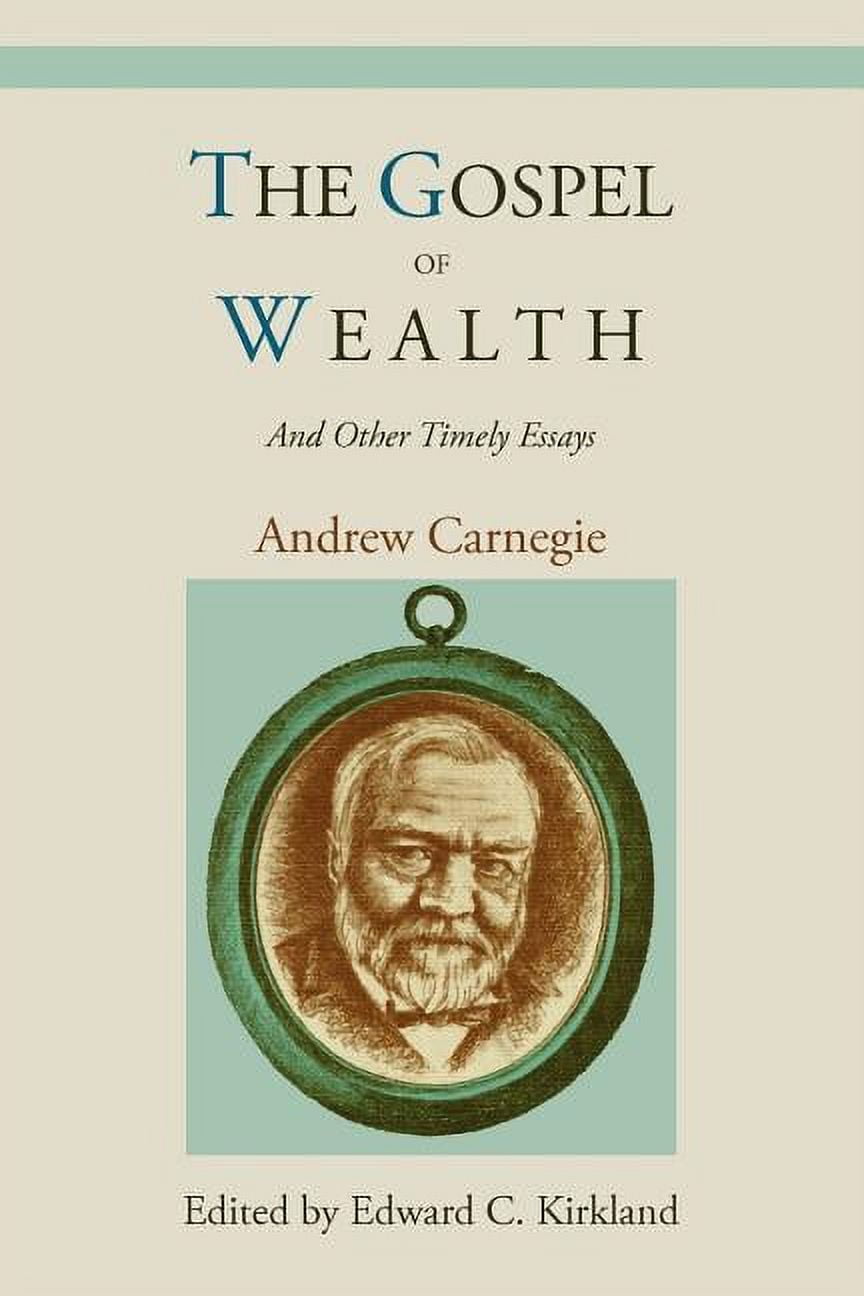
The “Gospel of Wealth” is a concept that emerged in the late 19th century, primarily associated with the writings of Andrew Carnegie. It posits that the wealthy have a moral obligation to use their fortunes to benefit society during their lifetime. This idea challenged the prevailing notions of philanthropy at the time, which often involved large bequests to heirs or the establishment of charitable trusts after death. Carnegie, a titan of industry, argued that the wealthy should actively engage in improving the lives of the less fortunate, not through handouts, but through investments in institutions and initiatives that foster self-improvement, education, and cultural development. This philosophy represents a significant shift in how wealth accumulation and its societal implications were understood, laying the groundwork for modern philanthropic practices and sparking enduring debates about the responsibilities of the affluent.

The Genesis and Core Tenets of the Gospel of Wealth
Andrew Carnegie’s influential essay, “The Gospel of Wealth,” first published in 1889, served as the manifesto for this transformative philosophy. The context of the Gilded Age, a period marked by immense industrial growth and stark wealth inequality, provided fertile ground for such a concept. Carnegie, having amassed a vast fortune through his steel empire, witnessed firsthand the chasm between the immensely rich and the working poor. He grappled with the moral implications of such disparities and sought to articulate a framework for responsible wealth stewardship.
Carnegie’s Argument for Philanthropy During Life
Carnegie’s central thesis was that the accumulation of wealth by a select few was not only inevitable but, under certain conditions, beneficial to society. However, he emphatically argued that this wealth should not be hoarded or passed on indiscriminately to descendants, who might not possess the judgment or work ethic to manage it effectively. Instead, he advocated for the wealthy to act as “trustees” of their fortunes, distributing them for the “improvement of mankind.” This involved a proactive approach, where the wealthy individual would personally oversee the allocation of resources during their lifetime, leveraging their experience and understanding of societal needs.
He believed that the best form of charity was one that empowered individuals to help themselves. This meant investing in libraries, universities, scientific research, public parks, and cultural institutions – facilities that provided opportunities for education, skill development, and intellectual growth. Carnegie’s vision was not about providing mere sustenance but about creating the infrastructure for upward mobility and fostering a more enlightened and productive society. He contrasted this with what he termed “alms,” which he saw as temporary relief that could foster dependence.
The Principle of Unequal Distribution and Its Justification
Carnegie acknowledged that the free enterprise system naturally led to unequal distribution of wealth. He saw this inequality not as an inherent evil, but as a byproduct of a system that rewarded innovation, hard work, and shrewd business acumen. He argued that this concentration of wealth in the hands of a few individuals created a unique opportunity for societal advancement. These individuals, having demonstrated the capacity to manage large enterprises, were best positioned to identify and fund initiatives that could yield significant social returns.
He posited that the “man who dies thus rich dies disgraced.” This stark pronouncement underscored his belief that the ultimate measure of a wealthy person’s success was not the extent of their fortune at death, but the positive impact they had made on the world during their life. The Gospel of Wealth, therefore, represented a moral imperative for the wealthy to engage in meaningful philanthropy, viewing their fortunes as a societal trust rather than personal property to be enjoyed solely by themselves and their heirs.
The Impact and Evolution of the Gospel of Wealth
The ideas espoused in the Gospel of Wealth had a profound and lasting impact on American society, shaping philanthropic practices and sparking ongoing debates about the role of wealth in a democracy. While Carnegie’s specific prescriptions may have evolved, the core principle of using wealth for societal good continues to resonate.
Transforming Philanthropy: From Bequests to Active Trusteeship

Prior to the Gospel of Wealth, much of the philanthropy undertaken by the rich was in the form of bequests – large sums donated to charitable organizations or institutions after the benefactor’s death. While valuable, this approach often lacked the direct involvement and strategic direction of the wealthy individual. Carnegie’s philosophy shifted the paradigm, encouraging the wealthy to become active participants in shaping the philanthropic landscape during their lifetimes.
This active trusteeship meant not just writing checks, but engaging in the planning, execution, and oversight of charitable endeavors. It fostered a more strategic and impactful approach to giving, moving beyond mere donations to the creation of enduring institutions that could serve generations. The establishment of numerous libraries, universities, and cultural centers across America during the late 19th and early 20th centuries can be directly traced to the influence of this philosophy. Carnegie himself was a prodigious philanthropist, funding over 2,500 libraries, endowments for universities like Carnegie Mellon, and the famed Carnegie Hall.
Enduring Debates: Responsibility, Inequality, and Social Justice
The Gospel of Wealth, while widely influential, also ignited considerable debate and criticism. Critics, including many socialists and labor leaders of the era, argued that the fundamental issue was not how the rich used their wealth, but how that wealth was accumulated in the first place. They contended that the vast fortunes were often built on the exploitation of labor, low wages, and unsafe working conditions. From this perspective, philanthropy was seen as a way for the wealthy to assuage their guilt or to gain social prestige, without addressing the systemic injustices that created extreme wealth inequality.
These debates continue to this day. Questions surrounding the concentration of wealth, the responsibilities of billionaires, and the effectiveness of philanthropic interventions remain at the forefront of public discourse. While the spirit of using wealth for good is generally applauded, the underlying mechanisms of wealth creation and distribution, and the potential for philanthropy to mask or even perpetuate societal problems, are subjects of ongoing scrutiny. The Gospel of Wealth, therefore, serves not only as a historical marker but also as a catalyst for continuous reflection on the complex relationship between wealth, power, and social responsibility.
Modern Interpretations and Applications of the Gospel of Wealth
The core principles of the Gospel of Wealth have not faded into historical obscurity. In the 21st century, the concept continues to inform and inspire philanthropic endeavors, albeit with evolving approaches and a broader understanding of societal challenges. The digital age and globalization have introduced new dimensions to wealth creation and distribution, necessitating new interpretations of this enduring philosophy.
The Rise of Impact Investing and Social Entrepreneurship
Modern interpretations of the Gospel of Wealth often manifest in approaches like impact investing and social entrepreneurship. Impact investing involves directing capital towards businesses and organizations that aim to generate both a financial return and a positive social or environmental impact. This aligns directly with Carnegie’s idea of investing in initiatives that foster self-improvement and societal progress, rather than simply providing aid.
Social entrepreneurs, in turn, are individuals who leverage business principles to address social and environmental problems. They are driven by a mission to create scalable solutions to issues like poverty, lack of access to education, or environmental degradation. This proactive, solution-oriented approach mirrors Carnegie’s emphasis on empowering individuals and communities through sustainable initiatives. The “giving while living” ethos remains central, with a focus on creating lasting change through innovative and market-based solutions.
The “Giving Pledge” and Contemporary Philanthropic Movements
The spirit of the Gospel of Wealth is vividly alive in contemporary philanthropic movements, most notably epitomized by “The Giving Pledge.” Launched by Bill and Melinda Gates and Warren Buffett, The Giving Pledge is a commitment by the world’s wealthiest individuals and families to publicly pledge the majority of their wealth to philanthropic causes. This initiative, much like Carnegie’s writings, encourages the wealthy to view their fortunes as a resource to be used for the betterment of humanity, primarily during their lifetimes.
The pledge emphasizes a commitment to addressing the world’s most pressing problems, from global health and education to poverty and climate change. It fosters a culture of philanthropic ambition and accountability among the ultra-wealthy, encouraging them to think deeply about the most effective ways to deploy their resources. While the specific avenues of philanthropy may differ from Carnegie’s era – with a greater emphasis on global issues and technological solutions – the underlying moral imperative to use wealth for societal good remains a powerful driving force. The ongoing dialogue around wealth distribution, philanthropic effectiveness, and the role of billionaires in addressing global challenges is a direct descendant of the conversations sparked by Carnegie’s seminal essay.
aViewFromTheCave is a participant in the Amazon Services LLC Associates Program, an affiliate advertising program designed to provide a means for sites to earn advertising fees by advertising and linking to Amazon.com. Amazon, the Amazon logo, AmazonSupply, and the AmazonSupply logo are trademarks of Amazon.com, Inc. or its affiliates. As an Amazon Associate we earn affiliate commissions from qualifying purchases.