
For a company that started in a humble garage in Bellevue, Washington, the question “Where is Amazon’s HQ?” no longer has a singular answer. Today, Amazon’s physical footprint is a sprawling testament to its evolution from a niche online bookseller to a global titan of commerce, cloud computing, and digital entertainment. However, for those looking to understand the core of the company, the answer lies in a dual-headquarters strategy that serves as a cornerstone of its corporate brand identity.
Amazon’s primary headquarters remains rooted in Seattle, Washington, while its second major headquarters (HQ2) is currently rising in Arlington, Virginia. Beyond these two pillars, the company maintains a series of “Tech Hubs” and regional corporate offices worldwide. From a brand strategy perspective, these locations are more than just office space; they are physical manifestations of Amazon’s “Day 1” philosophy and its commitment to urban integration.

The Seattle Core: A Brand Rooted in Urban Integration
Unlike many of its contemporaries in the technology sector who chose to build secluded, suburban “fortress” campuses, Amazon’s decision to remain in the heart of Seattle was a deliberate branding masterstroke. By weaving its corporate identity into the fabric of an existing metropolis, Amazon positioned itself as an accessible, energetic, and indispensable part of the modern urban landscape.
From South Lake Union to the Spheres
The heart of Amazon’s Seattle presence is located in the South Lake Union neighborhood. What was once an industrial district has been transformed into a vibrant tech corridor, largely driven by Amazon’s expansion. This transformation is a key element of the company’s brand narrative: the idea that Amazon is a catalyst for growth and modernization.
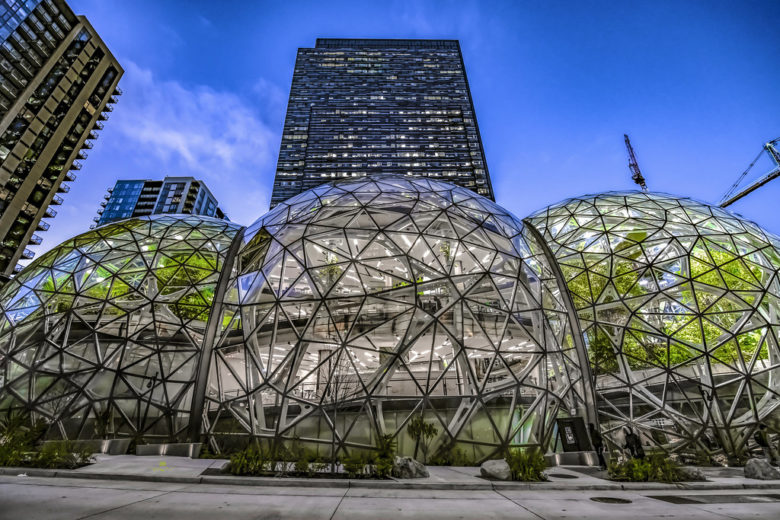
The most iconic symbol of this headquarters is “The Spheres.” These three glass-and-steel domes house over 40,000 plants from around the world. From a brand identity standpoint, the Spheres represent Amazon’s investment in employee well-being and its desire to foster innovation through unconventional environments. It tells the world that while Amazon is data-driven, it also values the organic, the creative, and the sustainable.
The “Day 1” Philosophy as Physical Space
Walking through the Seattle campus, one sees buildings with names like “Day 1,” “re:Invent,” and “Doppler.” These are not merely identifiers; they are reinforcements of the Amazon brand manifesto. The “Day 1” building, in particular, serves as a constant reminder to employees and visitors alike of Jeff Bezos’s founding principle: that the company must always act with the speed, curiosity, and risk-tolerance of a startup. By naming its primary corporate tower after this concept, Amazon anchors its brand identity in a state of perpetual evolution.
HQ2 and the “Bidding War”: A Masterclass in Brand Awareness
In 2017, Amazon initiated a search for a second headquarters, a move that would become one of the most successful corporate branding exercises in history. By inviting cities across North America to submit proposals, Amazon dominated the news cycle for over a year, positioning itself as the ultimate prize for any modern municipality.
The Search as a Strategic Marketing Event
The HQ2 search was less about real estate and more about defining Amazon’s value proposition to the world. Over 238 cities submitted bids, offering billions in incentives and showcasing their local talent pools. This process reinforced the “Amazon Brand” as a massive economic engine. It wasn’t just a company looking for an office; it was a sovereign-like entity choosing its next territory.
This global competition allowed Amazon to collect data on hundreds of cities, but more importantly, it forced city leaders to pitch themselves to Amazon, effectively flipping the traditional corporate-community relationship. The brand emerged as the dominant partner in the American economic story.
Arlington and the Brand of the “New Professional Hub”
The selection of Arlington, Virginia—specifically the area Amazon rebranded as “National Landing”—was a strategic move to align the brand with the political and intellectual capital of the United States. Located just across the Potomac River from Washington, D.C., HQ2 allows Amazon to be near the heart of federal policy and decision-making.
The signature architectural feature of HQ2 is “The Helix,” a spiraling outdoor walking trail integrated into a glass tower. Much like the Spheres in Seattle, the Helix is designed to be a landmark. It communicates a brand that is forward-thinking, focused on health, and architecturally daring. It establishes Amazon not just as a retailer, but as a sophisticated urban planner and a steward of the environment.
The Global Network: Exporting the Amazon Corporate Identity
While Seattle and Arlington are the “brains” of the operation, Amazon’s brand is reinforced through a network of regional hubs that allow it to recruit talent globally. These locations are carefully chosen to align with the company’s corporate identity as an innovator in specific sectors, such as AI, logistics, and digital media.
Luxembourg and the Strategic European Footprint
For its European operations, Amazon’s headquarters is located in Luxembourg. This choice is deeply tied to the brand’s strategic identity in the European market. Luxembourg provides a central location and a business-friendly environment that allows Amazon to manage its complex cross-border logistics and cloud services.
The Luxembourg office serves as the bridge between Amazon’s American roots and its global aspirations. The brand here is one of efficiency and scale, ensuring that the “Earth’s Most Customer-Centric Company” promise is fulfilled across dozens of different languages and cultures.
Adapting Brand Values to Local Tech Hubs
In cities like Austin, Boston, Berlin, and London, Amazon’s “Tech Hubs” function as localized extensions of the HQ brand. Each office is designed to reflect the local culture while maintaining the core Amazon aesthetic—minimalist, functional, and tech-forward.
By establishing these hubs, Amazon communicates that its brand is not monolithic. It is a brand that respects local expertise while providing the resources of a global giant. This “Global-Local” balance is essential for recruiting the world’s top engineers, who want to work for a prestigious brand without necessarily relocating to the Pacific Northwest.
The Future of the Corporate Campus: How Location Shapes Brand Perception
As we move further into the era of hybrid work, the physical location of a headquarters might seem less important. However, for Amazon, the “HQ” remains a vital tool for brand longevity and culture building. The company’s insistence on returning to the office is a testament to its belief that physical proximity is essential for its “peculiar” culture.
Sustainable Design as a Brand Promise
Future developments at Amazon’s headquarters are increasingly focused on sustainability. HQ2, for example, is designed to run on 100% renewable energy. This is a critical pivot in brand strategy. As consumers and investors become more concerned with climate change, Amazon is using its physical headquarters to prove its commitment to the “Climate Pledge.”
The brand is no longer just about fast shipping; it is trying to become a brand synonymous with “Net Zero.” The buildings themselves—with their LEED certifications and green spaces—serve as the most visible evidence of this promise.

The Hybrid Work Era and Brand Longevity
The evolution of Amazon’s headquarters reflects a brand that is learning to navigate the complexities of the 21st century. By maintaining massive, high-profile physical offices, Amazon signals stability and permanence. In an age of digital ephemeralness, a glass tower or a botanical sphere is a permanent stake in the ground.
Amazon’s HQ is not just a place where people work. It is a recruitment tool, a PR asset, and a physical embodiment of the company’s mission. Whether it is the rain-slicked streets of Seattle or the rising towers of Arlington, the “where” of Amazon’s headquarters tells us exactly “what” the company intends to be: a permanent, innovative, and inescapable force in the global economy. Through its strategic use of architecture and urban planning, Amazon has ensured that its brand is not just something you see on a screen, but something you experience in the physical world.
aViewFromTheCave is a participant in the Amazon Services LLC Associates Program, an affiliate advertising program designed to provide a means for sites to earn advertising fees by advertising and linking to Amazon.com. Amazon, the Amazon logo, AmazonSupply, and the AmazonSupply logo are trademarks of Amazon.com, Inc. or its affiliates. As an Amazon Associate we earn affiliate commissions from qualifying purchases.