
When Jeff Bezos founded Amazon in 1994, the “headquarters” was a garage in Bellevue, Washington. Today, the company’s physical footprint is a global marvel of corporate identity and urban integration. For a company that began as an online bookseller and transformed into the “Everything Store,” its headquarters are more than just office buildings; they are physical manifestations of the Amazon brand—utilitarian, innovative, and relentlessly forward-looking.
To understand where Amazon’s headquarters are located is to understand the brand’s strategic evolution. From the vertical campus in Seattle to the spiraling “Helix” in Arlington, Virginia, Amazon’s corporate architecture tells a story of a brand that seeks to be both a neighborly presence and a global superpower.

The Heart of the Brand: Seattle’s Urban Campus
Unlike many tech giants that retreated to isolated suburban “donuts” in Silicon Valley, Amazon made a defining brand choice in the early 2010s: it decided to build its primary headquarters in the heart of downtown Seattle. This decision solidified Amazon’s identity as an urban, integrated, and high-energy brand.
The “Day 1” Philosophy in Steel and Glass
At the center of the Seattle campus stands the “Day 1” tower. For the Amazon brand, “Day 1” is not just a building name; it is the core ethos of the company. It represents the idea that the company should always act like a startup—nimble, curious, and hungry. By naming its flagship headquarters building Day 1, Amazon uses its physical environment to remind employees and visitors of its brand values. The architecture is sleek and functional, reflecting the company’s “frugality” leadership principle (though the scale is anything but small).
The Spheres: A Living Brand Symbol
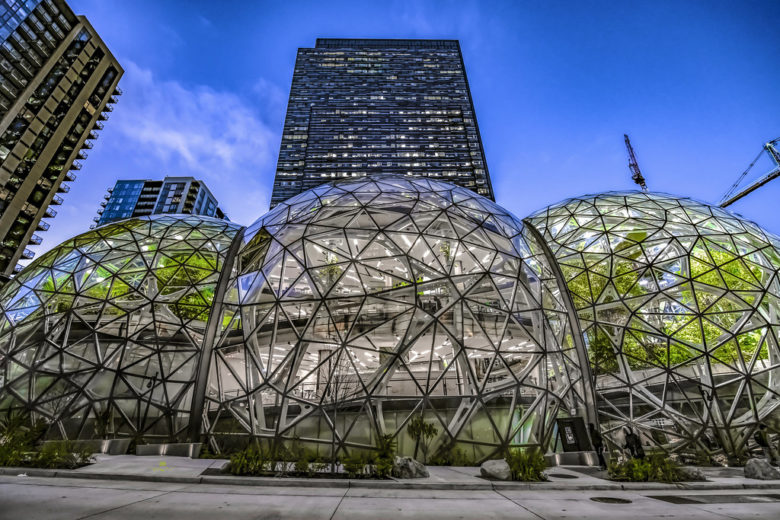
Perhaps the most recognizable part of Amazon’s Seattle headquarters is “The Spheres.” These three glass orbs, filled with thousands of plants from around the world, serve as a unique brand statement. They represent the intersection of nature and technology. In a world where tech brands are often viewed as cold or sterile, The Spheres project an image of Amazon as a brand that values biodiversity, employee well-being, and creative thinking. They have become an iconic landmark, synonymous with Amazon’s brand identity as an innovator that thinks outside the traditional “cubicle” box.
Urban Integration as a Brand Strategy
By weaving its offices into the fabric of the South Lake Union and Denny Triangle neighborhoods, Amazon branded itself as an “urban” company. Unlike the gated campuses of its competitors, Amazon’s Seattle headquarters features public plazas, dog parks, and retail spaces. This strategy was designed to attract top-tier talent who prefer city living over suburban commuting. It positions the Amazon brand as a central pillar of the modern metropolitan economy.
HQ2 and the Strategy of Geographic Expansion
In 2017, Amazon initiated one of the most successful corporate branding exercises in history: the search for a second headquarters, known as “HQ2.” By inviting cities across North America to bid for the project, Amazon effectively turned its expansion into a continental competition, reinforcing its status as one of the world’s most desirable corporate residents.
Arlington and the Brand of Modernity
The winner of the HQ2 search was Arlington, Virginia, specifically the area now known as National Landing. The development of HQ2 represents the next chapter in Amazon’s brand narrative. The flagship building of this campus, “The Helix,” is a spiraling outdoor forest that echoes the design language of the Seattle Spheres. This reinforces a consistent brand identity: Amazon is a company that builds “green,” “spiraling,” and “upwardly mobile” structures.
The Logic Behind Dual Hubs
The decision to split headquarters between the West Coast and the East Coast was a strategic brand move. It allowed Amazon to tap into the political and tech-talent corridors of the Atlantic coast while maintaining its roots in the Pacific Northwest. This dual-headquarter model brands Amazon as a truly national entity, deeply embedded in the economic engines of both sides of the United States. It mitigates the risk of being seen as a “regional” player and strengthens its identity as a global infrastructure leader.

Metropolitan Impact and Brand Perception
The HQ2 project was not without its branding challenges. The intense competition among cities led to a backlash regarding corporate subsidies and gentrification. Amazon’s brand identity had to shift from “scrappy underdog” to “responsible civic leader.” In response, the Arlington headquarters design emphasizes public green space and community engagement, showing an evolution in how the brand wishes to be perceived by the public.
The Design Language of Amazon’s Corporate Identity
Every detail of Amazon’s headquarters, from the interior layout to the choice of materials, is a reflection of the brand’s “Leadership Principles.” Corporate identity is not just about a logo; it is about the environment in which the company’s mission is executed.
Sustainable Branding Through Architecture
Amazon has committed to “The Climate Pledge,” aiming to be net-zero carbon by 2040. Its headquarters are the primary proof points for this brand promise. The Arlington campus is designed to run on 100% renewable energy. By prioritizing LEED Gold and Platinum certifications for its buildings, Amazon is using its real estate to communicate a brand message of environmental stewardship. For a company that relies heavily on a massive logistics and delivery fleet, these “green” headquarters serve as a vital counterbalance to help maintain a positive brand reputation.
The “Dog-Friendly” Identity
One of the most unique aspects of Amazon’s brand culture, reflected in its headquarters, is its dog-friendly policy. On any given day in the Seattle HQ, there are thousands of dogs accompanying their owners to work. This has become a core part of the Amazon brand identity—approachable, quirky, and human-centric. The presence of dog parks integrated into the corporate towers sends a message that despite its massive scale, the brand retains a sense of personality and community.
Community Integration vs. Corporate Seclusion
Modern brand strategy suggests that consumers and employees favor companies that contribute to their local communities. Amazon’s headquarters reflect this by avoiding the “fortress” mentality. Many of the ground-floor spaces in Amazon’s buildings are occupied by local small businesses, restaurants, and cafes. This “permeable” campus design helps the brand avoid being seen as an alien invader, instead positioning it as a foundational partner in urban development.
Global Presence: Translating Brand Culture Across Borders
While Seattle and Arlington are the two primary hubs, Amazon’s “headquarters” presence is actually a decentralized network of global offices that maintain brand consistency across different cultures.
European and Asian Hubs
Amazon’s European headquarters in Luxembourg and its massive campus in Hyderabad, India, are critical to its global identity. The Hyderabad campus is Amazon’s largest building in the world by floor space, a testament to the brand’s massive investment in the Indian market. Despite the geographic distance, these offices mirror the design aesthetic and cultural norms established in Seattle. The use of “collaboration hubs,” open-plan desks, and “writing-intensive” meeting rooms (where PowerPoints are banned in favor of six-page narratives) ensures that the Amazon brand culture remains the same whether an employee is in London, Tokyo, or Seattle.
Maintaining Consistency in a Decentralized World
The challenge for a brand as large as Amazon is maintaining a unified identity across hundreds of satellite offices and two main headquarters. Amazon achieves this through its “Standardized Brand Environment.” No matter where the office is, the “Day 1” signage, the focus on sustainable materials, and the emphasis on whiteboards and collaborative spaces remain constant. This physical consistency reinforces the brand’s reliability and its “customer-obsessed” focus, signaling to employees that the mission remains the same regardless of their coordinates.
The Future of the “Headquarters” Brand
As work-from-home and hybrid models evolve, the very concept of a “headquarters” is being redefined. For Amazon, the physical headquarters remains a vital tool for brand storytelling. The company continues to invest billions in physical spaces, signaling a belief that physical proximity is essential for innovation. By continuing to build ambitious, architecturally significant campuses, Amazon is betting that its headquarters will remain the ultimate symbol of its brand power—a place where the future is imagined, built, and delivered.
In conclusion, Amazon’s headquarters are located in Seattle, Washington, and Arlington, Virginia, but their brand presence is felt in every major city worldwide. These spaces are not merely offices; they are the physical manifestation of a brand that values innovation, sustainability, and an “always-evolving” mindset. From the bio-diverse Spheres to the renewable-energy-powered towers of National Landing, Amazon’s headquarters serve as a masterclass in how corporate real estate can be used to build and sustain a global brand identity.
aViewFromTheCave is a participant in the Amazon Services LLC Associates Program, an affiliate advertising program designed to provide a means for sites to earn advertising fees by advertising and linking to Amazon.com. Amazon, the Amazon logo, AmazonSupply, and the AmazonSupply logo are trademarks of Amazon.com, Inc. or its affiliates. As an Amazon Associate we earn affiliate commissions from qualifying purchases.