
The Advanced Placement (AP) United States Government and Politics exam is a rigorous course designed to introduce students to the fundamental concepts and institutions of American government. A significant component of this course, and thus a crucial aspect of student preparation, involves mastering the art of essay writing. Unlike factual recall or multiple-choice exams, AP Government essays demand critical thinking, analytical skills, and the ability to construct well-supported arguments. The essays assessed in AP Government fall into distinct categories, each requiring a specific approach and a deep understanding of the course material. Successfully navigating these essay types is paramount to achieving a high score on the exam.
Understanding the Essay Landscape: Types and Objectives
The AP Government exam typically features two free-response questions (FRQs): the Concept Application question and the Quantitative Analysis question. However, the underlying skills and essay structures are transferable to various other essay prompts that students might encounter throughout the course and in preparation for the exam. Understanding the core objectives behind each essay type helps students tailor their responses effectively.
The Concept Application Essay: Demonstrating Foundational Knowledge
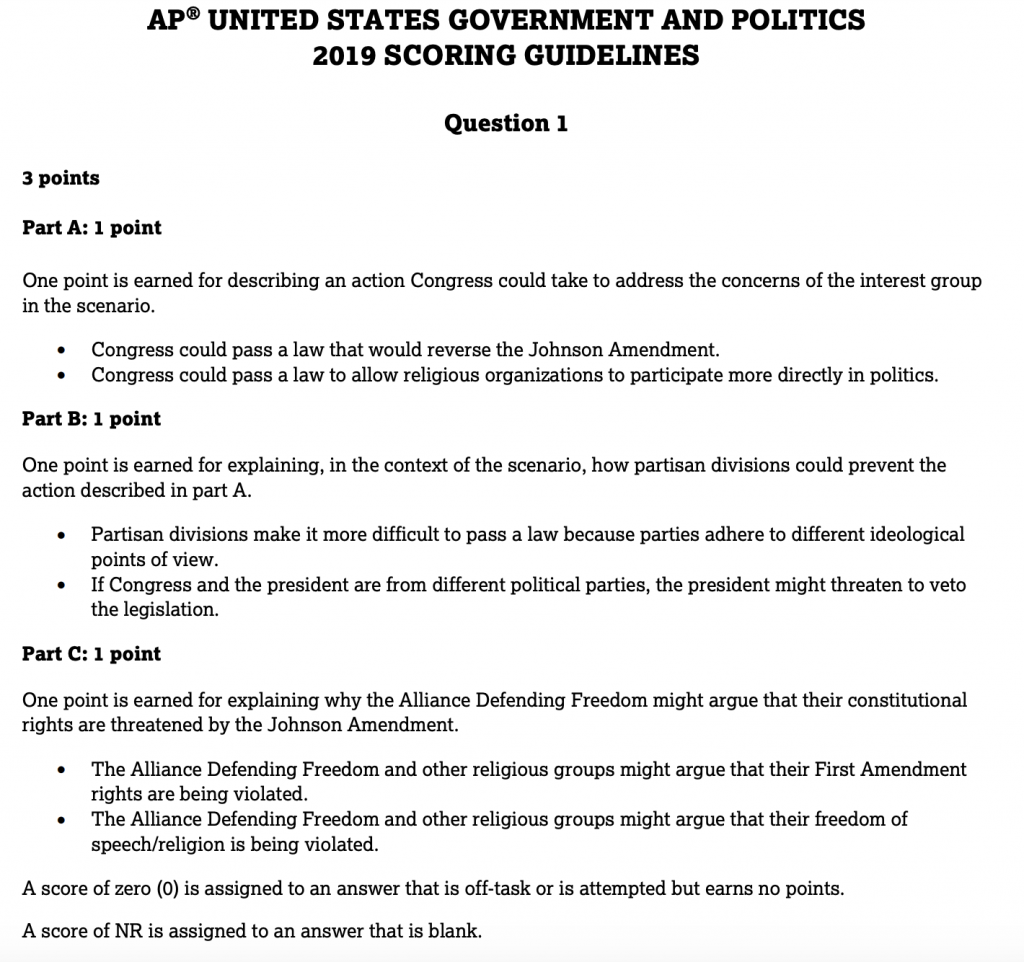
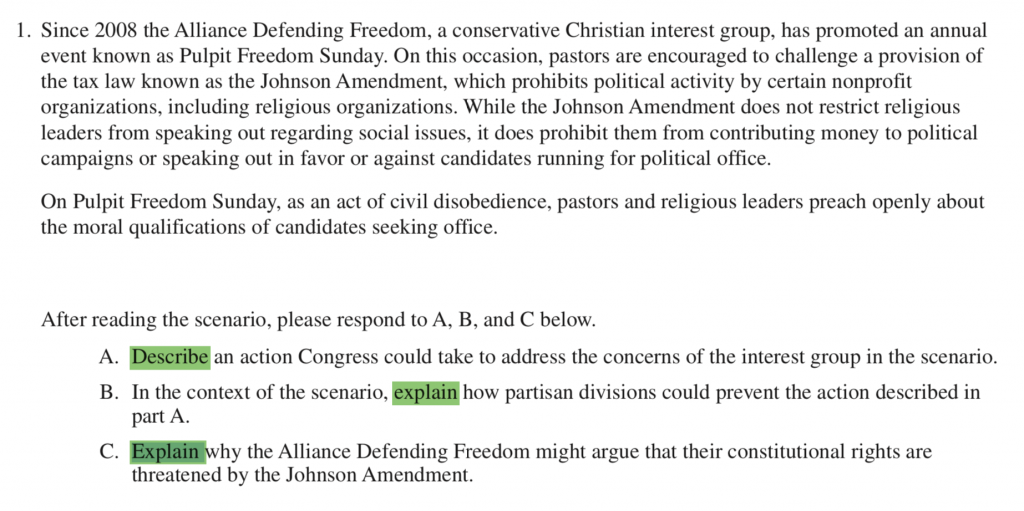
The Concept Application essay is perhaps the most straightforward in its requirement: to explain political concepts, theories, or events and apply them to specific, real-world scenarios. This essay type directly tests a student’s grasp of the core curriculum. The objective is to show that you can not only define and describe a political concept but also illustrate its relevance and impact in practical situations.
Deconstructing the Prompt: Identifying Key Concepts and Scenarios
Effective tackling of a Concept Application essay begins with meticulously dissecting the prompt. Students must identify the specific political concept(s) they are being asked to explain. This might involve terms like federalism, checks and balances, judicial review, political socialization, or civil liberties. Simultaneously, they need to pinpoint the scenario or hypothetical situation presented. The success of the essay hinges on the student’s ability to draw a clear and logical connection between the abstract concept and the concrete scenario.
Applying the Concept: The “Show, Don’t Just Tell” Principle
The heart of the Concept Application essay lies in the application. Simply defining the concept is insufficient. Students must demonstrate how the concept operates within the given scenario. This requires detailed explanations, often involving specific examples or logical reasoning. For instance, if asked to explain the concept of checks and balances and apply it to a scenario involving a presidential veto, a strong response would not only define checks and balances but also detail how the veto power is one specific check the executive branch holds over the legislative branch, and what the implications of that veto might be for the proposed legislation. Using precise terminology and avoiding vague language is crucial here.
Structuring the Response: Clarity and Cohesion
A well-structured Concept Application essay ensures that the argument flows logically and is easy for the grader to follow. A common and effective structure involves:
- Introduction: Briefly state the concepts you will be explaining and how you will apply them.
- Body Paragraph 1: Explaining the Concept: Clearly define and explain the first political concept.
- Body Paragraph 2 (and subsequent): Applying the Concept: Connect the explained concept to the specific scenario provided in the prompt, offering detailed explanations and examples. If multiple concepts are required, dedicate separate paragraphs or sections to each application.
- Conclusion: Briefly summarize the key connections made and reiterate the significance of the concepts in the given context.
The AP exam often provides explicit instructions on how many concepts to explain or how many applications to provide, and students must adhere to these guidelines strictly.
The Quantitative Analysis Essay: Interpreting Data and Drawing Conclusions
The Quantitative Analysis essay is designed to assess a student’s ability to interpret and analyze data presented in graphical or tabular form. This often involves understanding voting data, public opinion polls, budget allocations, or demographic information related to political participation. The objective is to move beyond simple observation and engage in critical analysis, drawing informed conclusions based on the provided data.
Deciphering the Data: Understanding Charts, Graphs, and Tables
The first step in a Quantitative Analysis essay is to thoroughly understand the data presented. This involves identifying the type of data (e.g., percentages, absolute numbers, trends over time), the variables being measured, and the units of measurement. Students need to be adept at reading various graphical representations, including bar graphs, line graphs, pie charts, and scatter plots, as well as interpreting the information within tables. Recognizing the limitations of the data, such as sample size or potential biases, can also be a sign of a sophisticated analysis.
Identifying Trends and Patterns: Making Meaning from Numbers
Once the data is understood, the student must identify significant trends, patterns, and relationships. This involves comparing data points, noting increases or decreases over time, identifying correlations between different variables, and recognizing outliers. For example, a graph showing voter turnout by age group might reveal a clear trend of higher participation among older demographics. The essay should articulate these findings clearly and precisely, using statistical language where appropriate.
Connecting Data to Concepts: The Bridge Between Numbers and Politics
The critical element of a Quantitative Analysis essay is the ability to connect the interpreted data back to the broader concepts and theories of AP Government. This is where students demonstrate a deep understanding of how political phenomena manifest in real-world data. For instance, if the data shows a decline in trust in government institutions, the student would need to connect this quantitative finding to qualitative concepts like political efficacy, partisanship, or the impact of media coverage. The essay must explain why these trends are occurring and what their implications are for the American political system.
Crafting a Well-Supported Argument: Evidence and Explanation
Similar to the Concept Application essay, structure and clarity are vital. A typical approach includes:
- Introduction: Briefly introduce the data presented and the main argument you will make based on its analysis.
- Body Paragraph 1: Describing the Data: Clearly describe the key trends and patterns observed in the data, referencing specific figures or data points.
- Body Paragraph 2 (and subsequent): Analyzing and Connecting: Interpret the meaning of these trends and connect them to relevant AP Government concepts, theories, or historical events. Explain the causal relationships or implications suggested by the data.
- Conclusion: Summarize the main findings and reiterate the significance of the data’s insights in understanding American government.
Students must be careful to avoid simply restating the numbers. The focus should always be on analysis and interpretation.
The Argumentative Essay: Developing a Thesis and Supporting It
While the AP exam specifically features the Concept Application and Quantitative Analysis essays, the skills honed for these are essential for any argumentative essay within the AP Gov curriculum. Argumentative essays require students to take a stance on a particular issue, develop a clear thesis statement, and support it with evidence and logical reasoning. This type of essay is common in classroom assignments and practice exams designed to simulate the rigor of the AP test.
Formulating a Strong Thesis Statement: The Essay’s Core Argument
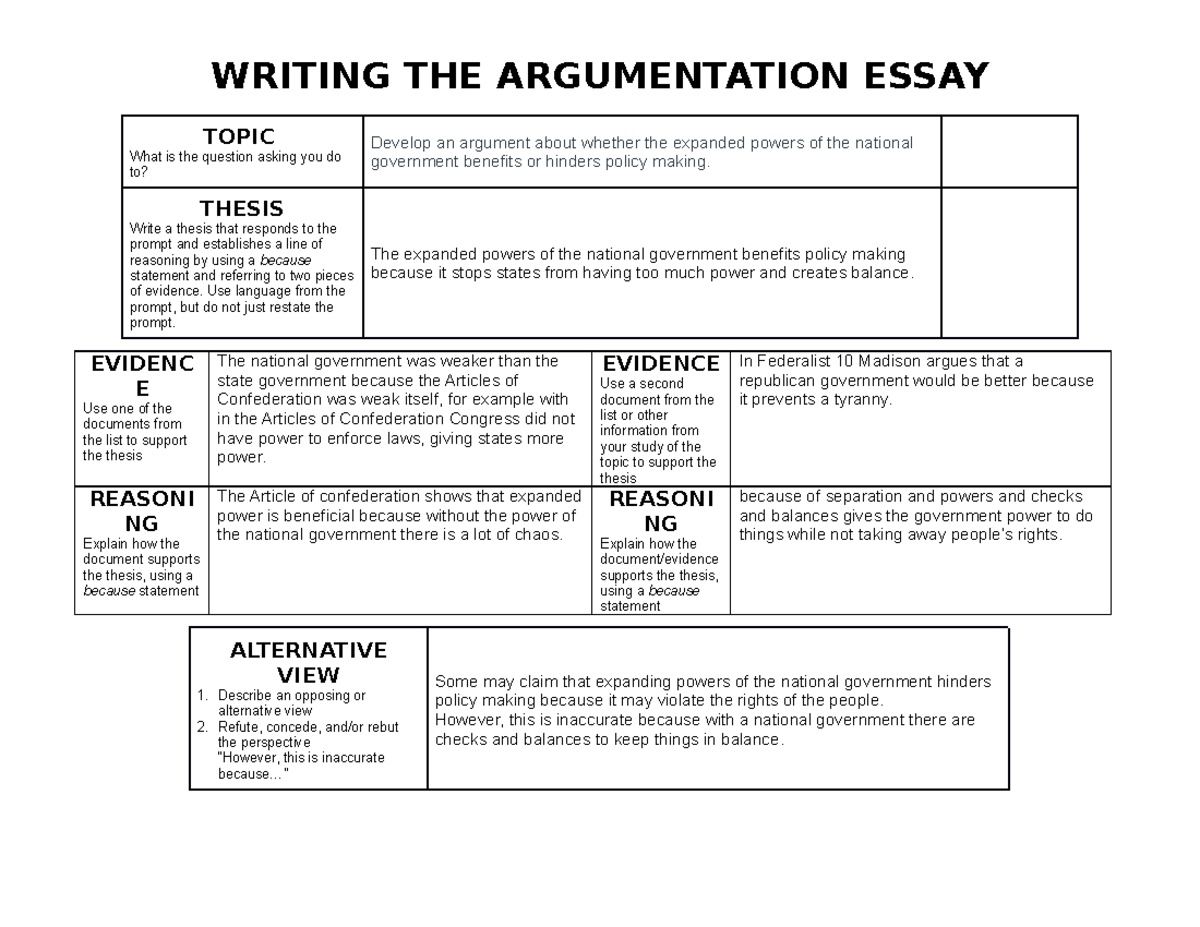
A compelling thesis statement is the backbone of any argumentative essay. It must be clear, concise, debatable, and directly address the prompt. A good thesis statement for an AP Government essay will not just state an opinion but will also hint at the reasoning or evidence that will be used to support it. For example, instead of saying “The Electoral College is unfair,” a stronger thesis might be: “While the Electoral College was designed to balance the power of populous states, its modern application disproportionately disadvantages voters in non-swing states and undermines the principle of direct popular representation.”
Gathering and Presenting Evidence: From Course Material to Real-World Examples
Evidence is what gives an argumentative essay credibility. In AP Government, this evidence can come from a variety of sources:
- Founding Documents: The Constitution, the Bill of Rights, and other foundational texts provide essential context and principles.
- Supreme Court Cases: Landmark court decisions often illustrate key constitutional principles and their evolution.
- Legislation and Policy: Examples of specific laws, policies, and government actions demonstrate the practical application of political concepts.
- Political Institutions and Processes: Understanding how Congress, the presidency, the bureaucracy, and the judiciary function is crucial.
- Political Theories and Concepts: Applying concepts like federalism, separation of powers, pluralism, or elite theory.
- Current Events and Historical Examples: Using relevant and specific examples from contemporary or historical American politics adds depth and relevance.
Students must cite their evidence accurately and integrate it smoothly into their arguments, not just as isolated facts but as support for their claims.
Constructing a Logical and Persuasive Argument: Building Your Case
A well-constructed argument flows logically from one point to the next. This involves:
- Introduction: Hook the reader, provide brief background context, and present the thesis statement.
- Body Paragraphs: Each body paragraph should focus on a single supporting point. Start with a topic sentence that states the main idea of the paragraph. Provide evidence to support that idea, followed by an explanation of how the evidence supports the topic sentence and, by extension, the thesis.
- Counterarguments (Optional but Recommended): Acknowledging and refuting potential counterarguments can strengthen an essay by demonstrating a comprehensive understanding of the issue.
- Conclusion: Restate the thesis in new words, summarize the main points, and offer a final thought or broader implication.
The persuasive power of an argumentative essay lies in its logical structure, the strength of its evidence, and the clarity of its reasoning.
Beyond the FRQ: The Importance of Essay Skills for All AP Gov Students
While the AP Government exam has specific FRQ formats, the skills developed through essay writing are universally beneficial. The ability to analyze, synthesize, and articulate complex political ideas is fundamental to understanding American government. Whether for classroom assignments, practice tests, or the eventual AP exam, mastering these essay types empowers students to engage critically with political concepts and demonstrate their knowledge in a coherent and persuasive manner. The practice of dissecting prompts, formulating arguments, supporting claims with evidence, and structuring responses logically will serve students well beyond the confines of the AP Government course, fostering informed and engaged citizens.
aViewFromTheCave is a participant in the Amazon Services LLC Associates Program, an affiliate advertising program designed to provide a means for sites to earn advertising fees by advertising and linking to Amazon.com. Amazon, the Amazon logo, AmazonSupply, and the AmazonSupply logo are trademarks of Amazon.com, Inc. or its affiliates. As an Amazon Associate we earn affiliate commissions from qualifying purchases.