
The term “vested balance” is a critical concept for anyone participating in a 401(k) retirement savings plan. It dictates how much of your employer’s contributions to your 401(k) you actually own and can take with you if you leave your job. Understanding this distinction between your vested balance and your total balance is fundamental to making informed financial decisions about your retirement and career. This article will demystify the concept of vested balance, explain how it works, and highlight its significance for your long-term financial security.
The Fundamentals of Vesting in 401(k) Plans
At its core, vesting refers to the process by which you gain ownership of employer contributions to your 401(k) plan. It’s important to distinguish this from your own contributions. Any money you contribute from your paycheck to your 401(k) is immediately 100% yours – fully vested from day one. This includes your pre-tax, Roth, and after-tax contributions, as well as any investment earnings generated from these contributions.
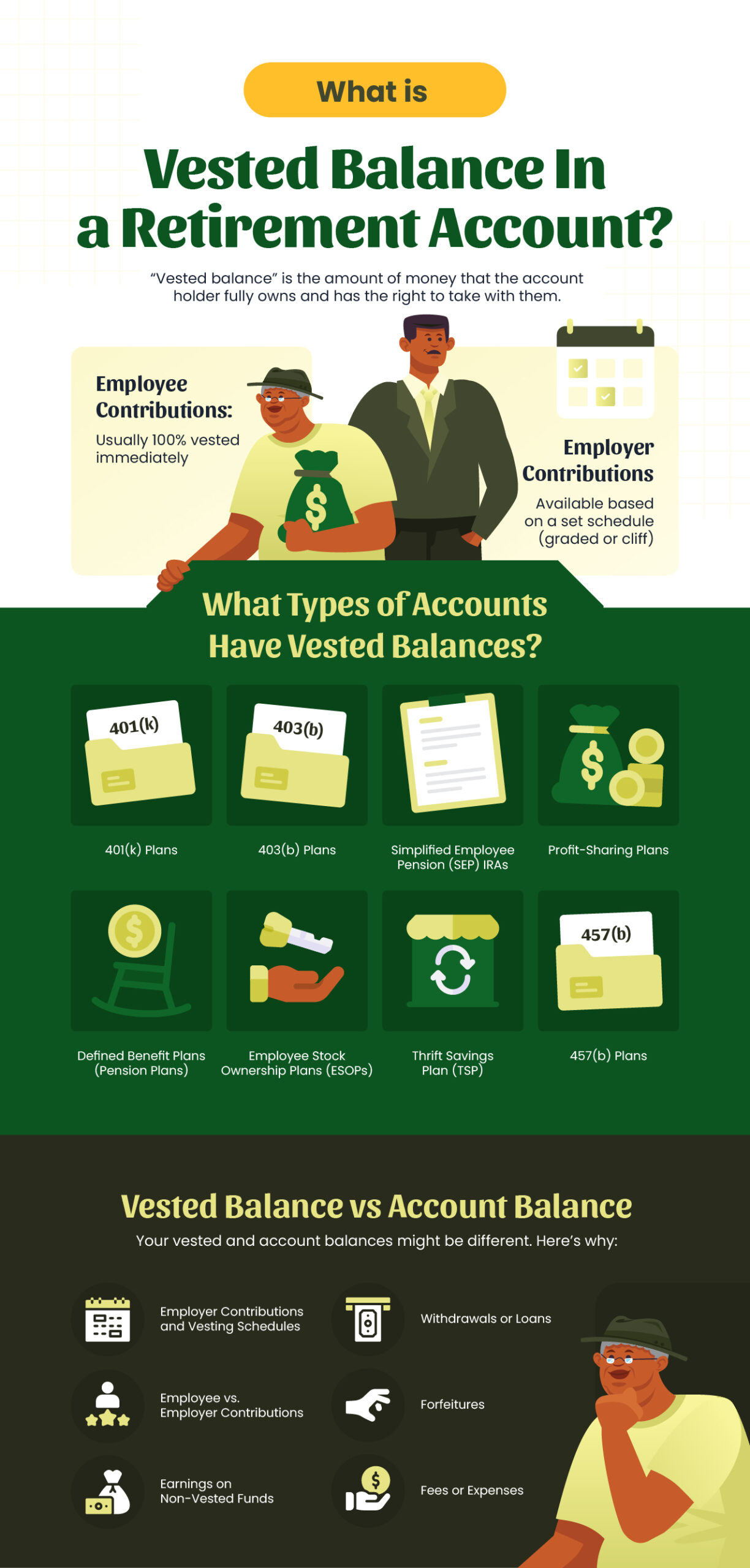
The complexity arises with employer contributions. These can take various forms, primarily matching contributions and profit-sharing contributions. Employers often use vesting schedules as an incentive for employees to stay with the company for a certain period. This strategy helps reduce employee turnover and rewards long-term loyalty.
Employer Contributions: Matching and Profit Sharing
Employer Matching Contributions: This is the most common type of employer contribution. Your employer agrees to match a portion of your own contributions, up to a certain percentage of your salary. For example, a common matching formula is “50% of the first 6% of your salary.” If you earn $60,000 per year and contribute 6% ($3,600), your employer would contribute $1,800. This matching money is often subject to a vesting schedule.
Profit-Sharing Contributions: Some employers also make discretionary contributions to employee 401(k) accounts, regardless of whether the employee contributes. These are typically a percentage of the company’s profits. These profit-sharing contributions are also frequently subject to vesting schedules.
Your Contributions vs. Employer Contributions: The Ownership Divide
The crucial distinction lies in ownership. Your personal contributions are always fully vested. This means that if you leave your job tomorrow, you can take all the money you contributed, plus any earnings on those contributions, with you.
Employer contributions, however, are different. While they are added to your 401(k) account and grow with investment earnings, you only gain ownership of them over time, according to the employer’s vesting schedule. The portion of employer contributions that you have earned ownership of is your “vested balance.” The portion you haven’t yet earned is often referred to as “unvested.”
Understanding Vesting Schedules: How Ownership Accumulates
Vesting schedules are the roadmap that dictates when you gain full ownership of your employer’s contributions. These schedules can vary significantly from one company to another, and it’s essential to review your specific plan documents to understand yours. There are generally two primary types of vesting schedules: cliff vesting and graded vesting.
Cliff Vesting: A Jump in Ownership
Cliff vesting is an “all-or-nothing” approach. Under this schedule, you receive 0% of your employer’s contributions until you reach a specific milestone, typically a certain number of years of service. Once you hit that milestone, you become 100% vested in all employer contributions made up to that point, as well as any future employer contributions.
Example of Cliff Vesting:
A common cliff vesting schedule is “3-year cliff vesting.” This means you receive no employer contributions until you have completed three full years of service with the company. On your third anniversary, you instantly become 100% vested in all employer contributions. If you leave before completing three years, you forfeit all employer contributions, keeping only your own.
While cliff vesting can be attractive for its simplicity, it can also be perceived as less employee-friendly, as there’s no gradual accumulation of ownership. It strongly incentivizes employees to stay for the full cliff period.
Graded Vesting: Gradual Ownership Accumulation
Graded vesting, also known as progressive vesting, allows you to gradually gain ownership of employer contributions over a specified period. With graded vesting, you become partially vested each year (or another specified period) until you reach 100% vesting.
Example of Graded Vesting:
A typical graded vesting schedule might be “6-year graded vesting.” This could break down as follows:
- Year 1: 0% vested
- Year 2: 20% vested
- Year 3: 40% vested
- Year 4: 60% vested
- Year 5: 80% vested
- Year 6: 100% vested
In this example, if you leave after four years of service, you would be entitled to 60% of the employer contributions, plus any earnings on that vested portion. The remaining 40% would be forfeited. Graded vesting offers a more continuous reward for your tenure, providing a growing stake in employer contributions with each passing year.
Immediate Vesting: The Ideal Scenario

The most employee-friendly vesting schedule is immediate vesting. In this case, you are 100% vested in all employer contributions from the moment they are made. This means you own all employer contributions, and any earnings on them, immediately. While less common, some companies, especially smaller ones or those in highly competitive industries, may offer immediate vesting as a recruitment and retention perk.
What Happens to Unvested Funds When You Leave a Job?
The consequences of leaving a job before you are fully vested in your employer’s contributions can be significant. If you depart your employer before meeting the vesting requirements of your 401(k) plan, you will forfeit the unvested portion of the employer contributions. This means that money, along with any investment earnings it has generated, will be returned to your former employer.
However, your own contributions and their earnings are always yours to keep, regardless of your vesting status. Upon leaving your employer, you will typically have several options for handling your vested 401(k) balance:
Rollover to a New Employer’s Plan
If your new employer offers a 401(k) plan, you may be able to roll over your vested balance from your old plan into the new one. This allows your retirement savings to continue growing tax-deferred in a single account. This is often the most straightforward option if your new plan has desirable investment choices and low fees.
Rollover to an Individual Retirement Arrangement (IRA)
Another common option is to roll your vested 401(k) balance into an IRA (Traditional or Roth, depending on the type of contributions and your tax situation). This gives you greater control over your investment choices and can be a good option if your new employer doesn’t offer a 401(k) or if you prefer the investment options available through an IRA.
Leave the Funds in Your Former Employer’s Plan
In some cases, you may be able to leave your vested balance in your former employer’s 401(k) plan. However, this is often not the most advantageous option. Your investment choices may be limited, and you might be subject to administrative fees. Additionally, if your vested balance falls below a certain threshold (often $5,000, as per IRS regulations), your former employer may be required to automatically distribute the funds to you, which could result in taxes and penalties if you’re not yet eligible for retirement.
Cash Out Your Vested Balance
You always have the option to cash out your vested 401(k) balance. However, this is generally the least recommended option, especially if you are under age 59½. Cashing out will subject your withdrawal to ordinary income taxes, and if you are under 55 (or 59½ if still employed), you will likely incur a 10% early withdrawal penalty. This significantly depletes your retirement savings.
Why Understanding Your Vested Balance Matters
Grasping the concept of vested balance is not just an administrative detail; it’s a cornerstone of effective retirement planning and career management. Here’s why it’s so crucial:
Maximizing Your Retirement Savings
Knowing your vested balance helps you understand the true value of your employer’s compensation package. It highlights the potential long-term benefits of staying with a company and allows you to project your future retirement nest egg more accurately. If you are close to being fully vested, it might be a compelling reason to stay a bit longer to secure the full employer contributions.
Informed Career Decisions
When considering a job change, understanding vesting schedules is paramount. If you are in the early stages of employment with a company that has a long cliff vesting schedule, leaving before that cliff can mean forfeiting a substantial amount of potential retirement savings. Conversely, if you have been with a company for many years and are fully vested, changing jobs might not have as significant an impact on your already secured retirement funds.
Negotiating Compensation
When negotiating new employment offers, the vesting schedule for 401(k) contributions can be a point of discussion. A shorter vesting schedule or immediate vesting can be a valuable benefit that can influence your decision to accept a position. You can inquire about the employer’s matching contributions and their associated vesting terms as part of your overall compensation assessment.

Planning for Life Events
Understanding your vested balance is also important for life events such as retirement, disability, or other financial needs. It provides clarity on how much of your retirement savings you can reliably count on.
In conclusion, your vested balance in a 401(k) plan represents the portion of your employer’s contributions that you have earned ownership of. While your own contributions are always 100% yours, employer matching and profit-sharing funds are typically subject to vesting schedules, such as cliff or graded vesting. Familiarizing yourself with your specific plan’s vesting terms and understanding the implications of leaving your job before being fully vested is essential for maximizing your retirement savings and making informed financial and career decisions. Regularly reviewing your 401(k) statements and consulting with your HR department or a financial advisor can ensure you have a clear picture of your vested balance and its role in your overall financial well-being.
aViewFromTheCave is a participant in the Amazon Services LLC Associates Program, an affiliate advertising program designed to provide a means for sites to earn advertising fees by advertising and linking to Amazon.com. Amazon, the Amazon logo, AmazonSupply, and the AmazonSupply logo are trademarks of Amazon.com, Inc. or its affiliates. As an Amazon Associate we earn affiliate commissions from qualifying purchases.