
Preferential trade agreements (PTAs) represent a significant pillar in the architecture of international commerce, shaping how nations interact economically and influencing global trade flows. At their core, PTAs are arrangements between two or more countries to reduce or eliminate tariffs and other trade barriers on specific goods and services traded between them. These agreements aim to foster economic growth, enhance trade volumes, and strengthen political ties among member nations. While the overarching goal of free trade is often lauded, PTAs offer a more nuanced approach, granting preferential treatment to certain trading partners over others. Understanding the mechanics, motivations, and implications of PTAs is crucial for businesses, policymakers, and individuals navigating the complex landscape of global economics.
The Mechanics and Motivations Behind Preferential Trade Agreements
Preferential Trade Agreements are not monolithic entities; they exist in various forms and are driven by a diverse set of economic and political motivations. At the most fundamental level, PTAs are about creating an advantage for member countries in their trade relationships. This advantage typically manifests as a reduction or complete elimination of the tariffs that would otherwise be applied to goods and services exchanged between these nations. Tariffs, as taxes on imported goods, increase the cost for consumers and businesses, making imported products less competitive compared to domestically produced ones. By lowering or removing these tariffs, PTAs make it cheaper and easier for businesses within the agreement to trade with each other.
Types of Preferential Trade Agreements
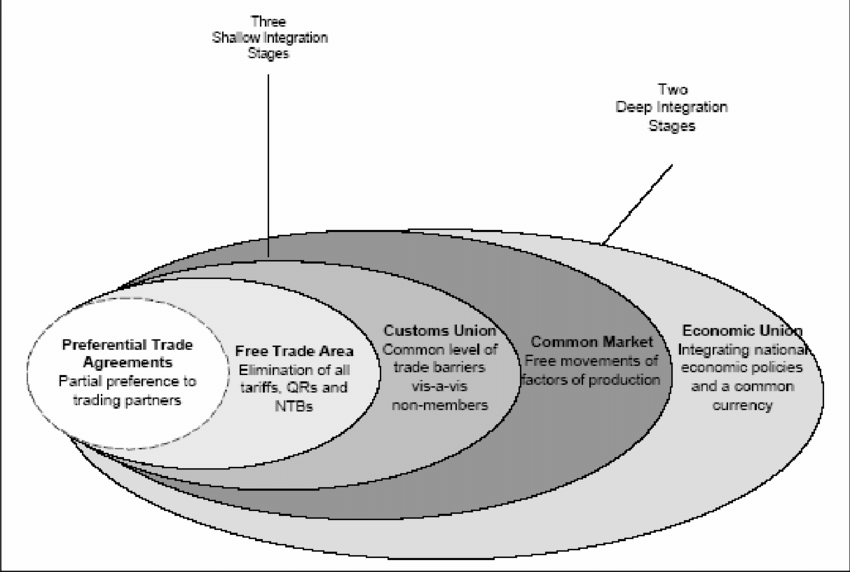
PTAs are often categorized based on the depth of economic integration they achieve. This spectrum ranges from relatively shallow arrangements to deep and comprehensive partnerships.
Partial Scope Agreements (PSAs)
These are the most basic form of PTA. PSAs cover only a limited range of goods and services, and the tariff reductions or eliminations are selective. For example, two countries might agree to lower tariffs only on agricultural products or specific manufactured goods. While they offer some benefits, they do not represent a broad liberalization of trade between the partners. PSAs are often used as a stepping stone towards deeper integration or as a pragmatic solution when full liberalization is not politically or economically feasible.
Free Trade Areas (FTAs)
In an FTA, member countries agree to eliminate or substantially reduce tariffs and quotas on “substantially all” trade among themselves. This means that goods originating from member countries can move freely between them without facing tariffs. However, each member country maintains its own independent trade policy towards non-member countries. This distinction is crucial: an FTA does not create a common external tariff. For instance, a car manufactured in one FTA member country and then exported to another member country would benefit from tariff elimination. But if that same car is imported into the FTA from a non-member country, each member country will apply its own set of tariffs. This necessitates rules of origin to ensure that goods benefiting from preferential treatment are genuinely produced within the FTA.
Customs Unions (CUs)
A Customs Union goes a step further than an FTA. Like an FTA, it involves the elimination of tariffs and quotas on trade among member countries. However, in addition to this, member countries of a CU also adopt a common external tariff (CET) policy towards non-member countries. This means that all member countries apply the same tariffs on goods imported from outside the union. The CET simplifies trade for businesses dealing with multiple partners within the union, as they only need to comply with one set of external tariff regulations. It also provides a stronger collective bargaining position for the union in international trade negotiations.
Common Markets (CMs)
A Common Market represents a deeper level of integration than a Customs Union. It includes all the features of a CU (elimination of internal tariffs, common external tariff) and, crucially, also allows for the free movement of factors of production, such as labor and capital, among member countries. This means that individuals can work in any member country, and businesses can invest and operate more freely across borders within the common market. The removal of barriers to factor mobility can lead to significant economic efficiencies, specialization, and economic growth.
Economic Unions (EUs)
An Economic Union is the most comprehensive form of economic integration. It encompasses all the elements of a Common Market and also involves the coordination and harmonization of economic policies among member countries. This can include fiscal policies (taxation and government spending), monetary policies (interest rates, exchange rates), and regulatory frameworks. In its most advanced form, an Economic Union may even involve a single currency, as seen with the Eurozone. The goal is to create a more unified and efficient economic system, eliminating remaining trade and economic friction.
Motivations for Establishing PTAs
The establishment of PTAs is driven by a confluence of economic and political objectives:
- Economic Growth and Efficiency: By reducing trade barriers, PTAs stimulate trade, leading to increased economies of scale for businesses, greater competition, and more efficient allocation of resources. Consumers benefit from lower prices and a wider variety of goods and services.
- Market Access: For businesses within a PTA, it provides privileged access to larger markets, potentially increasing export opportunities and revenue. This is particularly important for smaller economies seeking to expand their reach.
- Attracting Foreign Direct Investment (FDI): PTAs can make member countries more attractive destinations for FDI, as investors can benefit from preferential access to a larger regional market and potentially more stable trade policies.
- Political Cooperation and Stability: PTAs often serve as instruments to strengthen political ties and foster regional cooperation. By intertwining economies, countries become more interdependent, which can reduce the likelihood of conflict and promote peace and stability.
- Bargaining Power: Forming a PTA can enhance the collective bargaining power of member countries in negotiations with other countries or trade blocs. A larger, more unified economic bloc carries more weight on the global stage.
- Addressing Specific Trade Issues: PTAs can be tailored to address specific trade challenges or opportunities that are unique to a particular group of countries.
Economic Implications and Trade Creation vs. Trade Diversion
While the stated goals of PTAs are often positive, their economic impact is not always straightforward. A key concept in understanding this impact is the distinction between trade creation and trade diversion.
Trade Creation

Trade creation occurs when a PTA leads to an increase in trade between member countries that would not have occurred in the absence of the agreement. This happens when the PTA allows for the production of goods and services in a member country that is more efficient and has a lower opportunity cost than in a non-member country. For example, if a PTA eliminates tariffs on wine between two countries, and Country A is a highly efficient wine producer while Country B previously imported expensive wine from a non-member country due to high tariffs, then Country B will now import cheaper wine from Country A. This leads to more efficient global production and benefits consumers in Country B. Trade creation is generally considered a welfare-enhancing outcome of PTAs.
Trade Diversion
Trade diversion, on the other hand, occurs when a PTA causes member countries to shift their imports from a more efficient non-member country to a less efficient member country, simply because of the preferential tariffs. For instance, if Country B in the previous example was previously importing wine from a highly efficient non-member country at a lower cost (even with tariffs) than it could produce it domestically. When the PTA is formed, Country B eliminates tariffs on wine from Country A but not from the non-member. If Country A’s wine is now cheaper than the non-member’s wine after tariff elimination, Country B will switch its imports to Country A. This is trade diversion. While trade still occurs between member countries, it is at the expense of a more efficient producer outside the PTA, leading to a less efficient allocation of global resources and potentially a welfare loss for the importing country.
The net economic impact of a PTA depends on whether trade creation outweighs trade diversion. Factors such as the initial tariff levels, the efficiency of member countries versus non-member countries, and the scope of the agreement all play a role in determining this balance.
Challenges and Criticisms of Preferential Trade Agreements
Despite their potential benefits, PTAs are not without their challenges and criticisms.
Complexity and Bureaucracy
The implementation and administration of PTAs can be complex. Establishing and enforcing rules of origin, managing customs procedures, and ensuring compliance with the agreement’s provisions can create significant bureaucratic hurdles for businesses. This complexity can sometimes negate the intended benefits of reduced trade barriers, especially for smaller businesses.
Trade Distortions and Protectionism
While intended to liberalize trade, PTAs can, in practice, lead to trade distortions. The preferential treatment given to member countries can disadvantage efficient producers in non-member countries. Critics argue that PTAs can act as a form of “managed trade” or even disguised protectionism, where countries aim to boost trade within their bloc at the expense of broader global free trade. The proliferation of PTAs can also lead to a complex web of overlapping and sometimes conflicting trade rules, making the global trading system more fragmented.
Impact on Developing Countries
The impact of PTAs on developing countries can be mixed. While some developing countries may benefit from preferential access to larger markets, others can be disadvantaged by increased competition from more developed economies within the PTA. Furthermore, developing countries may lack the resources and institutional capacity to fully leverage the benefits of PTAs or to effectively negotiate favorable terms. There is also a concern that PTAs can divert attention and resources away from multilateral trade negotiations under the World Trade Organization (WTO), which aim for universal trade liberalization.
Erosion of Multilateralism
The rise of PTAs has led some to express concern about the potential erosion of the multilateral trading system. The WTO’s principle of Most-Favored-Nation (MFN) treatment, which requires countries to treat all WTO members equally, is fundamentally challenged by PTAs, which grant preferential treatment to specific partners. While PTAs are permitted under WTO rules under certain conditions (e.g., they should facilitate trade and not raise barriers for non-members), a proliferation of complex and diverse PTAs can undermine the WTO’s role as the primary forum for global trade rule-making and dispute settlement.
The Future of Preferential Trade Agreements
The landscape of international trade continues to evolve, and PTAs are an integral part of this evolution. As global trade dynamics shift, driven by technological advancements, geopolitical considerations, and changing consumer demands, PTAs are likely to adapt and proliferate further.
Deepening Integration and New Agendas
We are seeing a trend towards deeper and more comprehensive PTAs. These agreements are increasingly moving beyond traditional tariff reductions to cover a wider range of issues, including services trade, investment, intellectual property rights, e-commerce, environmental standards, and labor rights. These “21st-century trade agreements” aim to create more harmonized regulatory environments within the bloc, facilitating smoother cross-border economic activity.
The Role of PTAs in a Multipolar World
In a world characterized by increasing geopolitical complexities and a shifting balance of global economic power, PTAs can serve as crucial instruments for countries to secure their economic interests and forge strategic alliances. They can provide a framework for economic resilience and cooperation in the face of global uncertainties.

Balancing PTAs with Multilateralism
The ongoing debate about the relationship between PTAs and the multilateral trading system remains critical. While PTAs offer immediate benefits and can serve as building blocks for broader liberalization, maintaining a robust multilateral framework under the WTO is essential for ensuring a predictable, transparent, and inclusive global trading system. The challenge for policymakers will be to design PTAs that complement rather than undermine the principles of multilateral trade and to ensure that these agreements contribute to broader global economic welfare.
In conclusion, preferential trade agreements are multifaceted instruments of international economic policy. They offer tangible benefits in terms of reduced trade barriers and enhanced economic cooperation among member states. However, their effectiveness and ultimate impact are subject to careful consideration of the potential for trade diversion, the administrative complexities involved, and their broader implications for the global trading system. As the world economy continues its complex dance of globalization and regionalization, understanding the nuances of PTAs remains vital for navigating the currents of international commerce.
aViewFromTheCave is a participant in the Amazon Services LLC Associates Program, an affiliate advertising program designed to provide a means for sites to earn advertising fees by advertising and linking to Amazon.com. Amazon, the Amazon logo, AmazonSupply, and the AmazonSupply logo are trademarks of Amazon.com, Inc. or its affiliates. As an Amazon Associate we earn affiliate commissions from qualifying purchases.