
In the subterranean world beneath our cities and the silent trenches along our railways lies a vast, invisible network that powers the modern age. While we often discuss the “cloud” as if it were a nebulous, ethereal entity, the reality of the internet is grounded in physical glass and light. At the heart of this infrastructure is a concept known as “dark fiber.” Despite the somewhat ominous name, dark fiber is not a product of the dark web or a nefarious hacking tool; rather, it is the dormant backbone of global telecommunications, waiting to be “lit” by the next generation of technological innovation.
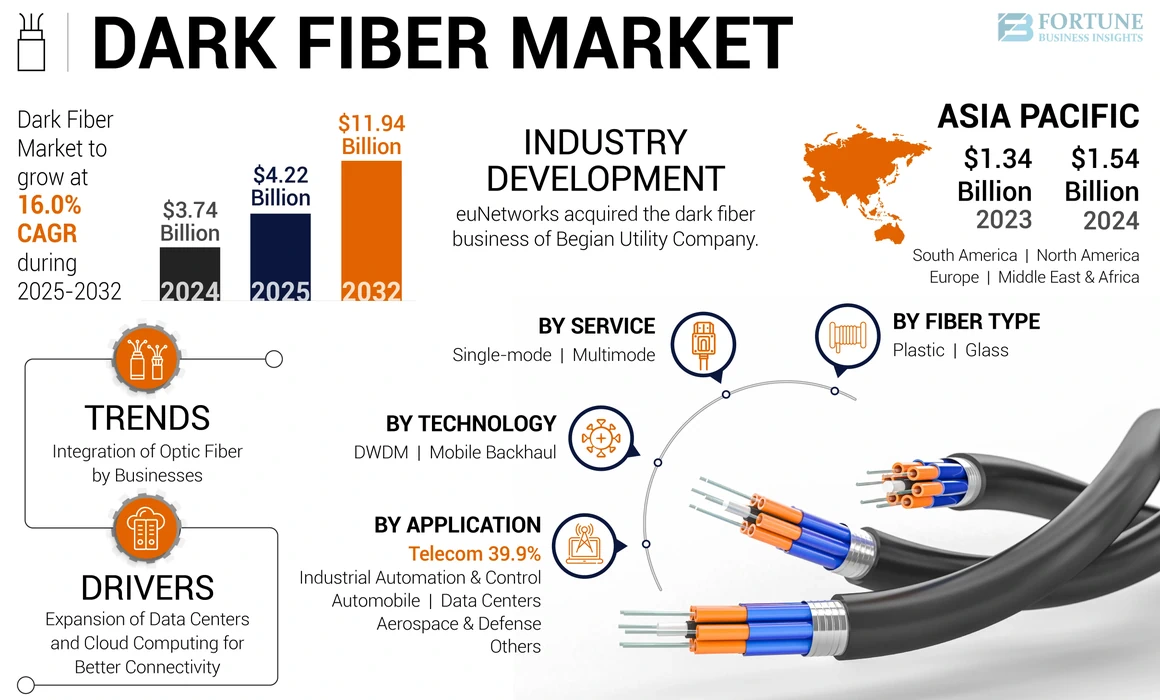
As data demands explode due to artificial intelligence, high-definition streaming, and the Internet of Things (IoT), understanding dark fiber has become essential for tech professionals, network engineers, and enterprises looking to future-proof their digital infrastructure.
Understanding the Infrastructure of Dark Fiber
To understand dark fiber, one must first understand the basics of fiber optic communication. Fiber optic cables consist of strands of glass or plastic, thinner than a human hair, that transmit data as pulses of light. When these cables are actively transmitting data, managed by a service provider, they are referred to as “lit fiber.”
How Fiber Optics Work
Fiber optic technology relies on the principle of total internal reflection. Light signals—photons—travel through the core of the fiber, bouncing off the cladding to stay within the glass strand. This allows for the transmission of data over vast distances with minimal signal loss and at speeds that dwarf traditional copper-based electrical transmission. In a standard setup, a telecommunications provider “lights” the fiber using lasers or LEDs and manages the hardware that translates digital data into light and back again.
Why Fiber Stays “Dark”
The term “dark fiber” refers to fiber optic strands that have been laid in the ground but are not yet connected to active electronics or transmitting data. During the late 1990s and early 2000s, telecommunications companies laid thousands of miles of extra fiber-optic cable. The logic was simple: the cost of digging trenches and laying conduits is the most expensive part of the process. Adding a hundred extra strands of fiber into a trench costs significantly less than digging a new trench later. As a result, there is a massive surplus of unused, “dark” fiber waiting for use.
Dark Fiber vs. Lit Fiber
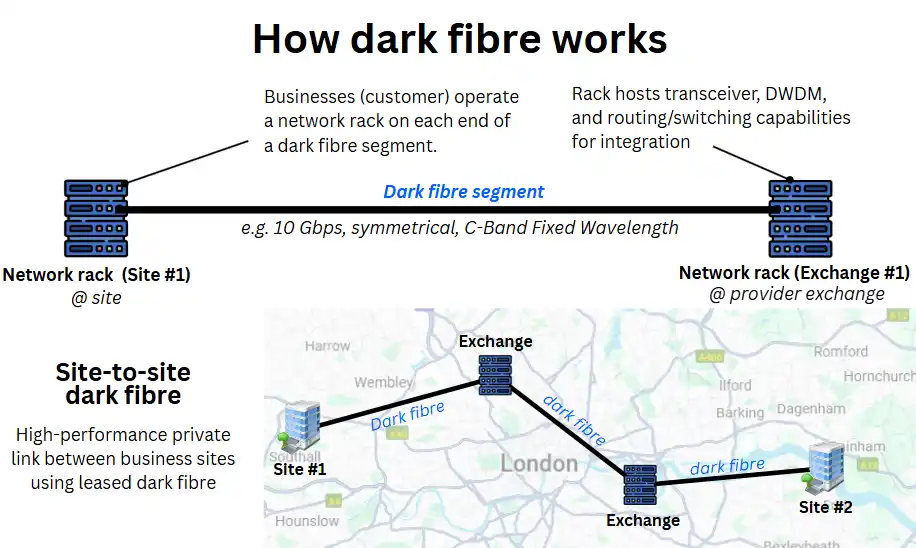
The primary difference lies in control and equipment. With lit fiber, a customer buys a specific amount of bandwidth (e.g., 1 Gbps) from a provider. The provider owns the equipment, manages the traffic, and ensures the service stays active. With dark fiber, the customer leases or buys the raw physical strands. The customer is responsible for providing their own optical transmission equipment, essentially becoming their own mini-telecom provider. This distinction is the catalyst for a range of technical advantages regarding performance and security.
The Technical Advantages for Modern Enterprises
For organizations with high data requirements, dark fiber offers a level of performance and customization that managed “lit” services simply cannot match. By taking control of the physical layer of the network, tech-centric enterprises can optimize their stacks for specific workloads.
Unprecedented Scalability and Bandwidth
When an organization uses a lit service, increasing bandwidth often requires a service contract upgrade and a wait period for the provider to provision the new speed. With dark fiber, the bandwidth is limited only by the hardware at either end of the cable. By using Dense Wavelength Division Multiplexing (DWDM), an organization can split a single strand of fiber into dozens of different wavelengths (colors) of light, each carrying a separate data stream. This allows a company to scale from 10 Gbps to 400 Gbps or even Terabits per second simply by upgrading their own optics, without needing to lay new cable or renegotiate a carrier contract.
Low Latency and Near-Instantaneous Transmission
Latency—the delay between sending and receiving data—is a critical metric for modern applications. In a lit fiber environment, data must pass through various “hops,” including routers and switches owned by the service provider. Each hop adds a few milliseconds of delay. Dark fiber provides a direct, point-to-point connection. Because the customer controls the routing and the hardware, they can eliminate unnecessary intermediary points, achieving the lowest possible latency allowed by the laws of physics.
Enhanced Security and Physical Control
In a shared lit fiber network, data from multiple companies may travel through the same equipment. While encryption helps, the risk of data interception or “side-channel” attacks on shared hardware remains a theoretical concern for high-security environments. Dark fiber provides a dedicated, private physical path. Since the traffic is not multiplexed with other companies’ data at the carrier level, it is significantly harder to intercept. Furthermore, the organization has total visibility into the health of the physical line, allowing for immediate detection of physical tampering or cable breaks through optical time-domain reflectometry (OTDR).
Key Use Cases in the Digital Age
Dark fiber is no longer just for telecommunications giants. A variety of tech-heavy sectors are utilizing these dormant strands to power the next wave of digital services.
Hyperscale Data Centers and Cloud Computing
Companies like Amazon (AWS), Google, and Microsoft are the largest consumers of dark fiber. To maintain the “Cloud,” these companies must sync massive amounts of data between geographically dispersed data centers. Using dark fiber allows them to create a “virtual” giant data center, where servers in two different buildings can communicate as if they were in the same room. This is essential for real-time data replication, load balancing, and disaster recovery.
Telecommunications and the 5G Rollout
The transition to 5G technology is perhaps the biggest driver of dark fiber demand today. Unlike 4G, which relies on large, distant towers, 5G requires a dense network of “small cells” placed on utility poles, buildings, and streetlights. Each of these small cells requires a high-capacity backhaul connection to handle the massive influx of mobile data. Dark fiber provides the necessary “fronthaul” and “backhaul” infrastructure to ensure that 5G speeds actually meet their theoretical potential without being bottlenecked by the network.
High-Frequency Trading and Financial Networks
In the world of high-frequency trading (HFT), a millisecond is an eternity. Financial institutions use dark fiber to connect their private servers directly to stock exchange data centers. By owning the “dark” path, they can shave microseconds off their trade execution times, providing a competitive edge in algorithmic trading where the first to react to a market signal wins.
Deployment Models and Networking Topologies
Implementing a dark fiber network requires a sophisticated understanding of optical networking and physical geography. It is not as simple as “plug and play.”
Point-to-Point vs. Ring Topologies
Most dark fiber deployments start with a point-to-point topology, connecting two specific sites (such as a headquarters and a data center). However, for mission-critical applications, tech teams often deploy “ring” topologies. In a ring setup, if a construction crew accidentally cuts a cable at one point (a common hazard known as “backhoe fade”), the data can instantly re-route in the opposite direction around the ring, ensuring zero downtime.
Colocation and Interconnectivity
Dark fiber often terminates in “carrier-neutral” data centers or colocation facilities. These buildings act as massive switchboards where dark fiber from different providers and customers meet. Within these facilities, “meet-me rooms” allow organizations to interconnect their dark fiber strands with those of partners, service providers, or internet exchange points (IXPs). This creates a highly interconnected ecosystem that bypasses the public internet’s congestion.
The Future of Connectivity: Beyond the Lit Spectrum
As we look toward the future, dark fiber is positioned to be the substrate upon which several emerging technologies will be built. The “unlit” nature of the fiber makes it a blank canvas for experimental physics and advanced computing.
Sustainable Infrastructure
From a sustainability perspective, dark fiber is highly efficient. Because the infrastructure is already in the ground, expanding network capacity does not require the carbon-intensive process of new construction. Furthermore, as optical hardware becomes more energy-efficient (using less power to send light over longer distances), the overall energy footprint of a dark fiber network decreases relative to the volume of data it carries.

Quantum Networking Readiness
The next frontier of digital security is Quantum Key Distribution (QKD). Quantum networking requires the transmission of individual photons that are extremely sensitive to interference. Managed lit networks, with their various amplifiers and switches, are currently unsuitable for quantum states. Dark fiber, however, provides a “clean” glass path that can be used for quantum experiments and secure quantum communication. As we approach the era of quantum computing, the availability of dark fiber will be the deciding factor in which cities and organizations become the first to host a functional quantum internet.
In conclusion, dark fiber represents the ultimate “raw material” of the digital age. By moving away from the constraints of managed services and taking control of the optical layer, organizations can achieve levels of speed, security, and scalability that were previously unimaginable. As our world becomes increasingly data-driven, these silent, dark strands of glass will continue to be the most vital—and powerful—infrastructure on the planet.
aViewFromTheCave is a participant in the Amazon Services LLC Associates Program, an affiliate advertising program designed to provide a means for sites to earn advertising fees by advertising and linking to Amazon.com. Amazon, the Amazon logo, AmazonSupply, and the AmazonSupply logo are trademarks of Amazon.com, Inc. or its affiliates. As an Amazon Associate we earn affiliate commissions from qualifying purchases.