
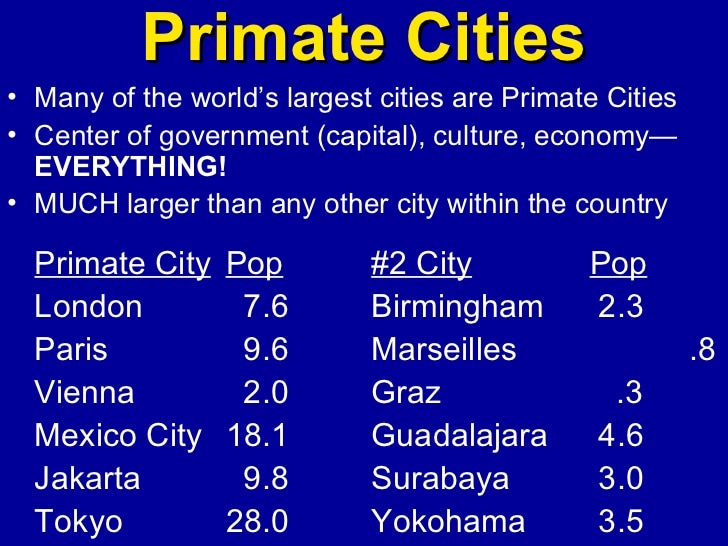
In the realm of urban economics and geography, the term “primate city” refers to a specific urban phenomenon where one city stands significantly larger and more influential than any other in its country. First coined by geographer Mark Jefferson in 1939, the concept describes a city that is at least twice as large as the second-largest city and disproportionately dominant in terms of its national influence. From a financial and investment perspective, a primate city is not just a population center; it is the beating heart of a nation’s wealth, the primary destination for foreign direct investment (FDI), and the ultimate hub for corporate finance.

Understanding the dynamics of a primate city is crucial for investors, entrepreneurs, and financial analysts. These cities—such as London, Paris, Bangkok, or Mexico City—act as economic “black holes,” pulling in talent, capital, and infrastructure at the expense of regional provinces. This article explores the economic architecture of the primate city and how its unique status creates both massive opportunities and significant risks for personal and corporate finance.
The Economic Mechanics of Urban Primacy
The existence of a primate city is rarely an accident of history. It is often the result of centralized economic planning, colonial legacies, or the natural gravity of financial markets. In these environments, the “Law of the Primate City” dictates that the leading city will grow faster and attract more resources than its peers, creating a self-reinforcing cycle of wealth accumulation.
The Law of the Primate City and Wealth Concentration
Jefferson’s original thesis was that “nationalism and civilization” find their highest expression in the primate city. Economically, this translates to the concentration of a nation’s Gross Domestic Product (GDP). In many developing nations, the primate city might account for 30% to 50% of the entire country’s economic output. For a financial strategist, this means that the “national economy” is essentially the economy of that single city. If you are looking to tap into the consumer market of Thailand, for instance, your focus is almost entirely on Bangkok, as the wealth disparity between the capital and the second city, Chiang Mai, is staggering.
Economies of Agglomeration
Primate cities thrive on “agglomeration economies.” This is the financial benefit firms obtain by locating near each other. When businesses, suppliers, and customers are all in one place, transaction costs plummet. In a primate city, the density of financial institutions, law firms, and specialized consultants creates a “thick” market. This environment facilitates faster deal-making, easier access to credit, and a more efficient flow of capital. For a business finance professional, the primate city is the only place where the full ecosystem of support services exists to facilitate large-scale expansion.
Why Investors Flock to Primate Cities
From an investment standpoint, primate cities offer a unique risk-reward profile. Whether you are a retail investor looking at international real estate or a venture capitalist seeking the next unicorn, the primate city is the most logical starting point.
Concentration of Financial Capital and Venture Activity
Primate cities are the headquarters of a nation’s banking system. The central bank, the primary stock exchange, and the headquarters of every major commercial bank are typically located within a few square miles. This proximity to capital is a magnet for startups and entrepreneurs. If you are looking for venture capital in France, you go to Paris; in the UK, you go to London. The “distance to capital” is a real metric in business finance, and in primate cities, that distance is zero. This leads to a concentration of high-growth investment opportunities that simply do not exist in secondary or tertiary cities.
Real Estate Dynamics: High Demand, High Liquidity
For real estate investors, primate cities represent some of the most resilient markets in the world. Because these cities attract the lion’s share of a country’s migration—both from rural areas and international expats—the demand for residential and commercial space remains perpetually high.
While the “buy-in” price for property in a primate city like Seoul or London is significantly higher than in regional areas, the liquidity is also much higher. In a financial downturn, properties in primate cities tend to hold their value better because they are “safe-haven” assets. Investors view these cities as “too big to fail,” assuming that the national government will prioritize the economic health of the capital above all else.
Infrastructure as an Investment Catalyst
Primate cities receive a disproportionate amount of national infrastructure spending. From high-speed rail and international airports to 5G rollouts and power grid upgrades, the primate city is always first in line. This public investment acts as a massive subsidy for private business. When the government spends billions on a new subway line in a primate city, the surrounding real estate values soar, and the cost of logistics for local businesses drops. For the savvy investor, following the path of government infrastructure spending within a primate city is a proven strategy for wealth generation.

The Business Finance of Urban Primacy
Corporate strategy is heavily influenced by the geography of primacy. Large corporations often find that the benefits of being in the primate city far outweigh the higher costs of rent and labor.
Corporate Headquarters and Networking Effects
A primate city serves as the “command and control” center of the national economy. Being located in the primate city provides a firm with proximity to political power and regulatory bodies. In many markets, business finance is deeply intertwined with government contracts and policy. By positioning a headquarters in the primate city, executives can engage in the “face-to-face” networking required to navigate complex regulatory landscapes and secure large-scale financing.
Labor Markets and Human Capital Investment
One of the greatest assets of a primate city is its labor pool. These cities act as talent magnets, drawing the most ambitious and educated individuals from across the country and the globe. For a company, this means access to a highly specialized workforce. While salaries in a primate city are higher, the productivity gains from hiring top-tier talent often justify the expense. From a personal finance perspective, individuals move to primate cities because the “income floor” and “income ceiling” are both higher, providing a faster trajectory for wealth building through career advancement.
Risks and Challenges for the Primate City Investor
While the economic pull of a primate city is powerful, it is not without its financial pitfalls. Over-concentration of resources can lead to systemic vulnerabilities that every investor and business owner must consider.
The Cost of Over-Centralization
The very factors that make a primate city successful can eventually lead to diminishing returns. Excessive demand for land leads to astronomical real estate prices, which can price out the essential workforce and drive up the “cost of doing business” to unsustainable levels. When a city becomes too expensive, it risks a “brain drain” or a corporate exodus to more affordable secondary hubs. Additionally, the extreme density of a primate city can lead to infrastructure strain, traffic congestion, and environmental issues that impact the bottom line of local businesses.
Diversification Strategies Outside the Primate Hub
For a balanced investment portfolio, total reliance on a primate city can be risky. If a nation experiences political instability, the primate city—as the seat of power—is often the hardest hit. Smart investors and corporate treasurers often look for “secondary city” opportunities where the growth potential may be higher due to a lower baseline. As remote work and digital nomadism rise, some of the capital previously locked in primate cities is beginning to flow toward “lifestyle cities,” creating new frontiers for personal finance and small business investment.
The Future of Urban Wealth: Primate Cities in the Digital Age
As we move further into the 21st century, the definition of a primate city is evolving. The digital revolution and the rise of decentralized finance (DeFi) are beginning to challenge the traditional dominance of physical geographic hubs.
Digital Transformation and the Decentralization of Capital
The necessity of being physically present in a primate city to access capital is slowly eroding. With the rise of online investment platforms, remote work, and digital banking, a founder in a secondary city can now pitch to a VC in the capital via Zoom and receive funding via a digital transfer. This shift has the potential to “flatten” the economic landscape. However, history suggests that even with better technology, the “social capital” and high-level networking of primate cities remain difficult to replicate online. The primate city of the future may be less about physical manufacturing and more about being a “knowledge hub” and financial clearinghouse.
Emerging Primate Cities in Developing Markets
The most significant opportunities for high-alpha returns are currently found in the emerging primate cities of Africa, Southeast Asia, and Latin America. Cities like Lagos, Nairobi, and Jakarta are experiencing explosive growth. In these markets, the “primacy” is even more pronounced than in the West. Investing in the infrastructure, retail, and financial services of these rising primate cities allows investors to capture the growth of an entire national middle class through a single urban gateway.
In conclusion, the primate city is the ultimate expression of economic concentration. For those focused on money—whether through personal investing, corporate finance, or business strategy—the primate city is an unavoidable reality. By understanding the forces that drive these urban giants, you can better position your capital to ride the wave of centralisation while remaining wary of the costs of over-congestion. The primate city remains the world’s most potent machine for generating wealth, provided one knows how to navigate its complex financial geography.
aViewFromTheCave is a participant in the Amazon Services LLC Associates Program, an affiliate advertising program designed to provide a means for sites to earn advertising fees by advertising and linking to Amazon.com. Amazon, the Amazon logo, AmazonSupply, and the AmazonSupply logo are trademarks of Amazon.com, Inc. or its affiliates. As an Amazon Associate we earn affiliate commissions from qualifying purchases.