
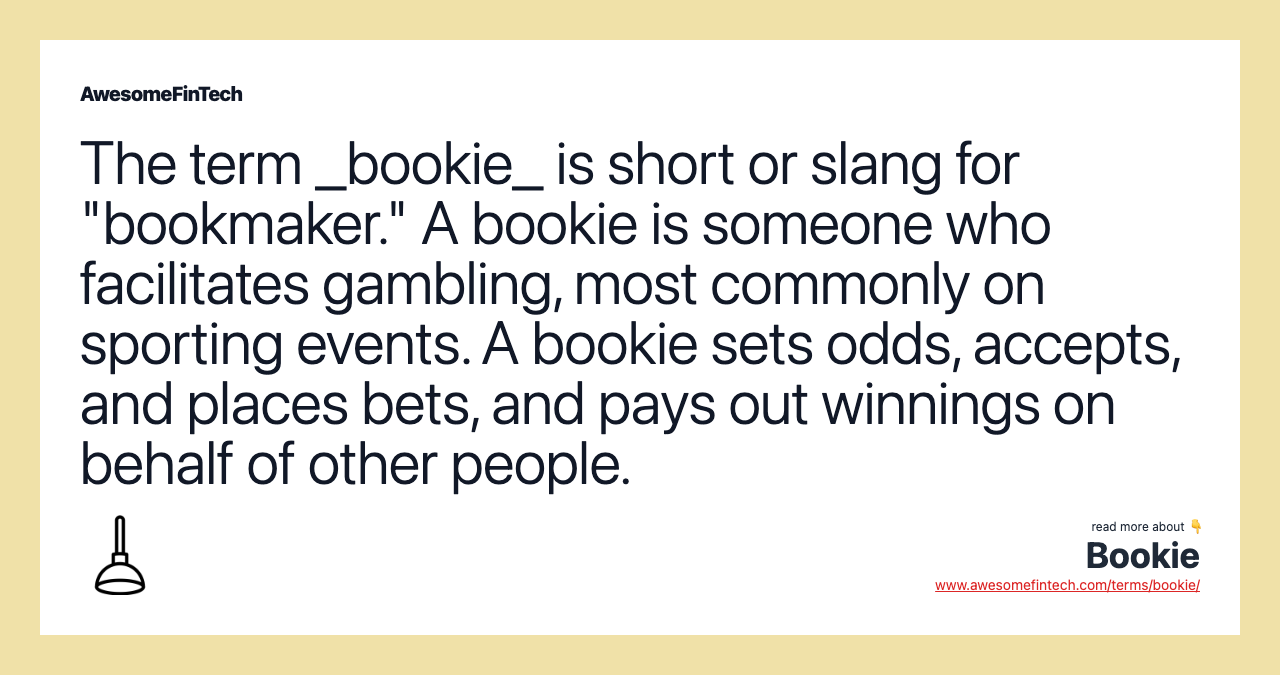
The term “bookie” often conjures images associated with the world of sports betting and gambling. While this association is historically accurate, understanding “bookie” in a contemporary financial context requires a broader perspective. In essence, a bookie, in its most fundamental financial definition, is an individual or entity that acts as a bookmaker. This role involves setting odds, accepting wagers, and managing the financial liabilities associated with those wagers. While illegal bookmaking still exists, the regulated and digitalized nature of modern financial markets has given rise to more sophisticated and legal interpretations of the bookie’s function, particularly in the realm of finance.
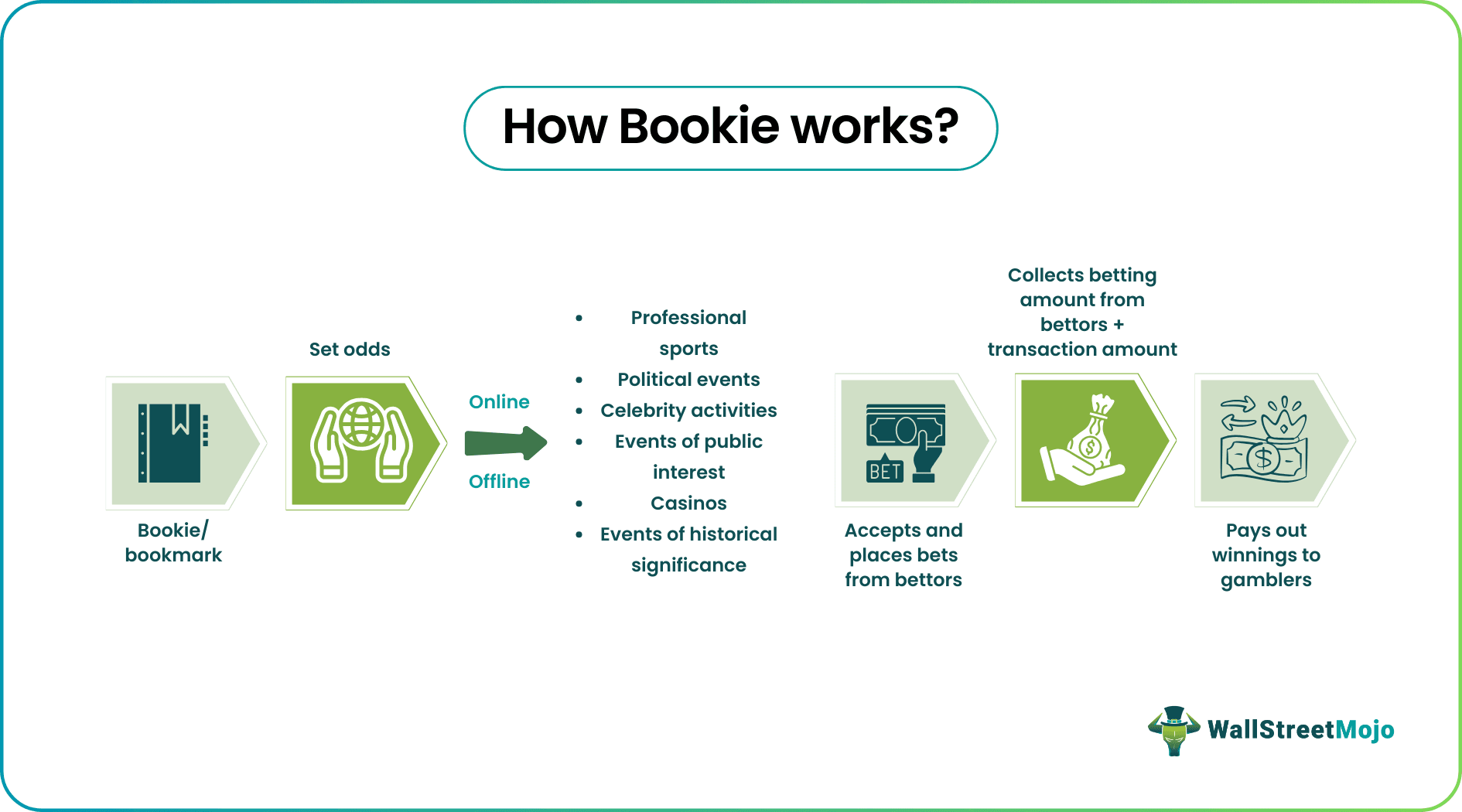
This article will delve into the multifaceted nature of the “bookie” from a financial perspective, exploring its historical roots, its evolution into legitimate financial operations, and the financial implications for individuals and businesses. We will examine how the core principles of a bookie – risk assessment, odds setting, and liability management – are mirrored in various financial sectors.
The Genesis of the Bookie: From Wagers to Financial Management
The concept of a bookie emerged from the practice of placing bets on events, most notably sporting contests. Historically, a bookie would meticulously record all bets placed on a particular event, effectively creating a “book” of liabilities and potential payouts. Their primary objective was to balance the book, ensuring that regardless of the outcome, they would make a profit. This involved skillfully setting odds that encouraged wagers on both sides of an event, thereby minimizing their exposure to significant losses.
Setting the Odds: A Calculation of Probability and Profit
At its core, the bookie’s skill lies in their ability to assess probabilities and translate them into betting odds. This is not simply a matter of guesswork. Historically, experienced bookies would draw upon a deep understanding of the participants, the conditions, and the inherent uncertainties of an event. In the modern era, this process has been significantly augmented by data analytics, statistical modeling, and sophisticated algorithms.
- Risk Assessment and Probability: The fundamental principle for any bookie is to understand the likelihood of different outcomes. In sports betting, this involves analyzing team performance, player statistics, historical data, and even external factors like weather or injuries. This probability assessment directly informs the odds they offer.
- Balancing the Book: A key objective for a bookie is to ensure that the total amount wagered on all possible outcomes is structured to guarantee a profit. If too much money is wagered on one outcome, the bookie’s potential payout could exceed their income. Therefore, odds are adjusted dynamically to encourage betting on under-bet outcomes and discourage betting on over-bet outcomes. This constant adjustment is a form of real-time financial risk management.
- Profit Margin: Every bookie builds a profit margin into their odds. This is often referred to as the “vig” or “juice” in sports betting. It represents a small percentage of the total wagers that the bookie keeps, regardless of the outcome, ensuring their operational sustainability. This ingrained profit margin is a fundamental aspect of their financial model.
Legal and Illegal Bookmaking: A Distinction in Regulation and Ethics
It is crucial to distinguish between legal and illegal bookmaking. Historically, bookmaking often operated in the shadows, leading to associations with illicit activities. However, in many jurisdictions, bookmaking has been legalized and regulated, particularly in the context of casinos, online betting platforms, and state-sanctioned lotteries.
- Regulated Operations: Legal bookmakers operate under strict governmental oversight. This includes licensing requirements, financial reporting obligations, and adherence to consumer protection laws. These regulations aim to ensure fair play, prevent fraud, and provide recourse for bettors. The financial stability and transparency of these operations are paramount.
- Illicit Activities: Illegal bookmakers operate outside the legal framework. They often lack transparency, offer no consumer protection, and are frequently associated with organized crime. Financial transactions with illegal bookies carry significant risks, including potential exposure to fraud, money laundering, and legal repercussions.
- The Ethical Divide: The distinction between legal and illegal bookmaking is not merely a regulatory one; it also represents an ethical divide. Legal bookmaking operates within a framework of transparency and accountability, while illegal operations often exploit individuals and operate with a disregard for legal and ethical norms.
The Modern Financial Bookie: Beyond Betting and into Investment
While the traditional understanding of a bookie is tied to gambling, the principles of risk assessment, odds setting, and liability management are deeply embedded in various legitimate financial operations. In essence, many financial institutions and professionals act as modern-day “bookies” in their own right, managing significant financial risks and offering financial instruments with defined probabilities of return.
Financial Markets as a “Book” of Wagers
The financial markets, particularly those involving derivatives, options, and futures, can be conceptualized as massive, complex “books” where probabilities of future asset prices are constantly being assessed and traded. Financial institutions that deal in these markets effectively act as bookies, taking on positions and managing the associated risks.
- Derivatives Trading: Options and futures contracts are financial instruments whose value is derived from an underlying asset. When financial institutions buy or sell these contracts, they are essentially placing a wager on the future price movement of the asset. The pricing of these derivatives is determined by complex mathematical models that assess probabilities of future price fluctuations, much like a bookie sets odds.
- Market Makers: In stock exchanges, market makers are entities that provide liquidity by quoting both buy and sell prices for securities. They essentially act as a counterparty to a large number of trades, managing their inventory and profiting from the bid-ask spread. This process involves continuous risk assessment and the management of potential price swings, akin to a bookie balancing their book.
- Insurance Companies: Insurance is a prime example of a financial “bookie” in action. An insurance company collects premiums (wagers) from a large number of policyholders, betting on the low probability of individual claims while profiting from the aggregated risk. They meticulously calculate the probability of various events (accidents, illnesses, natural disasters) and set premiums accordingly to ensure profitability.
Algorithmic Trading and the Automated Bookie
The advent of technology has revolutionized financial markets, giving rise to sophisticated algorithmic trading systems that operate with the precision and speed of an automated bookie. These algorithms are designed to identify trading opportunities, execute trades, and manage risk based on predefined parameters and complex statistical models.
- High-Frequency Trading (HFT): HFT firms utilize powerful computers and advanced algorithms to execute a vast number of orders at extremely high speeds. These systems are constantly analyzing market data, identifying fleeting arbitrage opportunities, and managing risk in real-time. They function as incredibly efficient, automated bookies, making micro-profits on millions of trades.
- Predictive Analytics in Finance: The use of artificial intelligence and machine learning in finance allows for sophisticated prediction of market movements. These technologies analyze vast datasets to identify patterns and correlations that can inform investment decisions. Institutions employing these tools are, in a sense, using advanced analytical capabilities to “set odds” on future financial outcomes.
- Risk Management Systems: Modern financial institutions rely on complex risk management systems to monitor and mitigate potential losses. These systems constantly assess exposure to market fluctuations, credit defaults, and operational risks. The underlying principles are similar to a bookie managing their liabilities, but on a vastly larger and more intricate scale.
Financial Opportunities and Risks Associated with the “Bookie” Model
Understanding the “bookie” concept within a financial framework reveals both significant opportunities for profit and substantial risks that must be carefully managed. Whether an individual is directly involved in financial markets or simply a consumer of financial products, the principles of risk and reward, central to the bookie’s trade, are always at play.
Investment Strategies Emulating Bookie Principles
Savvy investors and financial professionals often employ strategies that echo the bookie’s approach to risk and return. This involves a deep understanding of probabilities, diversification, and carefully managing one’s financial exposure.
- Options Trading Strategies: Advanced options traders, like sophisticated bookies, can construct complex strategies to profit from specific market movements or volatilities. They meticulously analyze the probabilities of different price outcomes and construct positions that can yield significant returns if their predictions are accurate, while also implementing strategies to limit potential losses.
- Arbitrage Opportunities: Arbitrage involves exploiting price discrepancies between different markets to make a risk-free profit. While true risk-free arbitrage is rare, sophisticated traders constantly seek out these opportunities. This is akin to a bookie identifying an imbalance in odds across different platforms and exploiting it for a guaranteed profit.
- Diversification as Risk Mitigation: Just as a bookie aims to balance their book across multiple outcomes, investors diversify their portfolios across different asset classes. This strategy reduces the impact of any single investment performing poorly, thereby mitigating overall risk. It’s a principle of spreading one’s “wagers” to protect against unfavorable outcomes.
The Perils of Financial Leverage and Speculation
The allure of rapid profit, inherent in the bookie’s trade, can also lead to significant financial ruin if not managed with extreme caution. The use of leverage and excessive speculation can amplify both gains and losses dramatically.
- Leveraged Trading: Borrowing money to increase trading positions, known as leverage, can magnify profits. However, it also magnifies losses. A leveraged position that moves against the trader can lead to losses exceeding their initial investment, a scenario where the “bookie” (the broker or lender) can claim a substantial portion of the trader’s assets.
- Gambling vs. Investing: While some financial activities can resemble gambling, it’s crucial to differentiate between calculated investment and pure speculation. True investors conduct thorough research, understand the risks, and invest with a long-term perspective. Speculators, on the other hand, may take on excessive risk with the hope of quick gains, mirroring the behavior of someone placing a reckless bet with a bookie.
- The Psychology of Risk: The human tendency towards overconfidence and the desire for quick returns can lead individuals to make poor financial decisions. Understanding one’s own risk tolerance and emotional responses to market fluctuations is as crucial as understanding financial instruments. The “bookie” within us, the part that seeks immediate gratification, can be a significant financial liability.

Conclusion: Navigating the Financial Landscape with Bookie Acumen
The term “bookie,” while rooted in gambling, offers a powerful lens through which to understand the dynamics of risk, probability, and financial management in the broader economic landscape. From the historical bookmaker meticulously balancing their wagers to the sophisticated algorithms driving modern financial markets, the core principles remain consistent: assessing risk, setting values, and managing liabilities to achieve a desired financial outcome.
For individuals navigating their personal finances, understanding these principles can lead to more informed investment decisions, a better grasp of insurance products, and a more cautious approach to speculative ventures. For financial professionals and institutions, the “bookie” mindset, when applied ethically and within regulatory frameworks, is fundamental to managing complex portfolios, mitigating risks, and generating profits.
Ultimately, whether we are placing a bet on a sporting event, investing in the stock market, or purchasing an insurance policy, we are engaging with a system that, at its heart, operates on the principles of risk and reward – the enduring domain of the bookie. By recognizing these underlying mechanisms, we can approach our financial lives with greater clarity, strategic insight, and a more robust understanding of the potential opportunities and inherent risks.
aViewFromTheCave is a participant in the Amazon Services LLC Associates Program, an affiliate advertising program designed to provide a means for sites to earn advertising fees by advertising and linking to Amazon.com. Amazon, the Amazon logo, AmazonSupply, and the AmazonSupply logo are trademarks of Amazon.com, Inc. or its affiliates. As an Amazon Associate we earn affiliate commissions from qualifying purchases.