
In the early 2000s, the landscape of mathematical technology was dominated by bulky, expensive handheld graphing calculators. For decades, these devices were the gatekeepers of higher mathematics, often creating a financial barrier to entry for students across the globe. Enter Desmos: a software-driven revolution that transformed the way we visualize equations. More than just a digital calculator, Desmos has evolved into a comprehensive suite of educational tools that leverages the power of modern web browsers to make mathematics accessible, interactive, and even beautiful.
At its core, Desmos is a technology company specializing in mathematical software. Its flagship product, the Desmos Graphing Calculator, is used by millions of students and educators worldwide. By prioritizing user experience and high-performance rendering, Desmos has shifted the focus from rote calculation to conceptual exploration.

The Core Technology: The Graphing Calculator and High-Performance Computation
The foundation of the Desmos ecosystem is its proprietary graphing engine. Unlike traditional hardware that relies on limited processing power, Desmos utilizes the modern web browser’s ability to execute complex JavaScript and utilize GPU acceleration. This allows for fluid, real-time updates that were previously impossible on standalone devices.
The Power of Browser-Based Computation
Desmos was built with the “web-first” philosophy. By using HTML5 and sophisticated algorithms for rendering curves and surfaces, the software provides instantaneous feedback. When a user changes a variable in an equation—such as the slope of a line or the frequency of a sine wave—the graph updates at 60 frames per second. This responsiveness is not just an aesthetic choice; it is a pedagogical tool that allows students to see the immediate relationship between numerical changes and visual outcomes.
Accessibility and Inclusivity in EdTech
One of the most significant technological triumphs of Desmos is its commitment to accessibility. In the tech world, “accessibility” often refers to screen-reader compatibility and keyboard navigation. Desmos has pushed these boundaries by developing “Audio Trace,” a feature that uses sonification to describe graphs to visually impaired users. By mapping the y-axis to pitch and the x-axis to time, students can “hear” the shape of a parabola or a circle. This focus on inclusive design has made Desmos the standard for digital assessments, including the SAT and ACT.
Cross-Platform Integration and API
Desmos is not a walled garden. The company offers a robust API that allows other educational platforms—such as Khan Academy, Pearson, and College Board—to embed the graphing engine directly into their software. This interoperability ensures that students have a consistent technological experience across different learning management systems (LMS) and digital textbooks.
Desmos Classroom: Redefining Interactive Learning Environments
While the calculator is the engine, Desmos Classroom is the vehicle for pedagogical transformation. Recognizing that technology in the classroom is often used merely to digitize old paper-based methods, Desmos developed a suite of tools designed to facilitate social and collaborative learning.
The Activity Builder and Interactive Sandboxes
Desmos Classroom allows educators to create “Activities”—sequenced digital lessons that guide students through mathematical discovery. Unlike a standard slide deck, these activities use “components” like graphs, tables, and sketchpads. A teacher might design a challenge where students must adjust the parameters of a quadratic equation to “land” a digital marble in a bucket. This gamification of mathematics encourages trial and error, a key component of the scientific method that is often lost in traditional instruction.
Real-Time Feedback and Teacher Dashboards
From a software perspective, the Teacher Dashboard is a masterclass in data visualization. As students progress through an activity, the teacher sees a bird’s-eye view of the entire class’s progress. They can see which students are struggling, which have found unique solutions, and even anonymize names to display student work on the board for class-wide discussion. This real-time data allows for “just-in-time” teaching, where instructors can pivot their lesson based on the actual tech-driven data appearing on their screens.
Computation Layer: The Hidden Scripting Language
For the power user, Desmos Classroom includes a feature called the “Computation Layer” (CL). CL is a simplified scripting language that allows creators to link different components of an activity. For example, a developer can write code so that a student’s text input automatically populates a graph or triggers a specific animation. This layer of “software within software” gives Desmos a level of flexibility that rivals dedicated programming environments while remaining tailored to the needs of math education.
The Impact on Modern Pedagogy: Shifting from Procedure to Discovery
The introduction of high-level software into the math classroom has sparked a debate about the role of technology in education. Desmos stands firmly on the side of “conceptual technology,” arguing that when the “grunt work” of manual plotting is handled by software, the human brain is freed to tackle higher-order problem-solving.
Shifting from Rote Procedure to Visual Discovery
Traditional math education often focuses on the “how”—the steps to solve for $x$. Desmos shifts the focus to the “why.” By allowing students to manipulate “sliders”—variables that can be dragged to change values—the software turns static equations into dynamic experiments. This approach aligns with the “Constructivist” theory of learning, where students build their own understanding through experience rather than passive reception of information.
Integration with Global Standardized Testing
The technological dominance of Desmos is perhaps most evident in its integration with high-stakes testing. In the past, students had to purchase specific models of handheld calculators to be eligible for exams. Today, many state and national exams have replaced physical calculators with a “locked-down” version of the Desmos app embedded directly into the testing software. This ensures that every student, regardless of their socioeconomic status, has access to the same high-powered tools during their most critical academic moments.
Bridging the Gap Between Math and Computer Science
Desmos serves as an entry point into the logic of programming. Because the software requires users to input equations using standard notation and functional logic, it mirrors the syntax found in many coding languages. Students who become proficient in Desmos often find the transition to Python or JavaScript more intuitive, as they have already mastered the art of using variables, functions, and logic gates to achieve a specific visual output.
Mathematical Art: Where Technology and Creativity Intersect
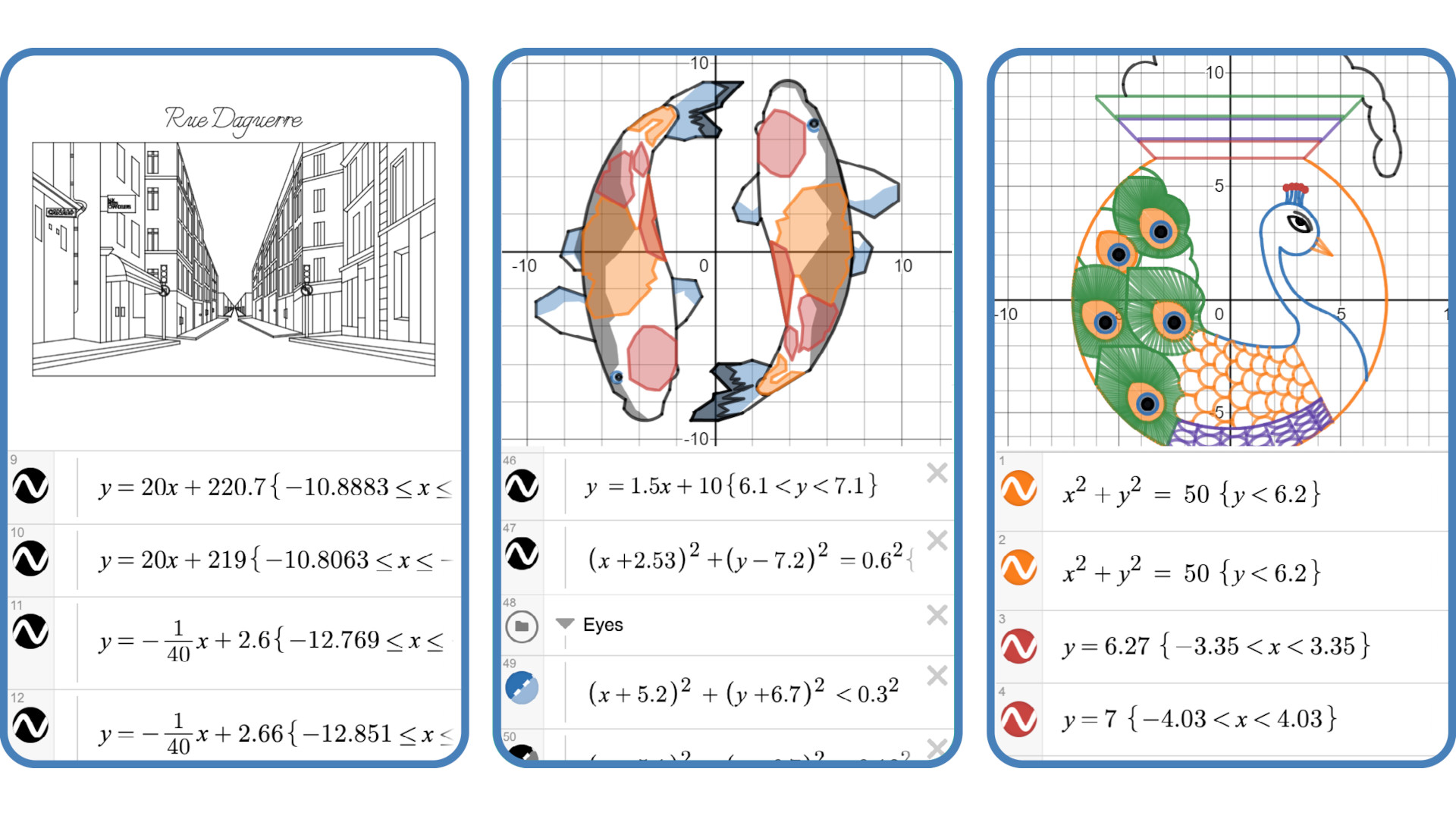
Perhaps the most unexpected evolution of the Desmos software is its role as a medium for digital art. The “Desmos Art” movement has seen students and professionals create incredibly complex portraits, landscapes, and animations using nothing but mathematical inequalities and functions.
Code as Canvas: Complex Functions as Art
Creating art in Desmos is an exercise in technical precision. To draw a human face, an artist might use hundreds of restricted-domain equations—circles for eyes, parabolas for the mouth, and complex trigonometric functions for the hair. This requires a deep understanding of domain and range, as well as the behavior of different function families. It is a perfect example of how tech can turn a “dry” subject like algebra into a creative outlet.
The Global Math Art Contest
Each year, Desmos hosts a global art competition that draws thousands of entries from around the world. These entries are not just static images; many include “tickers” (a feature that allows for recursive calculations) to create fluid animations. From a tech standpoint, these art pieces push the rendering engine to its limits, often involving thousands of lines of “code” that the browser must parse and display simultaneously.
The Future of Desmos and the Educational Software Landscape
As we look toward the future, the trajectory of Desmos reflects broader trends in the tech industry, including consolidation, the move toward SaaS (Software as a Service), and the integration of artificial intelligence.
The Evolution into Amplify and Commercial Expansion
In 2022, Desmos underwent a significant structural change. The “Classroom” side of the business was acquired by Amplify, a leader in K-12 education technology, while the “Studio” side (the calculator and core engine) remained an independent, public-benefit corporation. This move signifies the growing commercial value of high-quality EdTech software. By partnering with a larger curriculum company, Desmos technology can be integrated into full-year math programs, moving beyond a supplemental tool to become the primary interface for learning.
AI Integration and Adaptive Learning
The next frontier for Desmos likely involves Artificial Intelligence. Imagine an Activity Builder that uses machine learning to analyze student errors in real-time and automatically generate a “hint” or a custom graph to help the student self-correct. While Desmos has always prioritized human-to-human interaction, the data generated by millions of users provides a massive dataset for developing adaptive learning paths that can predict where a student might struggle before they even reach that part of the lesson.
Sustaining the Public-Benefit Mission
Despite its commercial success, Desmos Studio remains a Public Benefit Corporation. This is a unique tech business model that legally requires the company to prioritize its social mission alongside profit. For Desmos, that mission is to help every student learn math and love learning math. In an era where many tech companies are criticized for opaque algorithms and data mining, Desmos’s transparency and commitment to free access for students remain a breath of fresh air in the software world.
In conclusion, Desmos is far more than a “calculator app.” It is a sophisticated piece of mathematical software that has dismantled the physical and financial barriers of traditional EdTech. By leveraging browser-based computation, focusing on inclusive design, and fostering a global community of math artists, Desmos has proven that when technology is designed with the user in mind, it doesn’t just solve problems—it inspires wonder. As the company continues to evolve within the Amplify ecosystem and explore the potential of AI, it remains the gold standard for how software can transform an ancient discipline like mathematics into a dynamic, modern experience.
aViewFromTheCave is a participant in the Amazon Services LLC Associates Program, an affiliate advertising program designed to provide a means for sites to earn advertising fees by advertising and linking to Amazon.com. Amazon, the Amazon logo, AmazonSupply, and the AmazonSupply logo are trademarks of Amazon.com, Inc. or its affiliates. As an Amazon Associate we earn affiliate commissions from qualifying purchases.