
Intel, a name synonymous with personal computing for decades, has experienced a challenging period in the stock market, leading many investors to question the reasons behind its underperformance. Once an undisputed titan of the semiconductor industry, Intel’s stock performance has faltered amidst intense competition, strategic missteps, and a rapidly evolving technological landscape. For those observing the financial markets, understanding the complexities behind Intel’s stock depreciation requires a deep dive into its operational challenges, competitive pressures, and ambitious, yet costly, turnaround strategy. This analysis, firmly rooted in the “Money” category of investing and business finance, will dissect the multifaceted issues impacting Intel’s valuation and offer insights into its prospects.

A Legacy Under Pressure: Understanding Intel’s Market Position
For much of the late 20th and early 21st centuries, Intel was the dominant force in microprocessors, powering the vast majority of personal computers and data centers globally. Its x86 architecture became the industry standard, and its manufacturing prowess was legendary. However, the last decade has seen a dramatic shift, transforming Intel from an unassailable leader into a company grappling with significant market share erosion and technological hurdles.
From Dominance to Disruption: The Shifting Semiconductor Landscape
Intel’s historical dominance was built on its integrated device manufacturing (IDM) model, where it designed, manufactured, and sold its own chips. This vertical integration gave it immense control and a competitive edge in terms of cost and performance. However, the industry has gravitated towards a more diversified approach. The rise of ARM-based designs, championed by companies like Apple with its highly successful M-series chips, demonstrated that custom silicon designed for specific workloads could outperform general-purpose x86 processors in power efficiency and sometimes raw performance. This shift reduced reliance on Intel’s core products, particularly in the lucrative laptop market. Furthermore, the advent of specialized accelerators for AI and machine learning, spearheaded by companies like NVIDIA, began to chip away at the total addressable market previously dominated by general-purpose CPUs in data centers. The foundry model, where fabless companies design chips and outsource manufacturing to specialists like TSMC, also gained prominence, offering flexibility and access to cutting-edge process technology without the enormous capital expenditure of maintaining fabs. This structural change meant Intel’s traditional IDM advantage began to turn into a potential liability, demanding massive, continuous investment to keep pace.
Manufacturing Hurdles and Technological Lags
Perhaps the most significant factor contributing to Intel’s stock woes has been its repeated struggles with manufacturing process technology. For years, Intel boasted a “tick-tock” model, consistently shrinking its process nodes to deliver incremental performance gains. However, around 2015-2017, Intel began experiencing significant delays in transitioning to its next-generation 10nm (now branded as Intel 7) and later 7nm (now Intel 4) process nodes. While competitors like TSMC successfully moved to 7nm and then 5nm, Intel found itself stuck on variations of 14nm for an extended period. This lag meant that Intel’s processors often struggled to match the power efficiency and sometimes even the raw performance of AMD’s offerings, which were leveraging TSMC’s more advanced nodes. The inability to deliver cutting-edge process technology on time directly impacted Intel’s product competitiveness, leading to slower innovation, higher power consumption in its chips, and ultimately, a loss of customer confidence and market share. These manufacturing missteps were not just technical failures; they represented a significant financial burden, requiring massive R&D investments that failed to yield timely returns, thereby eroding gross margins and investor perception of the company’s operational efficiency.
Data Center and PC Market Dynamics
Intel’s financial performance is heavily tied to the health of the PC and data center markets. After a significant boom during the initial phases of the COVID-19 pandemic as remote work and learning drove demand for new hardware, the PC market has experienced a notable downturn. Inventory corrections, macroeconomic headwinds, and elongated refresh cycles have all contributed to softer demand for PCs, directly impacting Intel’s client computing group revenue. Simultaneously, while the data center market continues to grow, Intel’s position within it has faced unprecedented challenges. The increased adoption of cloud computing means that large hyperscalers (Google, Amazon, Microsoft) are becoming more sophisticated buyers, often designing their own custom silicon or demanding highly optimized solutions. Furthermore, the fierce competition from AMD in the server CPU space, coupled with the burgeoning market for specialized AI accelerators from NVIDIA, has diversified spending away from Intel’s traditional Xeon processors. This dual pressure from both its core markets has created a challenging financial environment, reflected in stagnant or declining revenue figures and, consequently, downward pressure on its stock price.
Competitive Headwinds and Market Share Erosion
Intel’s struggles cannot be viewed in isolation; they are intricately linked to the aggressive resurgence of its competitors and the emergence of new paradigms in chip design. The semiconductor industry is a zero-sum game when it comes to market share, and Intel has found itself on the defensive for much of the past few years.
AMD’s Resurgence: A Formidable Challenger
Advanced Micro Devices (AMD) has historically been a distant second to Intel in the CPU market. However, under the leadership of CEO Lisa Su, AMD orchestrated a remarkable turnaround. By focusing on superior product design, leveraging TSMC’s advanced manufacturing nodes, and delivering compelling price-to-performance ratios, AMD has made significant inroads into both the consumer PC and, more critically, the lucrative data center markets. Its Ryzen desktop processors and EPYC server CPUs have consistently matched or surpassed Intel’s offerings in performance, power efficiency, and core count for several generations. This direct competition has forced Intel to accelerate its product cycles, engage in more aggressive pricing, and invest heavily in R&D, all of which put pressure on its profit margins. Investors view AMD’s resurgence not just as a temporary threat but as a fundamental shift in the competitive landscape, making Intel’s path to reclaiming lost market share significantly more challenging and costly. The financial impact of this competition is clear: declining average selling prices (ASPs) for Intel’s products and a shrinking piece of the overall market pie.
The Rise of Specialized Silicon and In-House Designs
Beyond direct CPU competition, a growing trend involves major technology companies designing their own custom silicon to meet their specific needs. Apple’s transition from Intel x86 to its in-house designed ARM-based M-series chips for Macs is the most prominent example, delivering significant performance and power efficiency gains while reducing Apple’s reliance on a third-party supplier. Similarly, cloud giants like Amazon (with Graviton), Google (with Tensor and TPUs), and Microsoft are investing heavily in designing their own data center processors and AI accelerators. This trend effectively shrinks Intel’s addressable market by displacing its general-purpose CPUs with highly optimized, custom alternatives. From an investment perspective, this signifies a structural shift that could permanently reduce Intel’s revenue potential in certain high-value segments, forcing it to compete not just with traditional rivals but also with its former customers. The long-term financial implications are profound, suggesting a need for Intel to innovate beyond its core competency or find new avenues for growth to offset this erosion.
NVIDIA’s Expanding AI Dominance
While NVIDIA is primarily known for its Graphics Processing Units (GPUs), its dominance in the field of Artificial Intelligence and Machine Learning has become a critical factor influencing the broader semiconductor investment landscape. As AI workloads become more pervasive, the demand for specialized AI accelerators (like NVIDIA’s A100 and H100) has skyrocketed, becoming a major area of capital expenditure for data centers and cloud providers. This shift in spending priorities means that a significant portion of the growth in data center infrastructure is now flowing towards NVIDIA and away from traditional CPU vendors like Intel. While Intel also offers its own AI accelerators and integrates AI capabilities into its CPUs, it has not captured the mindshare or market share commanded by NVIDIA. Investors looking for exposure to the high-growth AI sector often choose NVIDIA, drawing capital and attention away from Intel. The financial consequence is that even if Intel maintains its server CPU share, the overall value of the compute market is diversifying, and Intel is not capturing the lion’s share of the fastest-growing segments.

Financial Implications and Investor Sentiment
The operational and competitive challenges faced by Intel have directly translated into a complex and often concerning financial picture, impacting investor sentiment and the company’s valuation.
Revenue and Profitability Trends
Intel’s financial reports over the past few years have reflected the struggles discussed. The company has experienced periods of stagnant or declining revenue, particularly in its core Client Computing Group and Data Center and AI Group. More critically, its gross margins—the profit made from selling its products before operating expenses—have been under immense pressure. This is a direct consequence of several factors: the costly delays in process technology development, the need to invest heavily in new manufacturing capabilities, aggressive pricing required to compete with AMD, and the overall slowdown in the PC market. Lower gross margins mean less cash flow available for reinvestment, dividends, or debt reduction, directly impacting the company’s financial health and appeal to investors seeking consistent profitability. Analysts closely watch these trends, and any sustained decline signals deep-seated issues that are difficult and expensive to resolve, justifying a lower stock valuation.
Capital Expenditure (CapEx) and Foundry Ambitions
Under CEO Pat Gelsinger’s “IDM 2.0” strategy, Intel has committed to rebuilding its manufacturing prowess and establishing a world-class foundry service (Intel Foundry Services – IFS) to compete with TSMC and Samsung. While this vision holds long-term potential, it requires an unprecedented level of capital expenditure. Intel is investing tens of billions of dollars annually in new fabs (e.g., in Arizona, Ohio, Germany) and advanced manufacturing equipment. These investments are crucial for the company’s future but represent a significant near-term financial drain. Investors are faced with a dilemma: while these investments could eventually restore Intel’s competitive edge, they also mean substantial cash outflows, potential dilution if new capital is raised, and a long payback period. The sheer scale of CapEx introduces execution risk and uncertainty, as any further delays or cost overruns could severely impact the company’s financial flexibility and profitability for years to come, understandably making investors cautious and contributing to a lower stock price.
Dividend Sustainability and Shareholder Returns
Intel has historically been a reliable dividend payer, a factor that attracts income-focused investors. However, the financial strain from declining revenue, compressed margins, and massive CapEx has put pressure on the sustainability of its dividend. In early 2023, Intel made the difficult decision to cut its quarterly dividend by 66%, a move that, while fiscally prudent for long-term reinvestment, sent a strong signal to the market about the company’s immediate financial health. For many investors who relied on Intel for steady income, this cut was a blow to confidence and a reason to reconsider their holdings. Beyond dividends, the ability to execute substantial share buybacks – another way to return value to shareholders – is also constrained by the financial commitments to its turnaround. The diminished ability to provide consistent shareholder returns through dividends and buybacks reduces Intel’s attractiveness compared to other investment opportunities, directly impacting demand for its stock and contributing to its downward trend.
Intel’s Turnaround Strategy: A Path Forward?
Despite the significant challenges, Intel is not standing still. CEO Pat Gelsinger has embarked on an ambitious multi-year turnaround strategy aimed at restoring the company’s technological leadership and financial prowess.
Pat Gelsinger’s “IDM 2.0” Vision
Gelsinger’s “IDM 2.0” strategy is a bold three-pronged approach: first, re-establish process leadership by rapidly advancing its manufacturing nodes (targeting five nodes in four years); second, leverage external foundries for certain products to ensure competitiveness even while its own fabs catch up; and third, build Intel Foundry Services (IFS) into a major foundry player, offering its manufacturing capabilities to other fabless companies. This vision seeks to blend the advantages of vertical integration with the flexibility of external manufacturing, while also creating a new revenue stream. From an investment perspective, IDM 2.0 is a high-stakes gamble. Its success is critical for Intel’s long-term viability, but it requires flawless execution, immense capital, and a significant amount of time. Investors are closely watching for tangible signs of progress, as any missteps in this ambitious plan could further depress the stock.
Product Roadmap and Innovation Initiatives
Beyond manufacturing, Intel is also revitalizing its product roadmap across all segments. This includes new generations of desktop and laptop CPUs (such as Meteor Lake, Arrow Lake, and Lunar Lake) designed with new architectural approaches (e.g., tile-based designs, disaggregated chips) to improve performance and power efficiency. In the data center, Intel is releasing new Xeon generations and pushing its discrete GPU strategy with its Arc line of graphics cards, aiming to compete with NVIDIA and AMD in a broader range of compute markets. Furthermore, Intel is investing in specialized AI accelerators and other emerging technologies to capture growth in new sectors. These product innovations are crucial for regaining market share and demonstrating that Intel can still lead in chip design. However, the success of these products relies heavily on the underlying manufacturing process. For investors, the product pipeline offers a glimmer of hope, but consistent delivery and market adoption are key metrics to watch.
Geopolitical Factors and Government Subsidies
The semiconductor industry has become a matter of national and economic security, leading governments worldwide to invest heavily in domestic chip manufacturing. The U.S. CHIPS Act and similar initiatives in Europe and Asia are providing significant subsidies and incentives for companies like Intel to build and expand fabs within their borders. These government grants and tax credits can help offset some of the massive capital expenditure required for Intel’s foundry expansion, potentially making its IDM 2.0 strategy more financially viable. For investors, these subsidies reduce the financial burden on Intel, offering a potentially more favorable risk-reward profile for its ambitious manufacturing plans. However, these factors also tie Intel’s fortunes to geopolitical considerations and government policies, adding another layer of complexity to its investment thesis. While beneficial, they don’t erase the fundamental need for Intel to execute flawlessly on its technology and product roadmaps.
Conclusion
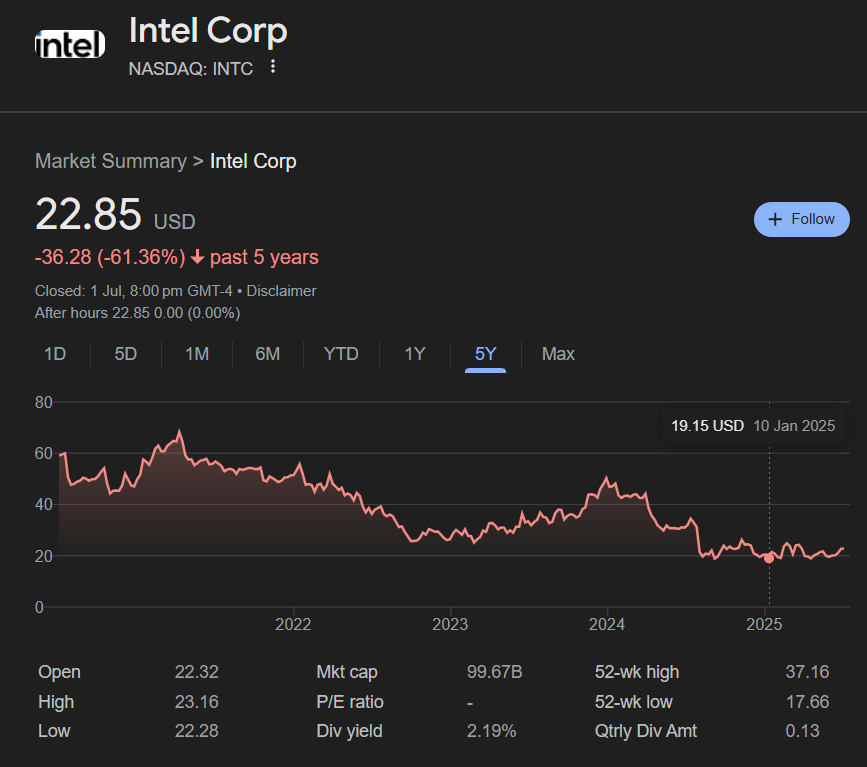
The question “Why is Intel stock down?” reveals a confluence of deep-seated challenges rooted in technological lags, fierce competition, and a demanding transition to a new strategic vision. From an investor’s perspective, Intel’s stock has faced significant headwinds due to manufacturing missteps that enabled competitors like AMD to gain market share, a structural shift towards custom silicon by major tech players, and the massive capital expenditures required for its ambitious IDM 2.0 turnaround. The resulting pressures on revenue, gross margins, and shareholder returns have justifiably impacted investor sentiment and valuation.
However, the current situation also presents a high-stakes scenario. If CEO Pat Gelsinger’s IDM 2.0 strategy succeeds in restoring process leadership, if new products resonate with the market, and if the Intel Foundry Services initiative gains traction, the company could eventually reclaim its position and see its stock rebound. The road ahead is undoubtedly long, arduous, and fraught with execution risk. For investors considering Intel, a thorough understanding of these financial and operational dynamics is paramount, recognizing that the company is currently in a challenging, capital-intensive rebuilding phase with significant long-term potential, but also considerable near-term uncertainty. It is a story of a titan fighting to adapt and innovate, with its stock performance serving as a real-time report card on its progress.
aViewFromTheCave is a participant in the Amazon Services LLC Associates Program, an affiliate advertising program designed to provide a means for sites to earn advertising fees by advertising and linking to Amazon.com. Amazon, the Amazon logo, AmazonSupply, and the AmazonSupply logo are trademarks of Amazon.com, Inc. or its affiliates. As an Amazon Associate we earn affiliate commissions from qualifying purchases.