
The calculator, a device so ubiquitous today that it often goes unnoticed, represents one of humanity’s most enduring quests: the desire to simplify and accelerate computation. Far from being a singular invention, its history is a fascinating tapestry woven over millennia, featuring brilliant minds, technological breakthroughs, and a relentless pursuit of efficiency. Tracing the calculator’s lineage is to embark on a journey through the evolution of technology itself, from rudimentary counting tools to the sophisticated microchips that power our digital world. Understanding “when the calculator was invented” isn’t about pinpointing a single date, but rather appreciating a continuous, incremental progression that forever altered the landscape of science, commerce, and everyday life.
The Dawn of Calculation: Pre-Mechanized Aids
Before the advent of any mechanical or electronic device, humans devised ingenious methods and tools to manage numbers. The very concept of calculation is as old as civilization, driven by needs ranging from trade and taxation to astronomy and architecture.
Ancient Abacus and Counting Devices
The earliest ancestors of the calculator were not machines but rather systems designed to organize and manipulate quantities. The abacus, in its various forms, stands as the most iconic example. Dating back possibly as far as 2700–2300 BC in Mesopotamia, and refined by cultures across China, Japan, and ancient Greece and Rome, the abacus provided a physical representation of numbers, allowing users to perform arithmetic operations with surprising speed and accuracy. It was essentially a manual calculator, requiring skilled manipulation of beads or counters on rods or grooves.
Beyond the abacus, other early methods included counting boards, tally sticks, and even elaborate systems of knot-tying (like the Inca quipu). These tools, while simple, underscored a fundamental truth: humans needed external aids to cope with increasingly complex numerical tasks, laying the groundwork for more advanced computational devices.
Early Mechanical Concepts: From Napier’s Bones to Slide Rules
The 17th century marked a significant pivot with the emergence of ideas that flirted with mechanization. Scottish mathematician John Napier introduced “Napier’s Bones” in 1617, a set of numbered rods used for multiplication and division. While not a calculator in the modern sense, it was a profound innovation for its time, simplifying calculations through a system of movable rods.
Building on these concepts, the slide rule, invented by William Oughtred around 1622, brought the power of logarithms to practical use. This analog mechanical calculator allowed for rapid multiplication, division, roots, and even trigonometric functions by sliding marked scales against each other. For centuries, the slide rule remained the primary tool for engineers and scientists, a testament to its ingenious design and effectiveness, until it was eventually superseded by electronic calculators in the latter half of the 20th century.
The Dawn of True Mechanical Calculation: Pioneering Minds
The dream of a fully automatic calculating machine truly began to materialize in the 17th and 18th centuries, spearheaded by some of history’s most brilliant polymaths. Their early attempts, though limited, established the fundamental principles upon which all subsequent calculating machines would be built.
Pascal’s Pascaline: A Revolutionary Step
In 1642, a mere nineteen-year-old French prodigy, Blaise Pascal, invented the “Pascaline” (or Pascal’s calculator). Driven by the need to assist his tax collector father with tedious arithmetic, Pascal’s device was a mechanical calculator capable of performing addition and subtraction directly, and multiplication and division through repeated additions or subtractions. It utilized a series of intermeshing gears and wheels, where a rotation of one wheel (representing a digit) would cause the adjacent wheel to advance when it completed a full rotation, effectively automating the carry-over operation. While expensive and somewhat cumbersome, the Pascaline was a monumental achievement, representing the first true mechanical calculator in history and a direct precursor to modern odometer mechanisms.
Leibniz’s Stepped Reckoner: Advancing the Vision
Following Pascal, the German polymath Gottfried Wilhelm Leibniz made significant contributions with his “Stepped Reckoner” (Staffelrechner) around 1672, completing it in 1694. Leibniz greatly admired Pascal’s work but aimed to create a machine that could perform all four basic arithmetic operations more directly. His invention introduced the “stepped drum” (or Leibniz wheel), a fluted cylinder with nine teeth of increasing length, which became a standard component in mechanical calculators for centuries. The Stepped Reckoner could directly multiply and divide by means of a movable carriage, representing a substantial improvement in functionality and ambition over the Pascaline. Though also temperamental and costly to produce, Leibniz’s machine demonstrated the potential for more sophisticated mechanical computation.
The Unfinished Dream: Babbage’s Difference and Analytical Engines
The 19th century witnessed the visionary work of Charles Babbage, often hailed as the “Father of the Computer.” While his machines were never fully completed during his lifetime, his designs were centuries ahead of their time and laid the theoretical groundwork for modern computers, not just calculators. His first major project, the Difference Engine, conceived in 1822, was designed to automatically calculate polynomial functions and tabulate mathematical tables with high precision, eliminating human error. It was purely mechanical, intended to be powered by steam.
Later, Babbage conceived the even more ambitious Analytical Engine in 1837. This machine was intended to be a general-purpose programmable computer, featuring an Arithmetic Logic Unit (the “mill”), conditional branching, loops, and integrated memory (the “store”). It even envisioned punched cards for input, inspired by the Jacquard loom. While the Analytical Engine was never fully built due to financial and technological constraints of the era, its architectural concepts were startlingly prescient, embodying many principles fundamental to modern digital computing. Though not calculators in the strictly functional sense of adding machines, Babbage’s designs represented the ultimate theoretical zenith of mechanical computation, whose impact would only be fully appreciated with the dawn of the electronic age.
The Mechanical Era: From Desk-Sized Giants to Commercial Success

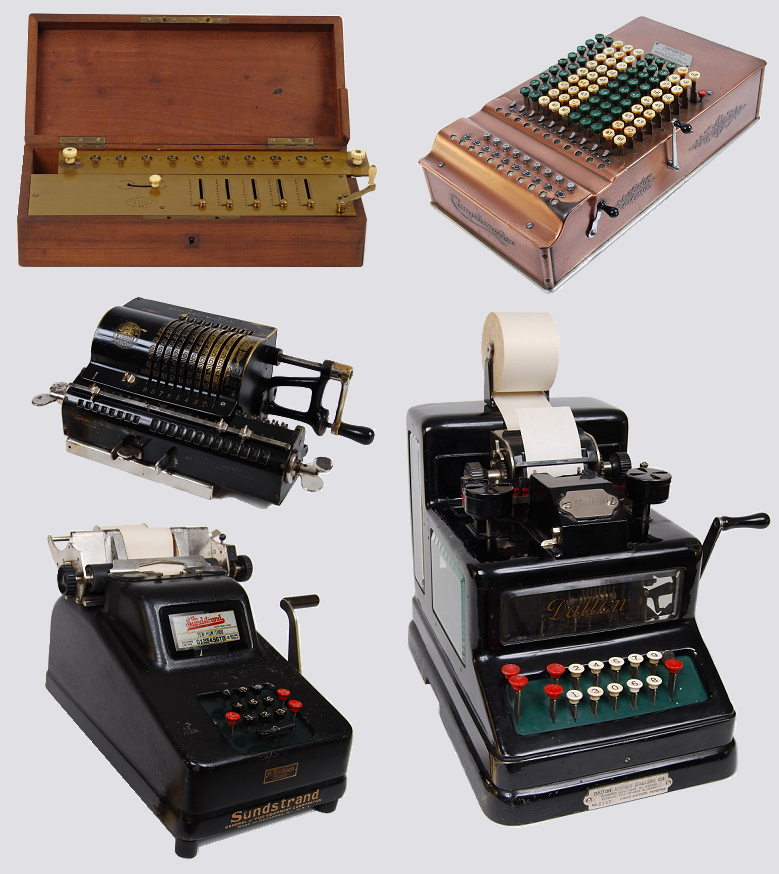
The late 19th and early 20th centuries saw the mechanical calculator evolve from bespoke curiosities into indispensable tools for businesses and scientific institutions. These machines, while still gear-driven, became more reliable, mass-producible, and widely adopted.
The Arithmometer and Its Descendants
One of the first commercially successful mechanical calculators was the Arithmometer, patented by Charles Xavier Thomas de Colmar in 1820. Based on Leibniz’s stepped drum design, the Arithmometer was robust, easy to operate, and could perform all four arithmetic operations reliably. It was manufactured for over 90 years, becoming the first calculator to be mass-produced and widely sold. Its success spurred the development of numerous other mechanical calculators throughout Europe and America, leading to a flourishing industry.
Adding Machines and the Rise of Office Automation
As businesses grew, the need for rapid and accurate calculation in offices became paramount. The late 19th century saw the invention of dedicated adding machines, which streamlined bookkeeping. Key figures like Dorr E. Felt with his “Comptometer” (1887), a key-driven, full-keyboard adding machine, revolutionized office work. These machines were designed for speed, allowing operators to enter numbers by pressing keys, with the result appearing almost instantly. James Ritty’s cash register (1879), while primarily for recording transactions, also incorporated adding mechanisms to tally sales, further demonstrating the integration of computation into daily commerce. The “Monroe” calculator (1911) and the “Friden” calculator (1934) further refined mechanical designs, offering more advanced features like automatic division and square roots, becoming workhorses in offices and labs until the electronic age.
The Limits of Mechanical Computation
Despite their ingenuity and widespread use, mechanical calculators had inherent limitations. They were large, heavy, noisy, and prone to mechanical wear. Their operational speed, while impressive for the era, was still bound by the physical movement of gears and levers. As computational demands grew with the advent of atomic physics, rocketry, and complex engineering, the mechanical approach began to reach its practical limits, paving the way for a revolutionary shift.
The Electronic Revolution: Transistors to Microchips
The mid-20th century heralded a paradigm shift in computing, moving from mechanical parts to electronic components, drastically increasing speed, reducing size, and expanding capabilities.
Vacuum Tubes and the First Electronic Computers
The first electronic computers, such as ENIAC (Electronic Numerical Integrator and Computer) completed in 1945, utilized thousands of vacuum tubes. While these colossal machines were not calculators in the everyday sense, their ability to perform calculations at unprecedented speeds (thousands per second) demonstrated the immense potential of electronics for computation. They were the ancestors of all modern digital devices, including the electronic calculator. However, vacuum tube technology was energy-intensive, produced a lot of heat, and tubes were prone to failure, making them impractical for personal calculation devices.
The Transistor’s Impact: Miniaturization Begins
The invention of the transistor at Bell Labs in 1947 was a game-changer. Transistors were much smaller, more reliable, consumed less power, and generated less heat than vacuum tubes. This breakthrough made it possible to build smaller, more efficient electronic circuits. The first entirely transistorized desktop calculators began appearing in the early 1960s, such as the ANITA Mark VII (1961) from Bell Punch Company. These machines, while still bulky by today’s standards, offered silent operation and speed far beyond their mechanical predecessors. They were often referred to as “electronic calculating machines” to distinguish them.
The Birth of the Handheld Electronic Calculator
The true democratization of the calculator came with further miniaturization. The development of integrated circuits (ICs) in the late 1950s and early 1960s allowed multiple transistors and other components to be fabricated on a single silicon chip. This paved the way for the personal, handheld electronic calculator. Texas Instruments’ “Cal-Tech” (1967) prototype was a significant step, showing that a calculator could be palm-sized.
However, the landmark moment for the first widely available handheld electronic calculator is often attributed to the Busicom LE-120A “HANDY” (Japan, 1971), which was the first to use a single “calculator on a chip” (developed by Intel and Busicom). Soon after, iconic devices like the HP-35 (1972) from Hewlett-Packard, the first scientific handheld calculator with trigonometric and logarithmic functions, and the Texas Instruments SR-10 (1973), which made scientific calculation affordable, flooded the market. These devices, weighing just a few ounces and powered by batteries, quickly made slide rules and mechanical calculators obsolete. This period truly defined “when the calculator was invented” for the average person, making advanced computation accessible and portable.
The Microprocessor Age: Ubiquity and Specialization
The introduction of the microprocessor (the “computer on a chip,” Intel 4004 in 1971) further propelled the calculator’s evolution. It led to more powerful, versatile, and cheaper calculators. By the late 1970s and 1980s, calculators became ubiquitous, found in schools, offices, homes, and even integrated into watches. Specialized calculators emerged, including financial calculators, graphing calculators (like the Casio fx-7000G in 1985 and the Texas Instruments TI-81 in 1990), and programmable calculators, catering to diverse professional and educational needs. Their affordability and ease of use fundamentally changed how people approached mathematics and problem-solving, fostering a generation comfortable with immediate computational results.
The Calculator’s Enduring Legacy and Future
From ancient counting devices to the powerful microprocessors in our pockets, the journey of the calculator is a testament to human ingenuity and the relentless pursuit of technological advancement. Its impact on society has been profound and continues to evolve.
Impact on Science, Engineering, and Everyday Life
The invention of the calculator, particularly the electronic handheld version, revolutionized fields dependent on numerical analysis. Scientists and engineers could perform complex calculations quickly, allowing for faster iterations in design, experimentation, and discovery. In education, it shifted the focus from rote calculation to understanding mathematical concepts and problem-solving strategies. For the general public, it removed the drudgery of manual arithmetic, making tasks from balancing a checkbook to calculating tips effortless. The calculator is not just a device; it is a catalyst that accelerated progress across nearly every domain of human endeavor.
Integration and Evolution: Calculators in the Digital Age
Today, the standalone calculator, while still prevalent, exists alongside a new generation of computational tools. Modern smartphones and computers come equipped with sophisticated calculator apps that far surpass the capabilities of early handheld devices. Online calculators cater to specific needs, from mortgage payments to currency conversions. Spreadsheets like Microsoft Excel and Google Sheets are, in essence, highly advanced, programmable calculators for data analysis and modeling. The calculator hasn’t disappeared; it has integrated itself deeper into the fabric of our digital ecosystem, becoming a feature rather than just a dedicated device.

The Future of Computational Tools
The future of computational tools will likely see even greater integration, intelligence, and accessibility. AI-powered tools may intuitively understand and solve mathematical problems presented in natural language. Augmented reality could project calculations directly onto our environment. Yet, at its core, these advancements will continue the millennia-old quest that began with simple pebbles and counting sticks: to make the manipulation of numbers easier, faster, and more powerful for everyone. The question of “when the calculator was invented” reveals not a single moment, but an ongoing saga of technological evolution, continually redefining the boundaries of human computation.
aViewFromTheCave is a participant in the Amazon Services LLC Associates Program, an affiliate advertising program designed to provide a means for sites to earn advertising fees by advertising and linking to Amazon.com. Amazon, the Amazon logo, AmazonSupply, and the AmazonSupply logo are trademarks of Amazon.com, Inc. or its affiliates. As an Amazon Associate we earn affiliate commissions from qualifying purchases.