
Navigating the landscape of government benefits can often feel like deciphering a complex code, particularly when it comes to programs designed to provide a financial safety net. For millions of Americans, Supplemental Security Income (SSI) represents a vital lifeline, offering financial assistance to those with limited income and resources who are aged, blind, or disabled. However, a common and critical question for potential recipients is, “How much SSI will I get?” The answer, far from simple, depends on a myriad of factors, including your income, resources, living arrangements, and even your geographic location. Understanding these intricacies is paramount to accurately estimate your potential benefit and ensuring you receive the support you’re entitled to. This article will demystify the SSI benefit calculation, guiding you through the essential components that determine your monthly payment.
Understanding Supplemental Security Income (SSI): The Basics
Before delving into the specifics of benefit amounts, it’s crucial to grasp the fundamental nature of SSI and the criteria for eligibility. This foundational knowledge will set the stage for understanding how your individual circumstances translate into a specific payment figure.
What is SSI and Who Qualifies?
Supplemental Security Income (SSI) is a federal income supplement program funded by general tax revenues (not Social Security taxes). It is designed to assist aged, blind, and disabled people who have little or no income and resources. The program provides cash to meet basic needs for food, clothing, and shelter. It’s important to distinguish SSI from Social Security Disability Insurance (SSDI). While both are administered by the Social Security Administration (SSA) and relate to disability, SSDI is an insurance program for workers who have paid into Social Security, whereas SSI is a needs-based program for individuals regardless of work history.
To qualify for SSI, applicants must meet specific criteria related to age, blindness, or disability, in addition to stringent financial limitations:
- Age: Be 65 or older.
- Blindness: Meet the SSA’s definition of blindness.
- Disability: Meet the SSA’s definition of disability, which generally means you cannot engage in substantial gainful activity due to a medical condition that has lasted or is expected to last for at least 12 months or result in death.
- Limited Income: Your “countable income” must fall below a certain threshold, which is typically the Federal Benefit Rate (FBR), discussed later.
- Limited Resources: Your “countable resources” must not exceed $2,000 for an individual or $3,000 for a couple.
Meeting these criteria is the first step towards eligibility; the next involves a thorough assessment of your financial situation.
Income and Resource Limits for SSI
The SSI program is designed for individuals with significant financial need, meaning both your income and the value of your assets (resources) are carefully scrutinized.
Income: The SSA defines “income” broadly to include almost anything you receive that can be used to obtain food or shelter. This encompasses:
- Earned Income: Wages, net earnings from self-employment.
- Unearned Income: Social Security benefits, pensions, interest, dividends, cash from friends/relatives, food stamps (in some cases).
- In-Kind Income: Food or shelter received for free or at a reduced rate.
Not all income is counted. The SSA has specific rules and exclusions, which are critical in determining your “countable income” – the figure used to calculate your benefit. For instance, the first $20 of most unearned income and the first $65 of earned income, plus half of the remaining earned income, are typically excluded. These exclusions are designed to encourage work and provide a slight buffer.
Resources: These are assets you own and could convert to cash to pay for food or shelter. Examples include cash, bank accounts, stocks, bonds, and certain properties. The resource limits are quite strict: $2,000 for an individual and $3,000 for a couple. However, certain assets are excluded from this calculation, such as:
- The home you live in and the land it’s on.
- One vehicle (regardless of value) if it’s used for transportation for you or a member of your household.
- Household goods and personal effects.
- Life insurance policies with a face value of $1,500 or less.
- Burial plots and up to $1,500 in burial funds per person.
Understanding these income and resource rules is vital because exceeding the limits, even slightly, can lead to ineligibility or a reduction in benefits. For married couples or disabled children living with parents, a process called “deeming” applies, where a portion of a spouse’s or parent’s income and resources is considered available to the SSI applicant, potentially affecting eligibility and benefit amounts.
Calculating Your Potential SSI Benefit
Once you’ve established eligibility based on your age/disability status and verified that your income and resources are within limits, the next step is to understand how your actual monthly payment is determined. This involves a formula that starts with a federal baseline and is then adjusted based on your specific financial situation.
The Federal Benefit Rate (FBR)
The foundation of your SSI payment is the Federal Benefit Rate (FBR). This is the maximum federal SSI payment an eligible individual or couple can receive if they have no other countable income. The FBR is set by Congress and typically increases annually based on the Cost-of-Living Adjustment (COLA) applied to Social Security benefits. For example, in a given year, the FBR might be, for instance, $943 for an eligible individual and $1,415 for an eligible couple. It’s crucial to check the SSA’s official website or contact them directly for the most current FBR, as these figures change. The FBR serves as a ceiling for the federal portion of your benefit; your actual payment may be lower depending on your countable income.
How Countable Income Reduces Your FBR
The core principle of SSI is to provide a safety net for those with little to no other income. Therefore, any countable income you have will directly reduce your FBR, dollar for dollar, after certain exclusions are applied. This is where the income exclusions mentioned earlier become significant.
Let’s illustrate with an example:
Suppose the FBR for an individual is $943.
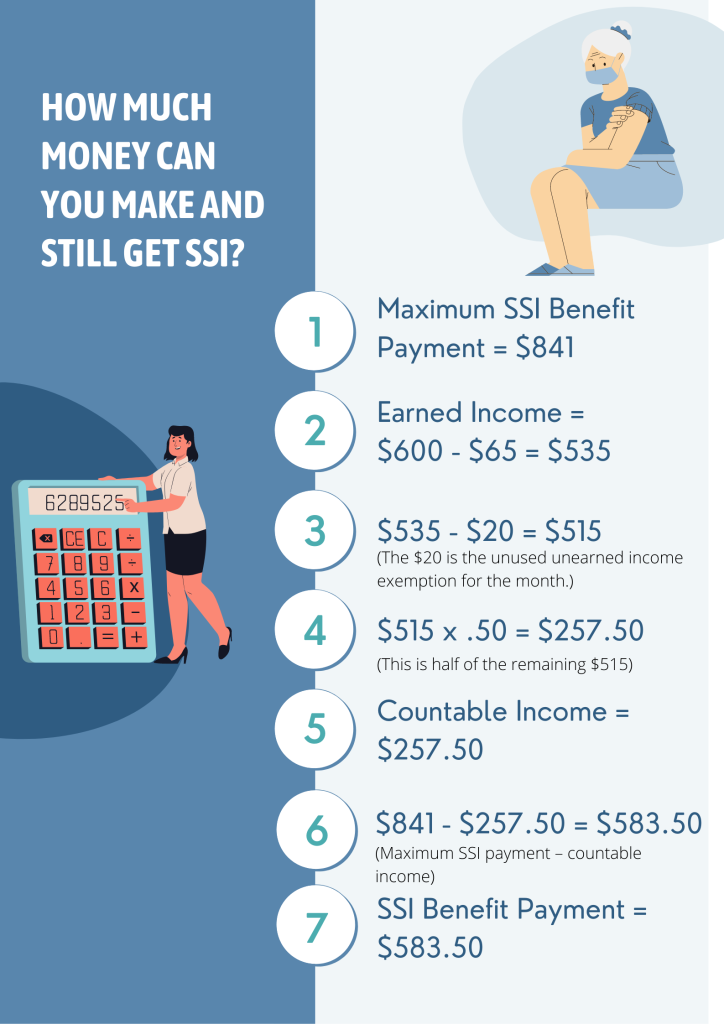
- General Income Exclusion: The first $20 of most unearned income (or earned income if you have no unearned income) is disregarded. So, if you receive $100 in unearned income (e.g., a small pension), the SSA only counts $80 ($100 – $20).
- Earned Income Exclusion: For earned income, the first $65 is disregarded, and then only half of the remaining earned income is counted.
- Example: You earn $500 from part-time work.
- Subtract the $65 exclusion: $500 – $65 = $435.
- Divide the remainder by two: $435 / 2 = $217.50. This is your countable earned income.
Combining Income and Calculation:
Let’s say you have $100 in unearned income and $500 in earned income.
- Countable unearned income: $100 – $20 = $80 (assuming you have no other unearned income or this is your first $20 of unearned income).
- Countable earned income: ($500 – $65) / 2 = $217.50.
- Total countable income: $80 + $217.50 = $297.50.
Your monthly SSI benefit would then be calculated as: FBR – Total Countable Income = Your SSI Benefit.
In this example: $943 (FBR) – $297.50 (Countable Income) = $645.50.
This means you would receive $645.50 in SSI benefits, in addition to your $100 unearned income and $500 gross earned income, bringing your total income to $1,245.50. This demonstrates how SSI supplements your existing low income to bring you closer to a basic living standard.
State Supplemental Payments (SSP)
Beyond the federal component, many states opt to provide an additional payment on top of the federal SSI benefit. These are known as State Supplemental Payments (SSP). The amount of an SSP, and even the eligibility criteria, can vary significantly from state to state. Some states administer their own SSPs, while others have the SSA administer them on their behalf.

The addition of an SSP can significantly increase your total monthly SSI payment. For example, two individuals with identical countable income and living arrangements might receive different total SSI amounts if they live in different states – one state might provide a generous SSP, while another might offer none or a very minimal amount. Some states even have higher resource limits or different eligibility rules for their state supplement. It’s essential for applicants to research the specific SSP rules and amounts for their state of residence through their state’s social services agency or the SSA website.
Factors That Can Affect Your SSI Payments
The journey to determining your final SSI benefit isn’t solely about income and resources. Several other factors related to your living situation and changes in circumstances can influence how much you receive.
Living Arrangements and In-Kind Support and Maintenance (ISM)
Your living situation is a major determinant of your SSI payment. If you receive “in-kind support and maintenance” (ISM), meaning someone else provides you with food or shelter for free or at a reduced rate, your SSI benefit can be reduced. The SSA has two primary rules for assessing ISM:
- The One-Third Reduction (VTR) Rule: This applies if you live in another person’s household for an entire calendar month and receive both food and shelter from them. In this scenario, your federal SSI benefit is reduced by one-third of the FBR. For example, if the FBR is $943, your benefit would be reduced by approximately $314.33.
- The Presumed Maximum Value (PMV) Rule: If the VTR doesn’t apply (e.g., you only receive food or only shelter, or you live in your own household but someone else pays a portion of your rent), the SSA uses the PMV rule. Under this rule, the value of the in-kind support is presumed to be one-third of the FBR plus $20 (the general income exclusion). However, the reduction cannot exceed the actual value of the support received. For instance, if the PMV is $334.33, but the actual value of the support you receive is only $200, your benefit would only be reduced by $200.
These rules highlight the importance of accurately reporting your living situation to the SSA, as even seemingly minor details can impact your monthly check.
Marital Status and Deeming
Your marital status plays a significant role in SSI benefit calculations, particularly when it comes to the “deeming” process. If you are married and your spouse is not also applying for SSI, a portion of their income and resources may be “deemed” available to you. This is because the SSA assumes spouses share financial responsibility.
- Spousal Deeming: If your spouse has income, a certain amount is set aside for their own needs, but any income above that threshold may be considered yours, reducing your countable income and thus your SSI benefit. Similarly, if your spouse’s resources exceed the individual resource limit, a portion may be deemed yours, potentially pushing you over the $2,000 individual limit and making you ineligible.
- Eligible Couples: If both spouses are applying for SSI and are found eligible, they are treated as an “eligible couple.” The FBR for an eligible couple is higher than for an individual, and their combined income and resources are considered against the couple’s limits ($3,000 for resources). The total benefit is then split between them.
The complexities of spousal deeming often necessitate careful review of income and asset distribution within a marriage to understand its impact on SSI eligibility and benefit amounts.
Other Income Sources and Changes in Circumstances
Any changes to your income, resources, or living situation must be reported to the SSA. Failure to report these changes promptly and accurately can lead to overpayments, which you would then be required to pay back, potentially with penalties.
- Other Benefits: If you begin receiving other benefits, such as Social Security Disability Insurance (SSDI), Veterans Affairs (VA) benefits, unemployment compensation, or private pensions, these are generally considered unearned income and will reduce your SSI payment. In some cases, if your SSDI benefit is high enough, it could make you ineligible for SSI altogether, though often people receive a small SSI payment as a supplement to a low SSDI benefit.
- Changes in Employment: Even if you are disabled, SSI has work incentives to encourage employment. However, an increase in earned income will affect your benefit, though the SSA’s income exclusions mean you generally keep more of your earnings than your benefit is reduced.
- Changes in Living Situation: Moving from one living arrangement to another (e.g., from an independent apartment to living with a family member who provides support) must be reported due to its potential impact via the ISM rules.
- Changes in Resources: Inheriting money, receiving a gift, or selling an asset that increases your cash on hand can push you over the resource limit if not properly managed.
Proactive reporting ensures that your benefits are calculated correctly and helps you avoid future financial complications.
Applying for SSI and Navigating the Process
The application process for SSI can be lengthy and detailed, requiring thorough documentation and adherence to specific procedures. Knowing what to expect can ease the burden and help ensure a smoother experience.
The Application Process
Applying for SSI typically involves several steps:
- Initial Contact: You can start your application online (for age 65+ or non-medical disability), by phone, or in person at your local Social Security office.
- Required Documentation: Be prepared to provide extensive documentation. This includes proof of identity and citizenship/legal residency, income and resource statements (bank accounts, property deeds, pay stubs, other benefit award letters), and detailed medical records for disability claims (doctor’s reports, test results, hospitalizations).
- The Interview: An SSA representative will conduct an interview to gather information about your financial situation, living arrangements, and other relevant details.
- Disability Determination (if applicable): If applying based on disability or blindness, your application will be forwarded to a state Disability Determination Services (DDS) agency. DDS staff, including medical and psychological consultants, will review your medical evidence to determine if you meet the SSA’s definition of disability. They may also request additional medical information or send you for a consultative examination.
Patience is key during this process, as disability determinations can take several months.
What to Do After Application and Receiving Benefits
If your application is approved, you will begin receiving monthly SSI payments. However, your responsibility doesn’t end there:
- Ongoing Reporting Requirements: You are legally obligated to report changes in your income, resources, living arrangements, marital status, or any other factor that could affect your eligibility or payment amount. The SSA specifies deadlines for reporting, and failing to do so can result in overpayments or even loss of benefits.
- Appeals Process: If your application is denied, don’t despair. You have the right to appeal the decision. There are several levels of appeal, including Reconsideration, a hearing by an Administrative Law Judge (ALJ), a review by the Appeals Council, and finally, a federal court review. Many successful claims are approved at the appeal stages, especially with proper representation.
- Work Incentives: For disabled SSI recipients, the SSA offers several “work incentives” designed to encourage beneficiaries to return to work without immediately losing their benefits. These include exclusions for impairment-related work expenses (IRWE), blind work expenses (BWE), and the Plan to Achieve Self-Support (PASS) program, which allows you to set aside income and resources for a work goal.
Seeking Professional Guidance
Given the complexity of SSI rules and calculations, seeking professional guidance can be invaluable.
- Social Security Administration (SSA): The SSA is your primary resource for accurate information, application assistance, and reporting changes.
- Legal Aid/Disability Advocates: Non-profit organizations and legal aid services often provide free or low-cost assistance with SSI applications and appeals, particularly for individuals with complex medical or financial situations.
- Financial Advisors: While less common for direct SSI applications, a financial advisor specializing in government benefits or elder care can help you understand how SSI fits into your overall financial plan, especially regarding resource management.

Conclusion
Determining “how much SSI will I get” involves a detailed assessment of multiple personal and financial factors. From the foundational Federal Benefit Rate to the intricate calculations involving countable income and resources, and the additional layer of state supplementary payments, each element plays a crucial role. Furthermore, your living arrangements, marital status, and any changes in your financial circumstances can significantly alter your monthly benefit.
Understanding these complexities is not merely an academic exercise; it is essential for accurately forecasting your financial support, making informed decisions, and navigating the application and ongoing reporting processes effectively. By grasping the core principles of SSI eligibility, income and resource exclusions, and the impact of various life events, you can better prepare for your application and ensure you receive the maximum benefit you are entitled to, providing a critical financial foundation for your well-being. Always remember that proactive engagement with the Social Security Administration and a clear understanding of your responsibilities are your best tools for successfully managing your SSI benefits.
aViewFromTheCave is a participant in the Amazon Services LLC Associates Program, an affiliate advertising program designed to provide a means for sites to earn advertising fees by advertising and linking to Amazon.com. Amazon, the Amazon logo, AmazonSupply, and the AmazonSupply logo are trademarks of Amazon.com, Inc. or its affiliates. As an Amazon Associate we earn affiliate commissions from qualifying purchases.