
The Provident Fund (PF) stands as a cornerstone of financial security for millions of salaried individuals, particularly in economies like India. It represents a mandatory savings scheme designed to provide employees with a lump sum payment at the time of retirement or in specific emergency situations. Understanding how PF contributions are calculated is not just a matter of compliance; it’s a vital aspect of personal finance management, offering clarity on one of your most significant long-term savings.
This guide delves deep into the intricacies of Provident Fund calculations, demystifying the percentages, components, and rules that govern both employee and employer contributions. Whether you’re an employee looking to understand your payslip, an HR professional managing payroll, or simply someone keen to grasp the mechanics of this critical financial tool, this comprehensive breakdown will equip you with the knowledge to accurately calculate and appreciate the value of your PF.
Understanding the Basics of Provident Fund
Before we dive into the numbers, it’s crucial to establish a foundational understanding of what the Provident Fund is, its purpose, and the various components that fall under its umbrella. This context is essential for appreciating why these calculations matter and how they contribute to your financial future.
What is Provident Fund (PF)?
At its core, the Provident Fund is a government-mandated retirement savings scheme. In India, it is primarily managed by the Employees’ Provident Fund Organization (EPFO), an autonomous body under the Ministry of Labour and Employment. The primary objective of the PF scheme is to ensure financial security for employees post-retirement, as well as to provide a safety net during specific unforeseen circumstances like illness, marriage, or housing needs. It operates on the principle of compulsory contributions from both the employee and the employer, building a corpus that earns tax-exempt interest over time. This dual contribution mechanism makes it a powerful savings tool, distinct from individual savings avenues.
Key Stakeholders: Employee, Employer, and Government
The PF ecosystem involves three primary stakeholders, each playing a critical role:
- The Employee: Every salaried individual whose establishment is covered under the Employees’ Provident Funds and Miscellaneous Provisions Act, 1952, is eligible and typically mandated to contribute to PF. Their contribution is a deduction from their monthly salary.
- The Employer: Employers are legally bound to contribute an equal or sometimes higher percentage towards their employees’ PF accounts. This employer contribution is a significant benefit and a part of the employee’s total compensation package, albeit not directly paid out monthly.
- The Government (EPFO): The EPFO is the administrative body responsible for managing the funds, processing contributions, maintaining accounts, declaring interest rates annually, and facilitating withdrawals. It ensures the smooth functioning and regulatory compliance of the entire scheme.
Different Types of Provident Funds
While the term “PF” is often used broadly, it primarily refers to the Employees’ Provident Fund (EPF). However, it’s worth noting other related funds:
- Employees’ Provident Fund (EPF): This is the most common type, mandatory for employees earning up to a certain wage ceiling. Both employee and employer contribute to it.
- Voluntary Provident Fund (VPF): Employees can choose to contribute more than the mandatory 12% of their basic salary to their EPF account. This additional contribution is known as VPF and offers the same tax benefits and interest rates as EPF.
- Public Provident Fund (PPF): This is a government-backed long-term savings scheme available to everyone, including self-employed individuals and those not covered by EPF. It’s not directly linked to employment but shares similarities in its tax-exempt status and interest earnings. While a powerful financial tool, PPF calculations are separate from EPF and VPF. Our focus for this article remains on EPF and VPF calculations linked to employment.
Deconstructing the EPF Calculation Formula
Calculating your EPF contribution involves understanding the components of your salary, the prescribed contribution rates, and certain statutory ceilings. This section breaks down these elements to give you a clear picture of how your PF is determined each month.
The Core Components: Basic Pay, Dearness Allowance (DA)
The foundation of your PF calculation is not your gross salary, but specific components of it:
- Basic Pay: This is the fundamental component of your salary, typically a fixed amount agreed upon in your employment contract. It forms the base for most statutory deductions and benefits.
- Dearness Allowance (DA): DA is an adjustment component paid to employees to offset the impact of inflation. It is usually a percentage of the basic salary and is revised periodically. For PF calculation purposes, Basic Pay and Dearness Allowance are typically combined. Therefore, whenever we refer to “Basic Pay” in the context of PF calculation, it often implies “Basic Pay + Dearness Allowance.”
Other allowances like House Rent Allowance (HRA), conveyance allowance, special allowance, etc., are generally not considered for PF calculation, unless they are contractually defined as part of “basic wages” or are designed to camouflage actual basic wages to reduce PF liability.
Employee’s Contribution Rate
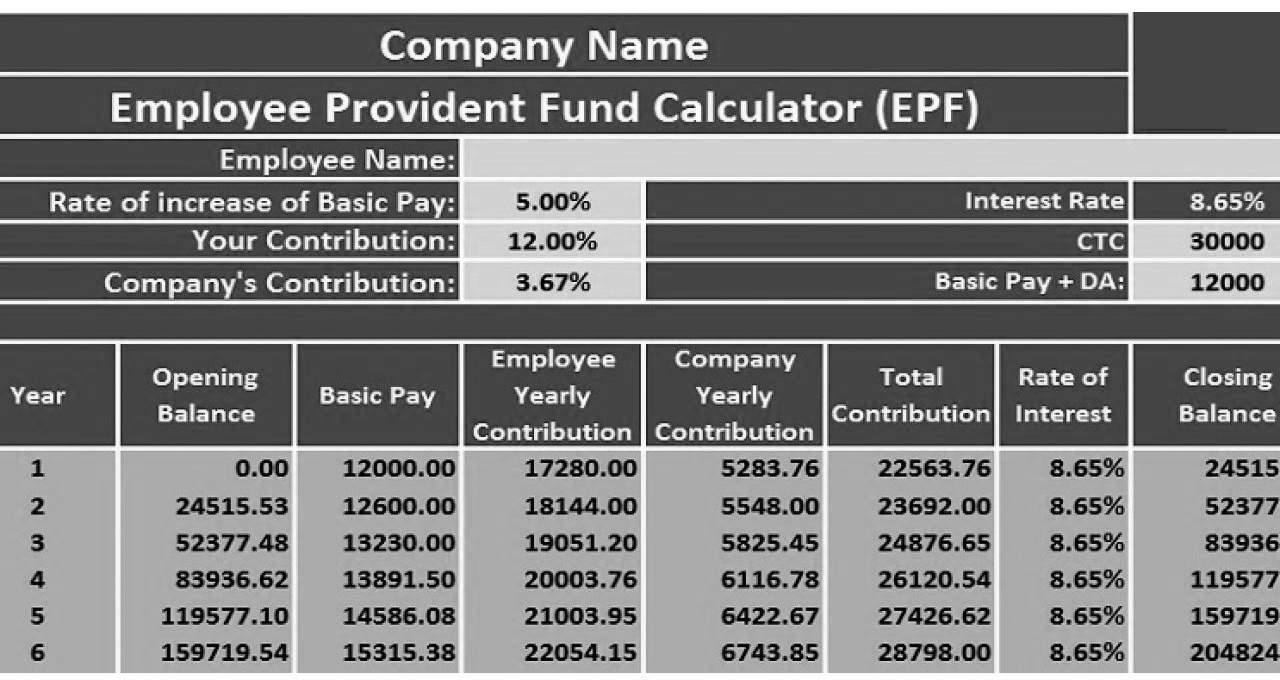
The standard statutory employee contribution rate to EPF is 12% of their Basic Pay + DA. This amount is deducted from the employee’s salary every month by the employer and deposited with the EPFO.
For instance, if an employee’s Basic Pay + DA is ₹20,000, their monthly contribution would be:
Employee Contribution = 12% of ₹20,000 = ₹2,400
Employer’s Contribution Breakdown
The employer is also mandated to contribute an equal percentage, i.e., 12% of the employee’s Basic Pay + DA. However, the employer’s 12% contribution is further bifurcated into different schemes:
- EPF (Employee Provident Fund) Scheme, 1952: A portion of the employer’s contribution (typically 3.67% of Basic + DA) goes into the employee’s EPF account, alongside the employee’s full 12%.
- EPS (Employee Pension Scheme) Scheme, 1995: A significant portion of the employer’s contribution (typically 8.33% of Basic + DA) goes into the EPS account, which is designed to provide a pension to the employee after retirement. It’s crucial to understand that this 8.33% is generally capped at a maximum wage ceiling.
- EDLI (Employee Deposit Linked Insurance) Scheme, 1976: Employers also contribute a small amount towards EDLI (0.5% of Basic + DA, subject to a ceiling of ₹15,000) and an administrative charge for both EPF and EDLI. These are not part of the employee’s direct PF corpus but offer insurance benefits in case of the employee’s demise while in service.
Let’s re-examine the employer’s 12% contribution:
- EPF: 3.67%
- EPS: 8.33%
- Total = 12.00%
So, for an employee with Basic Pay + DA of ₹20,000:
- Employer’s EPF contribution = 3.67% of ₹20,000 = ₹734
- Employer’s EPS contribution = 8.33% of ₹20,000 = ₹1,666
- Total Employer Contribution = ₹2,400
Combined (Employee + Employer) total EPF accumulation for the month (excluding EPS which is a pension fund) would be: ₹2,400 (employee) + ₹734 (employer) = ₹3,134. The ₹1,666 goes to EPS.
Impact of Wage Ceiling on Calculations
A critical aspect of EPF calculation is the statutory wage ceiling. Currently, the maximum Basic Pay + DA on which PF contributions are mandatory is ₹15,000 per month. This ceiling primarily impacts the EPS contribution and, consequently, the employer’s total contribution breakdown.
- For employees with Basic + DA ≤ ₹15,000: The calculation proceeds as described above, with 12% from both employee and employer applied directly to their actual Basic + DA.
- For employees with Basic + DA > ₹15,000:
- Employee Contribution: Remains 12% of their actual Basic + DA (unless they opt to restrict it to ₹15,000, which is rare as it impacts their future corpus).
- Employer Contribution: This is where the ceiling applies more significantly.
- The 8.33% for EPS is capped at 8.33% of ₹15,000, which amounts to ₹1,250.
- The remaining portion of the employer’s 12% contribution (i.e., 12% of actual Basic + DA minus ₹1,250 for EPS) will then go to the EPF account.
This means for high-earning employees, a larger portion of the employer’s 12% contribution goes into their EPF account rather than the EPS.
Step-by-Step Calculation Examples
Let’s illustrate the calculations with practical scenarios to solidify your understanding.
Scenario 1: Employee with Basic + DA Below Wage Ceiling (e.g., ₹12,000)
Assume an employee’s Basic Pay + DA is ₹12,000 per month.
- Employee Contribution (12% of ₹12,000): ₹1,440 (Goes to EPF account)
- Employer Contribution:
- To EPS (8.33% of ₹12,000): ₹999.60 (approx. ₹1,000)
- To EPF (3.67% of ₹12,000): ₹440.40 (approx. ₹440)
- Total Employer Contribution (12% of ₹12,000): ₹1,440
- Total Monthly EPF Accumulation: ₹1,440 (employee) + ₹440 (employer) = ₹1,880
- Total Monthly EPS Accumulation: ₹1,000
Scenario 2: Employee with Basic + DA Above Wage Ceiling (e.g., ₹30,000)
Assume an employee’s Basic Pay + DA is ₹30,000 per month.
-
Employee Contribution (12% of ₹30,000): ₹3,600 (Goes to EPF account)
-
Employer Contribution:
- To EPS (Capped at ₹15,000 wages, so 8.33% of ₹15,000): ₹1,250
- Remaining Employer Contribution to EPF: Total employer contribution (12% of ₹30,000 = ₹3,600) minus EPS contribution (₹1,250) = ₹2,350
- Total Employer Contribution: ₹3,600
-
Total Monthly EPF Accumulation: ₹3,600 (employee) + ₹2,350 (employer) = ₹5,950
-
Total Monthly EPS Accumulation: ₹1,250
Notice how in Scenario 2, despite the employer contributing ₹3,600, only ₹1,250 goes to EPS, and a much larger portion (₹2,350) goes into the employee’s EPF account, significantly boosting their provident fund corpus.
Voluntary Provident Fund (VPF) Contributions
For employees who wish to save more than the mandatory 12% towards their retirement, the Voluntary Provident Fund (VPF) offers an excellent avenue. An employee can contribute up to 100% of their Basic Pay + DA to VPF.
- Calculation: VPF is simply an additional percentage chosen by the employee, calculated on their Basic Pay + DA, and added to their mandatory 12% employee contribution.
- Employer’s Role: The employer is not obligated to match the VPF contribution. Their contribution remains at the statutory 12% (broken into 8.33% for EPS and 3.67% for EPF, subject to ceiling).
- Benefits: VPF contributions also receive the same tax benefits under Section 80C and earn the same tax-exempt interest as mandatory EPF contributions, making it a powerful tool for enhanced long-term savings.
Example: If the employee in Scenario 2 decides to contribute an additional 10% towards VPF:
- Employee VPF Contribution = 10% of ₹30,000 = ₹3,000
- Total Employee Contribution (Mandatory + VPF) = ₹3,600 + ₹3,000 = ₹6,600
The employer’s contribution remains ₹3,600 (₹1,250 to EPS, ₹2,350 to EPF).
Beyond Monthly Contributions: Interest and Withdrawals
The true power of PF lies not just in consistent contributions but also in the compounding interest it earns and the provisions for withdrawal when needed.
How PF Interest is Calculated and Credited
The EPFO declares an annual interest rate, which is typically calculated on the monthly running balance of the PF account.
- Monthly Calculation: Interest is calculated every month on the closing balance of the previous month. However, it’s credited to the account annually, usually at the end of the financial year (March 31st).
- Tax-Exempt: The interest earned on EPF is tax-exempt in the hands of the employee, provided they contribute for a continuous period of 5 years or more. If withdrawals are made before 5 years of continuous service, the interest may become taxable.
- Compound Growth: The compounding nature of the interest means that over several decades, even modest monthly contributions can grow into a substantial corpus.
Understanding PF Withdrawal Rules and Conditions
While primarily a retirement fund, EPF allows for partial and full withdrawals under specific conditions:
- Partial Withdrawals (Advances): These are allowed for specific purposes like house purchase/construction, higher education, marriage, medical emergencies, or even during unemployment (after 1 month). The amount that can be withdrawn and the conditions vary based on the reason.
- Full Withdrawals:
- Retirement: An employee can withdraw the full accumulated balance upon retirement (after 58 years of age).
- Unemployment: If an employee remains unemployed for more than one month, they can withdraw 75% of their PF balance. If unemployment continues for two months, the remaining 25% can be withdrawn.
- Medical Grounds/Death: Full withdrawal is also permitted in case of permanent disability or death.
It’s crucial to understand the withdrawal rules thoroughly, as premature or improper withdrawals can lead to tax implications and reduction of the retirement corpus.
Tax Implications of PF Contributions and Withdrawals
EPF enjoys an Exempt-Exempt-Exempt (EEE) status, making it a highly attractive investment:
- Contributions: Both employee’s and employer’s contributions (up to certain limits for the employee) are eligible for tax deductions under Section 80C of the Income Tax Act.
- Interest: The interest earned is tax-exempt.
- Withdrawals: The final accumulated amount, including interest, is tax-exempt upon maturity (typically after 5 years of continuous service).
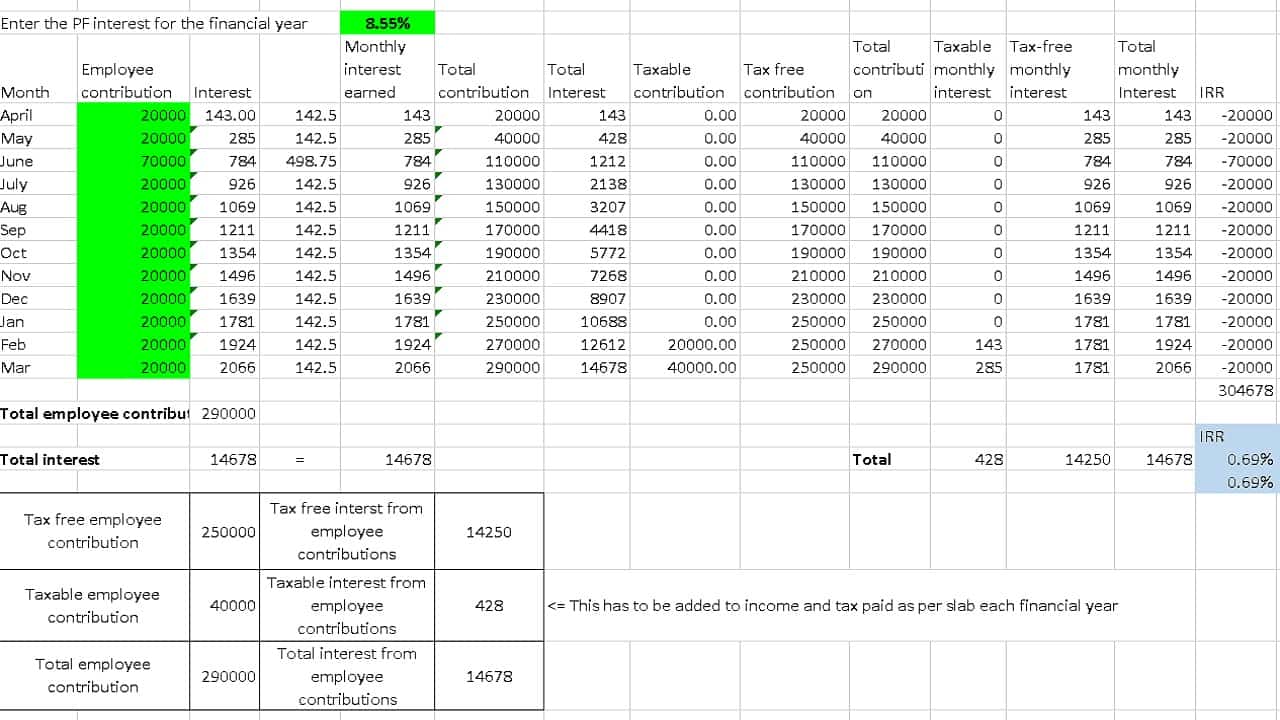
However, as mentioned, withdrawals before 5 years of continuous service can lead to the accumulated interest and employer’s contribution becoming taxable. Recent changes also imply that interest on employee contributions exceeding ₹2.5 lakh in a financial year for non-government employees (or ₹5 lakh for government employees) is now taxable. Keeping track of these evolving tax regulations is vital for effective financial planning.
Managing Your PF Account and Future Planning
Effective management of your PF account is essential to maximize its benefits and ensure a secure financial future.
Importance of UAN (Universal Account Number)
The Universal Account Number (UAN) is a 12-digit number allotted by the EPFO to every employee contributing to EPF. It acts as an umbrella for all PF accounts linked to an individual, even if they change jobs multiple times.
- Seamless Transfers: UAN simplifies the process of transferring PF balances from a previous employer to a new one, ensuring continuity of service and uninterrupted interest accrual.
- Online Access: It enables employees to access various online services, making PF management transparent and convenient.
Online PF Services and Tools
The EPFO has significantly digitized its services, empowering employees to manage their PF accounts easily:
- View Passbook/Balance: Through the UAN portal or UMANG app, employees can view their e-passbook, which shows detailed transactions, including contributions from both employee and employer, interest credits, and withdrawals.
- Update KYC: Link and update Aadhaar, PAN, bank account details online.
- File Claims: Submit withdrawal or transfer claims online, significantly reducing processing time.
- Activate UAN: Register and activate your UAN for full access to online services.
These digital tools provide unprecedented control and visibility over one’s PF corpus, making it easier to track and plan.

Strategic Role of PF in Retirement Planning
Beyond its mandatory nature, EPF plays a critical strategic role in long-term retirement planning:
- Forced Savings: For many, EPF serves as a disciplined, forced saving mechanism, building a substantial corpus that might otherwise not be achieved through voluntary savings alone.
- Risk-Free Returns: With government backing, EPF offers competitive and virtually risk-free returns, making it a safe haven for retirement funds, especially for conservative investors.
- Tax Efficiency: Its EEE status makes it an incredibly tax-efficient investment vehicle, allowing the corpus to grow significantly without tax erosion over the long term.
- Foundation for Retirement: For a significant portion of the workforce, the EPF corpus forms the primary or at least a substantial component of their retirement nest egg, providing a base upon which other investments can be built.
In conclusion, understanding how to calculate PF contributions is more than just crunching numbers; it’s about comprehending a vital component of your financial ecosystem. The Provident Fund, with its structured contributions, tax advantages, and compounding interest, is a powerful vehicle for building long-term wealth and ensuring financial security in retirement. By grasping its mechanics and actively utilizing the available tools, you can effectively monitor, manage, and leverage your PF account to secure a stable and prosperous future.
aViewFromTheCave is a participant in the Amazon Services LLC Associates Program, an affiliate advertising program designed to provide a means for sites to earn advertising fees by advertising and linking to Amazon.com. Amazon, the Amazon logo, AmazonSupply, and the AmazonSupply logo are trademarks of Amazon.com, Inc. or its affiliates. As an Amazon Associate we earn affiliate commissions from qualifying purchases.