
In an increasingly data-driven world, understanding and interpreting performance metrics is paramount. Whether you’re a student tracking academic progress, an educator evaluating cohorts, or a parent monitoring a child’s learning journey, the ability to accurately calculate the percentage of marks obtained is a fundamental skill. While the underlying mathematical principle remains constant, the methods and tools we employ have evolved significantly, making the process more efficient, accurate, and insightful than ever before. This guide delves into the essential techniques, both manual and technological, for mastering this crucial calculation, framed within the context of our digital age.

The Foundational Importance of Percentage Calculation in the Digital Age
At its core, calculating a percentage allows us to standardize performance across varying scales. A score of 45 out of 50 in one test, compared to 80 out of 100 in another, becomes immediately comparable once converted into a percentage. This standardization is vital not just for individual understanding but for broader analysis and decision-making in educational settings.
Beyond Grades: A Skill for Data Interpretation
The relevance of percentage calculation extends far beyond the classroom. In an era dominated by data analytics and information overload, the ability to distill raw numbers into comprehensible percentages is a critical form of digital literacy. From understanding sales growth rates and financial returns to interpreting survey results and app user engagement, percentages provide a universal language for comparative analysis. For students, mastering this skill early on sets a strong foundation for future academic pursuits and professional careers where data interpretation is a daily requirement. It’s about translating raw data points into meaningful insights, a skill highly valued across all tech-driven industries.
Bridging Traditional Learning with Digital Tools
While the conceptual understanding of percentages is rooted in traditional mathematics, their practical application today is intrinsically linked to technology. Manual calculations, while educational, are often prone to human error and are inefficient for large datasets. Modern educational environments, from online learning platforms to digital gradebooks, integrate tools that streamline these calculations, making it imperative for individuals to be adept at utilizing these digital aids effectively. This bridge between traditional mathematical principles and contemporary technological application forms the bedrock of efficient mark calculation.
Mastering the Manual Calculation: The Core Formula
Before diving into digital tools, a firm grasp of the basic mathematical formula is essential. This understanding empowers you to troubleshoot, verify results, and understand the logic behind automated calculations.
Deconstructing the Percentage Formula
The formula for calculating the percentage of marks is straightforward:
$$
text{Percentage} = left( frac{text{Marks Obtained}}{text{Total Marks}} right) times 100
$$
Here’s what each component signifies:
- Marks Obtained: This is the score or points a student has achieved in a particular assessment, assignment, or exam.
- Total Marks: This represents the maximum possible score for that assessment.
- 100: Multiplying by 100 converts the decimal fraction (Marks Obtained / Total Marks) into a percentage.
This formula provides a universally accepted method for expressing a part of a whole in terms of 100 units, making it easy to compare different performances.
Step-by-Step Manual Example
Let’s illustrate with a simple example:
Scenario: A student scores 65 marks in a mathematics test where the maximum possible score was 80 marks.
- Identify Marks Obtained: 65
- Identify Total Marks: 80
- Perform the Division: $65 div 80 = 0.8125$
- Multiply by 100: $0.8125 times 100 = 81.25$
Therefore, the student scored 81.25% in the mathematics test.
Common Pitfalls and How to Avoid Them
Even with a simple formula, errors can occur. Being aware of these common pitfalls can significantly improve accuracy:
- Interchanging Obtained and Total Marks: Always ensure the smaller (or equal) ‘marks obtained’ is in the numerator and the larger ‘total marks’ is in the denominator. A percentage greater than 100% (unless extra credit is involved) usually indicates an error here.
- Rounding Errors: When performing manual calculations, avoid premature rounding. Carry a sufficient number of decimal places during the division step and only round the final percentage to the desired precision (e.g., two decimal places).
- Calculation Mistakes: Simple arithmetic errors during division or multiplication are common. Double-checking your work is crucial, especially before relying on the figure for important decisions.
Leveraging Technology for Precision and Efficiency
While manual calculation is fundamental, technology offers unparalleled efficiency, accuracy, and scalability, especially when dealing with multiple subjects, students, or complex grading schemes.
The Ubiquitous Calculator: Your First Digital Assistant
The simplest technological tool at your disposal is the digital calculator. From the basic app on your smartphone to a dedicated scientific calculator, these devices perform arithmetic operations with speed and precision.
- Smartphone Calculators: Easily accessible and integrated into nearly every mobile device, they are perfect for quick, on-the-go calculations.
- Scientific Calculators: Offer more advanced functions and memory, ideal for complex multi-step problems or storing intermediate results.
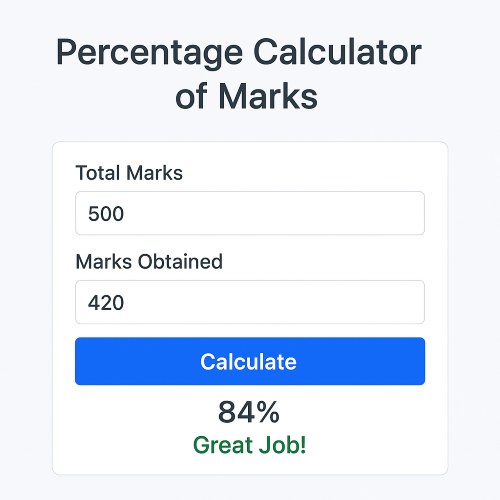
- Online Calculators: Numerous websites offer free, specialized percentage calculators. Simply input the obtained marks and total marks, and the tool instantly provides the percentage.

Using a calculator mitigates human error in arithmetic, allowing you to focus on inputting the correct values.
Spreadsheet Software: A Powerful Tool for Academic Analysis
For educators, students managing multiple subjects, or anyone needing to analyze performance over time, spreadsheet software like Microsoft Excel, Google Sheets, or Apple Numbers is an indispensable tool. Spreadsheets allow for automated calculations, data organization, and even basic data visualization.
- Setting up Your Spreadsheet: Create columns for ‘Subject’, ‘Marks Obtained’, ‘Total Marks’, and ‘Percentage’.
- Entering the Formula: In the ‘Percentage’ column, you can enter a formula. If ‘Marks Obtained’ is in cell B2 and ‘Total Marks’ is in cell C2, the formula for D2 would be:
= (B2/C2)*100. - Auto-filling: Once you’ve entered the formula for the first row, you can simply drag the fill handle (a small square at the bottom-right corner of the selected cell) down to apply the formula to all subsequent rows, instantly calculating percentages for all your subjects or students.
- Benefits:
- Accuracy: Eliminates manual calculation errors.
- Efficiency: Calculates hundreds of percentages in seconds.
- Data Management: Keeps all your academic data organized in one place.
- Flexibility: Easily adjust scores, and percentages will update automatically.
- Visualization: Can be used to create charts and graphs to visualize performance trends.
Online Calculators and Educational Platforms
Beyond general-purpose spreadsheets, many specialized online tools and educational platforms offer integrated percentage calculation features. Learning Management Systems (LMS) like Canvas, Moodle, or Blackboard often have built-in gradebooks that automatically calculate percentages for assignments, quizzes, and overall course grades, sometimes even allowing for weighted averages. Leveraging these platform-specific tools ensures consistency and often integrates directly with grade reporting.
Advanced Applications and Interpretation of Mark Percentages
Calculating a simple percentage is just the beginning. Technology allows for more sophisticated analyses that provide deeper insights into academic performance.
Calculating Cumulative and Weighted Percentages
In many academic contexts, not all marks carry equal weight. A final exam might be worth 40% of the overall grade, while assignments are worth 20%, and quizzes another 20%. Calculating these weighted percentages is crucial for an accurate overall assessment.
- Weighted Average Formula:
$$
text{Overall Percentage} = frac{sum (text{Marks Obtained} times text{Weight})}{sum text{Total Marks}} times 100
$$
Or, more commonly, for percentages:
$$
text{Overall Percentage} = sum (text{Percentage for Item} times text{Weight of Item})
$$ - Example in Spreadsheet: You would have columns for ‘Item’, ‘Marks Obtained’, ‘Total Marks’, ‘Percentage for Item’, and ‘Weight’. Then, you’d calculate a ‘Weighted Score’ (Percentage for Item * Weight) for each item and sum these up. Spreadsheets simplify this complex calculation significantly.
Cumulative percentages track performance over time, allowing students and educators to see progress or identify areas needing improvement across multiple assessments or semesters.
Visualizing Performance with Digital Tools
Raw numbers can sometimes be difficult to interpret quickly. Digital tools, particularly spreadsheets, allow you to convert percentage data into visually engaging charts and graphs.
- Bar Charts: Excellent for comparing percentages across different subjects or students.
- Line Graphs: Ideal for tracking a student’s percentage performance in a single subject over a period (e.g., test scores throughout a semester).
- Pie Charts: Can show the contribution of different weighted components to an overall grade.
Visualizing data transforms abstract numbers into actionable insights, helping identify strengths, weaknesses, and trends at a glance.
Setting Academic Goals and Benchmarks Digitally
Once you have a clear understanding of your current percentage performance, technology can assist in setting future goals. Students can use spreadsheets to project scores needed on upcoming assignments to achieve a desired overall percentage. Educators can set benchmarks for class performance and use calculated percentages to identify students who might need additional support or enrichment. This proactive approach, fueled by accurate percentage calculations, fosters a more strategic and informed path to academic success.
The Future of Mark Calculation: AI and Automated Assessment
The landscape of education is continually evolving, with technology playing an increasingly central role. The calculation and interpretation of marks are no exception, with artificial intelligence (AI) and advanced data analytics poised to revolutionize these processes.
AI-Powered Grading and Feedback Systems
AI and machine learning algorithms are already being deployed in automated grading systems, particularly for objective assessments like multiple-choice questions or even short-answer responses and coding assignments. These systems don’t just calculate percentages; they can provide instant feedback, identify patterns in errors, and even suggest personalized learning paths. While human oversight remains crucial, AI is streamlining the initial calculation and analysis phases, allowing educators to focus on more nuanced aspects of student development.
Data Analytics in Education: Beyond Simple Percentages
Educational technology platforms are moving beyond simple percentage calculations to sophisticated data analytics. These systems aggregate performance data from various sources – assignment scores, participation rates, time spent on learning modules – to provide holistic views of student engagement and achievement. Percentages serve as a foundational metric, but they are integrated into broader dashboards that offer predictive analytics, identifying students at risk or highlighting effective teaching strategies. This shift transforms “how to calculate percentage of marks” into “how to leverage percentages for predictive educational outcomes.”
The Evolving Role of Digital Literacy in Academic Success
As technology continues to reshape education, the importance of digital literacy, including proficiency in using tools for data calculation and interpretation, will only grow. Students and educators who can effectively navigate spreadsheets, interpret analytical dashboards, and understand the implications of AI-driven assessments will be better equipped to thrive. The ability to calculate percentage of marks, therefore, is not merely a mathematical exercise but a vital component of modern digital competency, crucial for navigating current and future academic and professional landscapes.
Conclusion
Calculating the percentage of marks, a seemingly simple mathematical task, has evolved into a cornerstone of academic and data literacy in our digital age. From understanding the foundational manual formula to harnessing the power of digital calculators, spreadsheet software, and specialized online platforms, the tools available for precision and efficiency are vast. Beyond basic computation, technology empowers us to conduct advanced analyses, visualize performance trends, and set strategic academic goals. As we look to the future, with AI and sophisticated data analytics becoming integral to educational ecosystems, mastering the calculation and interpretation of mark percentages remains a fundamental skill, indispensable for informed decision-making and continuous improvement in an increasingly connected world.
aViewFromTheCave is a participant in the Amazon Services LLC Associates Program, an affiliate advertising program designed to provide a means for sites to earn advertising fees by advertising and linking to Amazon.com. Amazon, the Amazon logo, AmazonSupply, and the AmazonSupply logo are trademarks of Amazon.com, Inc. or its affiliates. As an Amazon Associate we earn affiliate commissions from qualifying purchases.