
In the landscape of modern consumerism, discounts are ubiquitous. From seasonal sales to loyalty programs, the promise of saving money on purchases is a constant lure. Among the myriad percentages offered, “20 percent off” stands out as a particularly common and enticing figure. Mastering the simple calculation behind a 20% discount isn’t just a useful shopping trick; it’s a foundational skill for astute personal finance, enabling smarter budgeting, preventing overspending, and ensuring you genuinely benefit from advertised savings.
This article delves into the various methods for calculating 20 percent off, exploring practical applications, common pitfalls, and how this seemingly small calculation contributes significantly to your overall financial health. By understanding these principles, you empower yourself to be a more confident, savvy, and financially secure consumer.

The Fundamentals of Percentage Discounts
Before we dive into the specific mechanics of calculating 20% off, it’s crucial to grasp the underlying concept of percentages and why this particular discount figure is so prevalent in the financial world.
What is a Percentage?
At its core, a percentage is a way of expressing a number as a fraction of 100. The term “percent” literally means “per hundred.” So, 20 percent (written as 20%) means 20 out of every 100. When applied to a price, 20% off signifies that you are saving 20 units for every 100 units of the original cost. Understanding this basic definition is the first step towards accurately interpreting any discount. It clarifies that a percentage is not an absolute value but a proportional part of a whole.
Why 20%? The Ubiquity of a Common Discount
The 20% discount isn’t arbitrary; it holds significant psychological and practical weight. From a psychological perspective, 20% off feels substantial enough to be appealing without drastically eroding a retailer’s profit margins, making it a sweet spot for both consumers and businesses. It’s often used in introductory offers, clearance sales, employee discounts, and even as a standard tip recommendation in many service industries. For consumers, it’s a memorable and relatively easy percentage to work with, making quick mental calculations feasible and encouraging purchasing decisions. Its prevalence means that mastering this specific calculation is a highly transferable financial skill.
The Basic Formula: Your Starting Point
Every percentage discount calculation begins with a fundamental formula. To find the amount of the discount, you multiply the original price by the percentage (expressed as a decimal or fraction):
Discount Amount = Original Price × (Percentage / 100)
For 20% off, this translates to:
Discount Amount = Original Price × (20 / 100)
Or, more simply:
Discount Amount = Original Price × 0.20
Once you have the discount amount, you subtract it from the original price to find the final price you’ll pay. This foundational understanding is key to all subsequent methods.
Practical Methods for Calculating 20% Off
While the basic formula is straightforward, there are several practical methods to calculate 20% off, each with its own advantages depending on the situation and your preferred approach.
The Subtraction Method: Calculate Then Deduct
This is perhaps the most intuitive method, mirroring the two-step process described by the basic formula. You first calculate the value of the 20% discount, and then you subtract that value from the original price.
Step 1: Calculate the Discount Amount
Multiply the original price by 0.20 (or 20/100).
Step 2: Subtract the Discount from the Original Price
Final Price = Original Price – Discount Amount
Example: A jacket costs $150. It’s 20% off.
- Discount Amount = $150 × 0.20 = $30
- Final Price = $150 – $30 = $120
This method is excellent for clarity, as you explicitly see the amount you are saving, which can be satisfying for budget-conscious shoppers. It’s also easy to apply with a basic calculator or even mental math for round numbers.
The Multiplier Method: Go Directly to the Final Price
The multiplier method is often preferred for its efficiency, especially when you only care about the final price and not the explicit discount amount. If something is 20% off, it means you are paying 80% of the original price (100% – 20% = 80%).
Step 1: Determine the Percentage You Are Paying
100% – 20% = 80%
Step 2: Convert This Percentage to a Decimal
80% = 0.80
Step 3: Multiply the Original Price by This Decimal
Final Price = Original Price × 0.80
Example: A new gadget is priced at $499, with a 20% discount.
- Percentage Paid = 80%
- Decimal = 0.80
- Final Price = $499 × 0.80 = $399.20
This method streamlines the calculation into a single step, making it faster, particularly with a calculator or spreadsheet, and reduces the chance of errors in multi-step processes.
The “Divide by Five” Shortcut: Quick Mental Math
For those who prefer mental math or need a quick estimate, the “divide by five” shortcut is incredibly handy. Since 20% is equivalent to the fraction 1/5 (20/100 = 1/5), finding 20% of a number is the same as dividing that number by 5.
Step 1: Divide the Original Price by 5
This gives you the discount amount.
Step 2: Subtract this Discount Amount from the Original Price
Final Price = Original Price – (Original Price / 5)
Example: A book costs $35. It’s 20% off.
- Discount Amount = $35 / 5 = $7
- Final Price = $35 – $7 = $28
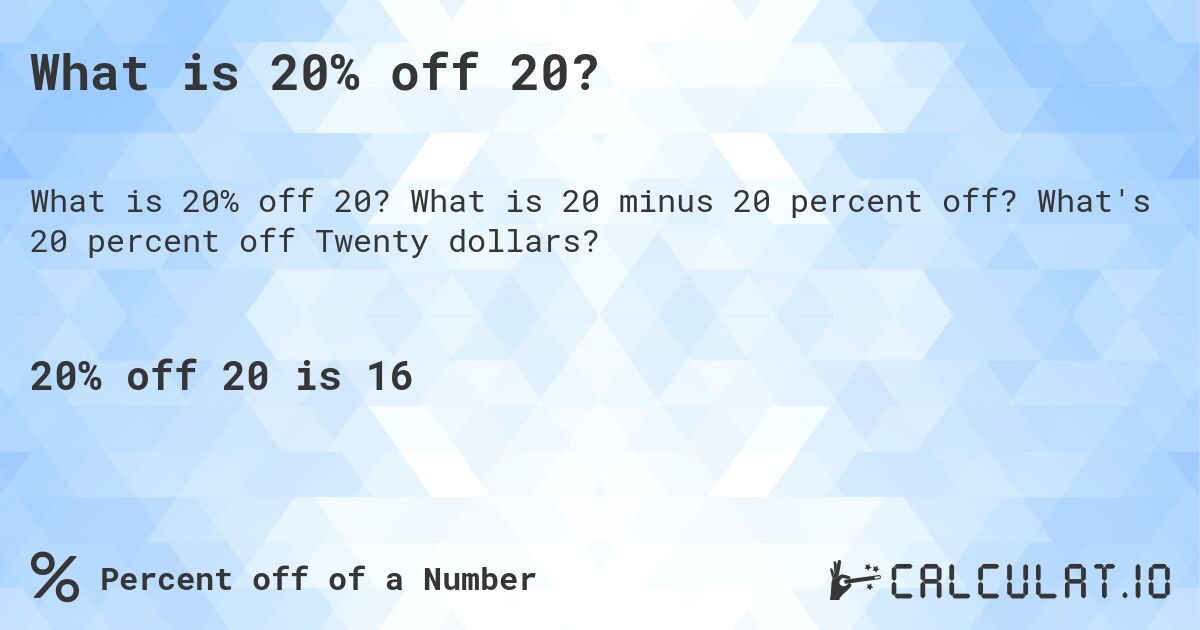
This method is fantastic for prices that are easily divisible by 5, allowing for rapid calculations without relying on a calculator. Even for numbers not perfectly divisible, it can provide a quick estimate.
Beyond Simple Discounts: Real-World Financial Scenarios
Understanding 20% off extends beyond simple retail purchases. It’s a critical component in various real-world financial scenarios, impacting your budget and savings strategies.
Stacking Discounts: A Common Trap
One common scenario involves “stacking” discounts, where you might see an item that’s already on sale for 20% off, and then you have an additional coupon for, say, 10% off the sale price. It’s a critical financial error to simply add these percentages together (e.g., assuming 20% + 10% = 30% off). Discounts are almost always applied sequentially.
Example: A laptop is $1000. It’s first discounted by 20%, then an additional 10% off the new price.
- First Discount (20% off $1000):
- Discount Amount = $1000 × 0.20 = $200
- Price after 20% off = $1000 – $200 = $800
- Second Discount (10% off the $800 sale price):
- Discount Amount = $800 × 0.10 = $80
- Final Price = $800 – $80 = $720
If you had incorrectly assumed a 30% total discount, you would have calculated $1000 × 0.70 = $700, leading to a false expectation of saving an extra $20. Understanding sequential discounts is vital for accurate budgeting and avoiding disappointment at the register.
Calculating Tips and Service Charges
In many service industries, particularly in dining, a 20% tip is a standard recommendation for good service. This is a direct application of the 20% calculation, but in reverse—you’re adding to the total, not subtracting.
Example: Your restaurant bill is $60, and you want to leave a 20% tip.
- Tip Amount = $60 × 0.20 = $12
- Total Paid = $60 + $12 = $72
Knowing how to quickly calculate a 20% tip ensures you can accurately budget for dining out and fairly compensate service staff without overspending or underspending.
The Impact on Your Budget and Savings
Mastering discount calculations, especially for common percentages like 20%, has a profound impact on your personal financial health.
- Smarter Spending: It allows you to quickly assess the true value of a sale, preventing impulse purchases driven by an inflated sense of savings. You can discern whether a 20% discount on an item you genuinely need is a good deal compared to its price history or competitor offerings.
- Effective Budgeting: Knowing the exact final price means your budget allocations are accurate. You avoid situations where you anticipate a certain saving, only to find the actual price is higher, throwing your budget off track.
- Long-Term Savings: Consistently making informed purchasing decisions, even for small discounts, adds up over time. The cumulative effect of saving 20% on numerous items throughout the year can free up significant funds that can be directed towards savings, investments, or debt reduction, contributing to your long-term financial goals.
Leveraging Technology for Discount Calculations
While mental math and manual calculations are essential skills, modern financial tools can significantly enhance accuracy and efficiency when dealing with discounts, especially for complex scenarios or large shopping lists.
Calculator Apps
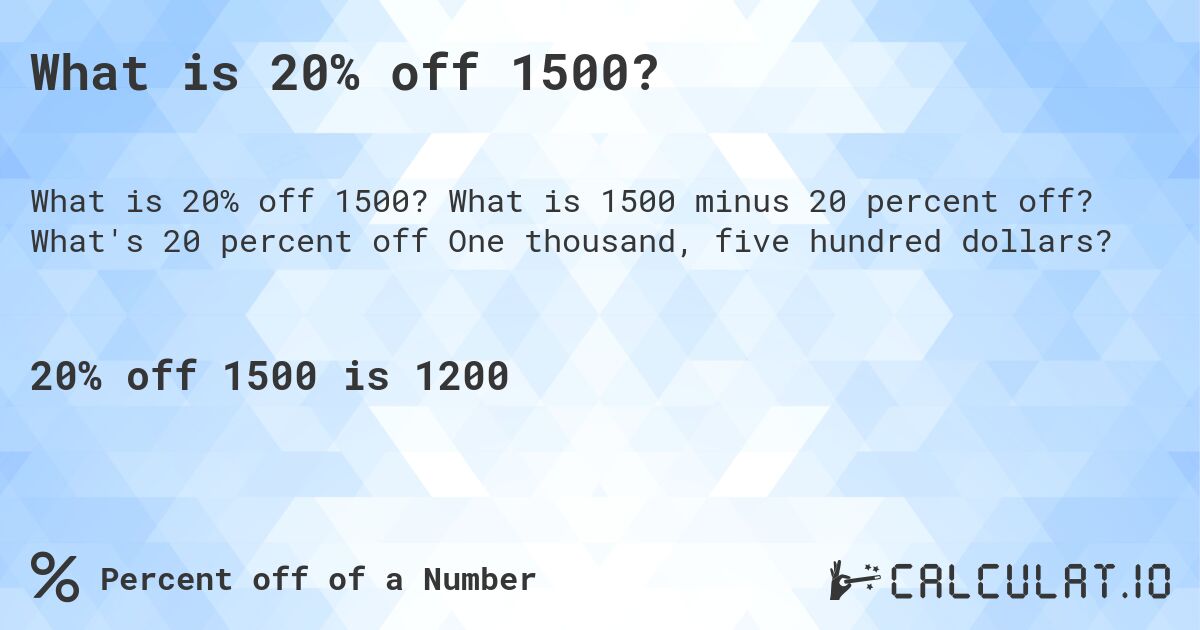
Your smartphone’s built-in calculator is an indispensable tool for discount calculations. It’s always with you and eliminates the risk of mental math errors. Whether you use the subtraction method (e.g., $150 * 0.20 = 30, then $150 - 30 = 120) or the multiplier method ($150 * 0.80 = 120), it provides instant, accurate results. For those who frequently shop, having a quick access calculator widget or app is a financial productivity hack.
Spreadsheet Software (Excel, Google Sheets)
For more extensive financial planning, budgeting, or when comparing multiple discounted items, spreadsheet software like Microsoft Excel or Google Sheets is incredibly powerful. You can set up columns for original price, discount percentage, discount amount, and final price.
Example Formula in Excel/Google Sheets:
If the original price is in cell A2 and the discount percentage (as a decimal) is in cell B2 (e.g., 0.20 for 20%), you can calculate:
- Discount Amount:
=A2 * B2 - Final Price:
=A2 - (A2 * B2)or=A2 * (1 - B2)
This allows you to quickly apply the calculation to dozens or hundreds of items, perfect for tracking large purchases, inventory, or creating detailed shopping lists with anticipated costs.
Online Discount Calculators and Budgeting Apps
The internet offers numerous dedicated “discount calculators” that allow you to simply input the original price and percentage off to get an instant result. Many personal finance and budgeting apps also include features that help track spending and can sometimes integrate with shopping lists or even automatically calculate savings from sales. These tools, while not replacing fundamental understanding, offer convenience and a double-check for your own calculations, acting as valuable financial assistants.
Strategic Shopping: Making Your 20% Off Go Further
Simply knowing how to calculate 20% off is only half the battle. Strategic shopping involves applying this knowledge to make genuinely smart financial decisions, ensuring that a discount truly translates into savings and value.
When to Buy: Timing Your Purchases
Understanding sale cycles is crucial. A 20% discount might be a standard offering during a flash sale, but the same item might see deeper discounts (e.g., 30-40%) during seasonal clearances (like end-of-season, Black Friday, or Boxing Day sales). Researching typical sale patterns for items you wish to purchase can help you determine if a 20% off deal is truly the best you’ll get or if patience could yield greater savings. Financial planning extends to anticipating needs and timing purchases strategically.
Comparing Prices: Is 20% Off Actually a Good Deal?
A common retail tactic is to inflate an item’s “original price” only to then offer a seemingly attractive discount. Always cross-reference prices across different retailers, both online and in-store, before committing to a purchase. A 20% discount on an artificially high original price might still leave you paying more than you would for the same item at a competitor with no advertised discount. Price comparison apps and browser extensions are excellent financial tools for this purpose, ensuring your 20% saving is legitimate.
Understanding Return Policies and Warranties
Even a great deal on an item with 20% off can become a financial burden if it doesn’t meet your expectations and comes with a restrictive return policy. Before buying, especially for larger purchases, always check the store’s return policy for sale items. Some retailers have stricter policies for discounted goods. Additionally, ensure the warranty is still valid for discounted items. A 20% saving might be negligible if the item breaks down shortly after purchase with no recourse.
The Psychology of Discounts: Avoiding the Trap
Retailers leverage the psychology of discounts to encourage spending. The mere presence of a “sale” sign or a “20% off” sticker can create a sense of urgency and scarcity, leading to impulse purchases. As a financially savvy consumer, it’s essential to differentiate between a genuine need coupled with a good discount, and an impulse triggered solely by the discount itself. Before buying, ask yourself: “Would I buy this at full price? Do I genuinely need this item?” If the answer is no, even a 20% discount might not be a true saving, as it’s money spent on something unnecessary. The real saving comes from not spending money on things you don’t need, regardless of the discount.
Conclusion
Mastering the calculation of “20 percent off” is far more than a simple arithmetic exercise; it’s a foundational pillar of sound personal finance. By understanding the different methods—the subtraction method, the multiplier method, and the quick “divide by five” shortcut—you equip yourself with the confidence to navigate the world of sales and promotions effectively.
Beyond the immediate transaction, this skill empowers you to avoid common pitfalls like miscalculating stacked discounts, accurately budget for tips, and critically evaluate whether a “deal” truly aligns with your financial goals. Coupled with strategic shopping habits and leveraging modern financial tools, your ability to quickly and accurately calculate a 20% discount transforms you from a passive consumer into an active manager of your own money. Embrace this fundamental financial skill, and watch as your understanding translates into smarter spending, enhanced savings, and greater financial peace of mind.
aViewFromTheCave is a participant in the Amazon Services LLC Associates Program, an affiliate advertising program designed to provide a means for sites to earn advertising fees by advertising and linking to Amazon.com. Amazon, the Amazon logo, AmazonSupply, and the AmazonSupply logo are trademarks of Amazon.com, Inc. or its affiliates. As an Amazon Associate we earn affiliate commissions from qualifying purchases.