
Percentages are an indispensable mathematical concept, serving as a universal language for comparison, proportion, and change across virtually every domain, especially within the vast landscape of technology. From understanding data analytics to programming software, monitoring system performance, or simply navigating daily digital interactions, the ability to accurately calculate percentages is a foundational skill. This tutorial demystifies the process, guiding you from the fundamental mathematical principles to leveraging sophisticated digital tools and programmatic approaches for efficient and accurate percentage computation. Whether you’re a student, a data analyst, a developer, or simply someone looking to enhance your digital literacy, mastering percentage calculations in a tech-driven world is crucial.

The Foundational Concept: What Exactly is a Percentage?
Before diving into calculations, it’s essential to grasp the core meaning of a percentage. This understanding forms the bedrock for all subsequent applications, whether manual or automated.
Defining the Term
The word “percentage” derives from “per cent,” which literally means “per hundred” or “out of one hundred.” In essence, a percentage is a way of expressing a number or a ratio as a fraction of 100. It’s denoted by the percent sign (%). For example, 25% means 25 out of 100, which can also be written as the fraction 25/100 or the decimal 0.25. This standardization to a base of 100 makes it easy to compare different quantities or proportions, regardless of their original total values.
Why Percentages Matter
Percentages are invaluable because they provide a standardized way to compare parts of different wholes. Imagine trying to compare the performance of two advertising campaigns: one that generated 50 leads from 500 visitors and another that generated 100 leads from 2000 visitors. Without percentages, it’s not immediately clear which is more effective. Expressing these as percentages (10% conversion for the first, 5% for the second) instantly clarifies the superior performance. In technology, this clarity is paramount for evaluating system efficiency, market share, data distribution, and myriad other metrics that inform decision-making.
The Basic Formula
At its heart, calculating a percentage involves a simple, yet powerful, formula. Regardless of the specific application, the core idea is to identify the “part” and the “whole.”
The fundamental formula for finding what percentage a “part” is of a “whole” is:
$$ text{Percentage} = left( frac{text{Part}}{text{Whole}} right) times 100% $$
This formula can be rearranged to find the “part” when you know the “whole” and the “percentage,” or to find the “whole” when you know the “part” and the “percentage.” Understanding this basic relationship is key to manipulating percentages effectively in any context.
Manual Calculation: Building the Core Understanding
Even with advanced technological tools at our disposal, understanding the manual calculation process for percentages is vital. It reinforces the underlying mathematical logic, making you a more adept problem-solver when using software or programming.
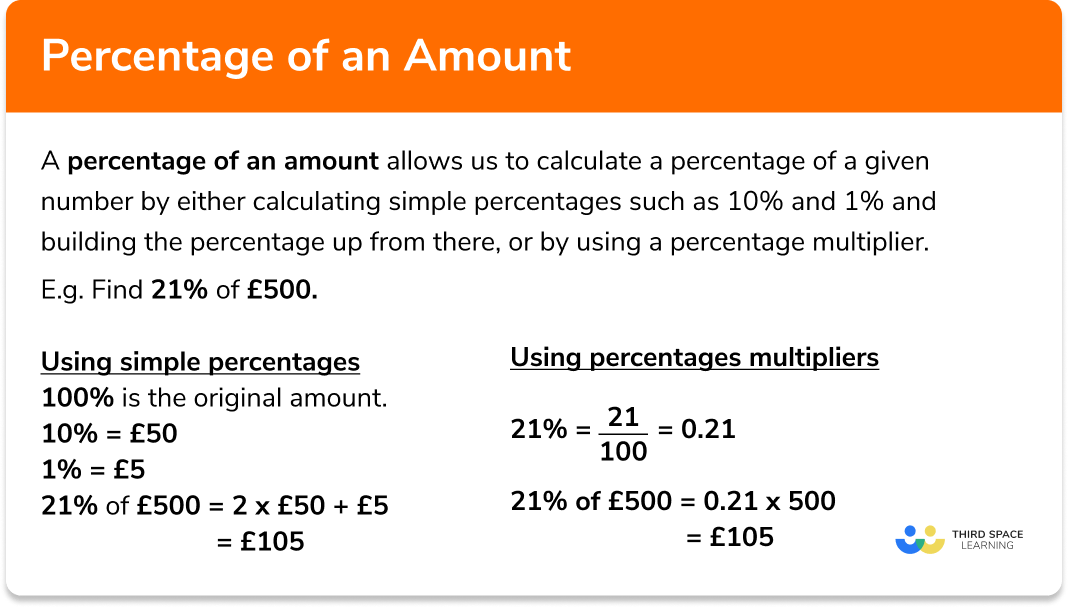
Calculating a Percentage of a Given Number
This is one of the most common percentage calculations. You want to find out what a certain percentage of a number is.
Method:
- Convert the percentage into a decimal by dividing it by 100 (or moving the decimal point two places to the left).
- Multiply this decimal by the number you’re working with.
Example: Find 20% of 150.
- Convert 20% to a decimal: $20 / 100 = 0.20$
- Multiply the decimal by the number: $0.20 times 150 = 30$
So, 20% of 150 is 30.
Finding What Percentage One Number is of Another
This calculation helps you express a portion of a total as a percentage.
Method:
- Divide the “part” (the number representing the portion) by the “whole” (the total number).
- Multiply the result by 100 to convert it into a percentage.
Example: What percentage is 30 of 150?
- Divide the part by the whole: $30 / 150 = 0.2$
- Multiply by 100: $0.2 times 100 = 20%$
So, 30 is 20% of 150.
Calculating Percentage Increase or Decrease
This is particularly useful in tracking growth, decline, or changes over time, frequently seen in performance metrics, data trends, or resource allocation.
Method:
- Find the difference between the new value and the old value.
- Divide this difference by the old value.
- Multiply the result by 100 to express it as a percentage.
The formula is: $$ text{Percentage Change} = left( frac{text{New Value} – text{Old Value}}{text{Old Value}} right) times 100% $$
A positive result indicates an increase, and a negative result indicates a decrease.
Example: A software subscription fee increased from $100 to $120. What is the percentage increase?
- Difference: $120 – 100 = 20$
- Divide by the old value: $20 / 100 = 0.2$
- Multiply by 100: $0.2 times 100 = 20%$
The subscription fee increased by 20%.
Leveraging Digital Tools for Efficiency and Accuracy
While manual calculations solidify understanding, digital tools are indispensable for speed, accuracy, and handling large datasets. They automate repetitive tasks, reduce human error, and allow for dynamic analysis.
Standard Calculators and Smartphone Apps
The simplest digital tools are basic calculators, whether physical or those integrated into smartphones and operating systems. Most scientific or advanced calculators have a dedicated “%” button.
- To find a percentage of a number: Input
[number] * [percentage] %. For example,150 * 20 %will often directly yield 30. - To find percentage change: You’ll typically need to perform the subtraction, division, and multiplication steps manually, as the “%” button’s function can vary, often only calculating a percentage of a number rather than percentage change.
Smartphone apps often offer more intuitive interfaces, sometimes even featuring dedicated percentage change calculators.
Spreadsheet Software (Excel, Google Sheets): The Powerhouse
Spreadsheets are arguably the most versatile and widely used tools for percentage calculations in professional and personal tech environments. Their ability to handle large datasets, perform complex calculations, and visualize results makes them invaluable.
- Calculating a percentage of a number: If a number is in cell A1, and you want to find 20% of it, you can enter
=A1*0.20or=A1*20%into another cell. - Finding what percentage one number is of another: If 30 is in cell B1 and 150 is in cell A1, you can enter
=B1/A1into a cell. To display this as a percentage, select the cell and click the “%” style button on the toolbar. This will automatically multiply by 100 and add the percent symbol. - Calculating percentage increase or decrease: With old value in A1 and new value in B1, use
=(B1-A1)/A1. Again, format the cell as a percentage to see the result clearly. - Scaling calculations: Spreadsheets excel at applying formulas across entire columns or rows using relative or absolute references ($). This allows you to calculate percentages for hundreds or thousands of data points with a single formula.
Online Percentage Calculators
For quick, one-off calculations without needing to open a spreadsheet or advanced calculator, numerous free online percentage calculators are available. These tools often have specific interfaces for finding percentages of numbers, percentage increases/decreases, or tip calculations. While convenient, they lack the data handling and analytical capabilities of spreadsheets or custom programming.
Programmatic Approaches: Automating Percentage Calculations
For developers, data scientists, and those working with large-scale automation or integrating calculations into custom applications, programmatic approaches offer unparalleled power and flexibility.
Basic Programming Concepts (Python Example)
Programming languages allow you to embed percentage calculations directly into scripts and applications. Python, due to its readability and extensive libraries, is an excellent choice for demonstrating these concepts.
1. Calculating a percentage of a number:
number = 150
percentage = 20
result = number * (percentage / 100)
print(f"{percentage}% of {number} is {result}")
# Output: 20% of 150 is 30.0
2. Finding what percentage one number is of another:
part = 30
whole = 150
if whole != 0: # Avoid division by zero
    percentage = (part / whole) * 100
    print(f"{part} is {percentage}% of {whole}")
# Output: 30 is 20.0% of 150
3. Calculating percentage increase or decrease:
old_value = 100
new_value = 120
if old_value != 0: # Avoid division by zero
    percentage_change = ((new_value - old_value) / old_value) * 100
    print(f"Percentage change from {old_value} to {new_value}: {percentage_change}%")
# Output: Percentage change from 100 to 120: 20.0%
These basic snippets demonstrate how the core mathematical formulas translate directly into code, enabling accurate and repeatable calculations.
Scripts and Data Analysis Tools
Beyond simple snippets, programmers integrate percentage calculations into more complex systems:
- Web Applications: E-commerce sites use percentages for discounts, tax calculations, and displaying savings. Dashboards for analytics might show growth percentages or market share.
- Data Science and Machine Learning: Libraries like Pandas in Python are heavily used for data manipulation, where calculating column-wise percentages, group-wise proportions, or statistical measures is commonplace. Machine learning models often output probabilities or confidence scores as percentages.
- Reporting Tools: Automated scripts can generate reports featuring key performance indicators (KPIs) expressed as percentages, such as system uptime, error rates, or conversion metrics. The ability to dynamically calculate and update these figures is crucial for real-time monitoring and decision-making.
Real-World Tech Applications of Percentages
The utility of percentage calculations extends into almost every facet of the technology world, driving insights, user experience, and system functionality.
Data Visualization and Reporting
Percentages are fundamental to making data digestible and comparable. Pie charts, for instance, visually represent parts of a whole as percentages, showing market share distribution, survey response breakdowns, or resource allocation. Bar graphs often compare percentage growth or decline across different categories or time periods, allowing for quick insights into trends. Dashboards, central to many tech operations, heavily rely on percentages to display KPIs like completion rates, success rates, and user engagement metrics.
Software Development
Within software, percentages are ubiquitous.
- Progress Bars: Whether downloading a file, installing an update, or loading an application, progress bars indicate completion as a percentage (e.g., “75% complete”).
- Resource Utilization: Operating systems and monitoring tools display CPU usage, memory consumption, and disk space as percentages to help users and administrators track system health and performance.
- Game Mechanics: Health bars, mana levels, skill cooldowns, and damage resistances in video games are frequently represented and calculated using percentages.
- UI/UX Design: Responsive web design often uses percentage-based layouts (e.g.,
width: 50%) to ensure elements scale appropriately across different screen sizes.
AI and Machine Learning
In the realm of artificial intelligence, percentages play a critical role in model evaluation and output interpretation.
- Confidence Scores: AI models, especially in areas like image recognition or natural language processing, often output their prediction alongside a confidence score, indicating how certain the model is, usually expressed as a percentage (e.g., “98% likely to be a cat”).
- Model Accuracy: The performance of machine learning models is frequently measured by metrics like accuracy, precision, and recall, all of which are expressed as percentages.
- Data Sampling: When training AI models, data scientists might sample a percentage of a large dataset to create training, validation, and test sets.
Digital Security and Performance Metrics
Monitoring and maintaining robust IT infrastructure heavily relies on percentage metrics.
- Uptime/Downtime: System availability is often quoted as a percentage (e.g., “99.99% uptime”), crucial for service level agreements (SLAs).
- Packet Loss: In network diagnostics, packet loss is measured as a percentage, indicating network congestion or instability.
- Malware Detection Rates: Cybersecurity tools report their effectiveness in detecting threats as percentages.
- Vulnerability Scores: Security audits might assign a percentage score to the overall security posture of a system or application.
Web Analytics and E-commerce
For websites and online businesses, percentages are the backbone of performance analysis.
- Conversion Rates: The percentage of visitors who complete a desired action (e.g., making a purchase, signing up for a newsletter).
- Bounce Rates: The percentage of visitors who leave a site after viewing only one page.
- Click-Through Rates (CTR): The percentage of users who click on a specific link or ad.
- Discounts and Promotions: E-commerce platforms display product discounts (e.g., “25% off”) and apply percentage-based taxes and shipping costs.

Conclusion
Understanding “how do you get percentage of a number” is far more than a basic math lesson; it’s a fundamental skill that underpins comprehension and functionality across the entire technological spectrum. From manual calculations that build core intuition to the sophisticated automation offered by spreadsheets and programming, the principles remain constant. As technology continues to evolve, the ability to accurately interpret, calculate, and apply percentages will only grow in importance, enabling clearer communication, more insightful analysis, and more robust system development. By mastering these methods, you equip yourself with a powerful tool for navigating and contributing to our increasingly data-driven and digitally integrated world.
aViewFromTheCave is a participant in the Amazon Services LLC Associates Program, an affiliate advertising program designed to provide a means for sites to earn advertising fees by advertising and linking to Amazon.com. Amazon, the Amazon logo, AmazonSupply, and the AmazonSupply logo are trademarks of Amazon.com, Inc. or its affiliates. As an Amazon Associate we earn affiliate commissions from qualifying purchases.