
The stock market, often perceived as a complex and intimidating entity, is in essence a sophisticated marketplace where ownership stakes in companies are bought and sold. Far from being a mere gambling arena, it serves as a critical engine for economic growth, enabling businesses to raise capital for expansion and innovation while offering individuals and institutions avenues to grow their wealth. Understanding its fundamental mechanisms is not just for seasoned investors; it’s a vital component of financial literacy in a globalized economy. This guide aims to demystify the stock market, breaking down its components, operational dynamics, and broader significance in an insightful and engaging manner.

The Foundation: What Are Stocks and Why Do Companies Issue Them?
At the heart of the stock market are stocks, also known as shares, which represent a fractional ownership in a company. When you buy a stock, you become a shareholder, holding a piece of that company’s assets and earnings.
What Constitutes a Stock?
A stock is a type of security that signifies proportional ownership in the issuing corporation. This ownership bestows upon shareholders certain rights, typically including the right to vote on corporate matters (like electing the board of directors) and the right to a share of the company’s profits, usually distributed as dividends. Stocks are broadly categorized into common stock and preferred stock. Common stock represents basic ownership and voting rights, with variable dividends, while preferred stock often carries no voting rights but guarantees a fixed dividend payment and has priority over common stockholders in receiving payment in case of liquidation.
The Purpose of Issuing Stocks for Companies
Companies primarily issue stocks for one fundamental reason: to raise capital. When a private company decides to “go public” through an Initial Public Offering (IPO), it sells shares to the public for the first time. This influx of capital allows the company to finance various objectives, such as:
- Expansion: Funding new facilities, product lines, or market penetration.
- Research and Development: Investing in innovation to stay competitive.
- Debt Repayment: Strengthening the company’s financial position.
- Acquisitions: Buying other companies to grow market share or diversify.
By selling ownership stakes, companies can access a vast pool of investor capital without incurring debt, providing them with greater financial flexibility and scalability.
Understanding Market Capitalization
Market capitalization, often shortened to “market cap,” is a crucial metric for understanding a company’s size and value in the stock market. It is calculated by multiplying the total number of outstanding shares by the current market price of one share. For instance, if a company has 100 million shares outstanding and each share trades at $50, its market cap is $5 billion. Market cap helps categorize companies (e.g., small-cap, mid-cap, large-cap) and provides investors with a quick indicator of a company’s overall valuation and influence within its industry and the broader economy.
The Mechanics of Trading: Exchanges, Brokers, and Participants
The buying and selling of stocks don’t happen randomly; they occur within structured environments with defined roles for various entities.
Stock Exchanges: The Central Marketplaces
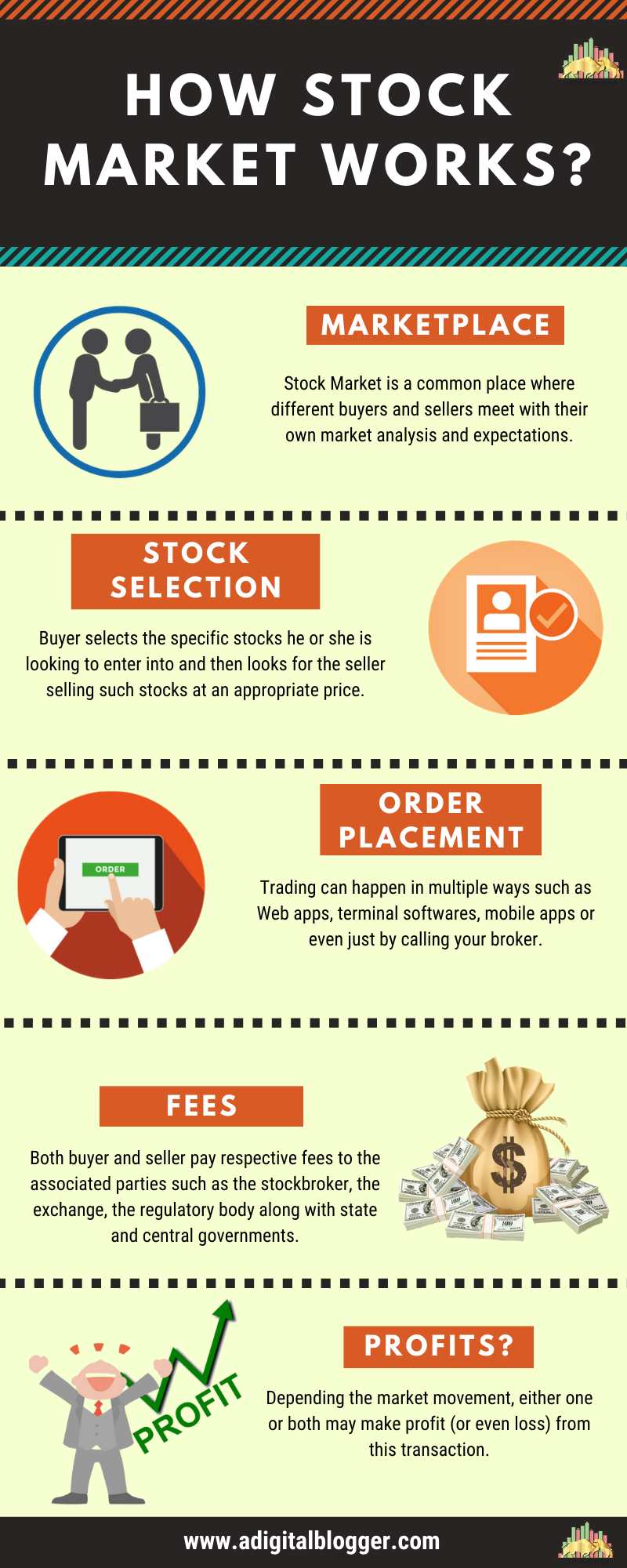
Stock exchanges are organized markets where securities are listed and traded. They provide a regulated platform for buyers and sellers to meet, ensuring fair and orderly transactions. The most well-known exchanges include the New York Stock Exchange (NYSE) and the NASDAQ in the United States, as well as the London Stock Exchange (LSE), Tokyo Stock Exchange (TSE), and many others globally. Each exchange has its own listing requirements that companies must meet to have their shares traded. These exchanges facilitate price discovery, provide liquidity, and maintain transparency for investors.
Brokers: Your Gateway to the Market
Individual investors typically cannot directly buy and sell stocks on an exchange. Instead, they must go through a licensed intermediary known as a broker. Brokers act as agents, executing buy and sell orders on behalf of their clients. In today’s digital age, most retail investors use online brokerage platforms, which offer tools for research, order placement, and portfolio management. Brokers earn revenue through commissions on trades, subscription fees, or by providing premium services. They play a vital role in connecting individual capital with market opportunities.
Investors: The Driving Force of Capital
The stock market is powered by a diverse array of investors, each with different motivations, risk appetites, and investment horizons.
- Retail Investors: These are individual investors trading for their own personal accounts. They might be saving for retirement, a down payment, or simply aiming to grow their wealth.
- Institutional Investors: These are large organizations that invest on behalf of clients or members. Examples include mutual funds, hedge funds, pension funds, insurance companies, and endowments. Institutional investors typically trade large volumes of shares and can significantly influence market movements due to their sheer capital.
- Market Makers: These financial institutions provide liquidity to the market by continuously quoting both buy (bid) and sell (ask) prices for a given stock. They stand ready to buy from sellers and sell to buyers, profiting from the spread between the bid and ask prices. Their role is crucial in ensuring that there’s always a willing counterparty for trades, making it easier for investors to buy or sell shares quickly.
Dynamics of Supply, Demand, and Stock Price Determination
The core principle governing stock prices is the immutable law of supply and demand. However, a multitude of factors constantly influences this delicate balance.

How Stock Prices Are Determined
When more investors want to buy a stock than sell it, demand exceeds supply, driving the price up. Conversely, when more investors want to sell a stock than buy it, supply exceeds demand, pushing the price down. This continuous interplay between buyers and sellers, facilitated by the order book on an exchange, determines the market price of a stock at any given moment. The “last traded price” is what is typically quoted as the current stock price.
Factors Influencing Stock Prices
Stock prices are not static; they are in constant flux, influenced by a complex web of interconnected factors:
- Company Performance: Earnings reports, revenue growth, profit margins, product launches, and management changes directly impact investor sentiment about a company’s future prospects. Strong performance typically leads to higher demand and price appreciation.
- Economic News and Indicators: Broader economic conditions, such as interest rate changes by central banks, inflation rates, GDP growth, employment figures, and consumer confidence, affect the overall market. A strong economy generally bodes well for corporate earnings, while a recession can lead to widespread declines.
- Industry Trends: Developments within a specific industry, such as technological advancements, regulatory changes, or shifts in consumer preferences, can significantly impact the companies operating within it.
- Geopolitical Events: International conflicts, trade wars, political instability, or major global events (like pandemics) can create widespread uncertainty, leading to market volatility.
- Market Sentiment and Investor Psychology: Fear, greed, and herd mentality can drive irrational exuberance or panic selling, sometimes decoupling prices from fundamental value in the short term.
- Analyst Ratings and News Coverage: Recommendations from financial analysts and media coverage can influence investor perception and trading activity.
Volatility and Risk
Volatility refers to the degree of variation of a trading price series over time, often measured by standard deviation. High volatility means a stock’s price can fluctuate dramatically over short periods, offering potential for significant gains but also significant losses. Risk, in the context of the stock market, encompasses the possibility of losing money. It’s inherent in investing, and investors must understand different types of risk:
- Market Risk (Systematic Risk): The risk that the overall market will decline, affecting most stocks. It cannot be diversified away.
- Specific Risk (Unsystematic Risk): Risk specific to a particular company or industry. This can be mitigated through diversification across different companies and sectors.
- Liquidity Risk: The risk that an asset cannot be quickly bought or sold without a significant price concession.
Approaches to Investing: Analysis and Strategies
Navigating the stock market effectively requires more than just understanding its mechanisms; it demands a strategic approach to selecting investments. Investors typically employ various methods of analysis and adopt specific strategies to meet their financial goals.
Fundamental Analysis
Fundamental analysis is a method of evaluating a security in an attempt to measure its intrinsic value, by examining related economic, financial, and other qualitative and quantitative factors. Its goal is to determine if a stock is undervalued or overvalued by the market. Fundamental analysts scrutinize:
- Financial Statements: Balance sheets (assets, liabilities, equity), income statements (revenues, expenses, profits), and cash flow statements (sources and uses of cash).
- Company Management: The quality, experience, and integrity of the leadership team.
- Industry and Economic Conditions: The competitive landscape, industry growth prospects, and broader macroeconomic environment.
- Competitive Advantages: Moats that protect a company from competition (e.g., brand recognition, patents, network effects).
The belief is that, in the long run, a stock’s market price will eventually reflect its true intrinsic value.
Technical Analysis
In contrast to fundamental analysis, technical analysis is a trading discipline employed to evaluate investments and identify trading opportunities by analyzing statistical trends gathered from trading activity, such as price movement and volume. Technical analysts do not focus on a company’s financial health but rather on historical price patterns and indicators (e.g., moving averages, relative strength index, MACD) to predict future price movements. The core assumption is that history tends to repeat itself and that all known fundamental information is already reflected in the stock price. It’s often used for short-term trading decisions.
Common Investment Strategies
Different investors adopt strategies aligned with their risk tolerance, financial goals, and time horizon:
- Value Investing: Seeking out stocks that appear to be trading for less than their intrinsic value, often characterized by low price-to-earnings (P/E) ratios or high dividend yields.
- Growth Investing: Focusing on companies that are expected to grow at an above-average rate compared to the market, even if their current valuation seems high. These companies often reinvest profits heavily for expansion.
- Dividend Investing: Targeting companies that regularly distribute a portion of their earnings to shareholders as dividends, providing a steady income stream.
- Index Investing: A passive strategy involving investing in an index fund or ETF that tracks a broad market index (e.g., S&P 500). This aims to match market performance rather than outperform it, typically with lower fees and diversification.
- Dollar-Cost Averaging: Investing a fixed amount of money at regular intervals, regardless of the stock’s price. This strategy helps mitigate the risk of buying at a market peak by averaging out the purchase price over time.
The Broader Economic Impact and Regulatory Framework
The stock market’s influence extends far beyond individual portfolios, playing a pivotal role in the economy and operating within a regulated environment designed to protect investors.
Role in Capital Allocation and Economic Growth
The stock market is a critical mechanism for efficient capital allocation. It directs savings from investors to productive enterprises, facilitating business expansion, job creation, and technological innovation. Companies use the capital raised through stock issuance to fund research and development, build infrastructure, and expand operations, which in turn drives economic productivity and competitiveness. By providing a platform for growth, the stock market contributes significantly to the overall health and dynamism of the national and global economies.
Regulatory Bodies and Investor Protection
To ensure fairness, transparency, and protect investors from fraud and manipulation, stock markets are heavily regulated. In the United States, key regulatory bodies include:
- Securities and Exchange Commission (SEC): The primary federal agency responsible for enforcing federal securities laws, regulating securities industries, and protecting investors. The SEC mandates detailed disclosures from public companies to ensure investors have access to vital information.
- Financial Industry Regulatory Authority (FINRA): A self-regulatory organization that oversees brokers and brokerage firms. FINRA develops and enforces rules governing the conduct of its members, examines firms for compliance, and provides investor education.
Similar regulatory frameworks exist in other countries, ensuring that markets operate with integrity and that investors have recourse in case of wrongdoing.
Market Crashes and Corrections: Historical Context
While the stock market is a powerful engine for wealth creation, it is not without its risks. Historically, markets have experienced periods of significant decline known as corrections (a drop of 10-20% from a recent peak) and crashes (a rapid and severe decline, often exceeding 20%). Examples include the Great Depression crash of 1929, Black Monday in 1987, the dot-com bubble burst in 2000, and the 2008 global financial crisis. These events, often triggered by economic downturns, speculative bubbles, or unforeseen global events, underscore the inherent volatility of the market. While unsettling, history also shows that markets tend to recover over time, emphasizing the importance of a long-term perspective and sound financial planning.
In conclusion, the stock market is a complex yet fascinating ecosystem where capital, innovation, and human ambition converge. From the fundamental concept of a stock as fractional ownership to the intricate dance of supply and demand determining prices, and from the critical roles of exchanges and brokers to the diverse strategies employed by investors, understanding these mechanisms is paramount. While it presents opportunities for significant wealth growth, it also carries inherent risks, underscoring the importance of informed decision-making, diversification, and a long-term outlook. By demystifying its workings, individuals can approach the stock market not as a daunting enigma, but as a powerful tool for achieving their financial aspirations and participating in the broader economic narrative.
aViewFromTheCave is a participant in the Amazon Services LLC Associates Program, an affiliate advertising program designed to provide a means for sites to earn advertising fees by advertising and linking to Amazon.com. Amazon, the Amazon logo, AmazonSupply, and the AmazonSupply logo are trademarks of Amazon.com, Inc. or its affiliates. As an Amazon Associate we earn affiliate commissions from qualifying purchases.