
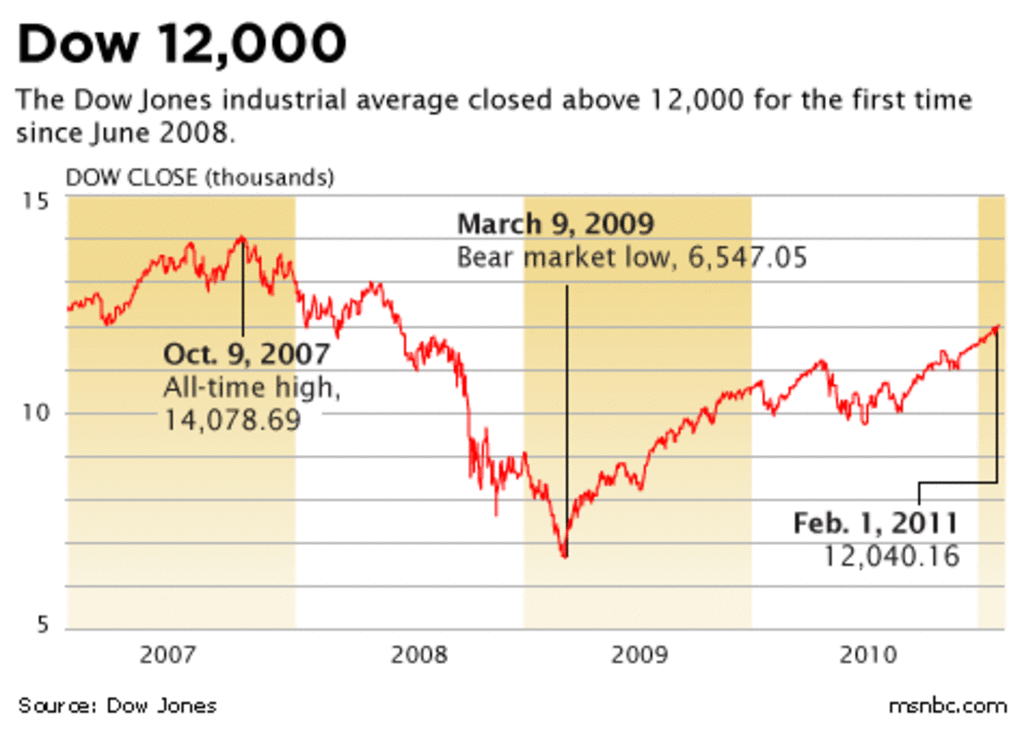
The daily closing value of the Dow Jones Industrial Average (DJIA) is more than just a fleeting number; it’s a critical snapshot of market sentiment, an indicator of the economic pulse, and a starting point for countless financial discussions. For investors, economists, and even the general public, knowing where the Dow closed can offer immediate insights into the day’s financial triumphs or challenges. While the specific number changes every trading day, understanding why that number matters and what influences it is far more valuable than the digit itself. This article delves into the significance of the DJIA’s closing value, the dynamics behind its movements, and how it fits into the broader landscape of investing and personal finance.
Understanding the Dow Jones Industrial Average (DJIA): More Than Just a Number
Before dissecting its daily close, it’s crucial to grasp what the Dow Jones Industrial Average truly represents. Often simply referred to as “the Dow,” it stands as one of the oldest and most widely recognized stock market indices in the world, embodying a significant portion of American industrial and economic power.
A Legacy of Market Representation
Established in 1896 by Charles Dow and Edward Jones, the DJIA initially comprised 12 companies, primarily in the industrial sector. Over its long history, the index has evolved significantly, reflecting the changing landscape of the U.S. economy. Today, it tracks the performance of 30 large, publicly traded companies that are leaders in their respective industries and broadly representative of the U.S. stock market. These companies are often household names, ranging from technology giants to financial institutions and consumer goods conglomerates. The selection process is not based on rigid quantitative rules but rather on the committee’s discretion, aiming for companies with excellent reputations, demonstrated growth, and investor interest, ensuring the index remains relevant as a barometer of the broader market.
The “Price-Weighted” Nuance: How It’s Calculated
Unlike many other market indices, such as the S&P 500, which are market-capitalization weighted, the DJIA is a price-weighted index. This means that stocks with higher share prices have a greater impact on the index’s value than stocks with lower share prices, regardless of their total market capitalization. To maintain comparability over time despite stock splits, dividends, and other corporate actions, the sum of the prices of the 30 component stocks is divided by a special divisor, known as the “Dow Divisor.” This divisor is adjusted periodically to ensure that such events do not distort the index’s historical continuity. A change of just $1 in a high-priced stock within the Dow can therefore have a more significant effect on the index’s overall movement than a similar dollar change in a lower-priced stock. This unique calculation method is a key characteristic that differentiates the Dow from other indices and influences how its movements are interpreted.
The Blue-Chip Barometer: What the 30 Companies Signify
The 30 companies comprising the DJIA are often referred to as “blue-chip” stocks. This term denotes financially sound, well-established companies with a long history of stable earnings and dividend payments. Consequently, the Dow is frequently viewed as a proxy for the health and performance of the U.S. economy’s most robust sectors. While it only tracks a small fraction of the thousands of publicly traded companies, the sheer scale and influence of these 30 corporations mean their collective performance offers a valuable, albeit limited, perspective on the broader economic landscape. Movements in the Dow can thus indicate investor confidence, corporate profitability, and the general direction of economic growth or contraction.
Why the Closing Value Matters: Interpreting Market Sentiment
The daily closing value of the Dow is more than just a data point; it’s a focal point for market participants globally, influencing perceptions, decisions, and future strategies. Its significance stems from its ability to condense a day’s worth of economic activity and investor sentiment into a single, digestible figure.
A Daily Snapshot of Economic Health
Each trading day, when the market bell rings at 4:00 PM EST, the DJIA’s final number provides an immediate, albeit superficial, assessment of the day’s economic narrative. A significant increase might signal optimism regarding corporate earnings, positive economic data, or effective government policies. Conversely, a substantial drop could reflect concerns over inflation, rising interest rates, geopolitical instability, or disappointing corporate guidance. While no single index tells the whole story, the Dow’s close serves as a leading headline, often shaping the initial interpretation of the day’s financial events for news outlets and individuals alike. It offers a quick pulse check on how the market has digested the influx of information throughout the day.
Investor Psychology and Decision Making
The Dow’s closing value plays a powerful role in investor psychology. A streak of positive closes can foster a sense of bullishness, encouraging more investment and risk-taking. Conversely, a series of declines can ignite fear and panic, leading to sell-offs and a more conservative approach. This psychological impact can create self-fulfilling prophecies, where sentiment drives market movements, which in turn reinforce that sentiment. Individual investors, often influenced by daily headlines, may use the Dow’s performance as a guide for their own portfolio adjustments, leading to reactive trading rather than strategic long-term planning. Sophisticated investors, however, use the close as one of many inputs, analyzing the underlying reasons for the movement rather than just the number itself.
The Ripple Effect on Broader Markets
Although the DJIA comprises only 30 stocks, its closing value can have a ripple effect across other financial markets, both domestic and international. Its performance can influence the trajectory of other major U.S. indices like the S&P 500 and Nasdaq Composite, as well as bond markets and currency exchanges. For instance, a strong Dow close might correlate with a weaker U.S. dollar, as investors move money out of safe-haven currencies into riskier assets like stocks. Globally, positive or negative closes on Wall Street can set the tone for Asian and European markets in subsequent trading sessions, demonstrating the interconnectedness of the world’s financial systems.
Factors Driving the Dow’s Daily Movements
The Dow’s closing value is not arbitrary; it’s the culmination of countless interactions driven by a complex interplay of economic, corporate, and geopolitical forces. Understanding these drivers is key to moving beyond simply observing the number to comprehending its implications.
Corporate Earnings and Guidance
At the heart of stock market performance are the individual companies themselves. Quarterly earnings reports, detailing revenue, profit, and future guidance, are monumental catalysts for stock price movements. When a Dow component company reports earnings that exceed expectations or provides an optimistic outlook, its stock price typically rises, contributing positively to the index. Conversely, missed expectations or a gloomy forecast can lead to a significant drop. Given the price-weighted nature of the Dow, a sharp movement in a high-priced component stock can notably swing the entire index. Furthermore, broad trends in corporate profitability across multiple Dow components can signify overall economic strength or weakness.

Macroeconomic Indicators: Inflation, Interest Rates, Employment
Broader economic data consistently moves the market. Reports on inflation (e.g., Consumer Price Index), interest rates (decisions by the Federal Reserve), employment figures (e.g., Non-Farm Payrolls), and Gross Domestic Product (GDP) growth provide critical insights into the economy’s health. For instance, an unexpected rise in inflation might signal a need for the Fed to increase interest rates, which can make borrowing more expensive for businesses and consumers, potentially slowing economic growth and negatively impacting stock valuations. Strong employment numbers, on the other hand, often fuel optimism about consumer spending and corporate profits. Traders and algorithms react instantaneously to these data releases, causing rapid shifts in stock prices and, consequently, the Dow’s value.
Geopolitical Events and Global News
The globalized nature of modern economies means that events far beyond U.S. borders can profoundly influence the Dow. Geopolitical tensions, trade disputes, international policy changes, major natural disasters, and global health crises can all introduce uncertainty, reduce consumer and business confidence, and disrupt supply chains. For example, a sudden escalation of a trade war could lead to tariffs that hurt multinational Dow components, causing their stock prices to fall. Similarly, oil price volatility driven by international conflicts can impact energy companies within the index and influence transportation costs for many others. These events often create swift, unpredictable movements in the market, making them particularly challenging to anticipate.
Sectoral Performance and Index Weighting
While the Dow is designed to represent industrial strength, its 30 components span diverse sectors including technology, healthcare, finance, and consumer discretionary. The performance of specific sectors can heavily influence the index. For example, if the technology sector is booming, and several tech giants are part of the Dow (like Apple or Microsoft), their strong performance will significantly lift the index. Conversely, if financial institutions face regulatory headwinds, the Dow’s financial components might drag down the overall average. Because of the price-weighted methodology, the movements of higher-priced stocks have a disproportionately larger impact, meaning the Dow’s performance might not always perfectly reflect the average sentiment across all 30 companies if one or two high-priced components experience extreme volatility.
Accessing the Latest DJIA Close and Historical Data
For anyone interested in the financial markets, accessing accurate and timely information about the Dow’s closing value is straightforward. Multiple reputable sources provide real-time updates, historical data, and insightful analysis.
Reliable Financial News Outlets
Major financial news organizations are the go-to sources for immediate updates on the Dow’s close. Websites like The Wall Street Journal, Bloomberg, Reuters, CNBC, and Yahoo Finance all feature prominent displays of the DJIA’s current and closing values. These platforms often provide not just the number but also accompanying analysis, highlighting the factors that influenced the day’s performance and offering commentary from market experts. They are generally updated within minutes of the market close and are accessible to everyone.
Brokerage Platforms and Financial Tools
For investors with active brokerage accounts, their platform will undoubtedly provide detailed information on the Dow. These platforms often offer advanced charting tools, historical data, and personalized alerts. Beyond brokerage sites, dedicated financial tracking apps and websites (e.g., Google Finance, Investing.com) allow users to monitor the DJIA, customize watchlists, and delve into extensive historical data for various timeframes. These tools are invaluable for tracking performance over time and conducting deeper research.
Official Index Provider Websites
For the most authoritative data, one can visit the official websites of index providers. For the Dow Jones Industrial Average, this would be S&P Dow Jones Indices. Their websites offer comprehensive data, methodology details, and news releases directly from the source, ensuring accuracy and providing a deeper dive into the index’s construction and governance. While perhaps less user-friendly for daily checks, they are crucial for detailed research.
Investing Beyond the Daily Close: A Long-Term Perspective
While the daily closing value of the Dow captures headlines, a truly insightful approach to investing requires looking beyond the immediate fluctuations and adopting a long-term, strategic mindset.
The Dow as a Component of a Diversified Portfolio
For most investors, the Dow is not a direct investment but rather a benchmark. While Exchange Traded Funds (ETFs) and mutual funds track the DJIA, it’s generally advisable for individual investors to maintain a diversified portfolio that includes a broader range of assets beyond just the 30 companies in the Dow. A well-diversified portfolio might include small-cap and mid-cap stocks, international equities, bonds, and other asset classes, reducing reliance on any single index or sector. The Dow’s performance can inform broader market sentiment, but it shouldn’t be the sole determinant of investment decisions.
Understanding Volatility vs. Trend
The Dow experiences daily volatility – upward and downward swings – which is a natural part of market dynamics. However, distinguishing between short-term volatility and long-term trends is crucial. A single day’s close, even if it’s a significant move, may not indicate a lasting trend. Over decades, the Dow has shown a consistent upward trend, reflecting economic growth and corporate innovation, despite numerous market corrections and bear markets along the way. Investors focused on long-term wealth creation typically prioritize these enduring trends over daily noise, employing strategies like dollar-cost averaging to mitigate the impact of short-term price fluctuations.

The Importance of Personal Financial Goals
Ultimately, the most important context for the Dow’s closing value is your personal financial goals. Whether you are saving for retirement, a down payment on a house, or your children’s education, your investment strategy should be tailored to your specific objectives, risk tolerance, and time horizon. Obsessing over the Dow’s daily close can lead to emotional decisions that deviate from a well-thought-out plan. Instead, use the Dow’s movements as a piece of information within a larger framework, understanding its role as a market barometer without letting it dictate your entire financial journey. Staying disciplined and focused on your individual goals, irrespective of daily market headlines, remains the cornerstone of successful investing.
In conclusion, “what did the Dow Jones Industrial Average close at” is a question with immediate relevance, offering a daily pulse on the market. However, its true value lies not just in the number itself, but in the deeper understanding of what it represents, the forces that drive it, and how it informs—but does not solely define—sound financial decision-making within a comprehensive investment strategy.
aViewFromTheCave is a participant in the Amazon Services LLC Associates Program, an affiliate advertising program designed to provide a means for sites to earn advertising fees by advertising and linking to Amazon.com. Amazon, the Amazon logo, AmazonSupply, and the AmazonSupply logo are trademarks of Amazon.com, Inc. or its affiliates. As an Amazon Associate we earn affiliate commissions from qualifying purchases.