
For anyone stepping into the world of personal finance and investing, the term “S&P” is likely one of the first acronyms they encounter. Whether you are listening to financial news, reading a market report, or discussing retirement accounts with a consultant, the S&P 500 is frequently cited as the definitive pulse of the American economy. But what exactly is it, and why does it carry so much weight in the financial world?
At its core, the S&P 500, or the Standard & Poor’s 500 Index, is a stock market index that tracks the performance of 500 of the largest companies listed on stock exchanges in the United States. It is not just a list; it is a meticulously curated benchmark that represents approximately 80% of the total value of the U.S. equity market. For the modern investor, understanding the S&P 500 is not merely an academic exercise—it is a foundational step toward building a robust and informed investment strategy.

Understanding the Foundations: What is the S&P 500?
To understand the S&P 500, one must first understand what an index is. In finance, an index is a statistical measure of the changes in a portfolio of assets. Instead of tracking every single stock in the world, an index tracks a specific segment to provide a snapshot of how that segment is performing.
The History and Evolution of Standard & Poor’s
The roots of the S&P 500 trace back to 1923, when Standard Statistics Company created its first stock market index. It wasn’t until 1957, following a merger between Standard Statistics and Poor’s Publishing, that the index expanded to include 500 companies and became the S&P 500 we recognize today.
Over the decades, the index has evolved from a simple tracking mechanism into the primary barometer for the U.S. economy. It has survived the Great Inflation of the 1970s, the Dot-com bubble, the 2008 Financial Crisis, and the volatility of the COVID-19 pandemic. Each of these eras has seen the index reinvent itself as the “old guard” of the industrial age made way for the “new giants” of the digital era.
Eligibility and Selection Criteria: More Than Just Size
A common misconception is that the S&P 500 is simply a list of the 500 largest companies in America. While size is a critical factor, the selection process managed by the S&P Dow Jones Indices committee is far more nuanced. To be considered for inclusion, a company must meet several stringent criteria:
- Market Capitalization: The company must have an unadjusted market cap of billions of dollars (the specific threshold is updated periodically based on market conditions).
- Liquidity: The stock must be highly liquid, meaning it is easy to buy and sell without causing massive price swings.
- Profitability: Generally, a company must have reported positive earnings over the most recent quarter, as well as the sum of its last four consecutive quarters.
- Public Float: At least 50% of its shares must be available for public trading.
These rules ensure that the index represents the highest quality, most stable, and most representative leaders of the U.S. corporate landscape.
How the Index Works: Market Capitalization and Weighting
The S&P 500 is a “market-capitalization-weighted” index. This mathematical approach determines how much influence each company has over the index’s total movement.
Explaining Market Cap-Weighting
In a market-cap-weighted index, companies with the highest total market value (share price multiplied by the number of outstanding shares) have the greatest impact on the index’s performance. For example, if a tech giant worth $3 trillion sees its stock price move by 2%, it will move the entire S&P 500 index far more than a 10% move from a smaller company worth $20 billion.
This structure is designed to reflect the reality of the market. Larger companies naturally have a larger impact on the economy, employment, and consumer spending. Therefore, their performance is given more “weight” in the calculation. While this ensures the index reflects where the majority of investor money is flowing, it also means that the S&P 500 can sometimes be dominated by a handful of massive firms, a phenomenon often referred to as “top-heavy” weighting.
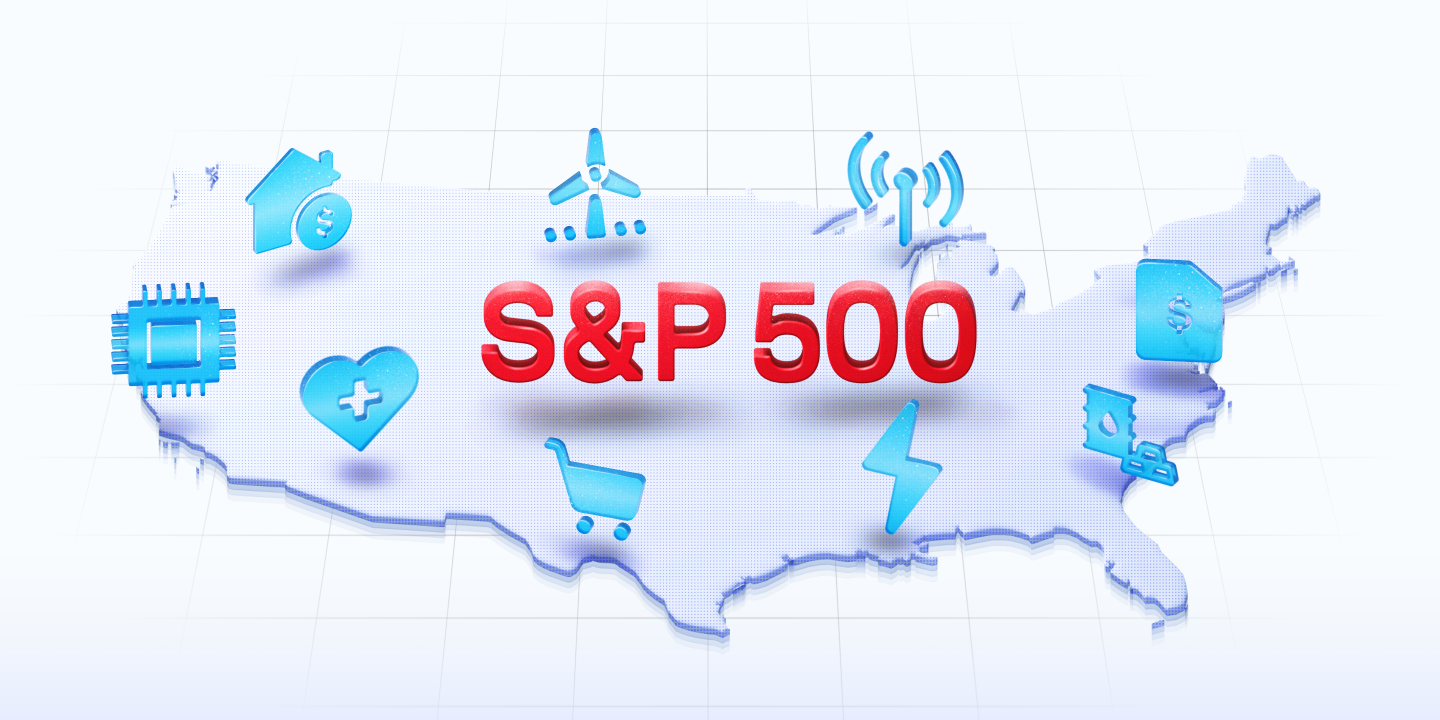
The Sector Diversification of the S&P 500
Although the S&P 500 is often associated with the “Big Tech” firms that dominate the headlines, it is actually remarkably diverse. The index is divided into 11 Global Industry Classification Standard (GICS) sectors:
- Information Technology
- Health Care
- Financials
- Consumer Discretionary
- Communication Services
- Industrials
- Consumer Staples
- Energy
- Utilities
- Real Estate
- Materials
By covering all these sectors, the S&P 500 provides investors with exposure to every corner of the economy, from the oil rigs of Texas to the pharmaceutical labs of New Jersey and the server farms of Silicon Valley.
The S&P 500 as a Financial Benchmark
For personal finance enthusiasts and professional fund managers alike, the S&P 500 serves as the “North Star” of performance.
Measuring Market Health and Economic Sentiment
When people ask, “How is the market doing today?” they are usually looking at the S&P 500. Because it includes 500 companies across various industries, it serves as a reliable proxy for the health of corporate America. When the S&P 500 is rising (a bull market), it suggests investor confidence, strong corporate earnings, and economic growth. When it falls (a bear market), it often signals economic contraction, rising interest rates, or geopolitical instability.
Active vs. Passive Management: The “Beat the Market” Challenge
The S&P 500 is the ultimate hurdle for professional investors. “Active” fund managers—those who try to hand-pick individual stocks to outperform the market—frequently fail to beat the S&P 500 over long periods.
In fact, data from S&P Dow Jones Indices (the SPIVA report) consistently shows that over a 15-year period, more than 90% of active large-cap fund managers underperform the S&P 500. This reality has fueled a massive shift in personal finance toward “passive” investing, where individuals simply buy the entire index rather than trying to outsmart it.
Strategic Approaches to Investing in the S&P 500
Knowing what the S&P 500 is represents only half the battle; the other half is knowing how to use it to grow your wealth. You cannot “buy” the S&P 500 directly because it is an index (a list/calculation), but you can invest in funds that track it.
Index Funds and ETFs: The Gateway to Diversification
For the average investor, the most efficient way to gain exposure to the S&P 500 is through Index Mutual Funds or Exchange-Traded Funds (ETFs). These financial instruments pool money from thousands of investors to buy all 500 stocks in the index in their exact proportions.
ETFs like the SPDR S&P 500 ETF Trust (SPY) or the Vanguard S&P 500 ETF (VOO) offer incredibly low fees (expense ratios). Because there is no human manager picking stocks, the costs are minimal, allowing more of your money to stay invested and compound over time. This “buy the haystack” approach provides instant diversification, reducing the risk that one company’s failure will ruin your portfolio.
The Power of Compounding and Long-Term Performance
Historically, the S&P 500 has provided an average annual return of approximately 10% (before inflation) over long periods. While the market may go down in any given year, its long-term trajectory has been upward.
For a personal finance strategy, the S&P 500 is the engine of wealth. Through a strategy called “Dollar-Cost Averaging”—investing a fixed amount of money at regular intervals regardless of the price—investors can harness the power of compounding. Over 20 or 30 years, even modest monthly contributions to an S&P 500 fund can grow into a significant retirement nest egg.
Risks and Considerations for the Modern Investor
While the S&P 500 is a powerhouse of wealth creation, it is not without its risks. No investment is a guaranteed “sure thing,” and understanding the downsides is vital for responsible financial planning.
Market Volatility and Concentration Risk
The S&P 500 is 100% equities (stocks). This means it is subject to market volatility. It is not uncommon for the index to drop 10% (a correction) or even 20% or more (a bear market) in a single year. Investors must have the stomach to stay invested during these downturns to reap the long-term rewards.
Furthermore, because of its market-cap weighting, the index is currently highly concentrated in the technology sector. If a major regulatory shift or technological disruption hits the “Magnificent Seven” (the largest tech companies), the entire index will suffer disproportionately, even if the other 493 companies are doing well.

The Impact of Global Events on the Index
Though the S&P 500 consists of U.S.-listed companies, they are global entities. Most S&P 500 companies derive a significant portion of their revenue from international markets. This means the index is sensitive to global events, such as currency fluctuations, trade wars, and international conflicts. An investor in the S&P 500 is, in many ways, an investor in the global economy, anchored by American corporate governance.
In conclusion, the S&P 500 is more than just a number on a screen; it is a dynamic, evolving representation of human ingenuity and economic progress. For anyone looking to master their money, the S&P 500 offers a transparent, low-cost, and historically proven path to participation in the growth of the world’s largest economy. Whether you are a novice saver or a seasoned investor, the S&P 500 remains the gold standard of the financial world.
aViewFromTheCave is a participant in the Amazon Services LLC Associates Program, an affiliate advertising program designed to provide a means for sites to earn advertising fees by advertising and linking to Amazon.com. Amazon, the Amazon logo, AmazonSupply, and the AmazonSupply logo are trademarks of Amazon.com, Inc. or its affiliates. As an Amazon Associate we earn affiliate commissions from qualifying purchases.