
In the landscape of modern investing, few names command as much attention as NVIDIA Corporation (NVDA). As the primary architect of the hardware fueling the artificial intelligence revolution, NVIDIA has seen its market capitalization soar into the trillions, making it one of the most valuable companies in the world. For many investors, however, the sheer price of a single share can often become a barrier to entry. This is where stock splits come into play.
A stock split is a corporate action that increases the number of a company’s outstanding shares while proportionally lowering the share price. While the total market value of the company remains unchanged, the move is often a signal of corporate health and a desire to make shares more accessible to a broader range of investors. Understanding when NVIDIA split and the financial reasoning behind these moves is essential for any investor looking to navigate the volatile yet rewarding semiconductor market.
A Chronological Journey: Tracking NVIDIA’s Strategic Stock Splits
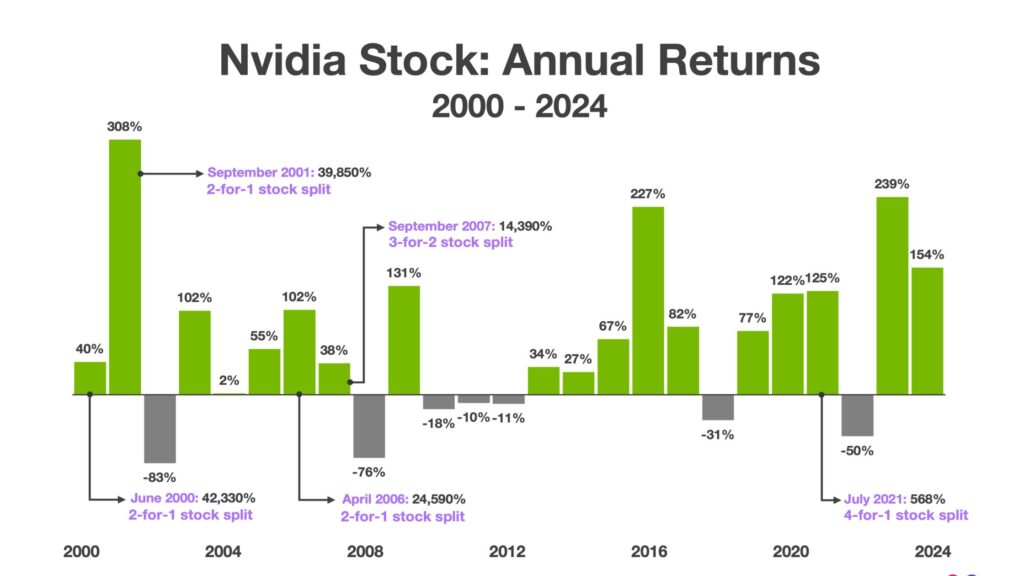
NVIDIA’s history is punctuated by moments of explosive growth followed by strategic splits to manage its share price. To date, NVIDIA has executed six stock splits since its initial public offering in 1999. Each split correlates with a specific era of technological advancement, from the early days of PC gaming to the current dominance of data centers and AI.
The 2024 Landmark 10-for-1 Split
The most recent and perhaps most significant split in NVIDIA’s history occurred on June 7, 2024. Following a meteoric rise driven by the demand for H100 GPUs, NVIDIA’s stock price had surged past the $1,000 mark. To maintain accessibility for retail investors and employees, the board approved a massive 10-for-1 split. This move effectively brought the share price back down to the $100–$120 range, significantly lowering the “sticker shock” for new market participants. This split was a clear indicator that NVIDIA expected its AI-driven revenue to remain sustainable for the long haul.
The 2021 Momentum Builder
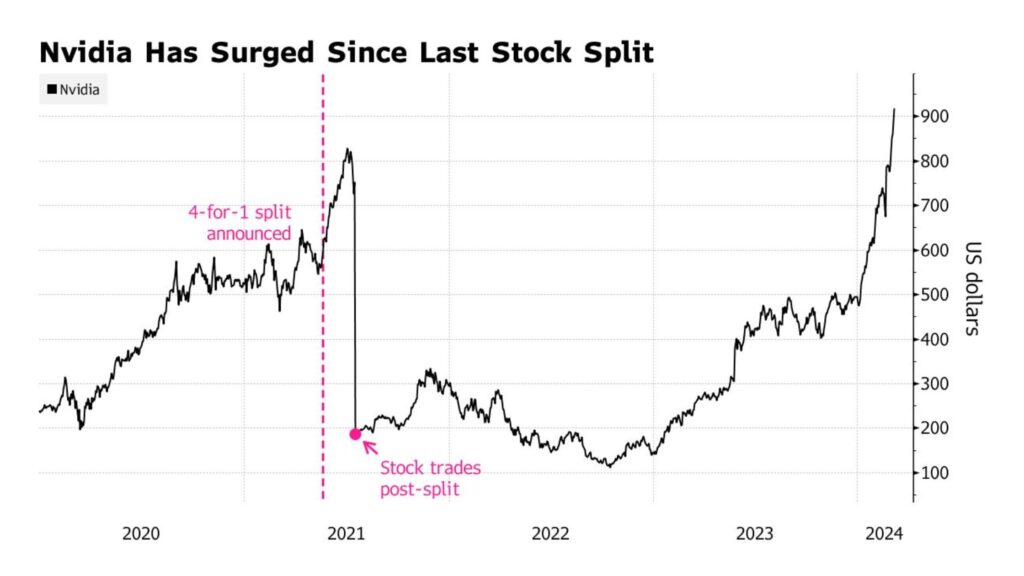
Prior to the AI boom of 2024, NVIDIA executed a 4-for-1 split on July 19, 2021. At this time, the company was benefiting from a surge in gaming demand during the global pandemic and the growing importance of its data center segment. The stock was trading near $800 per share before the split. By quadrupling the share count and quartering the price, NVIDIA made its stock more liquid during a period of intense market volatility, allowing a new wave of retail traders to enter the position.
Historical Splits: 2000–2007
NVIDIA’s earlier splits occurred during its formative years as it established dominance in the graphics processing unit (GPU) market:
- September 11, 2007: A 3-for-2 split.
- April 6, 2006: A 2-for-1 split.
- December 14, 2001: A 2-for-1 split.
- June 27, 2000: A 2-for-1 split.
These early actions were responses to the company’s initial successes in the gaming console and PC markets. During this era, NVIDIA was transitioning from a niche hardware manufacturer to a foundational pillar of the technology sector.
The Mechanics of a Split: Why NVIDIA Adjusts Its Share Price
From a fundamental accounting perspective, a stock split is a “zero-sum” event. If you own one share of a company worth $1,000 and it undergoes a 10-for-1 split, you now own ten shares worth $100 each. Your total equity remains $1,000. If the value doesn’t change, why does a financial powerhouse like NVIDIA bother with the administrative hurdle of a split? The reasons are rooted in market psychology and liquidity.
Enhancing Liquidity and Accessibility
Liquidity refers to how easily an asset can be bought or sold in the market without affecting its price. When a stock price climbs to $1,000 or $2,000, the “round lot” (100 shares) required for many institutional trading strategies becomes prohibitively expensive ($100,000 to $200,000). By splitting the stock, NVIDIA increases the total number of shares available for trade, which generally narrows the “bid-ask spread”—the difference between what buyers want to pay and what sellers want to receive. This makes the market for NVDA more efficient.
Psychological Pricing and Retail Investor Demand
While fractional shares have become common on platforms like Robinhood or Fidelity, many retail investors still prefer owning whole shares. Psychologically, buying 10 shares at $110 feels more attainable and rewarding to a small investor than buying 1.1 shares at $1,100. Furthermore, NVIDIA uses stock-based compensation for its thousands of employees. A lower share price allows the company to be more precise with its equity grants and makes it easier for employees to manage their individual portfolios.
Inclusion in Major Market Indices
One of the most tactical reasons for NVIDIA’s 2024 split was the potential for inclusion in the Dow Jones Industrial Average (DJIA). Unlike the S&P 500, which is market-cap weighted, the Dow is a price-weighted index. A company with a $1,000 share price would exert too much influence over the index, making it nearly impossible for the Dow to include it. By splitting 10-for-1 and bringing the price into the $100 range, NVIDIA positioned itself as a prime candidate for the blue-chip index, which it eventually joined in late 2024, replacing its rival Intel.
Analyzing the Financial Aftermath: Performance Trends Post-Split
Investors often look at a stock split as a bullish signal. Historically, companies that split their stock tend to outperform the broader market in the twelve months following the announcement. However, it is vital to distinguish between the split itself and the underlying business performance that necessitated the split.
Short-Term Volatility vs. Long-Term Value
In the immediate days following a split announcement, NVIDIA typically experiences a “split rally.” This is driven by anticipation and increased media coverage. However, once the split actually occurs, the stock often undergoes a period of consolidation. For example, after the 2024 split, NVIDIA saw significant volatility as the market digested the new share count and macro-economic factors like interest rate changes. Smart investors recognize that the split is a cosmetic change; the long-term value remains tied to NVIDIA’s ability to sell GPUs and maintain its competitive moat in the AI sector.
The “Split Run-Up” Phenomenon
Financial analysts often track the “run-up” period—the time between the announcement of a split and the date it takes effect. For NVIDIA, these periods have historically been characterized by high trading volume. Investors who buy during the run-up are often betting that the increased accessibility will drive a surge in buying pressure from retail investors once the price drops. While this trend has held true for NVIDIA in the past, it is a speculative strategy that carries risks, especially if the broader tech sector faces a downturn during that same window.
Investing in NVIDIA Post-Split: Strategies for Modern Portfolios
With NVIDIA now trading at a more accessible price point following its 10-for-1 split, many investors are re-evaluating their positions. While the lower price makes it easier to enter the market, the financial principles of valuation still apply.
Evaluating Valuation Multiples
A lower share price does not mean the stock is “cheap” in a fundamental sense. To determine if NVIDIA is a good investment post-split, investors must look at the Price-to-Earnings (P/E) ratio and the Forward P/E ratio. Because NVIDIA’s earnings have grown at an astronomical rate, its P/E ratio has often remained surprisingly reasonable despite its rising stock price. Investors should compare these multiples to historical averages and to peers like AMD or Microsoft to ensure they aren’t overpaying for growth.
Diversification Through ETFs and Fractional Shares
For those who are still wary of the volatility associated with a single semiconductor stock, the post-split environment offers several paths. Many Exchange-Traded Funds (ETFs), such as the VanEck Semiconductor ETF (SMH), carry NVIDIA as their largest holding. Additionally, now that the share price is lower, investors can more easily use “dollar-cost averaging” (DCA)—investing a fixed amount of money at regular intervals—to build a position over time without needing large capital outlays for each transaction.

Risk Management in a High-Growth Niche
The primary risk for NVIDIA investors post-split is “concentration risk.” Because NVIDIA has become such a massive part of the S&P 500 and the Nasdaq-100, many investors are inadvertently over-exposed to the company through their index funds. When the stock splits and retail interest spikes, it can lead to a crowded trade. Investors should regularly rebalance their portfolios to ensure that a correction in the semiconductor AI bubble doesn’t disproportionately damage their total net worth.
In conclusion, NVIDIA’s stock splits are more than just numerical adjustments; they are milestones in the company’s evolution from a gaming-centric hardware firm to the backbone of the global AI economy. By understanding the timing and the financial logic behind these splits, investors can better appreciate the company’s growth trajectory and make informed decisions about how to incorporate this tech giant into their long-term financial plans. Whether the price is $1,000 or $100, the underlying value of NVIDIA remains a cornerstone of the modern financial world.
aViewFromTheCave is a participant in the Amazon Services LLC Associates Program, an affiliate advertising program designed to provide a means for sites to earn advertising fees by advertising and linking to Amazon.com. Amazon, the Amazon logo, AmazonSupply, and the AmazonSupply logo are trademarks of Amazon.com, Inc. or its affiliates. As an Amazon Associate we earn affiliate commissions from qualifying purchases.