
The decision of when to claim Social Security is arguably the most significant financial choice you will make in your later adult life. For many Americans, Social Security represents the only source of inflation-adjusted, guaranteed income that lasts for life. Yet, the system is notoriously complex, governed by a web of rules regarding age, earnings, and marital status.
Taking benefits as soon as you are eligible at age 62 might seem tempting, especially if you are tired of the daily grind. On the other hand, waiting until age 70 can result in a substantially larger monthly check. Deciding where you fall on this spectrum requires more than just a cursory glance at your bank account; it requires a deep dive into your health, your portfolio, and your long-term legacy goals. This guide explores the financial mechanics of Social Security to help you determine the optimal time to file.
Understanding the Fundamentals: The Age and Benefit Relationship
The Social Security Administration (SSA) uses a formula to determine your Primary Insurance Amount (PIA), which is the benefit you receive if you wait until your Full Retirement Age (FRA). However, your actual monthly check is heavily influenced by the specific month and year you choose to begin receiving payments.
Full Retirement Age (FRA) and the 100% Benchmark
Your Full Retirement Age is the point at which you are entitled to 100% of your earned benefits. For those born between 1943 and 1954, the FRA is 66. For those born in 1960 or later, the FRA has shifted to 67. If you fall in between, your FRA increases by two months for every birth year. Understanding your specific FRA is the baseline for all subsequent calculations. Filing exactly at this age ensures no penalties, but it also means you miss out on the potential bonuses of a delayed filing.
The Cost of Early Filing
You can begin taking Social Security as early as age 62, but there is a permanent “price” for doing so. The SSA reduces your benefit for every month you claim prior to your FRA. For example, if your FRA is 67 and you claim at 62, your monthly benefit is permanently reduced by 30%. This reduction is designed to be actuarially fair—meaning that because you are receiving checks for a longer period, the individual checks must be smaller. However, in an era of increasing longevity, this 30% haircut can significantly undermine your purchasing power in your 80s and 90s.
The Power of Delayed Retirement Credits
Conversely, for every year you delay claiming past your FRA up until age 70, your benefit increases by approximately 8% per year. This is known as a Delayed Retirement Credit. This 8% annual “return” is guaranteed by the federal government and is inflation-adjusted. In the world of personal finance, finding a guaranteed 8% return is virtually impossible elsewhere. By waiting from age 67 to age 70, a retiree can increase their monthly check by 24%. For many, this “pension-like” growth makes waiting the most effective way to hedge against the risk of outliving their savings.
Factors Influencing Your Decision: When to Claim Early vs. Late
While the math of waiting is compelling, your personal circumstances might dictate a different path. Personal finance is more “personal” than “finance,” and several qualitative factors must be weighed against the quantitative benefits of waiting.
Health Status and Life Expectancy
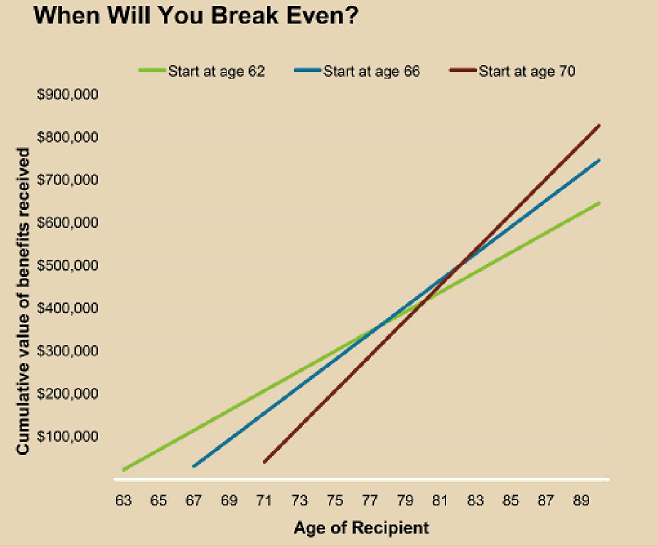
The entire Social Security system is built on “break-even” math. Generally, if you live past the age of 78 to 82, you will collect more total lifetime dollars by waiting until age 70 than if you had started at age 62. Therefore, your current health and family medical history are vital data points. If you have chronic health issues or a family history of shorter lifespans, claiming early may be the logical choice to ensure you receive your fair share of the system. Conversely, if you are in excellent health and have relatives who lived into their late 90s, delaying as long as possible is almost always the superior financial move.
Immediate Cash Flow Needs and Employment Status
If you are 62, unemployed, and have no other assets, the “luxury” of waiting until 70 is non-existent. Social Security acts as a safety net for a reason. However, if you are still working, claiming early can be counterproductive. If you are under your FRA and earn more than a certain threshold (which adjusts annually), the SSA will withhold $1 in benefits for every $2 you earn over that limit. While these withheld benefits are eventually added back to your check once you reach FRA, the immediate “tax” on your benefits often makes early filing while working a poor strategic move.

The Spousal and Survivor Benefit Factor
Deciding when to take Social Security isn’t just about you; it’s about your household. This is particularly true for the higher-earning spouse. When one spouse dies, the survivor is entitled to the higher of the two Social Security checks the couple was receiving. If the higher earner delays until age 70, they are not just maximizing their own benefit; they are maximizing the potential “survivor benefit” for their spouse. For couples with a significant age gap or where one spouse has a much smaller earnings history, the higher earner waiting until 70 is often the single best insurance policy the couple can “buy.”
Taxation and the Intersection of Work and Benefits
A common oversight in retirement planning is the impact of taxes on Social Security benefits. Many retirees are surprised to find that their “guaranteed” income is subject to federal (and sometimes state) income tax.
The Combined Income Formula
The IRS uses a metric called “provisional income” (or combined income) to determine if your benefits are taxable. This is calculated by taking your Adjusted Gross Income (AGI), plus non-taxable interest, plus 50% of your Social Security benefits. If this total exceeds $34,000 for individuals or $44,000 for joint filers, up to 85% of your Social Security benefits can be taxed. If you have large RMDs (Required Minimum Distributions) from a traditional IRA or 401(k), taking Social Security early might push you into a higher tax bracket, effectively reducing the net value of your benefits.
Strategic Withdrawals: Spending Down Private Assets
For those with significant retirement savings, it often makes sense to “spend down” traditional IRA or 401(k) balances between the ages of 62 and 70 while delaying Social Security. This strategy serves two purposes: it allows your Social Security benefit to grow by 8% annually, and it reduces the size of your tax-deferred accounts. Reducing these accounts early can lower your future RMDs, which in turn can lower your future tax bracket and reduce the percentage of your Social Security that is subject to taxation later in life.
Modern Tools and Strategies for Optimization
The decision to claim Social Security should not be made in a vacuum. It should be integrated into a comprehensive financial plan using data-driven tools and professional methodologies.
Utilizing Break-Even Analysis
A break-even analysis is a calculation that determines the age at which the total cumulative benefits of a later filing date exceed the total cumulative benefits of an earlier filing date. For most people, the break-even age for waiting until 70 versus 62 is approximately 80 years old. If you believe you will live past 80, the “math” says wait. Modern financial software can help you visualize these “cross-over points” and model how different inflation rates might affect the outcome.
Coordinating with Other Retirement Assets
In the modern “Money” landscape, Social Security is just one piece of the puzzle alongside Roth IRAs, brokerage accounts, and real estate. A sophisticated strategy might involve “Social Security Bridge” planning. This involves using a portion of your liquid investments to “bridge” the gap between your retirement date and age 70. This allows you to secure the maximum possible inflation-protected income for the remainder of your life, which functions as a “floor” for your retirement spending.
Professional Consultation and Software
The SSA employees are prohibited from giving specific “advice” on when you should claim; they can only provide information on your current options. Therefore, it is often wise to consult with a financial advisor who specializes in retirement income planning. Using specialized software, an advisor can run thousands of Monte Carlo simulations to show how different claiming ages affect your “portfolio success rate”—the probability that you will not run out of money before you die.

Conclusion: Making the Final Call
There is no “one-size-fits-all” answer to the question of when to take Social Security. It is a balancing act between mathematical optimization and personal peace of mind. If you value the “bird in the hand” and have immediate needs or health concerns, claiming at 62 or FRA is a valid choice. However, if you view Social Security as a hedge against longevity and a way to protect a surviving spouse, the 8% annual growth offered by delaying until age 70 is a financial opportunity that is hard to ignore.
By understanding the mechanics of FRA, accounting for the tax implications of your combined income, and viewing your benefits as a component of your broader investment portfolio, you can move away from guesswork and toward a calculated, confident retirement strategy. Treat Social Security not just as a monthly check, but as a strategic asset that requires careful timing to yield its maximum value.
aViewFromTheCave is a participant in the Amazon Services LLC Associates Program, an affiliate advertising program designed to provide a means for sites to earn advertising fees by advertising and linking to Amazon.com. Amazon, the Amazon logo, AmazonSupply, and the AmazonSupply logo are trademarks of Amazon.com, Inc. or its affiliates. As an Amazon Associate we earn affiliate commissions from qualifying purchases.