
For millions of Americans facing disabling conditions, Social Security Disability Insurance (SSDI) represents a crucial financial lifeline. However, the path to understanding and securing these benefits often feels complex and shrouded in uncertainty. One of the most common and pressing questions for potential applicants is, “How much is SSDI?” The answer, unfortunately, is not a simple fixed number. Instead, your SSDI benefit amount is highly individualized, meticulously calculated by the Social Security Administration (SSA) based on your unique work history, earnings record, and other specific factors.
Navigating the intricacies of federal benefit programs can be daunting. This comprehensive guide aims to demystify SSDI, shedding light on the factors that determine your potential payments, the application process, and what you can expect financially. We’ll break down the components that contribute to your monthly benefit, ensuring you have a clearer picture of this vital safety net and empowering you to approach your application with greater confidence and knowledge.

Demystifying SSDI: What It Is and Who Qualifies
Understanding the fundamental nature of SSDI is the first step toward comprehending its value and how your benefit amount is determined. It’s not a welfare program but an insurance benefit funded by the Social Security taxes you and your employers have paid throughout your working life.
Defining Social Security Disability Insurance (SSDI)
SSDI is a federal insurance program that provides monthly benefits to individuals who have worked long enough and recently enough, paid Social Security taxes, and are now unable to engage in any “substantial gainful activity” (SGA) due to a severe medical condition that is expected to last at least one year or result in death. It’s an earned benefit, meaning eligibility and payment amounts are tied directly to your contributions to the Social Security system over your career. Think of it as a long-term disability insurance policy that you’ve been contributing to through payroll taxes. The program aims to replace a portion of your lost income when a severe disability prevents you from working.
Key Eligibility Requirements for SSDI
Qualifying for SSDI involves meeting two primary sets of criteria: medical and technical (work-related).
- Medical Eligibility: The SSA has a stringent definition of disability. To qualify, you must have a medical condition that prevents you from doing any substantial gainful activity (SGA) and is expected to last for at least 12 months or result in death. This isn’t about being unable to do your previous job; it’s about being unable to do any job that exists in significant numbers in the national economy, considering your age, education, and work experience. The SSA evaluates your condition using a five-step sequential evaluation process.
- Technical (Work-Related) Eligibility: To be eligible for SSDI, you must have accumulated a sufficient number of “work credits” from your earnings. You can earn up to four work credits each year. The number of credits required depends on your age when your disability began. For instance, most adults need 40 credits, with 20 of them earned in the last 10 years ending with the year you became disabled. Younger workers may qualify with fewer credits. This work credit requirement is crucial because it establishes your “insured status” with the Social Security program, much like paying premiums for any other insurance policy.
The Difference Between SSDI and SSI
It’s common to confuse SSDI with Supplemental Security Income (SSI), but they are distinct programs. While both are administered by the SSA and provide financial assistance to disabled individuals, their eligibility criteria and funding sources differ significantly.
- SSDI (Social Security Disability Insurance): As discussed, it’s an insurance program based on your work history and contributions to Social Security taxes. It’s for those who have earned enough work credits.
- SSI (Supplemental Security Income): This is a needs-based program for low-income individuals who are aged, blind, or disabled. It’s funded by general tax revenues, not Social Security taxes. Eligibility for SSI does not depend on your work history or work credits, but rather on your income and resources being below certain very low limits. An individual can sometimes qualify for both SSDI and SSI if their SSDI benefit is very low and they meet the SSI income and resource limits.
Factors Influencing Your SSDI Benefit Amount
Once medical and technical eligibility are established, the next crucial step is determining the actual monthly payment. Unlike private disability insurance where you might choose a benefit level, your SSDI amount is calculated by the SSA using a precise formula primarily based on your past earnings.
Your Work History and Average Indexed Monthly Earnings (AIME)
The cornerstone of your SSDI benefit calculation is your “average indexed monthly earnings” (AIME). This isn’t simply a straightforward average of all your earnings. The SSA “indexes” your past earnings to account for changes in the general wage level over time. This process ensures that your earlier earnings are brought up to a more current value, reflecting their relative worth today. Essentially, the SSA looks at your earnings from various years, adjusts them for inflation, and then calculates an average of your highest earning years over a specific period (typically 35 years for retirement, but a shorter “computation period” for disability). The higher your AIME, the higher your potential SSDI benefit. Consistent and higher earnings throughout your career contribute to a more substantial AIME.
The Primary Insurance Amount (PIA) Calculation
Your AIME is then used to determine your “Primary Insurance Amount” (PIA). The PIA is the base amount of your monthly benefit before any adjustments. The SSA uses a progressive formula with “bend points” to calculate the PIA. This means that lower earners receive a higher percentage of their average indexed monthly earnings compared to higher earners, reflecting the program’s social insurance goal of providing a more substantial safety net for those with lower incomes.
For example, for 2024, the formula is:
- 90% of the first $1,174 of your AIME
- 32% of your AIME between $1,174 and $7,078
- 15% of your AIME over $7,078
These amounts are added together to arrive at your PIA. The bend points ($1,174 and $7,078) are updated annually to reflect changes in the national average wage index. The progressive nature of this formula means that while higher earners generally receive more, the benefit does not increase proportionally with earnings indefinitely.
Maximum and Minimum Benefit Amounts
While there isn’t an official “minimum” SSDI benefit, the calculation based on your work history naturally sets a floor. For individuals with very limited work histories and low earnings, the PIA formula will yield a lower benefit. However, the average SSDI benefit for disabled workers in December 2023 was approximately $1,537 per month.
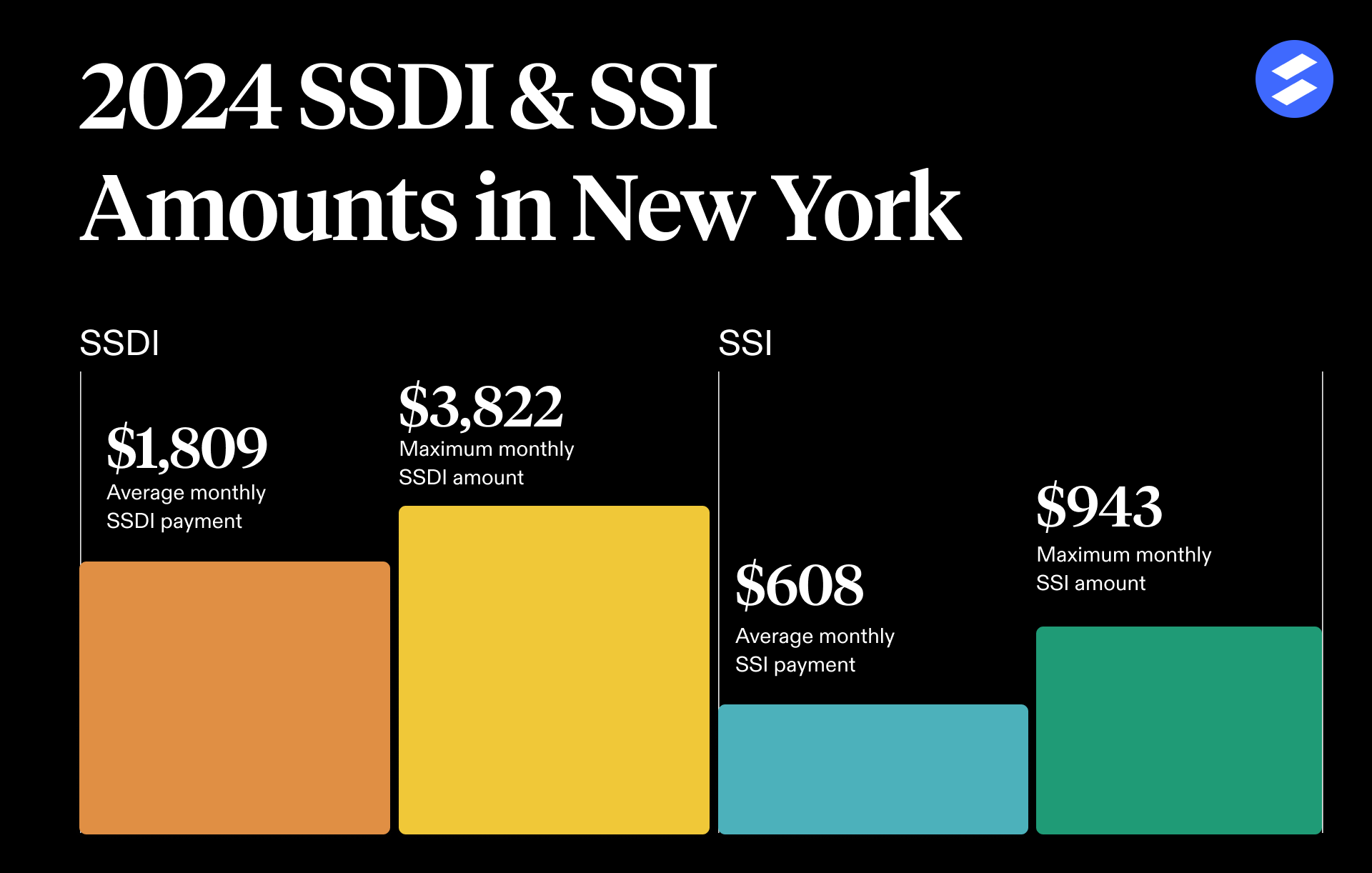
There is also a “maximum” SSDI benefit. For 2024, the maximum possible SSDI benefit for a disabled worker is $3,822 per month. This maximum is reached only by individuals who have consistently earned at or above the Social Security taxable maximum for many years. It’s important to note that very few individuals receive the maximum benefit, as it requires a history of high earnings over a significant period.
Family Benefits: When Others Can Receive Payments
SSDI isn’t just for the disabled worker; certain family members may also be eligible to receive auxiliary benefits based on your work record. These can include:
- Your spouse (if they are age 62 or older, or caring for your child who is under age 16 or disabled).
- Your unmarried dependent children (under age 18, or 18-19 if a full-time student, or disabled before age 22).
- In some cases, a divorced spouse (if the marriage lasted 10 years or more and other conditions are met).
The total amount that a family can receive on your record is capped by a “family maximum” benefit, which is typically between 150% and 180% of your PIA. If the sum of individual family benefits exceeds this cap, each family member’s benefit (except yours) will be proportionally reduced.
Understanding the Application and Approval Process
Securing SSDI benefits is rarely a swift or straightforward process. It requires diligence, patience, and a thorough understanding of the SSA’s requirements. The application itself, and the subsequent stages, play a crucial role in whether you ultimately receive benefits and how quickly.
Initial Application and Required Documentation
The application for SSDI can be started online, by phone, or in person at a local Social Security office. Regardless of how you initiate it, the application package requires an extensive array of personal, work, and medical information. You’ll need to provide details about your past employment (job titles, dates, duties, earnings), educational background, and, most importantly, comprehensive medical evidence. This includes names and contact information for all doctors, hospitals, and clinics that have treated you, as well as dates of visits, tests, and treatments. Accuracy and completeness are paramount at this stage to avoid unnecessary delays. The SSA will use this information to request your medical records directly.
The Importance of Medical Evidence
Medical evidence is the bedrock of any successful disability claim. The SSA’s decision relies almost entirely on objective medical findings, clinical diagnoses, treatment histories, and the opinions of your treating physicians. It’s not enough to simply state you are disabled; you must prove it through documentation. This includes:
- Medical Records: Hospitalizations, doctor’s visit notes, lab results, imaging scans (X-rays, MRIs, CTs), and psychological evaluations.
- Treatment History: Records detailing medications, therapies, surgeries, and their effectiveness.
- Doctor’s Opinions: Statements from your treating physicians outlining your diagnosis, prognosis, functional limitations, and how your condition affects your ability to perform work-related activities. These statements carry significant weight, particularly if they are well-supported by objective medical evidence.
A thorough and consistent medical history demonstrating the severity and duration of your condition is vital.
Potential Waiting Periods and Back Pay
Even after approval, there’s a mandatory five-month waiting period before your SSDI cash benefits can begin. This waiting period starts from the “established onset date” (EOD) of your disability, which is the date the SSA determines your disability began. So, if your EOD is January 1st, your first benefit payment would be for the month of June.
If the application process takes longer than five months from your EOD to your approval, you may be eligible for “back pay.” Back pay consists of the monthly benefits you would have received from the end of your waiting period up to the point your claim is approved. The SSA calculates back pay based on your established onset date and the date you applied, ensuring you receive benefits for the period you were medically eligible but awaiting a decision.
What Happens After Approval: Ongoing Reviews
SSDI benefits are not necessarily permanent. The SSA conducts periodic “Continuing Disability Reviews” (CDRs) to determine if your medical condition has improved to the point where you are no longer considered disabled. The frequency of these reviews depends on the likelihood of your medical improvement:
- Medical Improvement Expected (MIE): Review within 6-18 months.
- Medical Improvement Possible (MIP): Review every 3 years.
- Medical Improvement Not Expected (MINE): Review every 5-7 years.
During a CDR, you will need to provide updated medical information, and the SSA will re-evaluate your ability to work. It’s crucial to continue receiving medical treatment and maintaining thorough records even after approval.
Navigating Common Questions and Financial Implications
Receiving SSDI benefits brings with it a new set of financial considerations. Understanding how these benefits interact with other aspects of your financial life is crucial for effective budgeting and long-term planning.
Taxation of SSDI Benefits
For some recipients, a portion of their SSDI benefits may be subject to federal income tax. This typically occurs if your “combined income” (which includes half of your SSDI benefits plus all other taxable income) exceeds certain thresholds:
- Individual Filers: If your combined income is between $25,000 and $34,000, up to 50% of your benefits may be taxable. If it’s over $34,000, up to 85% may be taxable.
- Married Filing Jointly: If your combined income is between $32,000 and $44,000, up to 50% of your benefits may be taxable. If it’s over $44,000, up to 85% may be taxable.
It’s important to consult with a tax professional to understand your specific tax liability, as state taxation of benefits can also vary. The SSA will send you a Social Security Benefit Statement (Form SSA-1099) each January, which shows the amount of benefits you received in the previous year.
Impact on Other Benefits (Medicare, Medicaid)
One significant advantage of receiving SSDI is the eventual eligibility for Medicare. After you’ve received SSDI payments for 24 months, you will automatically become eligible for Medicare Part A (hospital insurance), Part B (medical insurance), and usually Part D (prescription drug coverage). There is a premium for Part B and Part D. This 24-month waiting period begins after your five-month SSDI waiting period ends. So, it’s typically 29 months from your established onset date before Medicare coverage kicks in.
For those with very low income and resources, Medicaid might provide health coverage during the Medicare waiting period or supplement Medicare coverage later. It’s also possible to receive both SSDI and Medicaid, particularly if your SSDI benefit is low. SSDI status does not automatically qualify you for Medicaid; you must still meet your state’s income and resource limits for the program.
Working While Receiving SSDI: The Trial Work Period
The SSA encourages SSDI recipients to attempt to return to work if they are able. To facilitate this, they have “work incentives” programs designed to allow beneficiaries to test their ability to work without immediately losing their benefits. The most notable of these is the “Trial Work Period” (TWP).
During your TWP, you can work and earn any amount for up to nine months without affecting your SSDI benefits. These nine months don’t have to be consecutive. A “trial work period month” is generally any month in which your gross earnings exceed a certain limit (e.g., $1,110 in 2024). After the nine TWP months are used, your case enters an “extended period of eligibility” (EPE) during which you can still receive benefits for any month your earnings are below “substantial gainful activity” (SGA) levels. This program provides a crucial safety net for those attempting to re-enter the workforce.
Financial Planning and Budgeting with SSDI
Receiving SSDI benefits often means a significant adjustment to your previous income level. Therefore, meticulous financial planning and budgeting become more critical than ever.
- Assess Your New Income: Understand your exact monthly SSDI benefit and any family benefits. Factor in potential taxation.
- Review Expenses: Go through all your monthly expenditures and identify areas where you can cut back.
- Prioritize Needs: Ensure essential expenses like housing, utilities, food, and medical costs are covered.
- Utilize Resources: Look into local and state programs that can assist with housing, food, energy bills, or transportation for individuals with disabilities.
- Emergency Fund: Even with SSDI, having an emergency fund is crucial for unexpected costs.
- Debt Management: Develop a plan to manage or reduce any outstanding debt, as interest payments can significantly strain a fixed income.
Seeking Expert Guidance for Your SSDI Claim
Given the complexity and the high stakes involved in an SSDI application, seeking professional assistance can significantly improve your chances of approval and alleviate much of the stress.
The Value of Legal Representation
Many individuals find the SSDI application and appeals process overwhelming. Disability attorneys or advocates specialize in this area and can provide invaluable support. They can:
- Help you gather and organize medical evidence.
- Communicate with your doctors to secure supportive statements.
- File appeals if your initial application is denied.
- Represent you at hearings before an administrative law judge (ALJ).
- Understand complex regulations and present your case effectively.
Their fees are regulated by law, typically a percentage of your back pay, capped at a certain amount (e.g., $7,200 in 2023), and are only collected if your claim is approved.
Resources from the Social Security Administration
The SSA itself offers numerous resources to help applicants. Their website (SSA.gov) is a treasure trove of information, forms, and tools. You can create a “my Social Security” account to check your earnings record, estimate future benefits, and track the status of your application. Local Social Security offices also have staff who can answer questions and assist with the application process, though they cannot provide legal advice. Utilizing these direct resources can clarify many uncertainties.

Proactive Steps for a Successful Application
While every case is unique, several proactive steps can strengthen your SSDI application:
- Seek Consistent Medical Treatment: Regular visits to your doctors, adherence to prescribed treatments, and specialists’ evaluations provide a strong medical record.
- Keep Meticulous Records: Maintain a personal file of all your medical records, doctor’s contact information, and details of treatments.
- Be Honest and Detailed: Provide accurate and comprehensive information on all application forms, especially regarding your symptoms, limitations, and how your condition affects daily activities.
- Understand SSA’s Definition of Disability: Frame your application and discussions around how your condition prevents “substantial gainful activity,” not just your former job.
- Be Patient and Persistent: The process can be lengthy, and initial denials are common. Many successful claims are approved at the reconsideration or hearing stage.
Understanding “how much is SSDI” is about more than just a number; it’s about grasping the intricate system that determines your financial security in times of disability. By educating yourself on the eligibility requirements, benefit calculation methods, application process, and financial implications, you empower yourself to navigate this critical federal program more effectively. While the journey to approval can be challenging, a clear understanding of the system and, where appropriate, professional guidance, can significantly ease the path toward securing the benefits you have earned and deserve.
aViewFromTheCave is a participant in the Amazon Services LLC Associates Program, an affiliate advertising program designed to provide a means for sites to earn advertising fees by advertising and linking to Amazon.com. Amazon, the Amazon logo, AmazonSupply, and the AmazonSupply logo are trademarks of Amazon.com, Inc. or its affiliates. As an Amazon Associate we earn affiliate commissions from qualifying purchases.