
In the dynamic world of investing, discerning the most effective and accessible strategies can often feel like navigating a labyrinth. Among the myriad of investment vehicles available, the S&P 500 index fund stands out as a remarkably popular and often recommended choice for both novice and seasoned investors. Far from being a complex, esoteric financial product, an S&P 500 index fund is a straightforward, low-cost way to invest in the broader U.S. stock market. It offers a unique blend of diversification, simplicity, and historical performance that aligns well with long-term wealth accumulation goals.

At its core, an S&P 500 index fund is an investment fund designed to replicate the performance of the S&P 500 Index. This index, a benchmark of the largest 500 publicly traded companies in the United States, represents a significant portion of the U.S. economy. By investing in such a fund, you are effectively buying a tiny piece of hundreds of America’s most influential and successful corporations, all within a single investment. This article will delve into the intricacies of what makes an S&P 500 index fund such a cornerstone of modern personal finance, exploring its underlying mechanics, its compelling benefits, and how one can strategically incorporate it into their investment portfolio.
Understanding the S&P 500 Index
Before we can fully appreciate the index fund that tracks it, it’s crucial to understand the S&P 500 Index itself. Often cited in financial news and analyst reports, the S&P 500 is more than just a list of companies; it’s a vital economic indicator and a benchmark for the health of the U.S. stock market.
What is the S&P 500?
The S&P 500, officially known as the Standard & Poor’s 500, is a stock market index maintained by S&P Dow Jones Indices. It comprises 500 of the largest publicly traded companies in the United States, selected by a committee based on criteria such as market size, liquidity, and sector representation. Unlike some other indices that might focus solely on a fixed number of companies or specific sectors, the S&P 500 aims to be a broad representation of the U.S. economy. These 500 companies span various industries, including technology, healthcare, financials, consumer discretionary, and industrials, among others. While it’s commonly referred to as the “top 500,” it’s not strictly the 500 largest by market capitalization at any given moment, but rather a curated list designed for broad market exposure and economic representation.
The Role of Market Capitalization
The S&P 500 is a market-capitalization-weighted index. This means that companies with larger market capitalizations (stock price multiplied by the number of outstanding shares) have a greater impact on the index’s performance than smaller companies within the index. For example, a significant movement in the stock price of Apple or Microsoft, both enormous companies by market cap, will have a more pronounced effect on the overall S&P 500 index value than a similar percentage move in a company with a smaller market cap. This weighting methodology ensures that the index accurately reflects the economic impact and stock market influence of its largest constituents. It also means that a single S&P 500 index fund inherently allocates more capital to these larger, often more established companies, aligning with their greater share of the overall market.
Why the S&P 500 is a Benchmark
The S&P 500 is widely regarded as the best gauge of large-cap U.S. equities and a proxy for the overall health of the U.S. stock market. Fund managers and individual investors alike often measure their portfolio’s performance against the S&P 500. If an actively managed fund aims to outperform the market, its success is frequently judged by whether it beats the S&P 500’s returns over a given period. Its broad coverage, rigorous selection process, and market-cap weighting make it an authoritative and credible benchmark, providing a clear reference point for evaluating investment performance and understanding market trends.
The Mechanics of an Index Fund
With a solid understanding of the S&P 500 index, we can now turn our attention to the investment vehicle designed to track it: the S&P 500 index fund. These funds embody a revolutionary approach to investing known as passive investing.
Passive Investing Philosophy
The core philosophy behind index funds, including those tracking the S&P 500, is passive investing. Unlike actively managed funds, where a team of professional managers attempts to “beat the market” by hand-picking stocks, timing purchases and sales, and conducting extensive research, passive index funds simply aim to mirror the performance of a specific market index. The underlying belief is that, over the long term, very few active managers consistently outperform the market after accounting for fees. Therefore, rather than trying to beat the market and incurring high costs in the process, investors can achieve market-level returns by simply tracking it. This hands-off approach significantly reduces management fees and trading costs, which can compound into substantial savings over decades.
How Index Funds Track the S&P 500
An S&P 500 index fund achieves its objective by holding the same stocks as the S&P 500 index, in roughly the same proportions. If the S&P 500 index decides to add or remove a company, the index fund will adjust its holdings accordingly. This rebalancing occurs periodically, ensuring the fund’s portfolio accurately reflects the current composition and weighting of the index. For instance, if Apple constitutes 7% of the S&P 500 index, the index fund will aim to have approximately 7% of its assets invested in Apple stock. This systematic replication means the fund’s performance will closely track that of the index, minus minor differences due to fees and transaction costs, known as “tracking error.” The goal is not to outperform but to mirror.
Mutual Funds vs. Exchange-Traded Funds (ETFs)
S&P 500 index funds are primarily offered in two structures: mutual funds and Exchange-Traded Funds (ETFs). While both aim to track the S&P 500, they differ in how they are bought and sold, and their typical fee structures.
-
Mutual Funds: These are typically bought and sold directly from the fund company at the end of the trading day, based on their Net Asset Value (NAV). They often require minimum investment amounts and are well-suited for regular, automated contributions, making them popular for retirement accounts like 401(k)s and IRAs. Many major financial institutions offer S&P 500 index mutual funds with very low expense ratios.
-
ETFs: ETFs trade like individual stocks on an exchange throughout the day. This offers more flexibility for intraday trading but also means their price can fluctuate based on supply and demand, potentially differing slightly from their NAV. ETFs generally have even lower expense ratios than their mutual fund counterparts and often allow for fractional share purchases, making them accessible with smaller initial investments. For many investors, especially those with brokerage accounts, S&P 500 ETFs like SPY, IVV, or VOO are a popular choice.
The choice between an S&P 500 mutual fund and an S&P 500 ETF often comes down to personal preference regarding trading flexibility, minimum investment requirements, and how one prefers to manage contributions. Both offer similar exposure and performance characteristics.
Key Benefits of Investing in an S&P 500 Index Fund
The widespread appeal of S&P 500 index funds isn’t accidental; it’s a direct result of several compelling advantages they offer to investors seeking long-term growth and stability.
Diversification Across Large-Cap U.S. Companies
One of the most significant benefits is instant diversification. By investing in a single S&P 500 index fund, you gain exposure to 500 different companies across numerous sectors of the U.S. economy. This significantly reduces the risk associated with investing in individual stocks. If one company performs poorly or even goes bankrupt, its impact on your overall portfolio is cushioned by the performance of the other 499 companies. This broad market exposure helps smooth out volatility and provides a more stable growth trajectory than a concentrated portfolio of a few stocks.
Low Costs and Expense Ratios
As passive investment vehicles, S&P 500 index funds do not require expensive teams of analysts or active trading strategies. This operational efficiency translates into very low expense ratios – the annual fee charged as a percentage of your investment. While actively managed funds might charge 1% or more annually, many S&P 500 index funds boast expense ratios well below 0.10%, some even as low as 0.03%. Over decades, these seemingly small differences in fees can amount to hundreds of thousands of dollars in extra returns for the investor, making low costs a powerful driver of long-term wealth.
Simplicity and Accessibility
S&P 500 index funds are remarkably simple to understand and manage. There’s no need to research individual companies, analyze financial statements, or fret over market timing. The strategy is clear: buy the market and hold for the long term. This simplicity makes them an excellent choice for beginners and busy individuals who want to invest wisely without dedicating extensive time to market analysis. They are also highly accessible, available through virtually all major brokerage platforms and retirement accounts.
Historical Performance and Long-Term Growth Potential
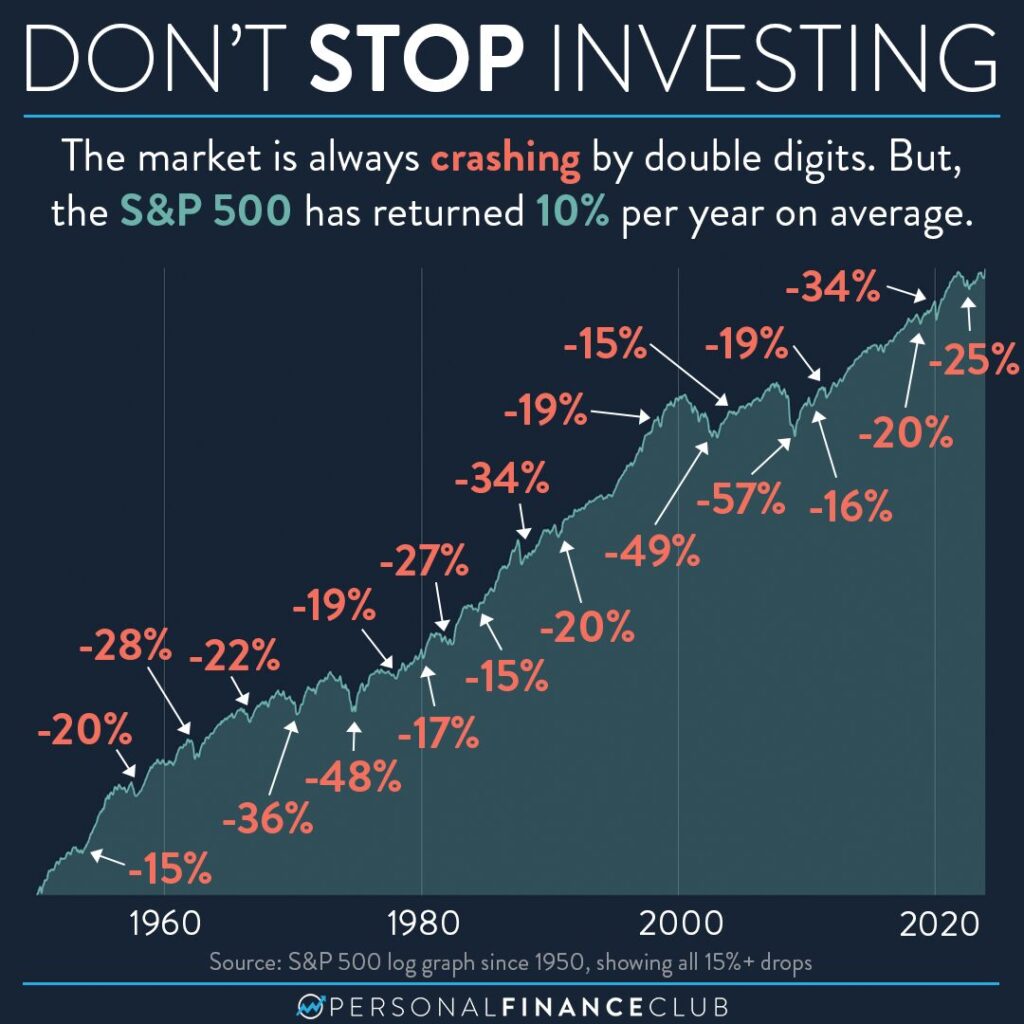
Historically, the S&P 500 has delivered robust average annual returns over the long term, typically in the range of 10-12% before inflation over multi-decade periods. While past performance is no guarantee of future results, this track record demonstrates its potential for significant wealth creation when combined with a consistent, long-term investment horizon. Investing in an S&P 500 index fund allows investors to capture this historical growth potential, benefiting from the collective innovation and expansion of America’s leading companies.
Potential Considerations and Risks
While S&P 500 index funds offer compelling advantages, it’s also important for investors to understand their inherent characteristics and potential risks, as no investment is entirely without downside.
Market Volatility and Drawdowns
Despite their diversification, S&P 500 index funds are still fully exposed to the overall movements of the stock market. During periods of economic recession, market corrections, or bear markets, the value of an S&P 500 index fund will decline along with the broader market. Investors must be prepared for this inherent volatility and understand that their portfolio value can fluctuate significantly in the short to medium term. The key is to maintain a long-term perspective and resist the urge to sell during downturns.
Lack of Active Management for Outperformance
The very nature of an index fund means it will never “beat the market” because its goal is to match the market’s performance. For investors who believe in their ability or a fund manager’s ability to consistently pick winning stocks and outperform the S&P 500, an index fund might feel restrictive. However, decades of financial research suggest that very few active managers consistently achieve this over the long run, especially after accounting for their higher fees.
Concentration in U.S. Large-Cap Stocks
While diversified across sectors within the U.S., an S&P 500 index fund is solely concentrated in large-capitalization American companies. This means it lacks exposure to international markets (developed or emerging), as well as small-cap and mid-cap U.S. companies. For investors seeking a truly globally diversified portfolio, an S&P 500 index fund should be considered a core component, but likely supplemented with international stock funds and potentially bonds or other asset classes to achieve broader diversification.
Tracking Error (Minor)
Although minimal for well-managed funds, “tracking error” is a small risk inherent in all index funds. This refers to the slight difference between the fund’s actual returns and the index’s theoretical returns. It can arise from factors like the fund’s expense ratio, transaction costs incurred when rebalancing, or holding a slightly different set of securities than the exact index for practical reasons. For most major S&P 500 index funds, this error is typically negligible and rarely impacts long-term returns significantly.
How to Invest in an S&P 500 Index Fund
Investing in an S&P 500 index fund is a straightforward process, making it accessible to nearly anyone looking to start their investment journey.
Choosing a Brokerage Account
The first step is to open an investment account with a reputable brokerage firm. Popular options include online brokers like Fidelity, Vanguard, Charles Schwab, E*TRADE, or TD Ameritrade (now Schwab). You can open various account types, such as a taxable brokerage account, a Traditional IRA, a Roth IRA, or even a 401(k) if offered by your employer. Ensure the brokerage offers low-cost S&P 500 index funds or ETFs.
Selecting the Right Fund (Mutual Fund or ETF)
Once your account is set up, you’ll need to choose between an S&P 500 index mutual fund or an S&P 500 ETF.
- For Mutual Funds: Look for funds with “S&P 500 Index” in their name from providers like Vanguard (e.g., VFIAX or VOO), Fidelity (e.g., FXAIX), or Schwab (e.g., SWPPX). Pay close attention to the expense ratio, aiming for one below 0.10%. Some mutual funds might have a minimum initial investment, sometimes several thousands of dollars.
- For ETFs: Popular S&P 500 ETFs include SPDR S&P 500 ETF Trust (SPY), iShares Core S&P 500 (IVV), and Vanguard S&P 500 ETF (VOO). These can be bought and sold like regular stocks. ETFs typically have no minimum investment beyond the price of one share, making them highly accessible.
Consider your investment style (e.g., automated contributions vs. buying individual shares) and initial capital when making your choice.
Regular Contributions and Dollar-Cost Averaging
One of the most effective strategies for investing in an S&P 500 index fund is through regular, consistent contributions. This practice, known as dollar-cost averaging, involves investing a fixed amount of money at regular intervals (e.g., weekly, bi-weekly, or monthly), regardless of market fluctuations. When prices are high, your fixed amount buys fewer shares; when prices are low, it buys more shares. Over time, this strategy helps average out your purchase price, reduces the impact of short-term volatility, and removes the emotional aspect of trying to time the market.

Integration into a Broader Investment Strategy
While powerful, an S&P 500 index fund is often just one component of a well-rounded investment portfolio. Depending on your age, risk tolerance, and financial goals, you might consider complementing it with:
- International Stock Funds: To diversify globally and capture growth outside the U.S.
- Bond Funds: To add stability and income, especially as you approach retirement.
- Other Asset Classes: Such as real estate or commodities, for further diversification.
For many, an S&P 500 index fund serves as the core “equity allocation” within a broader, diversified portfolio that aims to balance growth with risk management.
In conclusion, an S&P 500 index fund offers an elegant, efficient, and historically proven path to long-term wealth accumulation. By providing broad diversification across America’s leading companies at exceptionally low costs, it empowers investors to participate in the growth of the U.S. economy without the complexities and higher risks often associated with active stock picking. Whether you’re just starting your investment journey or looking to simplify your existing portfolio, an S&P 500 index fund often serves as a foundational building block for a robust and successful financial future.
aViewFromTheCave is a participant in the Amazon Services LLC Associates Program, an affiliate advertising program designed to provide a means for sites to earn advertising fees by advertising and linking to Amazon.com. Amazon, the Amazon logo, AmazonSupply, and the AmazonSupply logo are trademarks of Amazon.com, Inc. or its affiliates. As an Amazon Associate we earn affiliate commissions from qualifying purchases.