
Understanding the mechanics of daily interest is a foundational skill for anyone serious about mastering their personal finances. Whether you are looking to accelerate your journey toward debt freedom or seeking to maximize the yields on your investment portfolio, the way interest accrues on a day-to-day basis has a profound impact on your net worth.
Most financial institutions present interest rates as an annual figure (APR), but the reality of how money moves is often far more granular. Interest is frequently calculated or compounded daily, meaning that every 24 hours, the “cost” of your debt or the “reward” of your savings shifts. By learning how to calculate daily interest, you gain the transparency needed to make informed decisions about where to park your cash and which debts to prioritize.

Understanding the Fundamentals of Daily Interest
Before diving into the mathematical formulas, it is essential to understand what daily interest represents and why it differs from the broad percentages often advertised by banks. Interest is essentially the price of money—either the price you pay to borrow it or the price a bank pays to use your deposits.
Simple vs. Compound Interest
In the world of finance, interest generally falls into two categories: simple and compound. Simple interest is calculated only on the principal amount of a loan or investment. Daily simple interest is common in auto loans and some personal loans. Compound interest, however, is calculated on the principal plus any interest that has already accumulated. Most modern savings accounts and credit cards use compound interest. When interest compounds daily, your balance grows (or your debt increases) at an accelerating rate because you are earning interest on yesterday’s interest.
The Role of the Annual Percentage Rate (APR)
The Annual Percentage Rate (APR) is the standard way lenders express the cost of borrowing over a year. However, the APR is a “nominal” rate. It does not always reflect the true cost if interest is applied daily. To find the daily impact, we must break this annual figure down into its smallest parts. Understanding the APR is the starting point for all daily interest calculations, as it serves as the baseline for the periodic rate applied to your account balance every night.
The Step-by-Step Mathematical Formula for Daily Interest
Calculating daily interest might seem daunting at first, but it follows a logical, repeatable process. To calculate how much interest is accruing on a specific day, you need three pieces of information: your current principal balance, your annual interest rate, and the number of days in the year.
Calculating the Daily Periodic Rate
The first step is to determine the “Daily Periodic Rate.” This is the annual interest rate expressed as a decimal, divided by the number of days in the year. While most institutions use 365 days, some financial models use 360 days (often called the “Banker’s Year”) to simplify calculations.
To find the decimal version of your interest rate, divide the percentage by 100. For example, a 15% APR becomes 0.15. To find the daily periodic rate:
- Formula: $Annual Interest Rate / 365 = Daily Periodic Rate$
- Example: $0.15 / 365 = 0.0004109$
This small decimal represents the percentage of your balance that will be charged or earned as interest every single day.
Applying the Formula to Your Balance
Once you have the daily periodic rate, you simply multiply it by your current balance to find the interest for that day.
- Formula: $Current Balance times Daily Periodic Rate = Daily Interest Amount$
- Example: If you owe $5,000 on a credit card with a 15% APR:
- $5,000 times 0.0004109 = $2.05$
In this scenario, you are being charged roughly $2.05 in interest every day. If you leave that balance untouched for 30 days, you aren’t just paying $2.05 times 30; if the interest compounds, the balance grows slightly each day, making the next day’s interest charge slightly higher.

Daily Interest in the Context of Debt Management
For those carrying debt, daily interest is often the “hidden” hurdle that makes repayment feel so difficult. When you understand that interest is accruing daily, your strategy for making payments should shift from a monthly mindset to a frequency-based mindset.
Credit Card Balances and Average Daily Balance Methods
Most credit card issuers use a method called the “Average Daily Balance.” Instead of looking at your balance on the last day of the month, they add up the balance you held on each day of the billing cycle and divide it by the number of days in that cycle.
This means that making a payment early in your billing cycle—even if it is two weeks before the due date—reduces your average daily balance. By lowering the average balance earlier, you reduce the total amount of interest charged for that month. This is a powerful “side hustle” for your own money; by simply changing the timing of your payments, you keep more money in your pocket without actually spending a penny more on the debt itself.
Mortgages and Personal Loans
While many mortgages use monthly interest calculations, some personal loans and “daily simple interest” loans calculate interest based on the exact day the payment is received. In these cases, if you pay a few days late, more of your payment goes toward interest and less toward the principal. Conversely, paying a few days early ensures that a larger portion of your money goes toward chipping away at the principal, which reduces the amount of interest you’ll be charged in all subsequent months.
Maximizing Earnings via Daily Compounding
On the flip side of debt is the world of saving and investing, where daily interest becomes your greatest ally. High-yield savings accounts (HYSAs) and certain money market accounts often compound interest daily and credit it to your account monthly.
High-Yield Savings Accounts (HYSA)
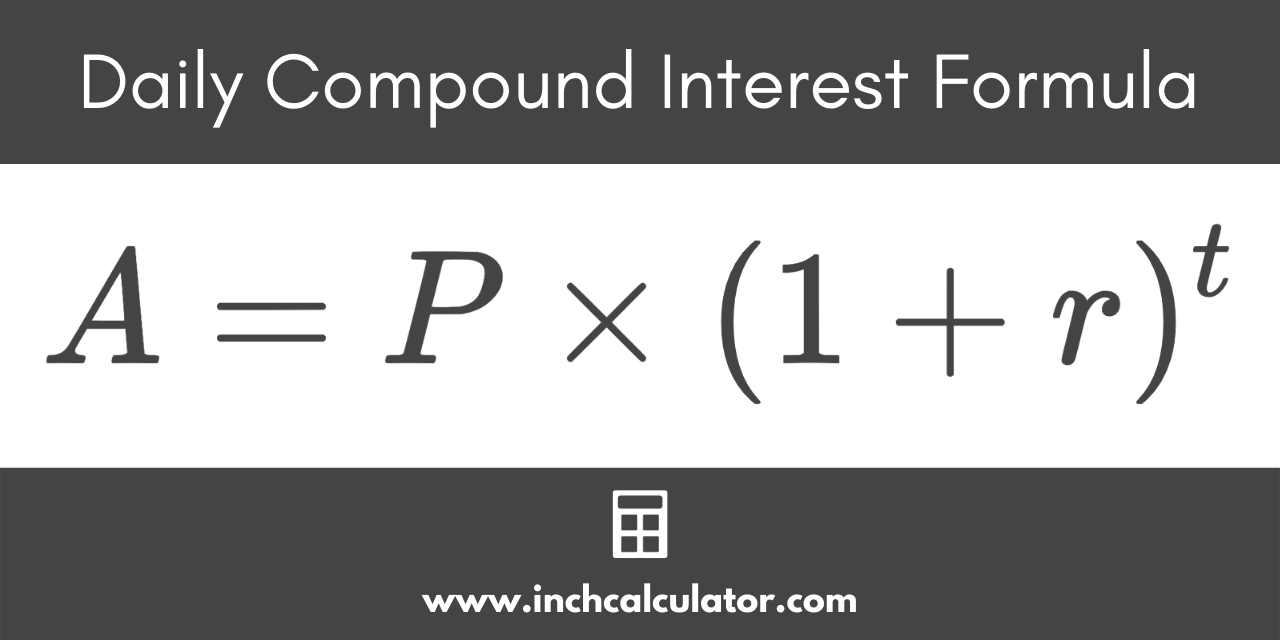
In a high-yield environment, the “Daily Interest” formula works in your favor. When a bank says they compound daily, they are adding that small daily interest amount back into your principal every day. Over years, this creates a snowball effect. This is why you will often see two numbers: the APR and the APY (Annual Percentage Yield). The APY is higher than the APR because it accounts for the effect of daily compounding. When choosing where to store your emergency fund or short-term savings, always look for the highest APY, as it reflects the true earning potential of daily interest.
The Power of Reinvestment
For investors, the concept of daily interest extends to dividend reinvestment and “cash sweep” accounts. When your brokerage account earns interest on uninvested cash daily, those small amounts add up. Over a 20-year horizon, the difference between an account that calculates interest monthly versus one that calculates it daily can amount to thousands of dollars in “found money.” The goal of any wealth-builder should be to ensure their capital is never sitting idle; every day is an opportunity for that capital to generate its own “daily wage” through interest.
Digital Tools and Financial Literacy Strategies
Manually calculating interest is an excellent way to understand the “why” behind your finances, but in practice, modern tools can help you automate this oversight. Integrating these calculations into your broader financial strategy is the final step in achieving professional-level money management.
Using Spreadsheets for Automation
Programs like Microsoft Excel or Google Sheets are perfect for tracking daily interest. By setting up a simple table with your balance in one column and a formula for the daily periodic rate in another, you can project your debt payoff dates or your savings growth with precision. You can create “what-if” scenarios: “What if I pay an extra $10 a day toward my loan?” Seeing the daily interest charge drop in real-time on a spreadsheet provides a psychological boost that monthly statements cannot match.
Financial Planning and the “Interest-First” Mindset
Ultimately, calculating daily interest should lead to a shift in your financial behavior. A professional approach to money involves viewing every dollar as an employee. If a dollar is sitting in a zero-interest checking account, it is “unemployed.” If it is sitting in a high-yield account earning daily interest, it is “working.”
By mastering the calculation of daily interest, you move away from being a passive consumer of financial products and become an active manager of your wealth. You begin to see the cost of procrastination—waiting a week to move money or pay a bill—in literal dollars and cents. This granular level of awareness is what separates those who struggle with money from those who build lasting financial legacies. Whether you are avoiding the drain of daily debt interest or harnessing the growth of daily investment yields, the math remains your most reliable tool for financial success.
aViewFromTheCave is a participant in the Amazon Services LLC Associates Program, an affiliate advertising program designed to provide a means for sites to earn advertising fees by advertising and linking to Amazon.com. Amazon, the Amazon logo, AmazonSupply, and the AmazonSupply logo are trademarks of Amazon.com, Inc. or its affiliates. As an Amazon Associate we earn affiliate commissions from qualifying purchases.