
In the fast-paced world of digital finance, Bitcoin remains the undisputed bellwether for the cryptocurrency market. However, its reputation for delivering astronomical returns is often mirrored by its propensity for sharp, sometimes gut-wrenching corrections. When Bitcoin experiences a significant price drop, investors—from retail newcomers to seasoned institutional fund managers—scramble to identify the catalyst. Understanding “why” is not just about dissecting the past; it is a vital part of risk management and strategic positioning in a modern investment portfolio.
The fluctuations in Bitcoin’s valuation are rarely the result of a single isolated event. Instead, they are usually the culmination of macroeconomic shifts, changes in market liquidity, regulatory developments, and the psychological state of the global investing community. To truly understand why Bitcoin drops, one must look at the intersection of traditional finance and the nascent digital asset ecosystem.
Macroeconomic Influences and Global Monetary Policy
Bitcoin does not exist in a vacuum. Although it was originally conceived as an alternative to the traditional banking system, it has become increasingly correlated with global financial markets. As institutional adoption has grown, Bitcoin has behaved more like a “risk-on” asset, sensitive to the same pressures that affect the Nasdaq or the S&P 500.
Interest Rates and the Federal Reserve’s Stance
One of the primary drivers of Bitcoin price action is the monetary policy of the United States Federal Reserve. When the Fed adopts a “hawkish” stance—raising interest rates to combat inflation—the cost of borrowing increases. This reduction in “easy money” leads investors to pull back from speculative assets.
In a high-interest-rate environment, traditional fixed-income assets like Treasury bonds become more attractive because they offer a guaranteed yield with virtually zero risk. When the “risk-free rate” rises, the opportunity cost of holding Bitcoin—which pays no dividends or interest—increases significantly. Consequently, large-scale investors often rotate their capital out of crypto and back into the safety of the dollar or bonds, leading to a localized or sustained drop in Bitcoin’s price.
Inflationary Pressures vs. Yield-Bearing Assets
While Bitcoin is often touted as “digital gold” and a hedge against inflation due to its fixed supply of 21 million coins, the short-term reality is often different. When inflation prints higher than expected, the market anticipates that central banks will tighten the money supply. This expectation causes immediate volatility.
Investors who viewed Bitcoin as a hedge may find themselves liquidated if they are over-leveraged, as the broader market reacts to the “strong dollar” narrative. When the DXY (U.S. Dollar Index) rises, Bitcoin typically falls. This inverse correlation is a fundamental pillar of modern crypto-finance analysis; a strengthening fiat currency usually spells downward pressure for decentralized assets.
Market Sentiment and Institutional Liquidations
The mechanics of how Bitcoin is traded play a massive role in its price stability. Unlike the traditional stock market, which has “circuit breakers” to halt trading during a crash, the 24/7 crypto market can experience rapid, cascading price drops fueled by automated trading and high-leverage positions.
The Role of Leverage and Cascading Liquidations
One of the most common reasons for a sudden “flash crash” in Bitcoin is a “long squeeze.” In the cryptocurrency derivatives market, traders often use leverage to amplify their gains. However, this means they must maintain a certain amount of collateral. If the price of Bitcoin drops even a few percentage points, it can trigger a wave of automatic liquidations.
As these positions are forcibly closed, the exchange sells the Bitcoin to cover the trader’s debt, which pushes the price down further. This creates a domino effect: lower prices trigger more liquidations, which trigger even lower prices. In a matter of minutes, hundreds of millions of dollars in “long” positions can be wiped out, causing a vertical drop on the price chart that feels disconnected from any specific news event.
Institutional Profit-Taking and ETF Flows
With the introduction of Spot Bitcoin ETFs (Exchange-Traded Funds), the market has seen a massive influx of institutional capital. While this provides legitimacy, it also introduces new risks. Large institutional holders, such as hedge funds or pension funds, operate on different timelines and requirements than retail investors.
If a major institution decides to “rebalance” its portfolio or “take profits” at the end of a fiscal quarter, the sheer volume of their sell orders can move the market. Furthermore, if the weekly “net flows” into Bitcoin ETFs turn negative, it signals a waning interest from Wall Street, which can dampen sentiment and lead to a slow bleed in price as retail investors follow the lead of the “smart money.”
Regulatory Headwinds and Geopolitical Uncertainty
The decentralized nature of Bitcoin is its greatest strength, but it is also a magnet for regulatory scrutiny. Because Bitcoin operates outside the direct control of any single government, it is frequently the target of legislative debates that can cause immediate market anxiety.
Global Regulatory Crackdowns and Compliance
News regarding the Securities and Exchange Commission (SEC) in the United States or similar bodies in Europe and Asia can cause instant price volatility. Whether it is a lawsuit against a major exchange, a new tax proposal for digital assets, or a ban on certain types of mining activities, regulatory “FUD” (Fear, Uncertainty, and Doubt) is a powerful catalyst for a drop.
When a major economy announces stricter “Know Your Customer” (KYC) or Anti-Money Laundering (AML) laws, some investors choose to exit the market rather than deal with the increased complexity of compliance. Furthermore, the threat of classifying Bitcoin or its associated ecosystem tokens as “unregistered securities” can lead to exchanges de-listing assets, reducing liquidity and causing prices to tumble.
Geopolitical Stability and Risk-Off Sentiments
In times of war, political instability, or global health crises, the general investing public moves into a “risk-off” posture. While Bitcoin enthusiasts argue that BTC is the ultimate “safe haven” during a systemic collapse, the historical data shows that during the initial onset of a global crisis, investors sell everything—including Bitcoin—to move into cash (USD).
The liquidity of Bitcoin makes it an easy target for investors who need to raise cash quickly to cover losses in other sectors (like real estate or equities). This “forced selling” during geopolitical turmoil often leads to a disconnect between Bitcoin’s long-term value proposition and its short-term price performance.
Network Health and Technical Indicators
Beyond the world of high finance and politics, the internal mechanics of the Bitcoin network itself can influence its market value. Miners, the individuals and companies that secure the network, are central to the ecosystem’s financial health.
Hash Rate Fluctuations and Miner Capitulation
Mining Bitcoin is a capital-intensive business requiring immense amounts of electricity and hardware. When the price of Bitcoin drops below a certain threshold, it may become unprofitable for some miners to continue operations. This leads to “miner capitulation,” where miners are forced to sell their hoarded Bitcoin to pay their bills.
When miners sell in bulk, it adds significant “sell pressure” to the market. Additionally, a significant drop in the “hash rate” (the total computational power securing the network) can occasionally spook investors, even if the network is designed to adjust its difficulty automatically. A healthy, growing hash rate is usually a bullish sign, while a stagnant or falling hash rate can signal that the price might need to find a lower floor to keep the ecosystem sustainable.
Key Support Levels and Psychological Barriers
In the world of investing, psychology is just as important as math. Traders look at “support” and “resistance” levels. For example, if Bitcoin has historically stayed above $50,000, that number becomes a psychological floor. If the price breaks below that support level, it often triggers a panic-selling event.
Many investors set “stop-loss” orders just below these key psychological levels. Once the price touches that trigger, the orders execute automatically, adding to the downward momentum. In the absence of positive news, Bitcoin may “drift” lower simply because it failed to break through a resistance level, leading to a loss of momentum and a subsequent retracement.
Strategic Approaches to Market Downturns
For the modern investor, a Bitcoin drop should be viewed as a data point rather than a disaster. Understanding the mechanics of the “Money” niche means recognizing that volatility is the price of admission for high-growth assets.
Dollar-Cost Averaging (DCA) and Long-Term Horizon
Successful financial planning in the crypto space often involves Dollar-Cost Averaging (DCA). Instead of trying to “time the bottom” during a drop, investors commit to buying a fixed dollar amount at regular intervals. This strategy mitigates the risk of buying at a local “top” and lowers the average cost basis over time. When Bitcoin drops, DCA practitioners see it as an opportunity to acquire more units at a discount, focusing on the five-to-ten-year horizon rather than the weekly chart.
Risk Management and Portfolio Diversification
A sharp drop in Bitcoin is a stark reminder of the importance of diversification. Professional wealth management dictates that one should never be over-leveraged or over-exposed to a single asset class. By balancing Bitcoin with traditional equities, real estate, and cash reserves, an investor can weather a 20% or 30% drop in crypto without facing financial ruin.
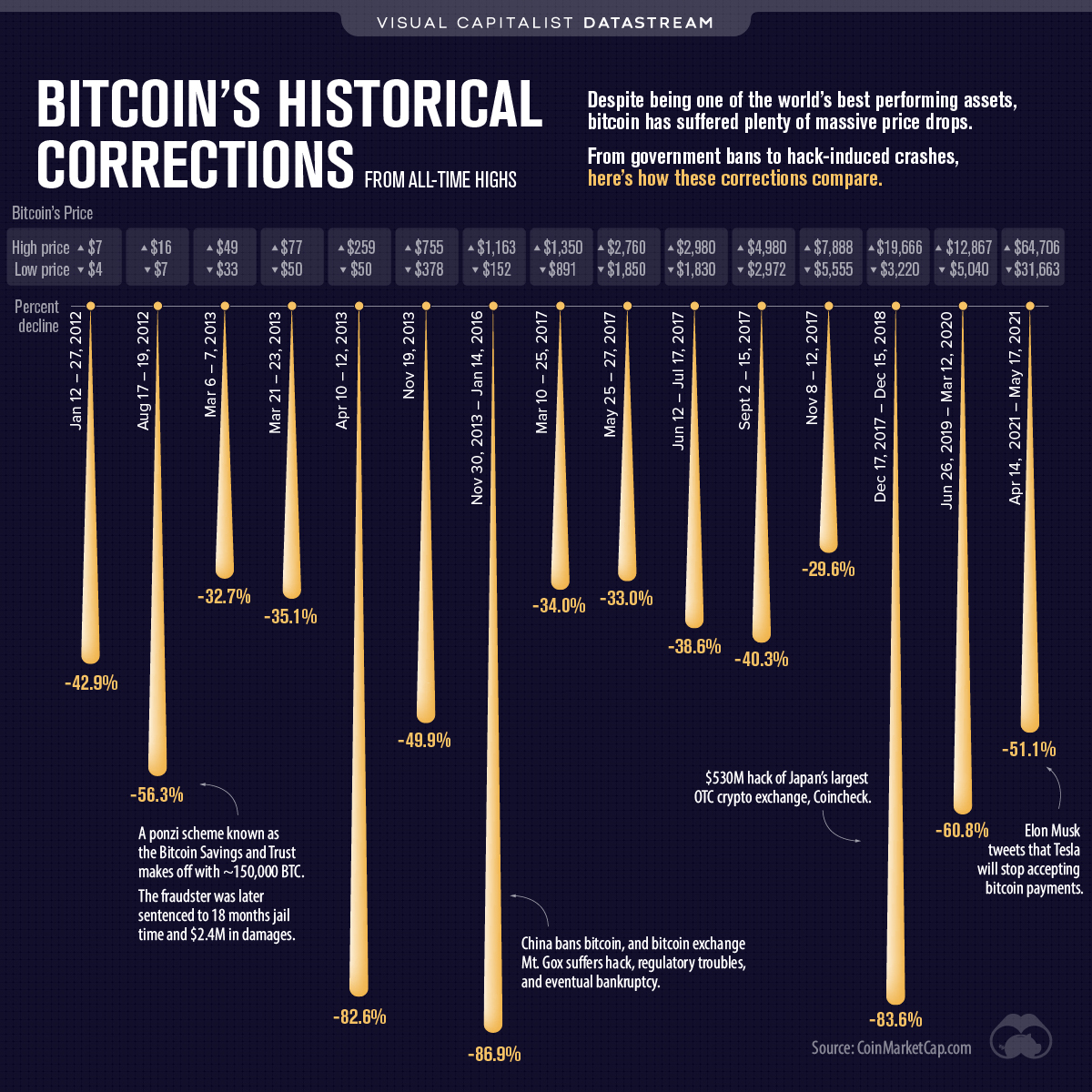
Ultimately, Bitcoin drops because it is a maturing asset class transitioning from a niche experiment to a global financial pillar. Each correction flushes out excess leverage, tests the resolve of “weak hands,” and sets the stage for the next cycle of growth. By understanding the macroeconomic, technical, and psychological reasons behind these movements, investors can move away from emotional reacting and toward informed, strategic decision-making.
aViewFromTheCave is a participant in the Amazon Services LLC Associates Program, an affiliate advertising program designed to provide a means for sites to earn advertising fees by advertising and linking to Amazon.com. Amazon, the Amazon logo, AmazonSupply, and the AmazonSupply logo are trademarks of Amazon.com, Inc. or its affiliates. As an Amazon Associate we earn affiliate commissions from qualifying purchases.