
The emergence of Bitcoin in 2009 did not happen in a vacuum. It was the culmination of decades of research into cryptography, distributed systems, and digital privacy. While often discussed in the context of finance, the creation of Bitcoin is, at its core, a monumental achievement in software engineering and computer science. It solved a problem that had plagued developers for years: the double-spending problem in a decentralized environment. To understand how Bitcoin was created, one must look past the market charts and into the architecture of the code, the consensus algorithms, and the cryptographic primitives that form its foundation.
1. The Cryptographic Foundation and the Double-Spending Problem
Before the first line of Bitcoin’s code was ever written, the primary challenge of digital currency was the “double-spending” problem. In a digital environment, a file can be copied and pasted infinitely. If a digital token represents value, a user could theoretically send the same token to two different recipients simultaneously. Traditional systems solve this using a central authority (like a bank) that maintains a master ledger. Bitcoin’s creation was centered on removing that central authority while maintaining the integrity of the ledger.
Hash Functions and SHA-256
The technical bedrock of Bitcoin is the Secure Hash Algorithm 256-bit (SHA-256). Created by the NSA and widely respected in the tech community, SHA-256 is a one-way cryptographic hash function. When Bitcoin was being architected, this algorithm was chosen to ensure data integrity. Any input, whether a single letter or an entire library of books, produces a unique 256-bit signature.
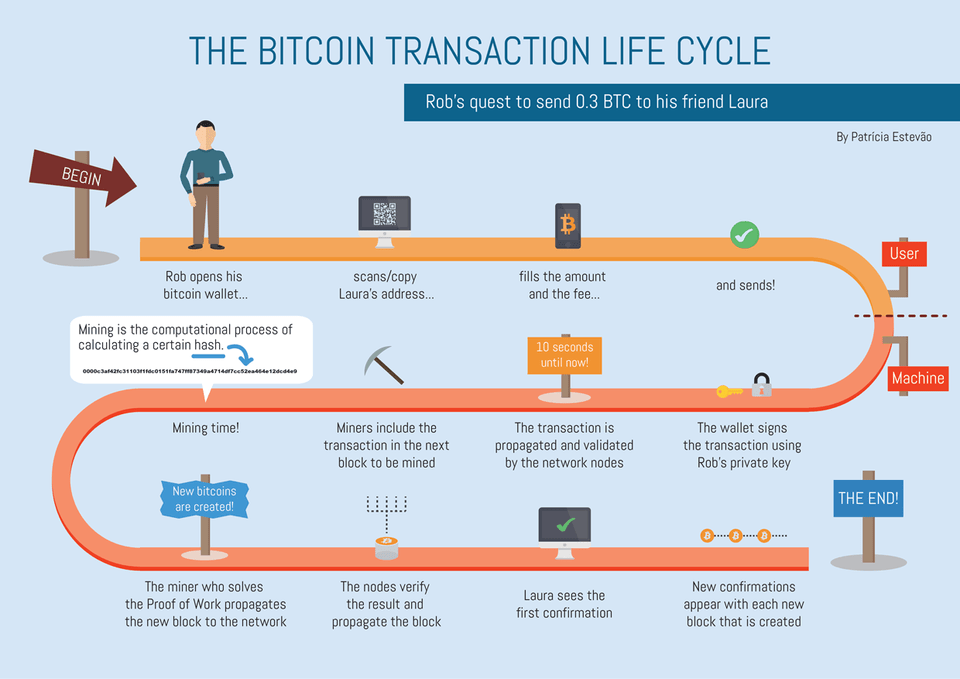
In the creation of Bitcoin, SHA-256 is used in two critical ways. First, it identifies blocks of data. Second, it serves as the “puzzle” for Proof of Work. Because the slightest change in input completely changes the output hash, the network can instantly verify if any transaction data has been tampered with. This mathematical certainty replaced the need for human trust.
The Breakthrough of Byzantine Fault Tolerance
A major technical hurdle in creating a decentralized network is ensuring that all nodes agree on the state of the system, even if some nodes are malicious or offline. This is known in computer science as the “Byzantine Generals Problem.”
Bitcoin solved this by implementing a probabilistic solution to Byzantine Fault Tolerance. By requiring computational work (CPU power) to participate in the consensus process, the creator of Bitcoin ensured that the cost of subverting the network would be prohibitively expensive. The creation of the “blockchain” was essentially the creation of a chronological, distributed time-stamp server that allows every node in the network to reach a singular technical truth without a central coordinator.
2. Architecture of the Blockchain: From Whitepaper to Genesis Block
The creation of Bitcoin followed a classic software development lifecycle: conceptualization, documentation, and implementation. In October 2008, the whitepaper titled Bitcoin: A Peer-to-Peer Electronic Cash System was released to a mailing list of cypherpunks. This document didn’t just propose a currency; it proposed a new protocol for data transmission.
The Whitepaper: Defining a Peer-to-Peer Network
The whitepaper outlined a system where data is organized into “blocks” and linked using hashes. This architecture ensured that the history of the system was immutable. From a technical standpoint, the whitepaper was revolutionary because it combined existing technologies—like Adam Back’s Hashcash and Merkle Trees—into a cohesive, self-sustaining ecosystem. It defined the rules for transaction validation, the 21 million supply cap, and the ten-minute block interval, providing the technical blueprint that would later be translated into C++.
Coding the Protocol in C++
Bitcoin was originally written in C++, a choice likely made for its performance, low-level memory management, and widespread use in systems programming. The initial codebase, often referred to as “Bitcoin 0.1,” was a monolithic application. It included the wallet, the miner, and the full node software all in one package.
The coding process involved creating a complex state machine. Every node running the software follows the same set of “Consensus Rules.” These rules are hard-coded: how many bitcoins are created per block, what constitutes a valid digital signature (using the Elliptic Curve Digital Signature Algorithm, or ECDSA), and how to handle “orphaned” blocks. The creation of this codebase was an exercise in precision; a single logic error could have led to a fork in the network or a total loss of funds.
Block 0: The Genesis Block and its Hard-Coded Message
On January 3, 2009, the Bitcoin network officially went live with the mining of “Block 0,” better known as the Genesis Block. Unlike subsequent blocks, the Genesis Block was hard-coded into the software. It contained 50 BTC that, due to the way the code was written, can never be spent.

Technically significant was the “coinbase” parameter of this block, which included the text: “The Times 03/Jan/2009 Chancellor on brink of second bailout for banks.” While often interpreted as a political statement, from a technical perspective, it served as a “proof of no pre-mine.” By including a headline from that specific day, the creator proved that the block had not been generated prior to that date, establishing a verifiable “Point Zero” for the blockchain’s timeline.
3. The Mechanics of Consensus: Proof of Work and Mining
The most innovative technical component of Bitcoin’s creation is the Proof of Work (PoW) consensus mechanism. This is the engine that drives the network, ensuring that the ledger remains secure without a central administrator.
The Role of Timestamps and Merkle Trees
To keep the data efficient, Bitcoin utilizes Merkle Trees (binary hash trees). Within each block, hundreds of transactions are hashed together in a tree structure until only a single hash remains—the Merkle Root. This root is then included in the block header.
This technical design allows for “Simplified Payment Verification” (SPV). It means a device doesn’t need to download the entire multi-gigabyte blockchain to verify a transaction; it only needs the block headers and the specific branch of the Merkle Tree. This foresight in the creation of Bitcoin allowed the technology to eventually run on lower-power devices and mobile wallets.
Mining Algorithms: Difficulty Adjustments and Security
The creation of Bitcoin introduced an autonomous “Difficulty Adjustment” algorithm. Every 2,016 blocks (approximately every two weeks), the software evaluates how quickly blocks are being found. If they are being found too fast, the mathematical “target” for the SHA-256 hash becomes harder to hit; if too slow, it becomes easier.
This is a masterpiece of game theory and software engineering. It creates a “Nakamoto Consensus” where the longest chain (the one with the most cumulative Proof of Work) is accepted as the truth. By tying security to physical energy consumption through mining hardware, the creator ensured that the cost to “lie” to the network (reversing a transaction) would require more hardware and electricity than any single entity could reasonably control.
4. Evolution of the Network: Nodes, Wallets, and Scalability
While the Genesis Block started the chain, the “creation” of Bitcoin is an ongoing technical process. The software has evolved from a Windows-only GUI application to a robust, cross-platform daemon (bitcoind) that powers a global infrastructure.
Decentralized Node Distribution
A critical technical aspect of Bitcoin’s creation is its peer-to-peer (P2P) discovery mechanism. When a new node starts up, it needs to find other nodes to download the blockchain. Bitcoin accomplishes this through “DNS seeds”—hard-coded addresses of stable nodes—and a custom P2P protocol that allows nodes to share IP addresses of other active participants. This decentralized discovery ensures that there is no single “server” to shut down, making the network’s tech stack resilient against censorship and hardware failure.
Public and Private Key Infrastructure (PKI)
Bitcoin’s security relies heavily on Asymmetric Cryptography. When a user “creates” a Bitcoin address, they are actually generating a 256-bit private key using a random number generator. The software then applies the Secp256k1 elliptic curve to derive a public key, which is then hashed to create the address.
This mathematical relationship is the core of Bitcoin’s “ownership” model. The creation of the protocol ensured that the private key never needs to be shared with the network. Only a digital signature, generated by the private key, is broadcasted. This ensures that even if a transaction is intercepted, the underlying “password” (the private key) remains mathematically shielded.

The Technical Legacy of Bitcoin’s Creation
The creation of Bitcoin was more than the launch of a new asset; it was the birth of a new category of software: the decentralized autonomous protocol. By combining SHA-256 hashing, P2P networking, and a Difficulty Adjustment algorithm, the creator built a system that has maintained 99.9% uptime for over a decade without a central IT department or a server farm.
Technically, Bitcoin proved that code could enforce scarcity and that decentralized consensus was possible at scale. Every subsequent blockchain and distributed ledger technology (DLT) is a derivative of the architectural choices made during those early years of Bitcoin’s development. From the choice of C++ to the implementation of the Merkle Tree, the technical decisions behind Bitcoin’s creation continue to define the boundaries of what is possible in the realm of digital security and software engineering. Bitcoin was not just “found”—it was meticulously engineered to be a self-sustaining, unhackable, and permanent piece of global infrastructure.
aViewFromTheCave is a participant in the Amazon Services LLC Associates Program, an affiliate advertising program designed to provide a means for sites to earn advertising fees by advertising and linking to Amazon.com. Amazon, the Amazon logo, AmazonSupply, and the AmazonSupply logo are trademarks of Amazon.com, Inc. or its affiliates. As an Amazon Associate we earn affiliate commissions from qualifying purchases.