
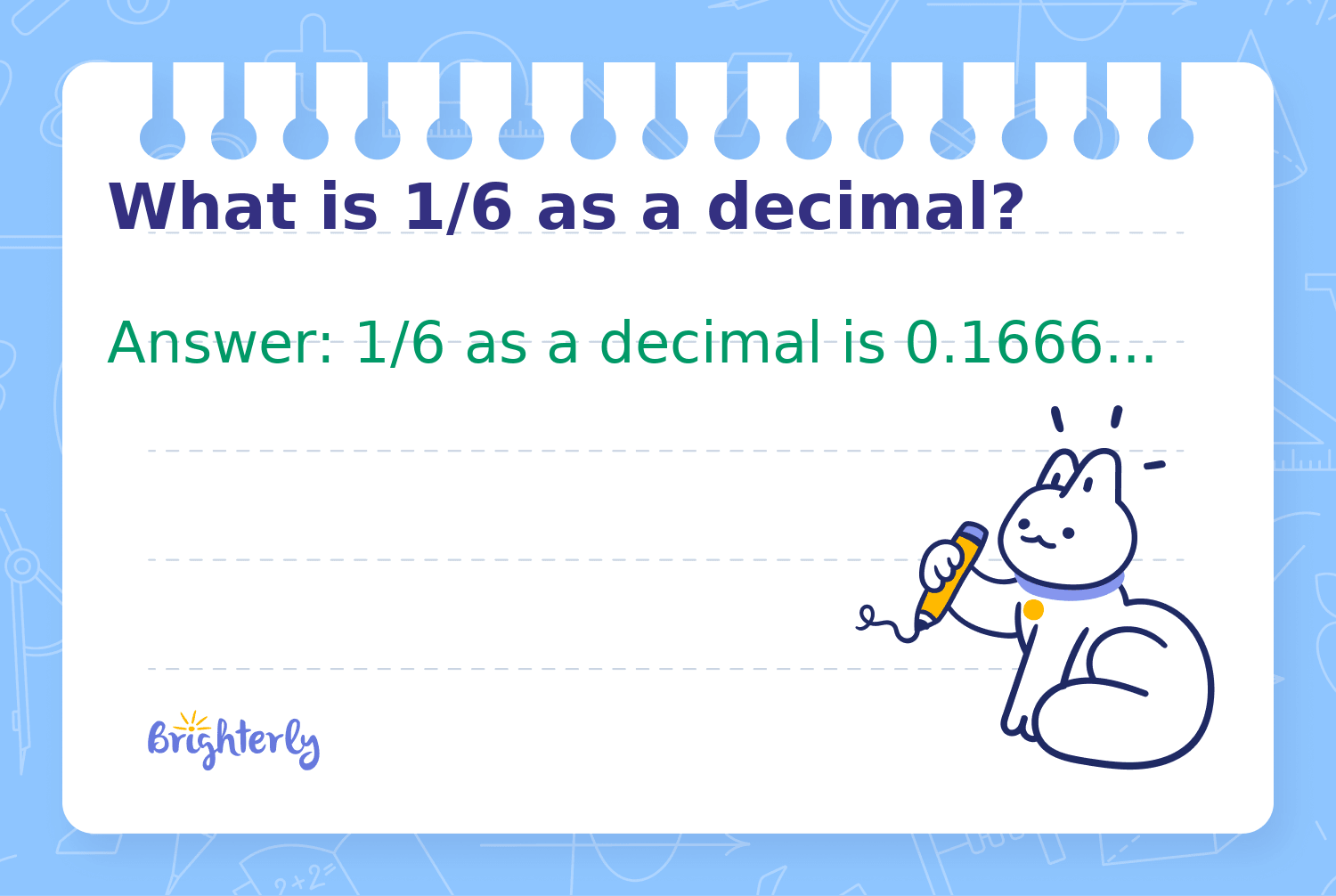
In the realm of mathematics, the conversion of a fraction into a decimal is a foundational concept taught in primary education. When we ask, “What is 1/6 as a decimal?” the answer appears straightforward: 0.1666…, with the 6 repeating infinitely. However, in the world of technology, software engineering, and hardware architecture, this simple repeating decimal unveils a complex layer of computational challenges.
For developers, data scientists, and systems architects, the way a machine handles the infinite nature of 1/6 is not just a math problem—it is a matter of precision, memory management, and system reliability. This article explores the technical nuances of representing 1/6 as a decimal within digital environments, the limitations of modern hardware, and the strategies used by high-level software to maintain accuracy.

The Mathematical Foundation: Converting 1/6 into the Digital Realm
To understand how technology processes the fraction 1/6, we must first look at its decimal representation. Dividing 1 by 6 yields a quotient where the digit 6 repeats indefinitely. In mathematical notation, this is expressed as $0.1bar{6}$. While humans can simply place a bar over the 6 to signify infinity, computers operate within the rigid constraints of finite memory.
The Repeating Decimal Challenge
The primary challenge with 1/6 is that it is a “non-terminating” decimal in base-10. Unlike 1/2 (0.5) or 1/5 (0.2), which terminate quickly, 1/6 requires an infinite amount of space to represent perfectly. In a technological context, this necessitates “truncation” or “rounding.” When a software application displays 1/6, it might show 0.1666667. This rounding is the first step where “approximation error” enters a system. For a simple calculator app, this error is negligible. For a flight control system or a high-frequency trading algorithm, it can be catastrophic.
Decimal vs. Binary Representation
Computers do not natively think in base-10 (decimal); they think in base-2 (binary). This adds another layer of complexity to 1/6. In binary, a fraction can only be represented as a terminating expansion if its denominator is a power of 2 (e.g., 1/2, 1/4, 1/8). Since 6 is not a power of 2, the binary representation of 1/6 is also an infinite repeating sequence ($0.001010101…$). This means that regardless of whether the system is looking at the decimal 0.166… or its binary equivalent, it is forced to deal with an approximation.
Floating-Point Arithmetic: How Modern CPUs Process Fractions
Most modern software handles fractions like 1/6 using a method called “floating-point arithmetic.” This is the tech industry’s standard for representing real numbers that require a trade-off between range and precision.
The IEEE 754 Standard
The most common implementation of floating-point numbers is the IEEE 754 standard. This technical standard defines how numbers are stored in bits. For instance, a 64-bit “double-precision” float allocates 1 bit for the sign, 11 bits for the exponent, and 52 bits for the fraction (the significand).
When a computer stores 1/6, it fits as much of the repeating binary sequence as possible into those 52 bits. Because the sequence is infinite, the 53rd bit is used to round the 52nd bit. This results in a stored value that is infinitesimally different from the true value of 1/6. This tiny discrepancy is known as a “floating-point error.”
The Ghost in the Machine: Rounding Errors and Precision Loss
While 0.16666666666666666 (the 64-bit approximation of 1/6) seems accurate enough for most tasks, errors accumulate during repetitive calculations. In software loops where 1/6 is added millions of times, the “ghost” of that missing precision begins to haunt the output.
Consider a graphics engine calculating the physics of light reflecting off a surface. If the engine uses 1/6 as a constant and performs millions of operations, the cumulative rounding error can lead to “visual artifacts”—glitches where shadows don’t align or textures jitter. This is why understanding the decimal nature of 1/6 is critical for developers working at the hardware-software interface.
Practical Applications in Software Development
Software engineers must decide how to handle the “1/6 problem” based on the specific needs of their application. Different niches within the tech industry prioritize different solutions.
Financial Software and the Need for Exactitude
In the fintech (financial technology) sector, floating-point errors are unacceptable. If a banking app calculates interest or splits a transaction by 6, using a standard float could result in “lost” fractions of a cent. Over millions of transactions, these fractions add up to significant sums—a phenomenon famously exploited in “salami slicing” cyber-attacks.
To solve this, fintech developers avoid standard decimals. Instead, they use “Decimal” data types (like Python’s decimal module or Java’s BigDecimal). These tools represent numbers in base-10 internally and allow the developer to specify exactly how many digits of 1/6 to keep and how to round them, ensuring that the ledger always balances.
High-Performance Computing and Scientific Simulations
In fields like aerospace engineering or meteorology, simulations rely on differential equations where 1/6 might appear as a coefficient. In these high-performance computing (HPC) environments, “Single Precision” (32-bit) is often swapped for “Double Precision” (64-bit) or even “Quadruple Precision” (128-bit) to minimize the drift caused by repeating decimals. When NASA calculates a trajectory for a Mars rover, the decimal representation of 1/6 must be accurate to a degree that accounts for millions of miles of travel, where a billionth of a decimal point could result in missing the planet entirely.
Tools and Strategies for Handling Recurring Decimals
As technology has evolved, so have the tools available to manage the inherent “messiness” of fractions like 1/6.
Arbitrary-Precision Arithmetic Libraries
When standard hardware limits are reached, developers turn to “Arbitrary-Precision Arithmetic,” often called “bignum” math. Libraries like GNU MP (GMP) allow a program to use as much RAM as necessary to store a number. If a researcher needs 1/6 calculated to a million decimal places, these libraries make it possible by bypassing the CPU’s standard floating-point unit and handling the calculation via software logic.
Symbolic Math Engines
Another technological approach is to avoid converting to a decimal altogether. Symbolic computation engines (like WolframAlpha, Maple, or the SymPy library in Python) treat “1/6” as an object rather than a value.
In symbolic math, $1/6 + 1/6$ is processed as $2/6$, which simplifies to $1/3$. No decimal conversion occurs until the final step of the process. This keeps the calculation 100% accurate throughout the entire logic chain. This is the preferred method for AI tools and computer algebra systems (CAS) that require perfect logical consistency.
The Future of Computational Precision
The way we handle 1/6 as a decimal is currently tied to our “von Neumann” architecture and binary logic. However, the next frontier of technology may change this.
Quantum Computing and New Numerical Paradigms
Quantum computers process information using qubits, which can exist in multiple states. While quantum computing is currently focused on optimization and cryptography, it opens the door to new ways of representing numerical values that may not suffer from the same “bit-depth” limitations as classical binary systems.
Furthermore, there is ongoing research into “Posit” arithmetic—a new hardware-level number format designed to replace IEEE 754. Posits offer more accuracy than floats for numbers near 1.0 and 0, which would theoretically allow for more precise representations of fractions like 1/6 without increasing the bit-count.
Conclusion: More Than Just a Number
What is 1/6 as a decimal? To a student, it is $0.166…$. To a computer scientist, it is a lesson in the limitations of digital representation. It is a reminder that our most powerful machines are still approximations of the infinite complexity found in mathematics.
By understanding how 1/6 is handled in tech—from the binary rounding in a CPU to the symbolic logic in an AI—we gain a deeper appreciation for the precision that drives our digital world. Whether you are coding a simple app or architecting a global financial network, the way you choose to represent that “0.166…” defines the reliability, security, and success of your technology.
aViewFromTheCave is a participant in the Amazon Services LLC Associates Program, an affiliate advertising program designed to provide a means for sites to earn advertising fees by advertising and linking to Amazon.com. Amazon, the Amazon logo, AmazonSupply, and the AmazonSupply logo are trademarks of Amazon.com, Inc. or its affiliates. As an Amazon Associate we earn affiliate commissions from qualifying purchases.