
The calculator is perhaps the most ubiquitous piece of technology in human history. Long before the smartphone occupied our pockets and the laptop became our primary workstation, the calculator served as the first true bridge between human thought and automated logic. While the question “who found the calculator” might seem to demand a single name, the reality is a multi-century saga of innovation, engineering breakthroughs, and a relentless pursuit of computational efficiency.
From ancient counting frames to the sophisticated AI-driven engines of today, the evolution of the calculator is a testament to the Tech niche’s core principle: the miniaturization of power and the democratization of information.
The Mechanical Renaissance: Engineering the First Logic Machines
The “discovery” or invention of the calculator did not happen in a vacuum. It began with the realization that physical objects could represent abstract numerical values. While the abacus served humanity for millennia, the leap into true mechanical computation occurred during the 17th century, driven by the pioneers of classical physics and mathematics.
Blaise Pascal and the Pascaline
In 1642, a young French mathematician named Blaise Pascal sought to ease the burden of his father’s work as a tax commissioner. The result was the Pascaline, widely considered the first functional mechanical calculator. Unlike earlier tools, the Pascaline used a series of geared wheels to perform addition and subtraction.
The engineering was revolutionary for its time. Each wheel was divided into ten segments, representing digits 0 through 9. When a wheel completed a full rotation, it triggered a “carry” mechanism to the next wheel. This was the first physical manifestation of a carry-over logic that we still use in digital circuits today.
Leibniz and the Stepped Reckoner
While Pascal paved the way, it was Gottfried Wilhelm Leibniz who expanded the machine’s capabilities. In 1673, Leibniz designed the Stepped Reckoner, which introduced a “stepped drum” mechanism. This allowed the machine to perform multiplication and division—operations that previously required complex manual iterations.
Leibniz’s contribution was more than just mechanical; he was a staunch advocate for the binary system. His philosophy that “it is unworthy of excellent men to lose hours like slaves in the labor of calculation” became the foundational ethos for all future developments in hardware and software automation.
The Arithmometer and Commercialization
For nearly 150 years, calculators remained curiosities of the elite. That changed in 1820 when Thomas de Colmar patented the Arithmometer. This was the first commercially successful mechanical calculator. It utilized Leibniz’s stepped drum but refined the build quality to be robust enough for daily office use. This transition from “scientific experiment” to “reliable tool” marked the beginning of the calculator’s role as an essential gadget in the world of business and engineering.
The Electronic Revolution: From Vacuum Tubes to Integrated Circuits
The transition from mechanical gears to electronic pulses was the most significant pivot in the history of the calculator. As the 20th century dawned, the limitations of physical gears—friction, size, and speed—became bottlenecks for the growing demands of the Industrial Revolution and the space race.
The Birth of the All-Electronic Calculator
In the late 1950s and early 1960s, the world saw the first shift toward vacuum tubes and transistors. In 1961, the Anita MK VII and MK VIII were released by the Bell Punch Company. These were the first “all-electronic” desktop calculators. They were silent, lightning-fast compared to mechanical units, but they were massive—the size of a heavy typewriter and filled with glass tubes.
The tech industry soon realized that for these machines to be truly useful, they needed to shrink. This push for miniaturization became the primary driver for the development of the Integrated Circuit (IC).
The “Cal-Tech” Project and Texas Instruments
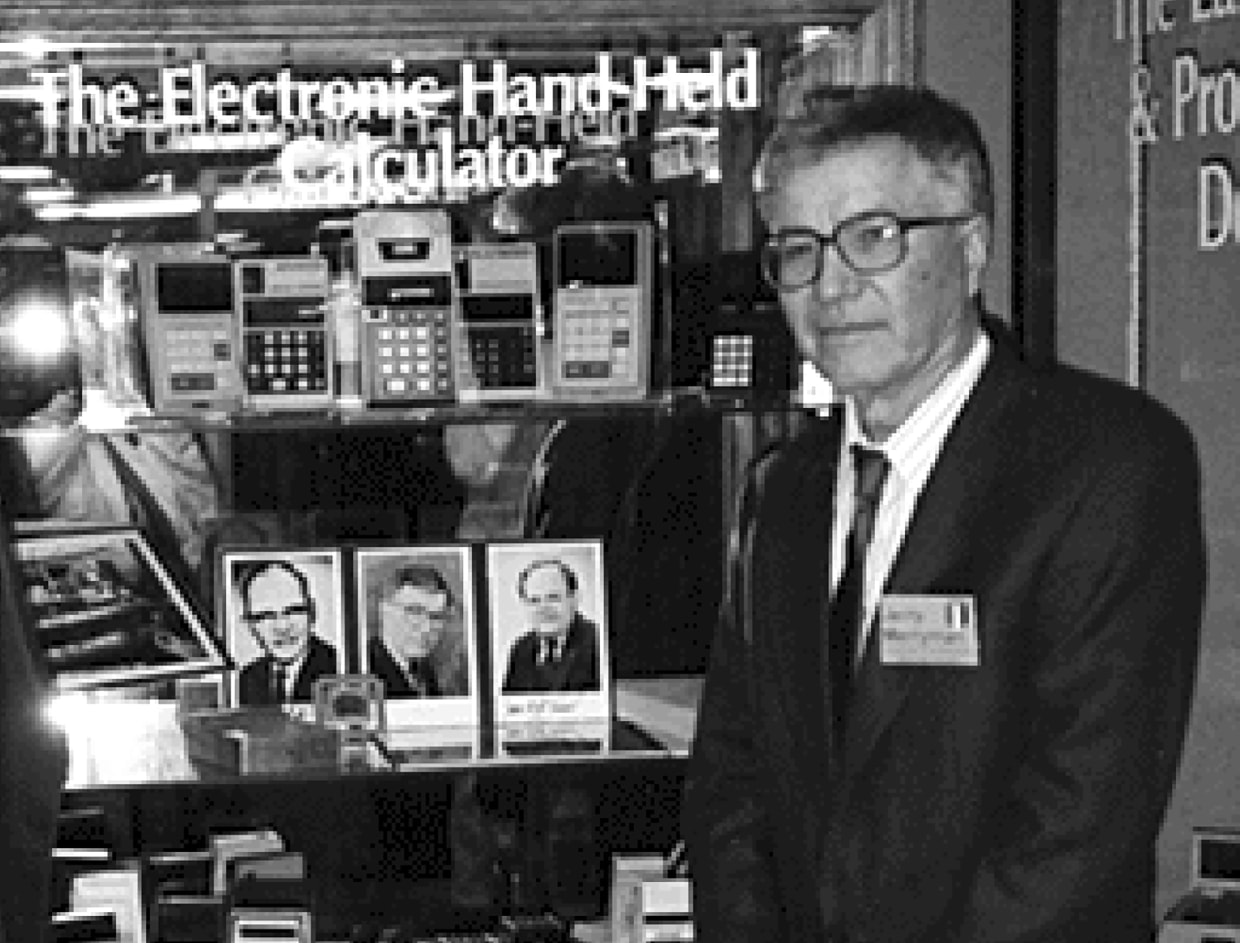
In 1967, Texas Instruments (TI) fundamentally changed the landscape of technology with the “Cal-Tech” project. Led by Jack Kilby—the co-inventor of the integrated circuit—the team developed a prototype that could perform four basic functions and print the results on thermal paper.
This was the “Eureka” moment. The Cal-Tech demonstrated that high-level computation didn’t require a room-sized mainframe; it could be contained within a device held in the palm of a hand. This set the stage for the consumer electronics boom of the 1970s.
The Rise of Japanese Innovation
While the US pioneered the chips, Japanese companies like Sharp and Casio revolutionized the user experience (UX) and affordability. Sharp’s QT-8D, released in 1969, was the first calculator to use LSI (Large Scale Integration) chips. By the early 1970s, the price of a calculator dropped from $1,000 to under $100, making it the first truly accessible high-tech gadget for students and professionals alike.

The Handheld Era: Microprocessors and the Power of Portability
By the mid-1970s, the “Calculator Wars” were in full swing. This era defined the aesthetic and functional standards of what we now consider a “gadget.” It was during this time that the calculator transitioned from a luxury item to a standard educational tool.
Hewlett-Packard and the Scientific Revolution
In 1972, Hewlett-Packard (HP) released the HP-35. It was the world’s first handheld scientific calculator. Before the HP-35, engineers relied on slide rules or massive desktop computers to calculate trigonometric and exponential functions.
The HP-35 was a masterpiece of digital security and logic engineering, using Reverse Polish Notation (RPN). This logical system allowed for complex calculations without the need for parentheses, optimizing the limited memory of the time. The HP-35 was so advanced that NASA used it to assist in space missions, proving that “handheld” did not mean “underpowered.”
The Graphing Calculator Legacy
As we moved into the 1980s and 90s, the focus shifted from simple arithmetic to visualization. The Casio fx-7000G (1985) and the subsequent TI-81 and TI-84 series introduced the world to the graphing calculator.
These devices were, in many ways, the first “smartphones” for students. They featured programmable memory, high-resolution (for the time) LCD screens, and the ability to plot complex equations. For many Millennials and Gen Xers, the TI-84 wasn’t just a calculator; it was an introduction to the world of software logic and rudimentary coding.
LCDs and Solar Power: Sustainable Tech
One of the most important tech trends of the calculator era was the shift from power-hungry LED displays to Liquid Crystal Displays (LCD) and solar power. Companies like Casio led this charge, creating calculators that could run indefinitely on ambient light. This innovation was a precursor to modern wearable tech and IoT (Internet of Things) devices that prioritize low energy consumption and long-term sustainability.
Software, AI, and the Modern Tech Stack
Today, the question “who found the calculator” has moved from a hardware-based answer to a software-based one. The calculator is no longer a physical object for most people; it is an app, a line of code, or a cloud-based service.
The Calculator as a Software Application
With the advent of the personal computer and the smartphone, the physical calculator became a legacy device. Every operating system—Windows, macOS, iOS, and Android—now ships with a built-in calculator. These apps are far more powerful than the most expensive scientific calculators of the 70s.
Software engineers have integrated these tools into larger ecosystems. Modern calculators can handle unit conversions, currency exchange rates (pulling real-time data via API), and complex statistical modeling. The “calculator” has evolved into a comprehensive Computational Engine.
WolframAlpha and Symbolic Computation
In the late 2000s, Stephen Wolfram launched WolframAlpha. This wasn’t just a calculator; it was a “computational knowledge engine.” Unlike traditional calculators that deal with numbers, WolframAlpha uses symbolic logic to solve equations, perform linguistic analysis, and provide data visualization. It represents the pinnacle of modern software calculation, where the “answer” is derived from a massive database of structured data rather than just a simple arithmetic circuit.
Artificial Intelligence and the Future of Calculation
We are currently entering the era of AI-driven computation. Tools like ChatGPT and specialized AI math solvers don’t just calculate; they understand intent. If you ask a modern AI to “calculate the trajectory of a projectile with X variables,” it writes the formula, executes the code, and explains the steps.
The future of the calculator lies in Natural Language Processing (NLP). We are moving away from buttons and towards conversational interfaces. In this new paradigm, “calculation” is a subset of “intelligence.”

Conclusion: The Legacy of a Digital Pioneer
The journey from Blaise Pascal’s wooden gears to the silicon-based neural networks of today highlights a fundamental truth about technology: we are constantly seeking ways to offload cognitive labor to machines.
The “calculator” was never found by a single person at a single moment. It was discovered by Pascal in his quest for accuracy, refined by Kilby in his quest for miniaturization, and perfected by software engineers in their quest for accessibility. As we look toward the future of quantum computing and integrated AI, the humble calculator remains the primary blueprint for how we interact with the digital world. It taught us that complex problems can be broken down into binary pulses, and that with the right tool, any human can possess the computing power of a god.
aViewFromTheCave is a participant in the Amazon Services LLC Associates Program, an affiliate advertising program designed to provide a means for sites to earn advertising fees by advertising and linking to Amazon.com. Amazon, the Amazon logo, AmazonSupply, and the AmazonSupply logo are trademarks of Amazon.com, Inc. or its affiliates. As an Amazon Associate we earn affiliate commissions from qualifying purchases.