
For the modern investor, the stock market is more than just a place to buy and sell shares; it is a living, breathing ecosystem that operates on a strict chronological pulse. While the digital age has made it feel as though finance is a 24/7 endeavor, the primary engines of American wealth—the New York Stock Exchange (NYSE) and the Nasdaq—still adhere to a traditional schedule. Understanding exactly when the stock market closes, and what happens in the hours surrounding that closing bell, is fundamental to any sound investment strategy.
Knowing the clock is not merely about administrative convenience. It is about liquidity, volatility, and the strategic execution of trades. In this guide, we will explore the nuances of market hours, the complexities of extended-hours trading, and how the timing of your moves can significantly impact your financial portfolio.
The Standard Trading Window: The Core Hours of the American Markets
The most important timeframe for any retail investor to memorize is the standard operating hours of the major U.S. exchanges. Both the NYSE and the Nasdaq operate from Monday through Friday, excluding specific holidays.
The 9:30 AM to 4:00 PM EST Window
The “regular” trading session begins at 9:30 AM Eastern Standard Time (EST) and concludes at 4:00 PM EST. This 6.5-hour window represents the period of highest liquidity. Liquidity refers to the ease with which an asset can be bought or sold without affecting its price. During these hours, institutional investors, mutual funds, and high-frequency trading algorithms are most active, ensuring that “bid-ask spreads” (the difference between what a buyer will pay and a seller will accept) are at their narrowest.
The Significance of the Closing Bell
The 4:00 PM EST closing bell is one of the most iconic sounds in the financial world. Beyond the ceremony, the “close” is a critical data point for the entire financial industry. The closing price of a stock is used to calculate the Net Asset Value (NAV) of mutual funds, determine the performance of indices like the S&P 500, and trigger various legal and margin requirements for brokerage accounts. When someone asks, “Where did the market end today?”, they are referring to the price established at the precise moment of the 4:00 PM close.
Time Zone Considerations for Global Investors
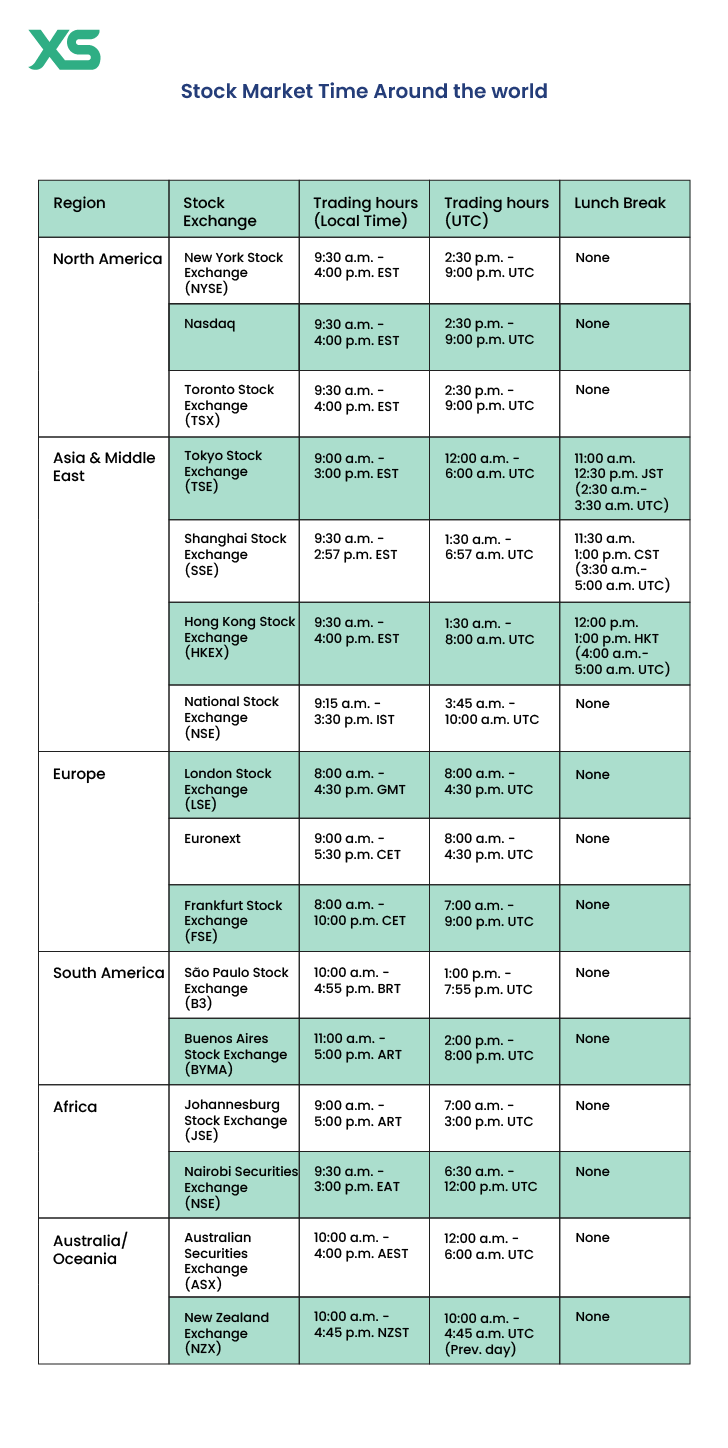
It is vital to remember that all official U.S. market times are quoted in Eastern Time. For an investor in Los Angeles, the market opens at 6:30 AM and closes at 1:00 PM. For those in London or Tokyo, the window shifts significantly. Investors must be hyper-aware of their local time relative to New York to avoid missing critical trading windows or the release of economic data that typically occurs just before the market opens.
Beyond the Bell: The World of Extended-Hours Trading
In our hyper-connected digital economy, the 4:00 PM close is no longer the absolute end of the trading day. Electronic Communication Networks (ECNs) allow investors to trade long after the physical floor has cleared.
Pre-Market Trading Sessions
While the official opening bell rings at 9:30 AM, pre-market trading can begin as early as 4:00 AM EST, though most retail brokers offer access starting at 7:00 AM or 8:00 AM. Pre-market trading is often driven by overnight news, international market performance, or early-morning earnings releases. It provides a glimpse into how the market might “gap” up or down when the regular session begins.
After-Hours Trading Sessions
The after-hours session begins immediately at 4:00 PM EST and typically runs until 8:00 PM EST. This is a critical time for corporate news. Most public companies wait until the market closes to release their quarterly earnings reports to prevent massive, knee-jerk volatility during standard hours. Consequently, the after-hours market is where the initial reaction to corporate profits or losses is digested.
The Risks and Rewards of Extended Trading
While the ability to trade outside of 9:30 AM to 4:00 PM offers flexibility, it comes with significant risks. The primary danger is low liquidity. With fewer participants, a large order can cause a stock’s price to swing wildly. Furthermore, the bid-ask spreads are often much wider, meaning you might pay significantly more to buy a stock or receive significantly less when selling it compared to the regular session. For most long-term personal investors, the risks of extended-hours trading often outweigh the benefits of early access.
Navigating the Calendar: Holidays and Early Closures
Just as the market has daily limits, it also observes a specific annual calendar. The stock market does not follow the same schedule as the post office or every retail bank; it has its own set of “Market Holidays.”
The Federal and Financial Holiday Schedule
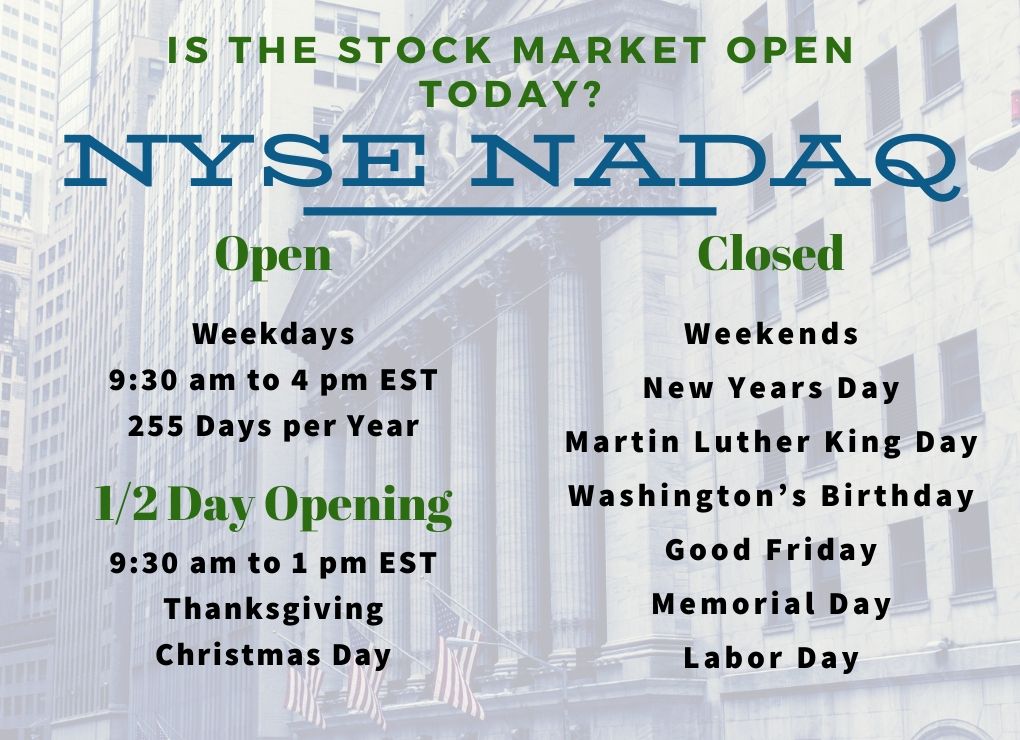
The U.S. stock markets close for nine major holidays: New Year’s Day, Martin Luther King Jr. Day, Washington’s Birthday (Presidents’ Day), Good Friday, Memorial Day, Juneteenth National Independence Day, Independence Day, Labor Day, Thanksgiving Day, and Christmas Day. If a holiday falls on a Saturday, the market usually closes on the preceding Friday. If it falls on a Sunday, the market closes on the following Monday.
Strategic Early Closures
There are specific days when the market does not close entirely but operates on a shortened schedule, typically closing at 1:00 PM EST. The most common examples are the Friday after Thanksgiving (Black Friday) and Christmas Eve (if it falls on a weekday). On these days, trading volume is usually very light, as many institutional traders take the day off. This low volume can lead to “choppy” price action, where small trades have an outsized impact on market movement.
The Impact of “Witching” Days
While not a holiday, investors should be aware of “Triple Witching” or “Quadruple Witching” days. These occur on the third Friday of March, June, September, and December, when various options and futures contracts expire simultaneously. While the market closes at the usual 4:00 PM, the final hour of trading—often called the “accelerated close”—can see massive spikes in volume and volatility as institutional players rebalance their portfolios.
Global Interconnectivity and the 24-Hour Cycle
In the modern financial landscape, no market exists in a vacuum. Even when the NYSE and Nasdaq are closed, the global “Money” machine is still turning.
The 24-Hour Cycle of Global Finance
As New York closes, the baton is passed to markets in Asia and then Europe. The Tokyo Stock Exchange, the Hong Kong Stock Exchange, and the London Stock Exchange all have their own operating hours. Movements in the FTSE 100 in London or the Nikkei 225 in Japan often set the tone for the U.S. opening. A professional investor monitors these global closes to gauge the “risk-on” or “risk-off” sentiment moving toward the American session.
Overnight Futures and Their Influence
For those who want to see where the market is headed while the exchanges are closed, “Futures” are the primary tool. S&P 500 Futures trade nearly 24 hours a day, five days a week. These contracts allow investors to hedge their positions or speculate on the market’s direction overnight. If a major geopolitical event happens at 2:00 AM EST, the futures market will react instantly, long before the NYSE opens its doors.
The Role of Cryptocurrency in the “Always-On” Era
While this guide focuses on the stock market, the rise of digital assets has changed the psychological expectations of investors. Unlike stocks, the cryptocurrency market never closes. It operates 24/7, 365 days a year. This has led some to advocate for longer stock market hours, though the traditional 4:00 PM close remains the standard due to the need for clearinghouse processing and the human element of institutional management.
Strategic Timing: Why the “When” Matters as Much as the “What”
Successful investing isn’t just about what you buy; it’s about when you execute the trade. The time of day can dictate the price quality and the level of risk you are assuming.
The “Power Hour” and Market Volatility
The first and last hours of the trading day (9:30–10:30 AM and 3:00–4:00 PM) are often referred to as the “Power Hours.” The opening hour is characterized by the “open outcry” of the digital era, where the market reacts to all the news that accumulated overnight. The final hour is when institutional “smart money” makes its final moves to position for the next day. For novice investors, these hours can be dangerous due to high volatility; however, for active traders, they provide the most opportunity.
Avoiding the “Mid-Day Lull”
Conversely, the period between 12:00 PM and 2:00 PM EST is often the quietest time on Wall Street. Many traders take their lunch breaks, and institutional volume drops. Prices may drift aimlessly during this time. If you are looking to execute a large position without causing a price spike, the mid-day lull can sometimes be beneficial, though the lack of liquidity can also lead to less-than-ideal pricing.
Tailoring Your Strategy to the Clock
Long-term “buy and hold” investors don’t need to worry about the 4:00 PM close on a daily basis. However, if you are a swing trader or someone managing their own retirement account, understanding these windows is vital. For example, placing a “market order” (an order to buy or sell immediately at the best available price) during the first five minutes of the market open can result in paying a much higher price than anticipated due to the opening volatility. Often, waiting until the market “settles” around 10:30 AM provides a more stable entry point.
Conclusion: Mastering the Financial Clock
In the world of money and investing, time is a resource just as valuable as capital. While the question “what time does the stock market close?” has a simple answer—4:00 PM EST—the implications of that answer are vast. From the high-stakes environment of the closing bell to the volatile waters of after-hours trading and the global influence of international exchanges, the clock dictates the flow of trillions of dollars.
By understanding these schedules, recognizing the importance of market holidays, and strategically timing your trades to coincide with peak liquidity, you position yourself as a more disciplined and informed investor. In the pursuit of financial independence, knowing when to act—and, more importantly, when to wait for the bell—is a hallmark of professional-grade wealth management.
aViewFromTheCave is a participant in the Amazon Services LLC Associates Program, an affiliate advertising program designed to provide a means for sites to earn advertising fees by advertising and linking to Amazon.com. Amazon, the Amazon logo, AmazonSupply, and the AmazonSupply logo are trademarks of Amazon.com, Inc. or its affiliates. As an Amazon Associate we earn affiliate commissions from qualifying purchases.