
For the modern investor, the stock market often feels like a living, breathing entity that never sleeps. In an era defined by 24/7 cryptocurrency trading and globalized digital finance, it is easy to assume that the pillars of high finance—like the New York Stock Exchange (NYSE) and the Nasdaq—operate with similar constancy. However, the traditional financial world operates under a much more structured and regulated calendar.
Understanding exactly how many days a year the stock market is open is more than just a piece of trivia; it is a fundamental component of professional financial planning, liquidity management, and strategic execution. Whether you are a day trader looking to maximize your sessions or a long-term investor calculating settlement dates, the market calendar dictates the rhythm of your capital.

Understanding the Standard Trading Calendar: The 252-Day Benchmark
When calculating the operational capacity of the financial markets, we must look at the Gregorian calendar through the lens of regulatory constraints. While a standard year has 365 days (or 366 in a leap year), the stock market is open for significantly fewer. On average, the U.S. stock market is open for 252 trading days per year.
The 252-Day Benchmark and Its Significance
The number 252 is a “magic number” in finance. It is the denominator used by analysts to calculate annualized volatility, daily returns, and various risk metrics like the Sharpe Ratio. This figure is derived by taking the total days in a year and subtracting the 104 weekend days (Saturdays and Sundays) and the roughly nine to ten scheduled federal holidays.
For institutional investors and quantitative hedge funds, the 252-day count is essential for algorithmic modeling. If a model assumes the market is open every day, its risk projections will be fundamentally flawed. Understanding this cadence allows investors to pace their portfolios and understand that for about 31% of the year, their assets are “static” in terms of public exchange pricing.
Weekend Closures and the History of Market Hours
The stock market remains closed on Saturdays and Sundays. This wasn’t always the case; historically, the NYSE held abbreviated sessions on Saturdays until the mid-20th century. The move to a five-day workweek was a response to labor trends and the need for back-office clearing houses to catch up on the physical paperwork associated with trades.
In the modern context, weekend closures provide a necessary “cooling-off” period. They prevent emotional cascading during periods of high volatility and allow firms to perform essential maintenance on the technological infrastructure that powers global finance. For the retail investor, these 104 days off represent a period of illiquidity where news can accumulate, often leading to “gaps” in price when the market reopens on Monday morning.
Federal Holidays and Scheduled Market Closures
While weekends account for the majority of days the market is closed, federal holidays represent the strategic pauses in the financial year. The U.S. equity markets follow a specific holiday schedule that aligns closely—though not perfectly—with the federal government and the banking system.
Major US Market Holidays: The Regular Absences
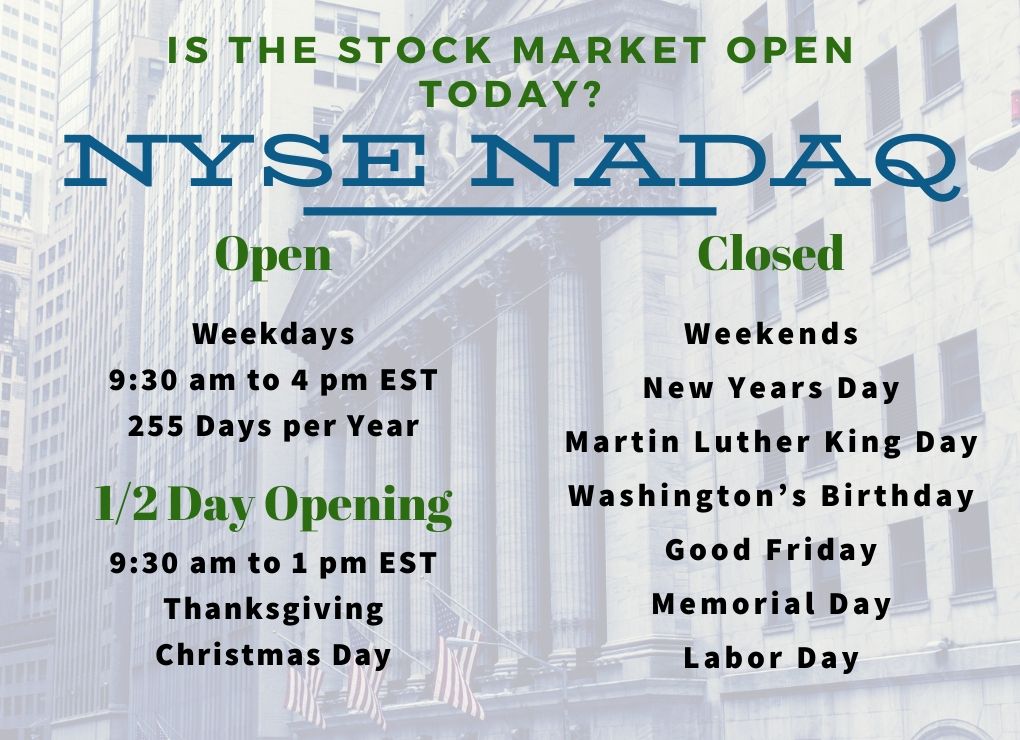
The NYSE and Nasdaq typically observe nine major holidays. When a holiday falls on a Saturday, the market usually closes on the preceding Friday. If it falls on a Sunday, the market closes on the following Monday. The standard list includes:
- New Year’s Day
- Martin Luther King, Jr. Day (Third Monday in January)
- Presidents’ Day (Third Monday in February)
- Good Friday (The Friday before Easter Sunday—notably a market holiday even though it is not a federal holiday)
- Memorial Day (Last Monday in May)
- Juneteenth National Independence Day (June 19)
- Independence Day (July 4)
- Labor Day (First Monday in September)
- Thanksgiving Day (Fourth Thursday in November)
- Christmas Day (December 25)
These closures are vital for investors to track, especially around “Quadruple Witching” dates or options expiration weeks, where a holiday can shorten the time premium remaining on a contract.
The Concept of Early Closures
Beyond full-day closures, the market also utilizes “early closures,” typically ending the session at 1:00 PM EST instead of the usual 4:00 PM EST. These usually occur on the day after Thanksgiving (Black Friday) and sometimes on Christmas Eve or July 3rd, depending on how those dates fall in the week.
From a money management perspective, early closure days are notorious for low “thin” liquidity. Large institutional desks are often understaffed, and trading volume drops significantly. For the sophisticated investor, these days are often avoided for major entries or exits, as the lack of volume can lead to wider bid-ask spreads and increased slippage.
Why Market Trading Days Matter for Your Investment Strategy
The number of days the market is open influences more than just when you can click “buy” or “sell.” It affects the very mechanics of how money moves and how risk is priced.
Volatility Patterns and the “Weekend Effect”
The transition from a Friday close to a Monday open is a critical window in finance known as the “Weekend Effect.” Because the market is closed for two full days, any geopolitical events, economic data releases, or corporate scandals that happen over the weekend cannot be priced in real-time.
When the market opens on Monday, all that pent-up information is released at once, often resulting in a “gap up” or “gap down” in stock prices. Investors must manage this “overnight risk” by ensuring they are not over-leveraged heading into a weekend or a long holiday break. Understanding the 252-day cycle helps investors realize that while the trading stops, the risk does not.
Settlement Periods and the T+1 Rule
One of the most practical reasons to know the market calendar is to understand settlement. In the world of finance, selling a stock is not the same as having the cash in your hand. For decades, the U.S. operated on a T+2 settlement cycle (Trade date plus two business days). However, as of May 2024, the U.S. transitioned to T+1 settlement.
This means if you sell a stock on a Friday, the “business days” rule applies. Since Saturday and Sunday are not trading days, your trade will not settle until Monday. If Monday is a federal holiday like Labor Day, the settlement is pushed to Tuesday. For individuals managing cash flow or looking to move money into a high-yield savings account or another investment, failing to account for market holidays can lead to missed opportunities or unexpected interest charges on margin accounts.
Beyond the Standard Session: After-Hours and Global Perspectives
While we have established that the market is “open” roughly 252 days a year from 9:30 AM to 4:00 PM EST, the reality of modern finance is slightly more nuanced. The definition of “open” depends on the tools and platforms an investor utilizes.
Extended Hours Trading: Pre-Market and After-Hours
The core 252 days refer to the “regular session.” However, most major brokerages now offer access to extended-hours trading. Pre-market trading can begin as early as 4:00 AM EST, and after-hours trading can continue until 8:00 PM EST.
While the exchanges are technically “open” for these electronic sessions, they do not count as additional days. Furthermore, the rules of engagement change. During these extended periods, liquidity is much lower, and the protections offered by certain order types (like “market orders”) are often restricted to “limit orders” only. For the disciplined investor, the regular 252-day session remains the gold standard for price discovery.
International Market Variations and Arbitrage
Investing is a global endeavor. While the U.S. market may be closed for Thanksgiving, the London Stock Exchange (LSE), the Tokyo Stock Exchange (TSE), and the Hong Kong Stock Exchange (HKEX) are all operational.
This discrepancy creates unique opportunities and risks. If you hold American Depository Receipts (ADRs) of a foreign company, the underlying shares might be trading in their home country while the U.S. market is closed for a holiday. This can lead to significant price adjustments when the U.S. market finally opens. Wealth managers often use these international operational days to hedge positions or engage in cross-border arbitrage, ensuring that their capital is working even when the domestic “252-day” clock has paused.

Conclusion: Mastering the Financial Calendar
The question “How many days a year is the stock market open?” serves as a gateway into the broader mechanics of global finance. By recognizing the standard 252-day trading year, investors can better understand the metrics used by professionals to measure risk and performance.
Navigating the holidays, understanding the implications of weekend gaps, and mastering the nuances of settlement cycles are all hallmarks of a sophisticated approach to money management. In a world that prizes “always-on” connectivity, the stock market’s structured calendar provides a necessary framework for stability, regulatory oversight, and strategic reflection. By aligning your investment activities with this calendar, you ensure that your financial decisions are timed with precision, maximizing both liquidity and long-term growth potential.
aViewFromTheCave is a participant in the Amazon Services LLC Associates Program, an affiliate advertising program designed to provide a means for sites to earn advertising fees by advertising and linking to Amazon.com. Amazon, the Amazon logo, AmazonSupply, and the AmazonSupply logo are trademarks of Amazon.com, Inc. or its affiliates. As an Amazon Associate we earn affiliate commissions from qualifying purchases.