
For investors, analysts, and casual observers alike, the question “What did the Dow Jones close at?” is more than just a request for a numerical value. It is a query about the health of the American economy, the sentiment of the global market, and the pulse of corporate profitability. The Dow Jones Industrial Average (DJIA), often simply called “the Dow,” is the oldest and most frequently cited stock market index in the world. While the final number at 4:00 PM EST provides a convenient snapshot, understanding what that number represents requires a deeper dive into the mechanics of the financial markets, the psychology of investing, and the economic forces that drive price action.

In the realm of personal finance and institutional investing, the daily close of the Dow serves as a benchmark for performance and a catalyst for decision-making. Whether the market finished “up 200” or “down 500,” those digits influence everything from retirement account balances to consumer confidence. To truly grasp the significance of the Dow’s closing price, one must look past the ticker tape and examine the structural, economic, and strategic elements that define this storied index.
Decoding the Dow Jones Industrial Average (DJIA)
To understand the daily closing price, one must first understand what the index actually is. Unlike the S&P 500, which tracks 500 of the largest U.S. companies, the Dow Jones Industrial Average is a price-weighted index composed of only 30 prominent, “blue-chip” companies listed on stock exchanges in the United States. These companies are leaders in their respective industries, ranging from technology and healthcare to retail and financial services.
What is the “Dow” and How is it Calculated?
The Dow is unique because it is price-weighted rather than market-capitalization-weighted. In a market-cap-weighted index, larger companies have a bigger impact on the index’s movement. In the Dow, however, the company with the highest stock price has the greatest influence on the index’s daily fluctuations, regardless of its total market value.
To calculate the Dow, the prices of all 30 component stocks are added together and then divided by the “Dow Divisor.” This divisor is a continuously adjusted figure that accounts for stock splits, spin-offs, and other structural changes in the component companies. This ensures that a 2-for-1 stock split doesn’t cause the index to “drop” simply because a price was halved. When you see the Dow close at a specific point value, you are seeing the sum of these prices adjusted by that mathematical constant.
The Significance of the Closing Bell
The closing price is the final price at which a stock trades during the regular market session. While “after-hours” trading exists, the 4:00 PM EST close is the official record used by mutual funds to calculate their Net Asset Value (NAV) and by analysts to chart historical performance. The “closing bell” at the New York Stock Exchange is an iconic symbol of this daily finality. For the Dow, the closing number represents the collective consensus of thousands of traders and millions of algorithms on the value of American industry at that specific moment in time.
Why the Closing Price Matters to Investors
The daily closing number of the Dow is often used as a shorthand for “how the market did today.” While savvy investors know that one index cannot represent the entire financial universe, the Dow’s movements carry significant weight in terms of psychological impact and portfolio management.
Market Sentiment and the Daily Narrative
Financial media outlets often build their daily narratives around the Dow’s close. If the Dow closes at a record high, the narrative is one of optimism, growth, and “bullish” behavior. Conversely, a sharp decline can trigger “bearish” sentiment, leading to headlines about economic cooling or geopolitical instability. This sentiment is a feedback loop; when investors see a positive close, they may be more likely to maintain their positions or invest more capital, whereas a negative close can spark fear-based selling.
Technical Analysis and Closing Trends
For technical analysts—investors who study price patterns to predict future movements—the closing price is the most critical data point of the day. Many “buy” or “sell” signals are only triggered if the Dow closes above or below a certain “resistance” or “support” level. For example, if the Dow has struggled to cross a specific threshold for weeks, a daily close above that line is seen as a “breakout,” suggesting that the market has the momentum to continue climbing.
Institutional Rebalancing and Liquidity
Large institutional investors, such as pension funds and insurance companies, often execute trades near the close of the market to ensure they receive the “benchmark” price for the day. This creates a surge in liquidity and volatility in the final minutes of trading, often referred to as the “market on close” (MOC) orders. Therefore, the closing price isn’t just a random last trade; it is often the result of massive capital shifts by the world’s largest financial players.
Factors that Influence the Daily Close
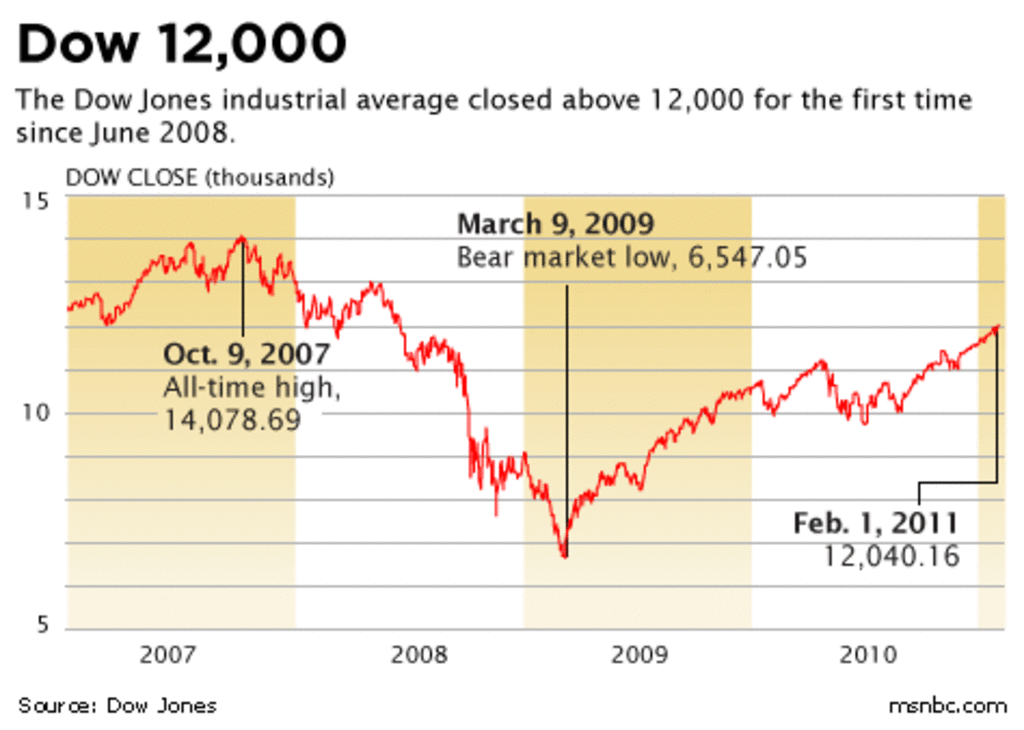
The question of “what the Dow closed at” is inextricably linked to the “why” behind the movement. On any given day, a multitude of variables can push the blue-chip stocks higher or lower.
Economic Indicators and Fed Decisions
The most potent drivers of the Dow are reports from the federal government and the Federal Reserve. Data regarding inflation (Consumer Price Index), employment (Non-Farm Payrolls), and GDP growth are scrutinized by traders. If inflation is higher than expected, the Dow may close lower on fears that the Federal Reserve will raise interest rates. Higher interest rates increase borrowing costs for corporations, which can eat into profits and lower stock valuations.
Corporate Earnings Reports
Since the Dow is composed of only 30 companies, a massive swing in just one or two stocks can significantly move the entire index. During “earnings season,” companies like UnitedHealth, Goldman Sachs, or Microsoft report their quarterly profits. If a heavyweight component misses its earnings targets or provides “weak guidance” for the future, its stock price will drop, potentially dragging the entire Dow Jones Industrial Average down with it, even if the other 29 stocks are performing well.
Geopolitical Events and Global Stability
Because the companies in the Dow are multinational giants, they are sensitive to global events. Trade wars, military conflicts, or political instability in major markets like Europe or China can affect supply chains and international sales. Investors often react to these events by shifting toward “safe-haven” assets or selling off equities, leading to a lower close for the Dow.
Looking Beyond the Number: Long-term Investment Strategy
While the daily closing price provides excitement and immediate data, successful long-term investing requires a perspective that spans years rather than hours. For the individual looking to build wealth or secure a retirement, the Dow’s daily fluctuations are often “noise” that should be filtered out.
The Danger of Overreacting to Daily Fluctuations
One of the most common mistakes in personal finance is “panic selling” based on a bad day or week for the Dow. History shows that the stock market has an upward trajectory over long periods. Investors who obsess over “what the Dow closed at” every day are more likely to make emotional decisions that disrupt the benefits of compound interest. A 500-point drop might seem catastrophic in a headline, but in the context of a thirty-year investment horizon, it is often a mere blip on the chart.
Diversification and Modern Portfolio Theory
While the Dow is a prestigious index, it is not a diversified portfolio. Because it only contains 30 stocks and excludes the transportation and utilities sectors (which have their own Dow indices), relying solely on the DJIA for investment health can be misleading. A modern financial strategy involves diversifying across different asset classes, including small-cap stocks, international equities, and bonds. This reduces the risk that a bad day for “Big Tech” or “Big Banking” will ruin an entire financial plan.
Tools for Tracking Real-Time Performance
In the modern era, investors no longer have to wait for the evening news to see the market’s performance. Financial tools and apps provide real-time streaming of the Dow, along with “futures” which predict where the market will open the following day. Utilizing these tools for education—rather than for impulsive trading—can help investors understand the relationship between news events and market reactions.
The Evolution of the Dow in the Digital Age
The Dow Jones Industrial Average has survived the Great Depression, two World Wars, the dot-com bubble, and the 2008 financial crisis. However, the way it closes has changed dramatically with the advent of technology.
High-Frequency Trading and After-Hours Markets
Today, much of the activity leading up to the closing price is driven by High-Frequency Trading (HFT) algorithms. These computers execute thousands of trades per second based on mathematical models. This has led to “flash crashes” and increased volatility in the final seconds of the trading day. Furthermore, the “close” is no longer the end of the story. After-hours trading allows investors to continue buying and selling, meaning the price you see at 4:00 PM might be significantly different from the price at 8:00 PM.

The Future of the Index in a Tech-Driven Economy
As the global economy shifts further toward artificial intelligence, renewable energy, and digital finance, the committee that manages the Dow (the S&P Dow Jones Indices) must decide which companies truly represent “Industrial” America. We have seen traditional companies replaced by tech giants like Apple and Salesforce in recent years. The closing price of the Dow will continue to evolve as it swaps out 20th-century legacy firms for 21st-century innovators, ensuring it remains the primary answer to the question: “How is the economy doing today?”
In conclusion, “what the Dow closed at” is a gateway to understanding the complex machinery of global finance. It is a number influenced by mathematics, human psychology, government policy, and corporate performance. For the disciplined investor, the closing price is a data point to be noted, but never a reason to abandon a well-constructed financial plan. Understanding the Dow is not just about tracking wealth; it is about observing the ongoing story of human enterprise and economic resilience.
aViewFromTheCave is a participant in the Amazon Services LLC Associates Program, an affiliate advertising program designed to provide a means for sites to earn advertising fees by advertising and linking to Amazon.com. Amazon, the Amazon logo, AmazonSupply, and the AmazonSupply logo are trademarks of Amazon.com, Inc. or its affiliates. As an Amazon Associate we earn affiliate commissions from qualifying purchases.