
In an era defined by the “subscription economy,” consumers are increasingly scrutinizing every recurring monthly charge. From streaming giants like Netflix to software suites and gym memberships, the modern budget is a patchwork of digital and physical services. For cinema enthusiasts, the AMC Stubs A-List program represents one of the most prominent players in this landscape. But the question “How much is AMC A-List?” involves more than just a single sticker price; it requires a deep dive into tiered pricing models, geographic cost variances, and a rigorous cost-benefit analysis.

For the savvy individual looking to optimize their entertainment budget, understanding the financial architecture of AMC A-List is essential. This article breaks down the costs, evaluates the return on investment (ROI), and compares the program against market competitors to determine its true value in a personal finance context.
The Cost Structure: Understanding Tiered Pricing by Region
Unlike a standard Netflix subscription that costs the same whether you live in rural Kansas or downtown Manhattan, AMC A-List utilizes a localized pricing model. This is a strategic financial move by AMC to account for the vastly different operating costs and ticket prices across the United States.
The Three Pricing Tiers
As of current market rates, AMC A-List is divided into three distinct price points based on the state in which you plan to view movies.
- The Entry Tier (Approx. $19.95 + tax): This tier covers 34 states where movie tickets are generally lower in price. This is the most budget-friendly option for those in the Midwest or Southern regions.
- The Mid-Level Tier (Approx. $22.95 + tax): This tier adds states like Colorado, Florida, Georgia, and others where the cost of living and entertainment is slightly higher.
- The Premium Tier (Approx. $24.95 + tax): This tier is mandatory for residents of high-cost states such as California, New York, New Jersey, and Massachusetts.
It is important to note that if you subscribe at a lower tier, you cannot use your membership in a higher-tier state without paying an upcharge. However, those in the $24.95 tier can use their membership at any AMC theater across the country.
Sales Tax and Hidden Financial Considerations
When calculating the monthly impact on your bank account, you must account for state-specific sales tax. A $24.95 membership in New York City can easily approach $27.00 after taxes. Furthermore, AMC requires a three-month minimum commitment upon initial sign-up. From a cash-flow perspective, this means you are committing to a minimum financial outlay of roughly $60 to $80 upfront, depending on your region.
The Value Proposition: Calculating the “Break-Even” Point
To determine if AMC A-List is a sound financial decision, one must apply a basic ROI calculation. The primary metric here is the “Break-Even Point”—the number of films you need to watch per month to make the subscription cheaper than buying individual tickets.
The Math of Modern Cinema
In major metropolitan areas, a standard evening ticket often ranges from $15 to $18. If you are in the $24.95 tier, seeing just two movies a month ($15 x 2 = $30) already places you in a “profit” position relative to individual purchases. If you utilize the program’s full capacity—three movies per week—you could theoretically see 12 to 13 movies a month. At that volume, the cost per movie drops to roughly $2.00, representing a staggering 85% discount on retail prices.
The Premium Format Advantage
The true financial “hack” of A-List lies in its inclusion of premium formats. Typically, IMAX, Dolby Cinema, and RealD 3D screenings carry a significant surcharge, often costing $22 to $28 for a single ticket in cities like Los Angeles or Chicago. Since A-List covers these formats at no additional cost, a member can exceed the value of their entire monthly subscription with a single IMAX screening. For the tech-forward moviegoer who refuses to settle for standard digital projection, the A-List membership functions more like a high-yield investment in their hobby.
Strategic Financial Management: Optimizing the Membership
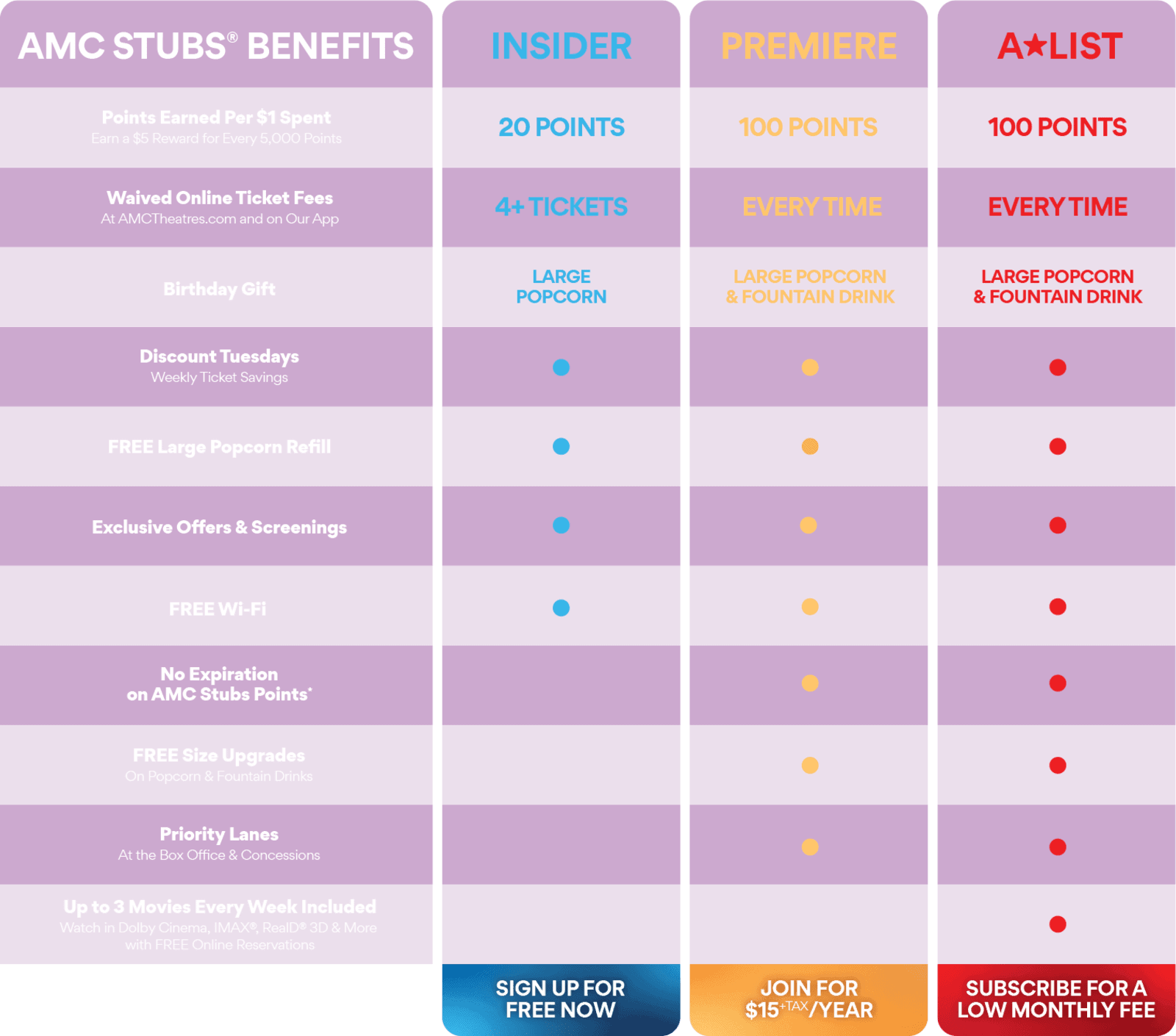
Beyond the core ticket savings, an A-List membership integrates with the broader AMC Stubs ecosystem to provide secondary financial benefits. Treating these perks as “dividends” can further lower the effective cost of the subscription.
Earning and Redeeming Rewards
For every dollar spent on the membership fee (and on concessions), A-List members earn points. Every 5,000 points equates to a $5 reward. For a member paying $25 a month, the membership itself generates a $5 reward every two months. This acts as a 10% “cash-back” mechanism on the subscription price, which can be applied toward popcorn, soda, or even future membership dues.
Concession Discounts and Waived Fees
A-List members are automatically upgraded to “Premiere” status, which includes waived online ticketing fees on third-party sites like Fandango or Atom Tickets. In a world where “convenience fees” often add $2.00 to $3.00 per ticket, a frequent moviegoer saves an additional $10 to $20 a month simply by avoiding these transaction costs. Additionally, the program offers free size upgrades on popcorn and fountain drinks, providing a marginal but measurable saving for those who frequent the snack bar.
Managing the Subscription Lifecycle
From a personal finance standpoint, flexibility is key. AMC allows members to manage their subscriptions digitally, but there are strict rules regarding cancellations. If you cancel, you are barred from re-joining for six months. This policy is designed to prevent “seasonal churning”—where users join only for summer blockbuster months. Budget-conscious users should audit their upcoming film schedule to ensure they will actually use the service during the three-month commitment period before signing up.
Competitive Landscape: AMC A-List vs. The Market
To understand the value of A-List, we must compare it to its primary competitors: Regal Unlimited and the general landscape of streaming services.
Regal Unlimited: The Chief Competitor
Regal Unlimited offers a similar tiered structure. While Regal’s base price is often slightly lower (starting around $18.99), it has a major financial drawback: it does not include premium formats for free. Regal members must pay the difference between a standard ticket and an IMAX/Dolby ticket. For consumers who prefer premium experiences, AMC A-List is almost always the superior financial choice, despite the slightly higher base monthly fee.
The Streaming Opportunity Cost
When comparing a $25/month theater subscription to a $15/month Max or Netflix subscription, the financial logic shifts toward the home environment. However, this is an “apples to oranges” comparison for the cinephile. Cinema subscriptions are for those who value the “first-run” experience. If you are someone who spends $20 to “Premium Video On Demand” (PVOD) a movie at home while it is still in theaters, A-List pays for itself in a single use.

The Verdict: Is AMC A-List a Sound Financial Move?
Determining whether AMC A-List belongs in your monthly budget depends entirely on your consumption habits and geographic location.
For the “Power User”—someone who sees at least two movies a month and prefers premium formats like Dolby Cinema—the program is an objective financial win. The inclusion of fees, rewards, and premium surcharges creates a value proposition that is difficult to beat in the modern entertainment market. It effectively caps your monthly entertainment spend, providing “unlimited” access (within the 3-per-week limit) for a predictable, fixed cost.
However, for the “Occasional Viewer” who only visits the theater for the annual Marvel movie or a holiday blockbuster, the $20–$25 monthly drain represents “subscription creep.” In this case, the $300 annual cost is far higher than simply paying for two or three tickets a year out of pocket.
In conclusion, the cost of AMC A-List is not just the $19.95 to $24.95 price tag; it is a strategic trade-off. By committing to a single brand, you unlock a high-value ecosystem that rewards frequent use and protects your budget from the rising costs of individual cinema tickets. For the dedicated film lover, it is perhaps the most efficient way to manage a movie-going budget in today’s economy.
aViewFromTheCave is a participant in the Amazon Services LLC Associates Program, an affiliate advertising program designed to provide a means for sites to earn advertising fees by advertising and linking to Amazon.com. Amazon, the Amazon logo, AmazonSupply, and the AmazonSupply logo are trademarks of Amazon.com, Inc. or its affiliates. As an Amazon Associate we earn affiliate commissions from qualifying purchases.