
The Dow Jones Industrial Average (DJIA) has long served as the primary barometer for the health of the American economy. Often referred to simply as “the Dow,” this price-weighted index of 30 prominent companies listed on stock exchanges in the United States provides a snapshot of the industrial and financial landscape. To understand where the Dow Jones is today, one must look beyond the daily fluctuations of points and percentages and delve into the underlying economic forces, corporate performance metrics, and investor sentiments that dictate its trajectory. In an era defined by rapid technological shifts and complex geopolitical realities, the Dow remains a critical focal point for both institutional and retail investors seeking to gauge the stability of the “Blue Chip” sector.

1. Navigating the Macroeconomic Landscape: Interest Rates and Inflation
The current position of the Dow Jones is inextricably linked to the monetary policy decisions of the Federal Reserve. For much of the recent past, the index has been reactive to the “higher-for-longer” interest rate environment designed to combat persistent inflation. When investors ask where the Dow is today, they are effectively asking how the market is pricing in the future of the U.S. dollar and the cost of borrowing.
The Federal Reserve’s Pivot and Market Sentiment
The trajectory of the Dow is heavily influenced by the Fed’s dot plot and the commentary of its officials. As inflation figures show signs of cooling, the market begins to anticipate a shift from a restrictive stance to a more accommodative one. A lower interest rate environment is generally bullish for the Dow, as it reduces the cost of capital for the 30 constituent companies, ranging from manufacturing giants to financial institutions. However, the “today” of the Dow is often a reflection of the delicate balance between hoping for rate cuts and fearing that those cuts are necessitated by a cooling economy.
Inflationary Pressures and Consumer Spending
Inflation remains a double-edged sword for the components of the Dow. While some companies, such as those in the consumer staples or healthcare sectors, possess the pricing power to pass costs on to consumers, others may see their margins squeezed. The Dow’s current level reflects the collective earnings power of these entities in a world where the Consumer Price Index (CPI) and Personal Consumption Expenditures (PCE) price index are the most watched data points. If consumer spending remains resilient despite high prices, the Dow tends to find a solid floor.
2. Technical Analysis: Key Levels, Resistance, and Support
From a technical perspective, determining where the Dow Jones is today requires an examination of historical price action and psychological milestones. Investors use technical analysis to filter out the “noise” of daily news cycles and focus on the actual movement of capital.
Psychological Thresholds and All-Time Highs
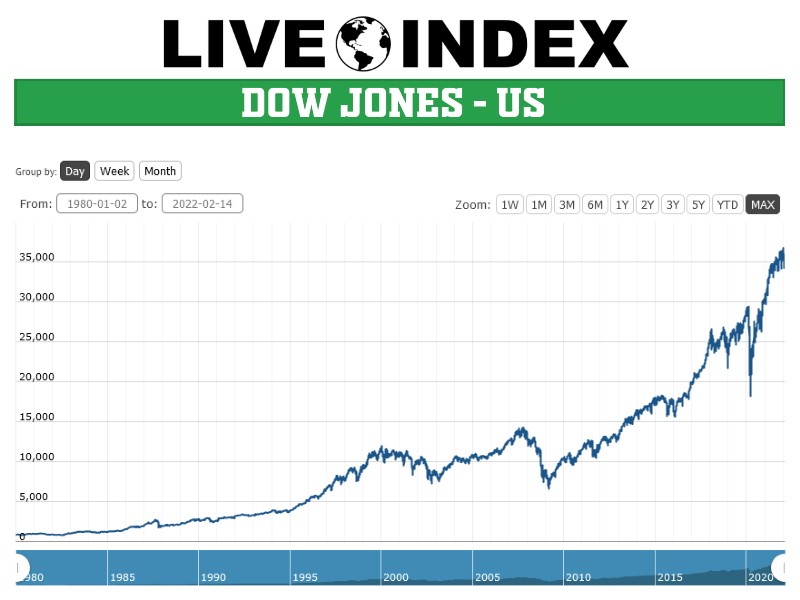
The Dow is a master of psychological numbers. Whether it is crossing the 30,000, 35,000, or 40,000 mark, these round numbers act as magnets for market activity. When the Dow approaches a new all-time high, it often encounters “resistance”—a level where selling pressure outweighs buying pressure as investors take profits. Conversely, identifying “support” levels—prices where the index has historically bounced back—is essential for understanding the downside risk in the current market.
Moving Averages and Volatility Indicators
To understand the Dow’s current momentum, analysts frequently look at the 50-day and 200-day simple moving averages (SMA). If the Dow is trading above these levels, it is generally considered to be in a healthy uptrend. “Where the Dow is today” can also be measured by the Volatility Index (VIX). High volatility often correlates with a downward trend in the Dow, as uncertainty prompts investors to move away from equities and into “safe-haven” assets like Treasury bonds or gold.
3. The Power of the 30: Sector Rotation and Component Performance
Unlike the S&P 500, which is market-cap weighted, the Dow is price-weighted. This means that stocks with a higher share price have a greater influence on the index’s movement, regardless of the company’s actual size. Understanding the Dow today requires looking at the specific performance of its 30 components.

The Tech Influence on a Traditional Index
While the Dow is historically “industrial,” it has evolved to include tech heavyweights like Microsoft and Apple. In the current market, the performance of the Dow is often skewed by the “AI revolution” and the digital transformation of business. If tech is rallying, the Dow may rise even if traditional industrial or energy components are lagging. This internal “sector rotation” is a key theme; when investors rotate out of high-growth tech and into value-oriented stocks like Coca-Cola or UnitedHealth, the Dow can show unique resilience compared to the Nasdaq.
Recent Changes in Index Composition
The Dow is not a static list. The S&P Dow Jones Indices committee periodically updates the components to ensure the index remains a relevant representation of the U.S. economy. Recent additions or removals—such as the inclusion of Amazon to reflect the dominance of e-commerce—fundamentally change how the index reacts to news. Evaluating the Dow today means recognizing that it is a more diversified and “modern” index than it was even a decade ago, encompassing retail, cloud computing, and advanced healthcare.
4. Global Influences and Geopolitical Factors
The companies within the Dow Jones are global entities. A significant portion of their revenue is generated outside the United States. Consequently, “where the Dow is today” is as much a reflection of international stability as it is of domestic policy.
Trade Relations and Supply Chain Integrity
Many Dow components, such as Boeing or Caterpillar, are highly sensitive to international trade relations. Trade tensions or tariffs can significantly impact their bottom line. Today, the Dow reflects the ongoing efforts of these corporations to “near-shore” or “friend-shore” their supply chains to mitigate the risks of geopolitical disruptions. Any news regarding trade agreements or diplomatic friction immediately ripples through the Dow’s price action.
The Strength of the U.S. Dollar
Because the Dow consists of multinational corporations, the strength of the U.S. dollar is a critical factor. A strong dollar can be a headwind for the Dow, as it makes American goods more expensive abroad and reduces the value of international earnings when converted back into dollars. Investors tracking the Dow today must keep a close eye on the DXY (Dollar Index) to understand why the index might be struggling despite positive domestic news.
5. Investment Strategies for the Current Dow Climate
For the individual investor, knowing where the Dow Jones is today is the first step in formulating a robust financial strategy. Whether the market is in a bull run or a corrective phase, the Dow offers various avenues for wealth preservation and growth.
Long-Term Value vs. Short-Term Trading
The Dow is traditionally favored by “value” investors—those looking for established companies with a history of dividend payments. In today’s market, the Dow represents a “flight to quality.” During periods of economic uncertainty, investors often flee speculative small-cap stocks and seek the safety of the Dow’s blue-chip components. Using a dollar-cost averaging strategy in a Dow-tracking ETF (Exchange Traded Fund) remains one of the most reliable ways to build long-term wealth, regardless of where the index sits on any given day.
The Importance of Diversification
While the Dow is a prestigious index, it only represents 30 companies. An informed investor understands that “where the Dow is today” does not tell the whole story of the financial markets. It is essential to balance a Dow-centric portfolio with exposure to small-cap stocks, international markets, and fixed-income assets. However, because the Dow components are so deeply integrated into the global economy, their health is often a leading indicator for other asset classes.
Conclusion: The Dow as a Living Economic Narrative
In conclusion, “where is the Dow Jones today” is a question with a multi-layered answer. It is a numerical value, yes, but it is also a reflection of the Federal Reserve’s next move, the strength of the American consumer, the innovation of Silicon Valley, and the stability of global trade.
As we look at the current state of the market, the Dow continues to demonstrate remarkable adaptability. It has survived world wars, depressions, and pandemics, consistently evolving to represent the most successful and influential corporations in the world. For the modern investor, the Dow is not just a ticker on a screen; it is a comprehensive narrative of the collective efforts of the world’s leading businesses to navigate a complex financial landscape. By monitoring the Dow’s technical levels, its component performance, and the broader macroeconomic environment, one can gain a sophisticated understanding of not just where the market is today, but where the economy is headed tomorrow.
aViewFromTheCave is a participant in the Amazon Services LLC Associates Program, an affiliate advertising program designed to provide a means for sites to earn advertising fees by advertising and linking to Amazon.com. Amazon, the Amazon logo, AmazonSupply, and the AmazonSupply logo are trademarks of Amazon.com, Inc. or its affiliates. As an Amazon Associate we earn affiliate commissions from qualifying purchases.