
In the world of personal finance and strategic travel budgeting, every dollar spent is an investment in either time, comfort, or convenience. For the frequent flyer or the budget-conscious traveler, Southwest Airlines presents a unique financial puzzle. Unlike its competitors, Southwest operates on an open-seating model, making the boarding position a high-value commodity.
At the center of this ecosystem is “EarlyBird Check-In.” Far from being just a simple “add-on,” EarlyBird Check-In is a strategic financial tool that allows travelers to buy their way into a more favorable boarding group. To the casual observer, it is a nominal fee; to the savvy traveler, it is a calculated expenditure designed to mitigate the risks of middle seats and overhead bin scarcity. This article explores the financial mechanics of EarlyBird Check-In, analyzing its return on investment (ROI) and how it fits into a broader personal finance strategy for modern travel.
The Financial Mechanics of EarlyBird Check-In
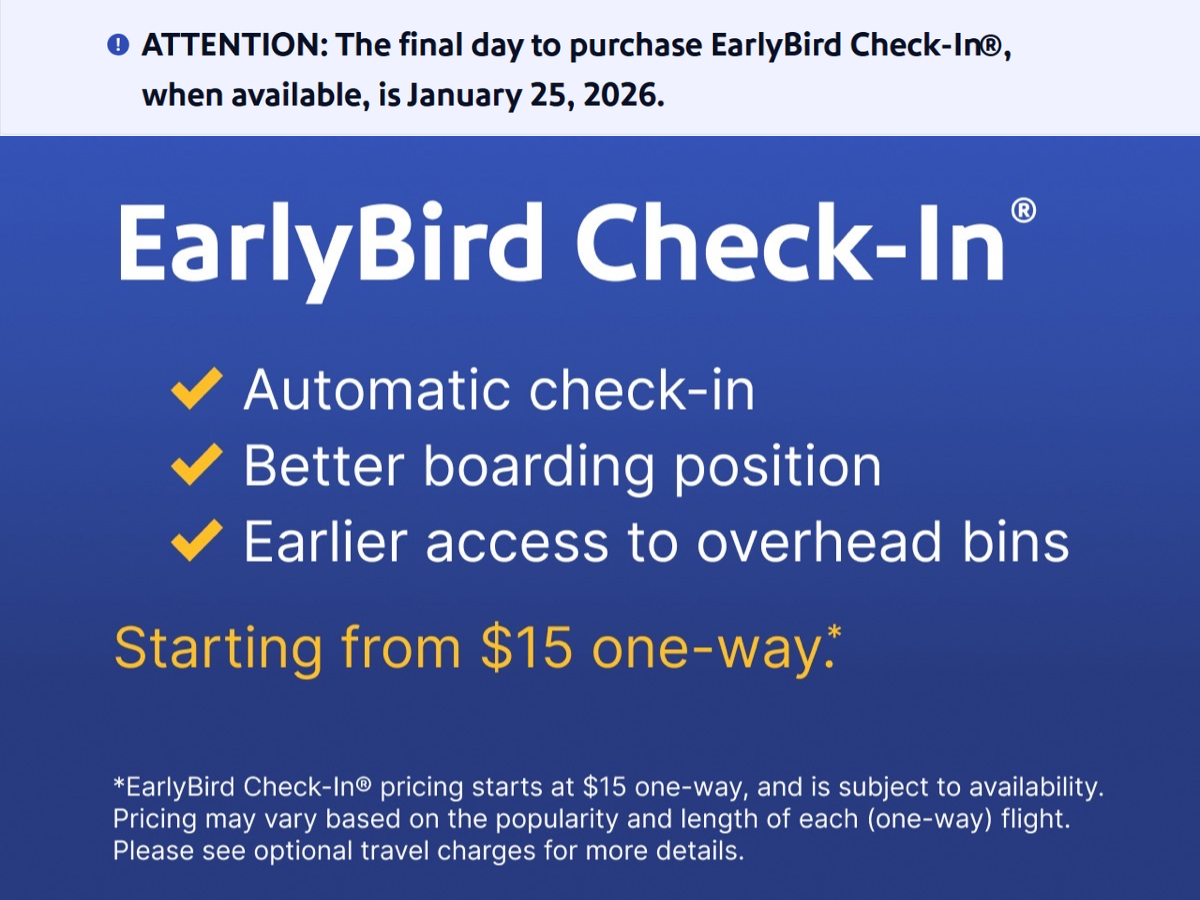
To understand whether EarlyBird Check-In is a sound financial decision, one must first understand how the product is priced and delivered. EarlyBird Check-In is an ancillary revenue stream for Southwest Airlines that provides automatic check-in for a passenger 36 hours before a flight’s scheduled departure. This is 12 hours before the general public is allowed to check in manually.
Variable Pricing and Market Demand
Historically, Southwest utilized a flat-fee model for EarlyBird. However, in recent years, the airline transitioned to a variable pricing structure. Currently, the cost ranges typically from $15 to $25 per one-way flight, depending on the length of the route and the demand for that specific flight. From a business finance perspective, this is a classic example of dynamic pricing—the airline maximizes its “ancillary revenue” (revenue from non-ticket sources) by charging more for high-demand routes, such as transcontinental flights or popular holiday segments.
The “First-In, First-Out” Queue System
When you purchase EarlyBird Check-In, you are essentially entering a secondary priority queue. The airline’s system assigns boarding positions in a specific order: first to Business Select passengers, then to A-List Preferred and A-List members, and then to EarlyBird Check-In customers in the order they purchased the service. This means the timing of your purchase is a financial variable; buying EarlyBird months in advance provides a higher “value” (a better boarding position) than buying it 48 hours before the flight for the same price.
Cost-Benefit Analysis: Is the Investment Worth It?
In personal finance, the value of a purchase is often measured against the “opportunity cost” or the “pain of payment.” When evaluating EarlyBird Check-In, travelers must determine if the expenditure yields a high enough return in terms of physical comfort and reduced stress.
The Value of Time and Stress Mitigation
The primary “dividend” of EarlyBird Check-In is the elimination of the 24-hour check-in scramble. For many professionals, being glued to a smartphone exactly 24 hours before a flight to hit the “check-in” button is an inconvenience that carries a high cognitive cost. If an individual values their time at $50 per hour, spending 15 minutes of mental energy and manual effort to check in has a theoretical cost of $12.50. In this light, a $15 EarlyBird fee is almost a break-even financial proposition that buys back peace of mind.
Overhead Bin Real Estate and Indirect Savings
Southwest is famous for its “two bags fly free” policy. However, this policy creates a high demand for overhead bin space, as more passengers carry on larger bags to avoid the wait at baggage claim. A poor boarding position (such as the late C-group) often results in “gate-checking” a bag because the bins are full. For a business traveler, the 20 to 30 minutes saved by not waiting at a luggage carousel has a quantifiable financial value. By ensuring an earlier boarding position, EarlyBird Check-In acts as a “productivity insurance policy,” guaranteeing that your luggage stays with you and you can exit the airport immediately upon landing.
The Middle Seat Penalty
The financial downside of not purchasing EarlyBird is the increased probability of ending up in a middle seat. While difficult to quantify in dollars, the “comfort tax” of a five-hour flight in a middle seat can impact a traveler’s physical well-being and productivity for the remainder of the day. If the lack of sleep or physical crampedness results in a lost day of work or a sub-optimal business meeting, the $25 investment in EarlyBird would have yielded an exponential return.
Strategic Travel Budgeting: When to Pay and When to Pass
A disciplined approach to personal finance requires knowing when to opt out of premium services. EarlyBird Check-In is not a mandatory expense, and there are several scenarios where the financial logic for purchasing it fails.
Evaluating Route Duration and Aircraft Type
The ROI on EarlyBird fluctuates based on the “cost per hour of comfort.” On a short “puddle-jumper” flight (e.g., Las Vegas to Los Angeles), the flight duration is less than an hour. In this case, the $15–$25 fee represents a high premium for a very short period of benefit. Conversely, on a flight from Baltimore to Honolulu, the investment is spread across nearly ten hours of travel, making the hourly cost of the upgrade negligible.
Group Travel Economics
For a family of four, EarlyBird Check-In is not a $25 decision; it is a $100 decision (or $200 for a round trip). From a household budgeting perspective, $200 can often cover a significant portion of ground transportation or dining at the destination. Families must weigh the financial cost against the risk of being separated. It is important to note that Southwest has a “Family Boarding” policy between the A and B groups for those with children aged six and under. For these families, paying for EarlyBird is often a redundant expense, as they are already financially “subsidized” by the airline’s boarding policy.
Leveraging Credit Card Rewards and Travel Credits
Sophisticated flyers often use “other people’s money” to fund these conveniences. Several co-branded Southwest credit cards offer two to four “Upgraded Boardings” per year or “EarlyBird Check-In” reimbursements as part of their annual fee. From a wealth-management perspective, using these credits is a way to enjoy the service without impacting your liquid cash flow. If your credit card covers the cost, the ROI becomes infinite.
Managing Your Travel Expenses: Refund Policies and Hidden Risks
A crucial part of business finance is understanding the “fine print” and the risks associated with non-refundable capital expenditures. EarlyBird Check-In is a unique financial product because of its rigid terms and conditions.
The Non-Refundability Trap
Once purchased, EarlyBird Check-In is non-refundable. If a traveler decides to cancel their flight, the funds used for the ticket are often converted into “Travel Funds,” but the money spent on EarlyBird is forfeited. This represents a “sunk cost” in the truest sense. For travelers with volatile schedules, the financial risk of losing the $25 fee may outweigh the benefits of early check-in. In these cases, it is more financially sound to wait until the 24-hour window and check in manually.
Flight Changes and Re-Allocation
If a traveler changes their flight time, the EarlyBird Check-In status does not always “travel” with them seamlessly. If the change is made within the 24-hour window of the new flight, the traveler may lose their priority position despite having paid for it. This lack of portability makes EarlyBird a “per-segment” investment rather than a “per-ticket” investment, requiring the traveler to be certain of their itinerary before committing the capital.
Comparison with “Upgraded Boarding”
At the gate, Southwest often sells “Upgraded Boarding” (positions A1–A15) for $30 to $80. From a financial optimization standpoint, EarlyBird is the “budget” version of this product. If you are a traveler who absolutely requires an aisle seat near the front of the plane for a quick exit, you must decide whether to invest $25 early (EarlyBird) for a chance at a high A-group position or wait and spend $50 later (Upgraded Boarding) for a guaranteed top-tier position. The former is a speculative investment; the latter is a premium purchase for a guaranteed outcome.
Conclusion: The Financial Verdict on EarlyBird
In the final analysis, EarlyBird Check-In on Southwest Airlines is more than a travel perk—it is a micro-transaction that reflects a traveler’s broader financial philosophy regarding time, risk, and comfort.
For the solo business traveler whose time is a billable asset, the $15–$25 fee is a negligible expense that provides a high return in productivity and stress reduction. For the budget-conscious family or the short-haul flyer, the cumulative cost of EarlyBird can quickly erode the savings found by choosing a low-cost carrier in the first place.
To master the “money” side of Southwest travel, one must view EarlyBird as a tool of strategic allocation. Buy it early for long-haul flights to maximize the value of the queue position, use credit card credits to offset the cost, and avoid it on short flights or when traveling with young children who qualify for family boarding. By treating these small travel fees with the same analytical rigor as a stock market investment, travelers can ensure that their transit experience is as cost-effective as it is comfortable.
aViewFromTheCave is a participant in the Amazon Services LLC Associates Program, an affiliate advertising program designed to provide a means for sites to earn advertising fees by advertising and linking to Amazon.com. Amazon, the Amazon logo, AmazonSupply, and the AmazonSupply logo are trademarks of Amazon.com, Inc. or its affiliates. As an Amazon Associate we earn affiliate commissions from qualifying purchases.