
In the world of business finance, liquidity is the lifeblood of any successful enterprise. While a company may report impressive sales figures and high profit margins on paper, its actual survival depends on its ability to convert those sales into cold, hard cash. This is where the Accounts Receivable (AR) Turnover Ratio comes into play. Often referred to simply as the “receivables turnover,” this metric serves as a critical barometer for how efficiently a company manages the credit it extends to its customers and how effectively it collects the debts owed to it.
Understanding AR turnover is not just for accountants and CFOs; it is a vital concept for business owners, investors, and financial analysts who want to gauge the operational health and financial stability of a company. In this guide, we will break down the mechanics of the AR turnover ratio, explore why it matters, and provide actionable strategies to optimize it for better cash flow.
1. Defining the Accounts Receivable Turnover Ratio
The Accounts Receivable Turnover Ratio is an efficiency metric that quantifies how many times, on average, a company collects its accounts receivable balance during a specific period—usually a fiscal year or a quarter. In simpler terms, it measures the speed at which a company turns its credit sales into cash.
The Core Formula
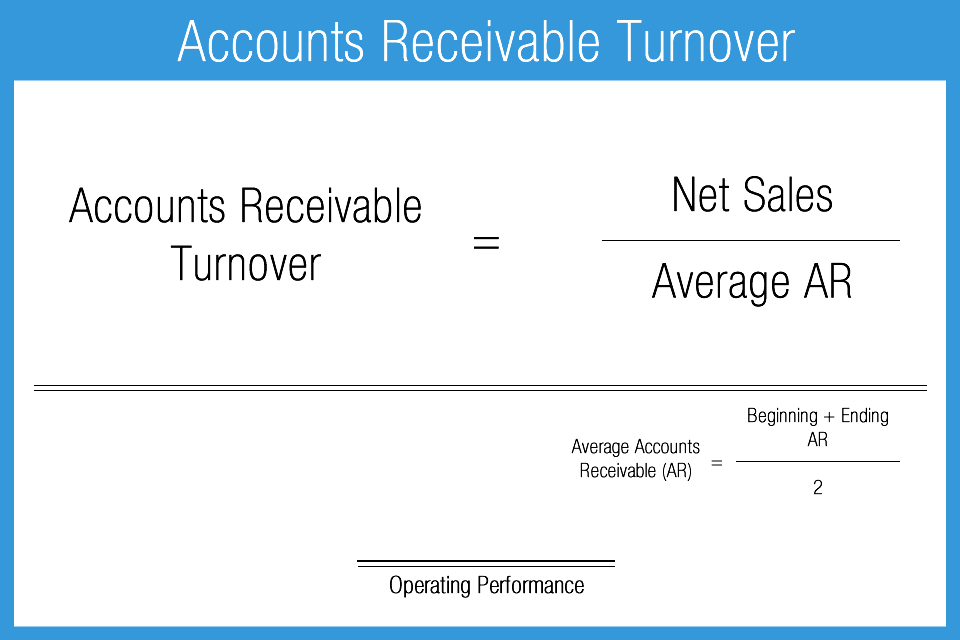
To calculate this ratio, you need two primary pieces of data from your financial statements: Net Credit Sales (found on the Income Statement) and Average Accounts Receivable (found on the Balance Sheet). The formula is as follows:
AR Turnover Ratio = Net Credit Sales / Average Accounts Receivable
Where:
- Net Credit Sales are the total sales generated on credit, minus any returns, allowances, or discounts. It is important to exclude cash sales, as they do not generate accounts receivable.
- Average Accounts Receivable is calculated by adding the starting AR balance and the ending AR balance for the period and dividing by two.
The “Days Sales Outstanding” (DSO) Connection
While the turnover ratio tells you how many times you “clear” your receivables in a year, many finance professionals prefer to view this through the lens of time. By dividing 365 days by the AR turnover ratio, you get the Days Sales Outstanding (DSO). This number tells you exactly how many days, on average, it takes for a customer to pay their bill. For example, if your AR turnover is 10, your DSO is 36.5 days.
Real-World Calculation Example
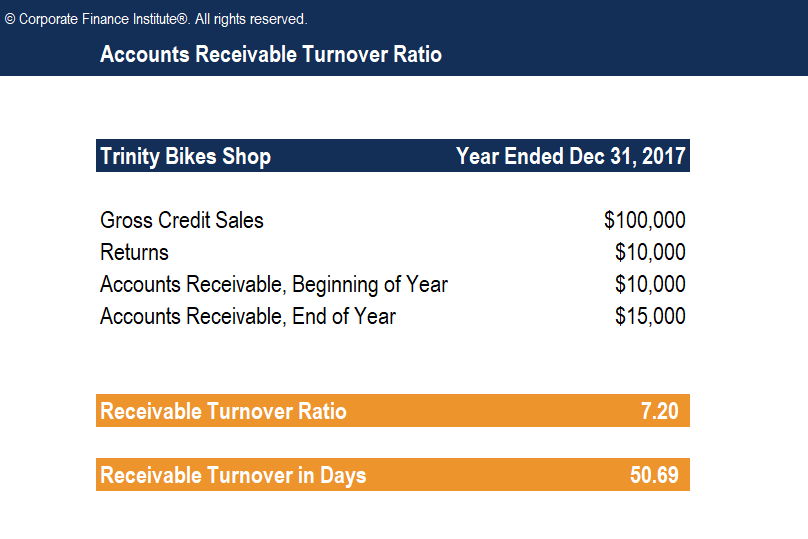
Imagine a wholesale business that finished the year with $1,000,000 in net credit sales. At the beginning of the year, they had $80,000 in receivables, and they ended the year with $120,000.
- Calculate Average AR: ($80,000 + $120,000) / 2 = $100,000.
- Calculate Turnover: $1,000,000 / $100,000 = 10.
This company turns over its receivables 10 times per year, suggesting a healthy and consistent cycle of credit extension and collection.
2. Interpreting the Numbers: High vs. Low Ratios
The AR turnover ratio is not a “one size fits all” metric. Its value depends heavily on the industry, the company’s specific credit policy, and the broader economic climate. However, general trends in the ratio can provide significant insights into a company’s financial trajectory.
The Benefits of a High AR Turnover Ratio
A high ratio indicates that a company is efficient at collecting its debts. It suggests that the company has a high-quality customer base that pays bills promptly and a collection department that is proactive and effective. High turnover results in more frequent cash infusions, which allows the business to pay its own debts, reinvest in growth, or distribute dividends without relying on external financing.
The Risks of an Exceptionally High Ratio
While a high ratio is generally positive, there is a point of diminishing returns. If the ratio is significantly higher than the industry average, it may indicate that the company’s credit policy is too restrictive. By only extending credit to the most “sure-bet” customers or demanding immediate payment, the company might be turning away potential clients who require more flexible terms. In this case, the pursuit of a perfect ratio could actually be stifling total sales growth.
Red Flags of a Low AR Turnover Ratio
A low AR turnover ratio is often a cause for concern. It suggests that the company is struggling to collect payments, which ties up capital in unpaid invoices. Common reasons for a low ratio include:
- Poor Collection Processes: The company may lack a systematic way to follow up on late payments.
- Loose Credit Policies: Extending credit to customers who are not creditworthy.
- Disputes: Customers may be intentionally withholding payment due to dissatisfaction with products or services.
- Economic Downturn: In a struggling economy, even good customers may delay payments to manage their own cash flow.
3. The Strategic Impact of AR Turnover on Business Finance
For a business to thrive, it must treat its accounts receivable as an asset, not just an entry on a ledger. The AR turnover ratio is a strategic tool that impacts various facets of corporate finance.
Strengthening Cash Flow Management
Cash flow is distinct from profit. A profitable company can still go bankrupt if its cash is tied up in receivables while its bills come due. By monitoring and improving AR turnover, a business ensures a steady “velocity of money.” This liquidity provides a safety net for unexpected expenses and reduces the need for short-term loans or lines of credit, which carry interest costs.
Assessing Credit Policy Effectiveness
The AR turnover ratio serves as a feedback loop for the sales and credit departments. If the ratio begins to dip, it may be time to reassess who is being granted credit. Financial managers use this data to refine credit limits and payment terms. For instance, if a specific segment of customers consistently drags down the turnover ratio, the company may move them to “cash on delivery” (COD) terms.
Attracting Investors and Securing Loans
When a business seeks external funding, investors and lenders look closely at the AR turnover ratio. It is a proxy for management efficiency. A high turnover ratio suggests that the management team knows how to operate leanly and minimize risk. For a bank, a high ratio serves as collateral security—it proves that the company’s receivables are “liquid” and likely to be converted into cash soon, making the company a lower-risk borrower.
4. Practical Strategies to Optimize Your AR Turnover
Improving your AR turnover ratio requires a multi-pronged approach that combines technology, psychology, and disciplined financial management. Here are several ways businesses can accelerate their collection cycles.
Streamlining the Invoicing Process
The most common reason for delayed payment is a delayed invoice. If a service is completed on the 1st of the month, but the invoice isn’t sent until the 15th, you have already lost two weeks of potential liquidity.
- Immediate Billing: Send invoices as soon as a product is shipped or a service is rendered.
- Accuracy Matters: Ensure invoices are clear, itemized, and sent to the correct department. Disputes over “hidden fees” or incorrect quantities are major bottlenecks in the turnover cycle.
Implementing Early Payment Incentives
One of the most effective ways to boost AR turnover is to offer a small discount for early payment. A common term used in business finance is “2/10, net 30.” This means the customer receives a 2% discount if they pay within 10 days; otherwise, the full amount is due in 30 days. While this reduces the total revenue by a small margin, the benefit of having cash in hand 20 days early often outweighs the cost, especially for capital-intensive businesses.
Utilizing Financial Tools and Automation
Manual tracking of unpaid invoices is prone to human error and oversight. Modern financial software can automate the entire AR lifecycle.
- Automated Reminders: Systems can automatically email customers three days before a payment is due, on the due date, and every week thereafter.
- Electronic Payment Portals: The easier it is for a customer to pay (e.g., via ACH, credit card, or digital wallet), the faster they will do it. Providing a “Pay Now” link directly in the digital invoice can significantly reduce friction.
5. Industry Benchmarks: Why Context is Everything
When evaluating an AR turnover ratio, it is vital to compare it against the right benchmarks. A “good” ratio in one industry might be catastrophic in another.
Comparing B2B vs. B2C Models
In the B2C (Business-to-Consumer) world, particularly in retail, the AR turnover ratio is often extremely high because most transactions are settled immediately via cash or credit card. However, in B2B (Business-to-Business) sectors, credit terms of 30, 60, or even 90 days are standard practice. Therefore, a B2B manufacturing firm with an AR turnover of 8 (approx. 45 days) might be performing excellently, whereas a retail store with the same ratio would be in serious trouble.
Seasonal Fluctuations and Their Effects
Seasonality can skew the AR turnover ratio if it is only calculated once a year. For example, a toy manufacturer will see a massive spike in credit sales in October and November, but the collections may not happen until January. If you calculate the ratio using only year-end data, the results might look artificially low or high. Savvy financial managers use rolling averages or monthly turnover calculations to account for these seasonal ebbs and flows, providing a more accurate picture of the company’s ongoing health.

Conclusion
The Accounts Receivable Turnover Ratio is far more than a dry accounting figure; it is a pulse check on a company’s financial discipline and operational efficiency. By maintaining a high (but balanced) turnover ratio, businesses ensure they have the liquidity necessary to weather economic storms and seize new opportunities. Whether through stricter credit vetting, the implementation of early payment discounts, or the adoption of automated invoicing tools, mastering AR turnover is a fundamental step toward long-term financial success and stability.
aViewFromTheCave is a participant in the Amazon Services LLC Associates Program, an affiliate advertising program designed to provide a means for sites to earn advertising fees by advertising and linking to Amazon.com. Amazon, the Amazon logo, AmazonSupply, and the AmazonSupply logo are trademarks of Amazon.com, Inc. or its affiliates. As an Amazon Associate we earn affiliate commissions from qualifying purchases.