
In the intricate world of cybersecurity and network architecture, acronyms abound, often representing critical concepts that underpin the digital infrastructure we rely on daily. Among these, “DMZ” stands out as a fundamental component in securing organizational networks. Far from a military term in this context, the DMZ, or Demilitarized Zone, is a crucial subnetwork that acts as a buffer between an organization’s secure internal network and the untrusted external network, typically the internet. It’s a strategic security measure designed to protect sensitive internal data from direct exposure to potential threats while still allowing external access to specific public-facing services. Understanding the DMZ is not just for network administrators; it’s essential for anyone seeking a deeper insight into how modern digital environments are safeguarded against an ever-evolving landscape of cyber threats.

The concept of a DMZ is rooted in the principle of layered security, acknowledging that no single defense mechanism is foolproof. Instead, by segmenting networks and controlling traffic flow meticulously, organizations can significantly reduce their attack surface and mitigate the impact of successful breaches. This article will delve into the architecture, functionality, benefits, and challenges associated with implementing a DMZ, offering a comprehensive look at its enduring relevance in today’s cybersecurity landscape.
The Core Concept: Demilitarized Zone Explained
At its heart, a DMZ is a physical or logical subnetwork that contains and exposes an organization’s external-facing services to an un-trusted network, usually the internet. It acts as an intermediary, a neutral territory where services that need to be accessible from the outside world – such as web servers, mail servers, and DNS servers – can reside without exposing the entire internal network. This strategic placement creates a crucial layer of separation, ensuring that even if the public-facing services within the DMZ are compromised, the attackers gain no direct access to the sensitive data and systems within the private internal network.
What is a DMZ? A Buffer in Cyberspace
Think of a DMZ as a secure waiting room or a fortified checkpoint. It allows legitimate external users to access specific resources while keeping them isolated from the more sensitive areas of your network. If an attacker manages to breach a server located within the DMZ, the breach is contained within that specific zone. The DMZ is configured with its own set of security policies, typically more restrictive than those for the internal network but less so than those for the public internet. This allows for a balance between accessibility and security. For instance, a web server hosting a company’s public website must be reachable by anyone on the internet, but it doesn’t need to communicate directly with the company’s employee payroll database. The DMZ facilitates this necessary interaction while preventing unwanted connections.
Why the Name? A Historical Analogy
The term “Demilitarized Zone” is borrowed directly from military terminology, referring to a specific area in which military forces or operations are prohibited. Historically, DMZs were created as buffer zones between former adversaries to prevent conflicts and ensure peace. In the networking context, the analogy is remarkably apt. The DMZ network acts as a neutral “no man’s land” between your organization’s “allied” internal network and the “hostile” internet. It’s a place where limited interaction is permitted under strict rules, designed to prevent hostile actions (cyberattacks) from escalating into a full-scale assault on the core, private network. This evocative name effectively communicates its role as a controlled, limited-trust area, distinct from both the fully trusted internal environment and the entirely untrusted external world.
The Primary Goal: Isolation and Protection
The fundamental objective of a DMZ is two-fold: isolation and protection. By isolating public-facing services in a separate segment, an organization ensures that these services, which are inherently more vulnerable due to their public exposure, cannot serve as a direct springboard for attackers to penetrate deeper into the corporate network. This containment strategy significantly enhances the overall security posture. Should a server in the DMZ be compromised, the breach is confined, limiting the potential damage and preventing lateral movement to more critical systems. It adds a crucial layer to the defense-in-depth strategy, forcing attackers to overcome multiple security barriers rather than just one perimeter firewall. This tiered approach is a cornerstone of robust cybersecurity practices, ensuring that even if one defense layer fails, others are in place to prevent total system compromise.
Architectural Design and Operational Mechanics
The effectiveness of a DMZ largely hinges on its architectural design and the meticulous configuration of its operational mechanics, particularly how firewalls are deployed and how traffic is managed. While various configurations exist, they all share the common goal of creating a secure, isolated subnetwork. Understanding these designs is crucial for anyone involved in network security, as it dictates the level of protection and the complexity of management.
Single vs. Dual Firewall DMZ Architectures
There are two primary DMZ architectures:
-
Single Firewall DMZ (Three-Legged DMZ): In this setup, a single firewall has three interfaces (or “legs”). One interface connects to the internet (WAN), another to the internal local area network (LAN), and the third to the DMZ itself. All traffic, whether external-to-DMZ, DMZ-to-internal, or internal-to-DMZ, is managed by this single firewall. While simpler and less expensive to implement, it presents a single point of failure. If this single firewall is compromised, the entire network security can be jeopardized, as the attacker could potentially bypass all segmentation. This setup is often found in smaller organizations or home networks due to its ease of configuration.
-
Dual Firewall DMZ (Back-to-Back DMZ): This is the more robust and recommended architecture for enterprise environments. It uses two separate firewalls. The first firewall (often called the perimeter or external firewall) sits between the internet and the DMZ. The second firewall (internal firewall) sits between the DMZ and the internal network. This provides two distinct layers of defense. If the external firewall is breached, the attacker still faces the internal firewall before reaching the private network. Each firewall can be configured with different security policies tailored to its specific role, enhancing overall security and redundancy. This setup drastically reduces the risk of a single point of failure and provides a much stronger defensive posture.
How Traffic Flows Through a DMZ
The flow of traffic is meticulously controlled within a DMZ environment. For example, when a user on the internet wants to access a web server located in the DMZ:
- The request first hits the external firewall.
- The external firewall inspects the request. If it matches a predefined rule (e.g., allowing HTTP/HTTPS traffic to the web server’s IP address), it forwards the request to the DMZ.
- The web server in the DMZ processes the request.
- If the web server needs to access an internal database (which is generally discouraged but sometimes necessary for specific applications), it sends a request that must then pass through the internal firewall. The internal firewall has extremely strict rules, often only allowing specific, pre-approved connections from the DMZ to specific internal servers on specific ports.
- Conversely, traffic originating from the internal network destined for the internet might pass through the internal firewall, then potentially the DMZ (without interacting with DMZ servers unless specifically configured), and finally through the external firewall to the internet. Traffic from the internal network to the DMZ is also strictly controlled by the internal firewall, allowing only necessary communication, such as updates to DMZ servers.
The Role of Firewall Rules and ACLs
Firewall rules and Access Control Lists (ACLs) are the backbone of DMZ security. They dictate precisely what type of traffic is permitted or denied, based on source IP, destination IP, port number, protocol, and even application-layer information. In a DMZ setup:
- External Firewall Rules: Typically allow incoming connections from the internet to specific services in the DMZ (e.g., port 80 for web, port 25 for email) and outgoing connections from the DMZ to the internet. It explicitly denies any direct inbound connections from the internet to the internal network.
- Internal Firewall Rules: Are much stricter. They primarily allow outgoing connections from the internal network to the DMZ (e.g., for patching DMZ servers) and to the internet. Crucially, they restrict or deny most, if not all, incoming connections from the DMZ to the internal network, except for explicitly required communication paths (e.g., a web server in the DMZ needing to query a specific database server in the internal network on a specific port). Even these exceptions are heavily scrutinized and minimized.
The meticulous configuration and regular auditing of these rules are paramount. Any misconfiguration can create security holes, effectively nullifying the protective benefits of the DMZ. This level of granular control is what makes the DMZ such a powerful tool in a defense-in-depth strategy.
Key Benefits and Practical Applications of a DMZ
The implementation of a DMZ is not merely a technical exercise; it’s a strategic decision that offers substantial benefits to an organization’s overall cybersecurity posture. By creating this isolated segment, businesses can confidently deploy public-facing services while significantly reducing the risk to their core assets.
Safeguarding Internal Networks
The most compelling benefit of a DMZ is its ability to shield the internal, private network from direct exposure to the untrusted internet. In the event of a successful cyberattack targeting a public-facing service (like a web server or email server), the breach is contained within the DMZ. This means that attackers must overcome yet another sophisticated firewall and a new set of security policies to even attempt to reach the internal network. This multi-layered defense significantly increases the effort, time, and resources required for an attacker to achieve their objectives, often leading them to abandon their efforts or be detected before they can cause significant damage. Without a DMZ, a compromise of a public server would provide direct access to the internal network, making the entire organization vulnerable.
Hosting Public-Facing Services Securely
Many organizations require services that must be accessible to the public internet. These include:
- Web Servers: Hosting company websites, e-commerce platforms, or customer portals.
- Email Servers: Managing incoming and outgoing emails for the organization.
- DNS Servers: Translating domain names into IP addresses, essential for internet navigation.
- FTP Servers: For file transfers, though often replaced by more secure methods.
- VPN Endpoints: Allowing remote users to securely connect to the internal network (though the VPN tunnel itself would be established through the DMZ, the authenticated user would then connect to the internal network via the internal firewall).
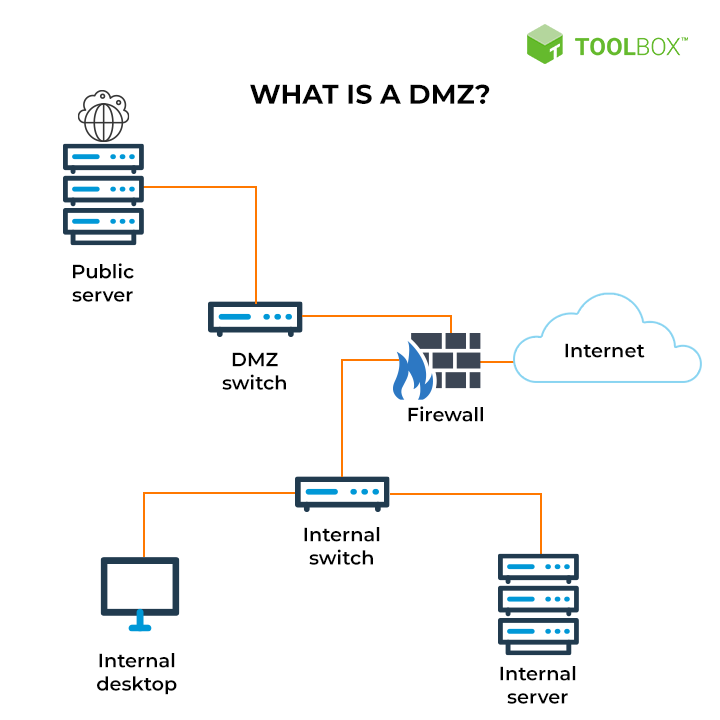
Placing these services within the DMZ allows them to fulfill their function without granting unhindered access to the company’s sensitive internal infrastructure. This setup ensures that while these services are publicly available and functional, they are doing so from a sandboxed environment. Even if a vulnerability is exploited in, say, a web application, the compromised server is restricted to the DMZ, unable to communicate freely with other internal systems that contain proprietary data, customer information, or employee records.
Meeting Compliance and Best Practice Standards
Many industry regulations and security compliance standards, such as PCI DSS (Payment Card Industry Data Security Standard) for handling credit card information, HIPAA (Health Insurance Portability and Accountability Act) for healthcare data, or GDPR (General Data Protection Regulation) for privacy, mandate strong network segmentation and isolation of sensitive data. Implementing a DMZ is often a critical step in achieving these compliance requirements.
By creating a clear boundary between publicly accessible services and internal sensitive data stores, organizations can demonstrate due diligence in protecting information. Auditors often look for evidence of such segmentation as a fundamental aspect of a secure network architecture. Adhering to these best practices not only helps avoid hefty fines and legal repercussions but also builds trust with customers and partners, proving a commitment to data security. A well-designed and maintained DMZ reflects a mature approach to risk management and proactive cybersecurity.
Risks, Challenges, and Best Practices for DMZ Implementation
While a DMZ offers significant security advantages, its implementation is not without complexities and potential pitfalls. A poorly configured or inadequately managed DMZ can become a weak link in an organization’s security chain rather than a robust defense. Understanding these challenges and adhering to best practices is critical for maximizing the DMZ’s effectiveness.
Common Attack Vectors and Vulnerabilities
Servers residing in the DMZ are inherently more exposed to the internet and, therefore, to a wider array of attack vectors. Common threats include:
- Web Application Vulnerabilities: SQL injection, cross-site scripting (XSS), remote code execution in web servers or applications.
- Denial of Service (DoS/DDoS) Attacks: Attempting to overwhelm DMZ services, making them unavailable to legitimate users.
- Brute-Force Attacks: Targeting login credentials for mail servers, FTP servers, or web application administration panels.
- Software Exploits: Vulnerabilities in the operating system, web server software (e.g., Apache, Nginx), or other applications running on DMZ servers.
- Configuration Errors: Misconfigured firewalls, open ports, or default credentials can create gaping security holes.
- Zero-Day Exploits: Exploiting previously unknown vulnerabilities that have no available patch.
Attackers often target DMZ assets because they are the most accessible entry points. A successful breach of a DMZ server, even if contained, can still lead to data theft from that specific server, defacement of a website, or its use as a pivot point for launching further attacks against other external targets.
Essential Configuration and Management Tips
To ensure a DMZ truly enhances security, several best practices must be followed:
- Principle of Least Privilege: Grant only the absolute minimum necessary access for services to function. This applies to user accounts, network permissions, and firewall rules.
- Hardening DMZ Servers: Remove unnecessary software, disable unused services, and apply security patches promptly. Configure strong passwords and multi-factor authentication where applicable.
- Strict Firewall Rules: Configure firewalls to be “deny all, permit by exception.” Only allow traffic explicitly needed for a service to operate. Regularly review and audit these rules.
- Network Segmentation within DMZ: For larger DMZs, consider further segmenting the DMZ itself to isolate different services (e.g., web servers in one segment, email in another).
- No Direct Access to Internal Network: Unless absolutely necessary for an application’s function (and then, under very strict, specific rules), DMZ servers should not have direct, unauthenticated access to the internal network.
- Secure Communication: Use encrypted protocols (HTTPS, SSH, SFTP, SMTPS) for all communication, especially when transferring sensitive data.
- Regular Backups: Implement a robust backup and recovery strategy for all DMZ servers.
- Logging and Auditing: Enable comprehensive logging on all DMZ devices and firewalls. Regularly review logs for suspicious activity.
Continuous Monitoring and Incident Response
A DMZ is not a “set it and forget it” solution. Continuous monitoring is essential to detect anomalous behavior, attempted breaches, and successful compromises in real-time. This involves:
- Intrusion Detection/Prevention Systems (IDPS): Deploying IDPS within the DMZ and between the DMZ and internal network to detect and prevent known attack patterns.
- Security Information and Event Management (SIEM): Centralizing logs from firewalls, servers, and other security devices for correlation and analysis.
- Vulnerability Scanning and Penetration Testing: Regularly scanning DMZ assets for known vulnerabilities and conducting penetration tests to simulate real-world attacks.
- Proactive Threat Intelligence: Staying informed about the latest threats and vulnerabilities affecting technologies used in the DMZ.
Equally important is a well-defined Incident Response Plan. In the event of a DMZ breach, the plan should detail steps for containment, eradication, recovery, and post-incident analysis. A rapid and effective response can significantly limit the damage and prevent an attacker from pivoting to the internal network.
The DMZ in Modern Network Security Landscapes
The digital landscape is constantly evolving, with the rise of cloud computing, microservices, and remote work challenging traditional network perimeters. While the fundamental concept of a DMZ remains valid, its application and integration with modern security strategies have adapted.
DMZ vs. Cloud-Based Security
The migration of applications and infrastructure to cloud platforms (AWS, Azure, GCP) has introduced new ways to achieve network segmentation and isolation. Cloud providers offer virtual private clouds (VPCs) and sophisticated firewall rules, security groups, and network access control lists (NACLs) that effectively create virtual DMZs. Public-facing instances can be placed in public subnets with strict ingress/egress rules, while sensitive database servers reside in private subnets, only accessible from authorized public-facing instances or internal networks via VPNs or direct connections.
While the physical manifestation of a DMZ changes in the cloud (no longer distinct physical hardware), the architectural principle of separating public-facing services from internal resources remains identical. Cloud environments allow for greater flexibility, scalability, and often more granular control over network traffic, making them powerful tools for implementing DMZ-like security postures.
Evolution of Network Perimeters
Historically, the network perimeter was a clear, hard line around an organization’s physical premises. The DMZ was a literal buffer at this line. However, with remote work, mobile devices, and cloud services, the traditional perimeter has dissolved. The concept of a “zero-trust” network has emerged, where no user or device, whether inside or outside the traditional network boundary, is trusted by default. Every access request is authenticated and authorized.
In a zero-trust model, the DMZ’s role shifts slightly. While still providing isolation for public services, the emphasis moves to micro-segmentation, where even internal networks are broken down into smaller, isolated zones with their own security policies. The DMZ becomes one of many segmented zones, rather than the sole buffer.
When is a DMZ Still Relevant?
Despite the evolution of security paradigms, the DMZ remains highly relevant for several reasons:
- Hybrid Environments: Many organizations operate in hybrid environments, with a mix of on-premise infrastructure and cloud services. A traditional DMZ is crucial for securing the on-premise components that interact with the internet.
- Legacy Applications: Older applications or systems that cannot be easily migrated to the cloud or refactored for a zero-trust architecture still benefit immensely from DMZ protection.
- Specific Compliance Needs: Certain regulations might specifically require a DMZ or similar network segmentation for on-premise data centers.
- Controlled Exposure: For services that genuinely need a global public presence, a DMZ provides a controlled and isolated environment to manage that exposure, regardless of other security strategies in place.
- Cost-Effectiveness for On-Premise: For smaller organizations or those with limited cloud adoption, a well-implemented on-premise DMZ can be a highly cost-effective and robust security measure.
The DMZ concept, whether in its traditional hardware form or as a virtual construct in the cloud, continues to be a foundational element in a comprehensive, multi-layered cybersecurity strategy. It serves as a testament to the enduring principle of isolation and controlled access for enhancing network security.

Conclusion
The Demilitarized Zone (DMZ) is far more than just another acronym in the tech lexicon; it is a critical architectural pattern that has underpinned network security for decades. By creating a strategically isolated subnetwork, the DMZ acts as an invaluable buffer, allowing organizations to present necessary public-facing services to the world while meticulously safeguarding their sensitive internal assets. From web servers and email gateways to DNS infrastructure, the DMZ provides a secure staging ground, mitigating the inherent risks associated with direct internet exposure.
Understanding the various architectural designs, the meticulous flow of traffic governed by stringent firewall rules, and the myriad benefits it offers – from enhanced protection to compliance adherence – is paramount for anyone involved in securing digital environments. While the modern cybersecurity landscape introduces new complexities with cloud computing and zero-trust models, the core principle of a DMZ remains remarkably relevant. Whether manifested through physical firewalls or virtual network constructs, the concept of a controlled, isolated zone for public services continues to be a cornerstone of a robust, multi-layered defense strategy. As cyber threats continue to evolve in sophistication and frequency, the DMZ stands as a testament to the enduring power of thoughtful network segmentation and strategic isolation in building resilient and secure digital infrastructure.
aViewFromTheCave is a participant in the Amazon Services LLC Associates Program, an affiliate advertising program designed to provide a means for sites to earn advertising fees by advertising and linking to Amazon.com. Amazon, the Amazon logo, AmazonSupply, and the AmazonSupply logo are trademarks of Amazon.com, Inc. or its affiliates. As an Amazon Associate we earn affiliate commissions from qualifying purchases.