
For over a decade, Apple Inc. (AAPL) has been the gold standard of the “buy and hold” investment strategy. As the cornerstone of many institutional portfolios and a favorite of retail investors, the Cupertino giant has historically represented stability, massive cash flows, and relentless growth. However, recent market sessions have seen the tech titan underperforming relative to its peers in the “Magnificent Seven.” When Apple stock dips, it sends ripples through the S&P 500 and the Nasdaq-100, prompting investors to ask a critical question: What exactly is dragging down the world’s most iconic brand?
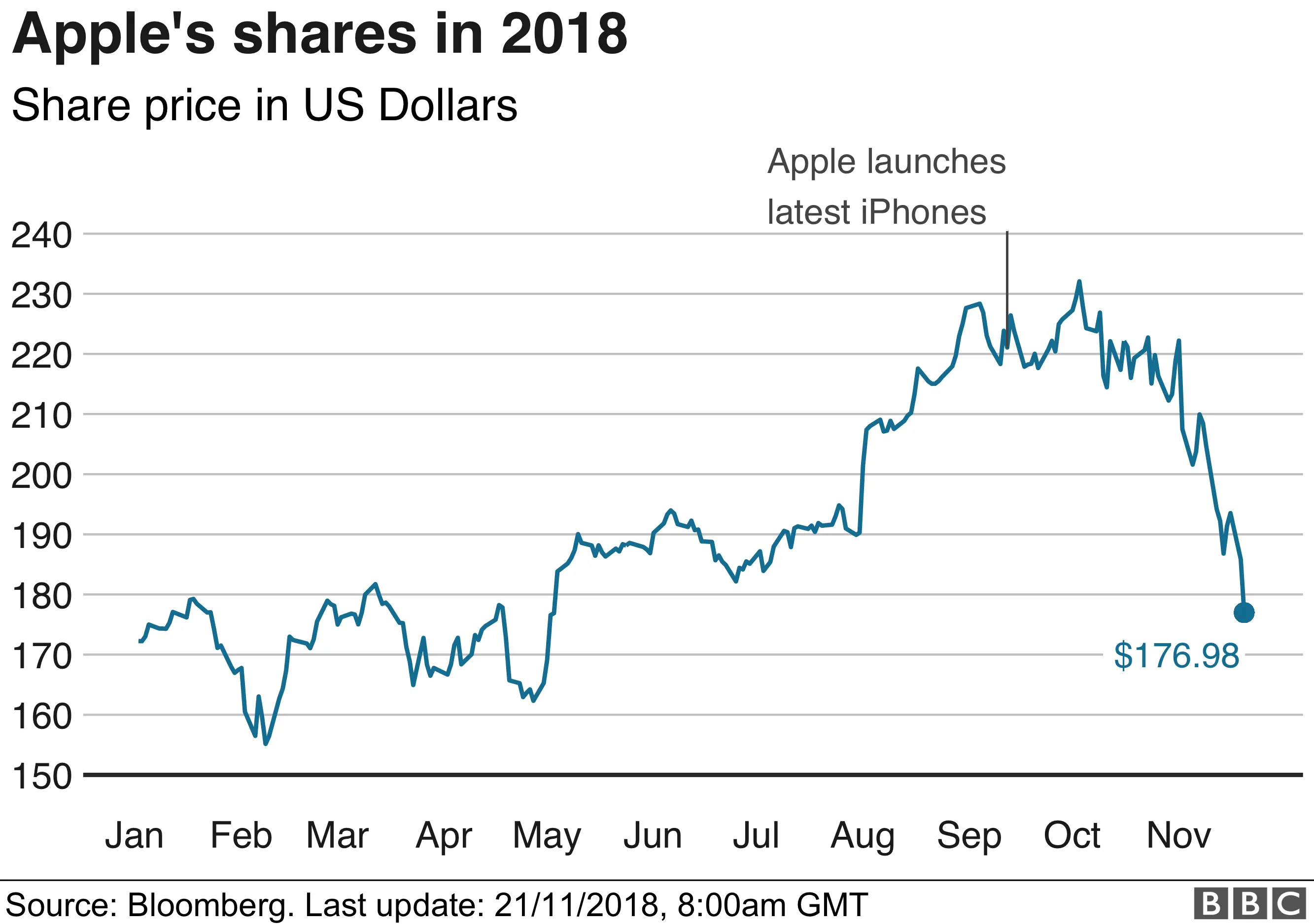
The answer is not found in a single quarterly report, but rather in a complex intersection of macroeconomic shifts, geopolitical friction, and a perceived lag in the next great technological frontier. Understanding why Apple stock is down requires a deep dive into the financial metrics and market sentiment currently shaping the landscape.
Macroeconomic Headwinds and the Broader Market Sentiment
The primary driver behind any stock’s performance is the environment in which it operates. For Apple, a company with a market capitalization that has flirted with the $3 trillion mark, even minor shifts in the global economy can lead to billions of dollars in valuation swings.
High Interest Rates and the Discounting of Growth Stocks
While Apple is often viewed as a “defensive” tech stock due to its massive cash reserves, it is not immune to the Federal Reserve’s “higher for longer” interest rate policy. In financial modeling, future earnings are discounted back to the present value using current interest rates. When rates remain elevated, the present value of those future cash flows decreases, naturally compressing the Price-to-Earnings (P/E) multiples of growth-oriented companies. Investors who previously accepted a premium for Apple’s stability are now looking at high-yield Treasury bills as a viable, low-risk alternative, siphoning off some of the capital that would otherwise flow into AAPL shares.
The Shift from Defensive Play to Risk-On Assets
During periods of market volatility, Apple often acts as a safe haven. However, when the market enters a “risk-on” phase—driven by euphoria in specific sectors like semiconductors or pure-play AI—Apple can paradoxically suffer. Investors may rotate out of “steady” names like Apple to chase the exponential gains seen in companies like NVIDIA or Broadcom. This capital rotation creates selling pressure on Apple as fund managers rebalance their portfolios to capture more aggressive growth elsewhere, leaving Apple to trade sideways or downward despite its solid fundamentals.
The “China Challenge”: Geopolitical Tensions and Local Competition
Perhaps the most significant specific weight on Apple’s stock price is its performance and positioning in Greater China. China represents roughly 20% of Apple’s total revenue and serves as its primary manufacturing hub. Any disruption in this region has an outsized impact on the company’s bottom line.
Huawei’s Resurgence and Domestic Preference
For several years, Apple enjoyed a near-monopoly on the high-end smartphone market in China, largely due to U.S. sanctions that crippled its main competitor, Huawei. However, the tide has turned. With the release of the Mate 60 series and subsequent models featuring domestically produced 7nm chips, Huawei has staged a dramatic comeback. Chinese consumers are increasingly showing a preference for home-grown brands, fueled by a sense of national pride and local software ecosystems that are highly optimized for the Chinese market. This resurgence has led to double-digit declines in iPhone sales within the region, a metric that Wall Street watches with extreme scrutiny.
Regulatory Hurdles and Government Restrictions
Beyond consumer preference, the Chinese government has reportedly expanded restrictions on the use of iPhones among state-affiliated employees and government agencies. While the official scope of these bans is often debated, the psychological impact on the market is clear: it signals a cooling relationship between the Chinese state and American big tech. For investors, this introduces a “geopolitical risk premium” into Apple’s stock price, as the certainty of the Chinese market—once a guaranteed growth engine—is now being questioned.
Stagnation in Innovation and the Hardware Cycle
Apple’s financial engine is built on the iPhone. While the Services division has grown into a powerhouse, the hardware cycle remains the primary catalyst for stock movement. Recent iterations of Apple’s flagship products have led to concerns that the company has reached a “saturation point” in innovation.
The iPhone Saturation Point
The “Supercycle” is a term investors love to hear, referring to a year where a massive number of users upgrade their devices simultaneously. However, recent iPhone models (from the 13 through the 16) have been characterized by incremental rather than revolutionary updates. Longer replacement cycles—now stretching toward 3 or 4 years for the average consumer—mean that hardware revenue is no longer the explosive growth driver it once was. When sales figures show “flat” or “low single-digit” growth, the market reacts by devaluing the stock, as the path to double-digit revenue expansion becomes less clear.
Services Growth vs. Hardware Declines
Apple has attempted to pivot the investor narrative toward its Services business (App Store, iCloud, Apple Music, Apple Pay). While Services boast much higher margins than hardware, they are still tethered to the “installed base.” If hardware sales slow down, the growth of the installed base slows down, eventually capping the potential for Services revenue. Furthermore, regulatory scrutiny from the EU and the U.S. Department of Justice regarding App Store fees threatens the high-margin “Apple Tax,” leading to fears that the company’s most profitable division may face forced margin compression in the coming years.
The AI Gap: Perceptions of Laggardness in the Generative Era
In the current investing climate, “AI” is the word that moves markets. Companies that are perceived as leaders in Generative AI have seen their valuations skyrocket, while those perceived as laggards have been punished.
Comparing Apple to the “Magnificent Seven” AI Leaders
While Microsoft partnered with OpenAI and Google integrated Gemini into its core search product, Apple remained uncharacteristically quiet during the initial AI explosion. This “silence” was interpreted by some analysts as Apple being behind the curve. In a market that prizes “first-mover advantage” in transformative technologies, Apple’s methodical, “wait-and-see” approach caused a temporary loss of investor confidence. The stock has faced pressure as investors questioned whether Apple could integrate AI in a way that would drive a new hardware upgrade cycle or if it was simply playing catch-up.
Investor Expectations for “Apple Intelligence”
The introduction of “Apple Intelligence” at the Worldwide Developers Conference (WWDC) was an attempt to bridge this gap. However, the phased rollout and the requirement for only the newest, high-end chips to run these features mean that the financial impact won’t be felt immediately. Investors are currently in a “show me” phase. Until there is concrete evidence that AI features are driving a significant uptick in iPhone 16 and 17 sales, the stock may continue to struggle against the high bar set by other AI-integrated tech giants.
Valuation Concerns and Future Outlook
Finally, the downward movement of Apple stock can be attributed to a simple reality of the stock market: valuation. A stock is only a “good” investment if the price you pay justifies the future earnings you expect to receive.
Price-to-Earnings Ratios and Overextension
Historically, Apple traded at a P/E ratio in the mid-teens. In the post-2020 era, that multiple expanded to the high 20s and even 30s. When a company’s growth slows from 15% to 5%, but its P/E ratio remains at 30, a “valuation correction” is inevitable. Many institutional investors believe that Apple’s stock simply got ahead of its fundamentals. The current dip can be viewed as a healthy “reset” where the stock price aligns more closely with its actual earnings growth trajectory rather than speculative fervor.
Dividend Yields and Buybacks as a Safety Net
Despite the current downward pressure, it is important to note the “floor” that prevents Apple from a total collapse. Apple remains a cash-generating machine, returning tens of billions of dollars to shareholders every quarter through dividends and massive share buyback programs. These buybacks reduce the total share count, effectively increasing earnings per share (EPS) even when net income remains flat. For long-term investors, this financial engineering provides a level of downside protection that few other companies in the world can offer.
In summary, Apple stock is down because it is navigating a “perfect storm” of high interest rates, a resurgent competitor in its second-largest market, and a transition period between traditional hardware sales and the new era of AI-driven consumer tech. While the short-term outlook may remain choppy as these narratives play out, the company’s core financial strength and its ability to monetize its massive ecosystem suggest that the current downturn may be a period of consolidation rather than a permanent decline. For the savvy investor, understanding these “Money” fundamentals is the key to distinguishing between a temporary dip and a fundamental shift in the company’s value proposition.
aViewFromTheCave is a participant in the Amazon Services LLC Associates Program, an affiliate advertising program designed to provide a means for sites to earn advertising fees by advertising and linking to Amazon.com. Amazon, the Amazon logo, AmazonSupply, and the AmazonSupply logo are trademarks of Amazon.com, Inc. or its affiliates. As an Amazon Associate we earn affiliate commissions from qualifying purchases.