
In the world of finance, business, and personal wealth management, contracts are the silent architects of trust and obligation. From a simple online purchase to a multi-million dollar business acquisition, a legally sound contract is the bedrock upon which financial transactions are built, investments are secured, and obligations are enforced. Understanding what makes a contract valid isn’t just a legal nicety; it’s a critical financial literacy skill that protects assets, mitigates risks, and ensures that financial expectations can be legally upheld.
An invalid contract, conversely, can lead to devastating financial consequences: lost investments, unrecoverable debts, costly disputes, and wasted resources. Without a clear grasp of the core elements of validity, individuals and businesses alike operate in a precarious landscape, vulnerable to exploitation and unforeseen liabilities. This article will delve into the essential components that give a contract its legal force, examining each through the lens of its financial implications, empowering you to navigate your financial dealings with greater confidence and security.
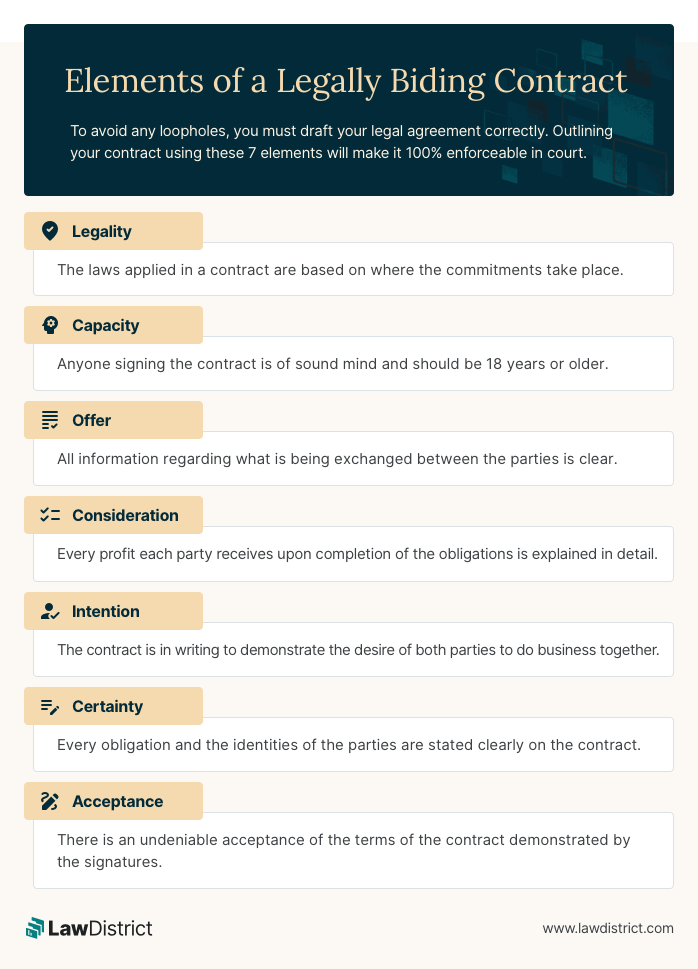
The Fundamental Pillars of a Valid Contract
At its heart, a valid contract is a legally binding agreement between two or more parties that is enforceable by law. While the specifics can vary by jurisdiction, several universal principles form the foundation of any legitimate contract, each carrying significant financial weight.
Offer and Acceptance (Mutual Assent)
The first step in forming a valid contract is the clear expression of an offer by one party and an unequivocal acceptance of that offer by another. This creates “mutual assent,” signifying that all parties understand and agree to the same set of terms.
- Financial Relevance: In a financial context, an offer might be a proposal to sell a business for a specific price, to lend money at a certain interest rate, or to invest a sum for a defined share of equity. Acceptance means agreeing to these exact terms without alteration. If the acceptance introduces new terms, it typically becomes a counter-offer, effectively rejecting the original offer and initiating a new round of negotiation. Without clear offer and acceptance, there is no meeting of the minds, and thus, no contractual agreement on which to base financial obligations. Imagine an investment deal where one party believes they’re buying 10% equity for $1 million, while the other believes they’re selling 5% for the same amount. Without a clear offer and acceptance, this financial transaction is doomed to fail and could lead to significant financial loss and legal battles over perceived agreements.
Consideration (The Quid Pro Quo)
Consideration is often referred to as “the bargain for exchange” or “quid pro quo” – something of value exchanged between the contracting parties. It ensures that a contract is not merely a gratuitous promise but involves a genuine exchange that forms the basis of the agreement.
- Financial Relevance: Consideration doesn’t always have to be money, but it must have legal value. This could be goods, services, a promise to perform an action, or a promise to refrain from an action. For financial contracts, consideration is paramount. When you take out a loan, the principal amount is the consideration you receive, and your promise to repay it with interest is the bank’s consideration. When you buy shares in a company, the money you pay is your consideration, and the shares themselves are the company’s consideration. Without valid consideration, a contract is usually unenforceable, meaning that one party might receive a financial benefit without any legal obligation to provide anything in return, or vice versa, leading to potential financial unfairness and a lack of legal recourse.
Capacity (Competence of Parties)
For a contract to be valid, all parties entering into it must have the legal capacity to do so. This primarily refers to their age and mental state, ensuring they understand the nature and consequences of their actions.
- Financial Relevance: Generally, individuals must be of legal age (usually 18) and of sound mind to enter into binding financial agreements. A minor, for instance, typically lacks the capacity to enter into most contracts, which are therefore voidable at their discretion. Similarly, someone suffering from severe mental incapacitation, or who is under extreme intoxication or duress, may not have the capacity to understand the terms of a loan, investment, or property purchase agreement. Any financial contract entered into by an individual without legal capacity is susceptible to being challenged and invalidated, potentially leading to the reversal of transactions, restitution of funds, or a complete collapse of the agreement, with significant financial implications for all parties involved.
Legality of Purpose (Lawful Objective)
The objective or purpose of a contract must be legal and not contrary to public policy. A contract formed for an illegal act, or one that violates specific statutes, will be deemed invalid from its inception.
- Financial Relevance: This principle is crucial in preventing agreements that facilitate illegal financial activities. For example, a contract to launder money, engage in fraud, or deal in illegal substances, even if it has clear offer, acceptance, and consideration, would be void and unenforceable in a court of law. Parties involved in such contracts have no legal recourse if the terms are not met, meaning any financial investment or expected return within such an agreement is entirely unprotected. Furthermore, entering into contracts with an illegal purpose can lead to severe criminal penalties, including fines and imprisonment, alongside the complete forfeiture of any financial gains. For businesses, ensuring all contracts comply with regulatory frameworks and ethical standards is vital to maintain financial integrity and avoid costly legal battles and reputational damage.
Essential Elements Beyond the Basics
While the fundamental pillars are non-negotiable, other elements play a crucial role in ensuring a contract’s enforceability, particularly in complex financial and business dealings.
Intent to Create Legal Relations
Beyond mere agreement, the parties must intend for their agreement to have legal consequences. This distinguishes casual social arrangements from formal, legally binding contracts.
- Financial Relevance: In a business or financial context, there is a strong presumption that parties intend to create legal relations. However, in informal settings, such as family loans or promises between friends, the intent may be less clear. Without a clear intention for the agreement to be legally binding, a financial promise (e.g., a promise to invest in a friend’s startup) might not be enforceable in court, leaving the “lender” or “investor” without legal recourse if the terms are not met. Therefore, for any significant financial transaction, it’s imperative that parties clearly manifest their intent to be legally bound, often best achieved through formal, written agreements.
Certainty of Terms
A valid contract must have terms that are sufficiently clear, definite, and unambiguous. Vague or uncertain terms can render a contract unenforceable, as a court may not be able to ascertain what the parties actually agreed to.
- Financial Relevance: In financial contracts, certainty of terms is paramount. This includes clearly defining the price, payment schedules, interest rates, quantities, scope of work, delivery dates, and any conditions precedent or subsequent. For example, a contract to “sell a business for a fair price” without specifying how that price will be determined, or a loan agreement without a definite repayment schedule, introduces significant ambiguity. Such vagueness creates fertile ground for disputes, leading to costly litigation, delays in financial transactions, and potential financial losses when the expected obligations cannot be legally enforced due to a lack of clarity. Clear, precise language minimizes misunderstandings and provides a solid basis for financial planning and dispute resolution.
Formality (When Required)
While many contracts can be oral, some specific types of contracts are legally required to be in writing and, in some cases, to be executed with specific formalities (e.g., witnessed, notarized). This requirement often stems from the Statute of Frauds.

- Financial Relevance: The Statute of Frauds typically applies to contracts that involve real estate, contracts that cannot be performed within one year, contracts for the sale of goods above a certain monetary value, and contracts of suretyship (guaranteeing another’s debt). For instance, an oral agreement to purchase a multi-million dollar commercial property is generally unenforceable. Similarly, a long-term service agreement or a significant business loan guarantee must be in writing to be valid. In the digital age, electronic contracts and e-signatures are often legally recognized, but the principle remains: where writing is required, an oral agreement, no matter how clear, will not be legally binding. Failing to adhere to these formal requirements can lead to the complete invalidation of a financial agreement, leaving parties with no legal standing to enforce their rights or recover their investments.
Common Pitfalls That Invalidate Contracts
Even with the fundamental elements in place, several factors can undermine a contract’s validity, making it void (as if it never existed) or voidable (allowing one party to cancel it). These pitfalls often arise from a lack of true consent or fairness.
Misrepresentation, Fraud, and Duress
A contract formed under false pretenses, coercion, or unfair pressure is typically not enforceable because genuine consent was absent.
-
Misrepresentation: An innocent or negligent false statement of a material fact made during negotiations, which induces the other party to enter the contract.
-
Fraud: An intentional misrepresentation of a material fact designed to deceive and induce another party into a contract, resulting in financial harm.
-
Duress: Unlawful threats or coercion used to compel someone to enter into a contract against their will.
-
Undue Influence: The improper use of power or trust in a way that deprives a person of free will and substitutes another’s choice in a contract.
-
Financial Relevance: If a party is tricked into investing in a fraudulent scheme, signs a loan agreement under duress, or is manipulated into a disadvantageous business deal through undue influence, the contract can be voided. This protects the wronged party from financial exploitation. However, proving these elements can be challenging and costly in court. For businesses, avoiding any appearance of misrepresentation or unethical pressure is crucial to maintain reputation and avoid legal liabilities that can lead to significant financial penalties and loss of trust.
Mistake
A contract can be invalidated if one or both parties made a fundamental mistake about a material fact essential to the agreement.
-
Mutual Mistake: Both parties share the same mistaken belief about a fundamental aspect of the contract. For example, agreeing to buy a parcel of land, unaware that a key part of it was destroyed by a natural disaster before the contract was signed.
-
Unilateral Mistake: Only one party is mistaken. Generally, this does not invalidate a contract unless the non-mistaken party knew or should have known of the mistake and took advantage of it, or if the mistake was so severe that enforcing the contract would be unconscionable.
-
Financial Relevance: A mutual mistake regarding the existence, identity, or quality of a financial asset, for example, could render a contract for its sale or investment invalid. Imagine a contract for a specific portfolio of stocks, only for both parties to discover the portfolio was liquidated days before the agreement. Such a mistake could invalidate the deal, preventing financial transfers or obligating parties to reverse transactions, thereby preventing significant financial losses or gains based on erroneous assumptions.
Unconscionability
An unconscionable contract is one that is so severely one-sided and oppressive that it shocks the conscience of the court. This often arises where there is a significant power imbalance between the parties, and the stronger party has exploited the weaker one.
- Financial Relevance: This principle is particularly relevant in consumer finance and business dealings where one party has significantly more bargaining power, legal expertise, or information. Predatory lending practices, exorbitant interest rates, or contracts with excessively harsh terms that exploit a vulnerable party can be deemed unconscionable and thus unenforceable. This legal doctrine serves as a safeguard against extreme financial unfairness, providing a mechanism for courts to refuse to enforce contracts that would lead to severe financial hardship or injustice for one party.
The Financial Ramifications of Invalidity
The implications of an invalid contract extend far beyond mere legal theory; they directly impact financial stability, resource allocation, and overall economic success.
Loss of Investment and Revenue
Perhaps the most direct financial consequence of an invalid contract is the inability to enforce obligations, leading to lost investments, uncollected revenues, and unrecovered expenses. If a contract is declared void, any money or resources exchanged under it may need to be returned, or the expected financial benefit may never materialize. For instance, a freelancer who completes work under an invalid service agreement may never be able to legally demand payment, losing time and potential income. A business that invests heavily in a partnership based on an unenforceable contract risks having that investment completely wiped out.
Legal Costs and Disputes
Disputes over contract validity are inherently costly. Litigation involves substantial legal fees, court costs, and expert witness charges, regardless of the outcome. Even if a party successfully argues for invalidity, the financial drain of the process itself can be significant. The time and resources spent in court are diverted from productive financial activities, representing a considerable opportunity cost. Proactive due diligence and ensuring contract validity upfront is a far more cost-effective strategy than battling over enforceability after the fact.
Reputational Damage
For businesses, involvement in contracts that are later found to be invalid, especially due to elements like fraud, misrepresentation, or unconscionability, can severely damage their reputation. This can lead to a loss of trust from clients, investors, and partners, impacting future financial opportunities, creditworthiness, and market value. A tarnished reputation can translate directly into reduced sales, difficulty securing funding, and a negative impact on the company’s financial bottom line.
Opportunity Cost
Time and capital are finite resources. Engaging in negotiations, planning, and execution based on an invalid contract means those resources were not allocated to potentially profitable or beneficial ventures. The opportunity cost—the benefit that would have been gained by choosing an alternative financial path—can be substantial, potentially setting back growth, delaying financial goals, and hindering overall economic progress.

Conclusion
Understanding “what makes a contract valid” is not merely academic; it is an indispensable component of financial literacy and responsible business practice. From personal loans and employment agreements to complex investment deals and real estate transactions, contracts underpin nearly every financial interaction. Ensuring that agreements meet the fundamental requirements of offer and acceptance, consideration, capacity, and legality, while also being free from pitfalls like misrepresentation or mistake, is paramount.
Proactive attention to contract validity acts as a robust financial safeguard, protecting against unexpected losses, costly legal battles, and reputational harm. For any significant financial undertaking, seeking professional legal advice to draft and review contracts is not an expense, but a vital investment in your financial security and future success. By adhering to these legal and financial cornerstones, individuals and businesses can build a stable foundation for their financial endeavors, fostering trust and predictability in an often unpredictable economic landscape.
aViewFromTheCave is a participant in the Amazon Services LLC Associates Program, an affiliate advertising program designed to provide a means for sites to earn advertising fees by advertising and linking to Amazon.com. Amazon, the Amazon logo, AmazonSupply, and the AmazonSupply logo are trademarks of Amazon.com, Inc. or its affiliates. As an Amazon Associate we earn affiliate commissions from qualifying purchases.