
At its core, the speed of sound is a fundamental physical constant that describes how quickly sound waves propagate through a medium. For technologists, engineers, and innovators, this seemingly simple metric—the speed of sound at sea level—is far more than a textbook fact. It is a critical parameter underpinning a vast array of technological applications, from the precision of sonar systems to the design of supersonic aircraft and the fidelity of advanced audio equipment.
The speed of sound, often denoted as ‘c’ (from the Latin ‘celeritas’ for swiftness), is not static. It varies primarily with the properties of the medium through which it travels, most notably its temperature, but also its density and elasticity. At sea level, a standard atmospheric pressure of 1 atmosphere (1013.25 millibars) and a typical air temperature of 20°C (68°F), the speed of sound is approximately 343 meters per second (m/s), or about 1,235 kilometers per hour (767 miles per hour). This is the benchmark value around which countless technological designs and calculations are made. For a slightly colder 0°C (32°F), it drops to approximately 331 m/s. This variability, even within the narrow band of “sea level” conditions, introduces a fascinating layer of complexity and opportunity for technological solutions.
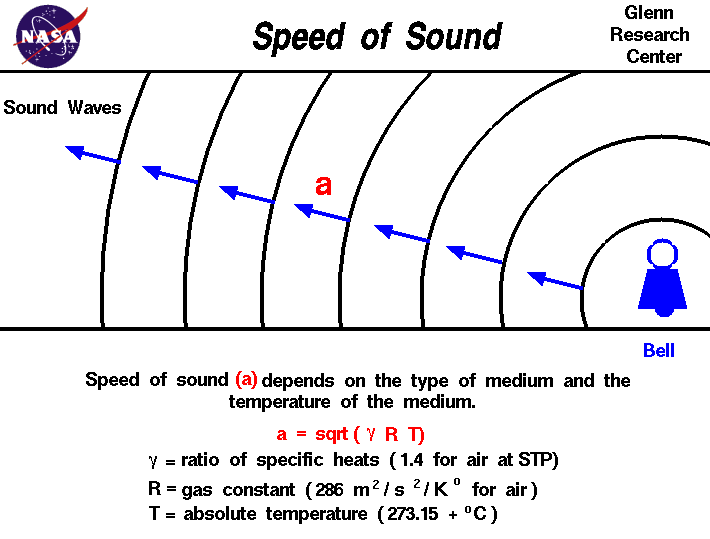
Understanding this value, and its environmental dependencies, is not merely academic; it is foundational for engineers developing everything from advanced sensor arrays to next-generation communication systems. Its influence permeates areas such as digital signal processing, acoustic modeling software, and even the development of materials that interact with sound waves in specific ways.
The Foundational Physics: Defining Sound Propagation for Tech Applications
The speed of sound is a direct consequence of how quickly particles in a medium can transmit vibrational energy. In air, sound travels as longitudinal waves, where particles oscillate parallel to the direction of wave propagation. The primary factors influencing this speed are temperature, humidity, and the composition of the gas. For technologists, this means that real-world applications must account for these variables, often dynamically.
Temperature’s Dominant Role
Temperature is by far the most significant factor affecting the speed of sound in air. As temperature increases, the kinetic energy of air molecules also increases, causing them to collide more frequently and transmit vibrational energy more efficiently. This direct relationship is crucial for any technology operating in varying ambient conditions. For example, a radar system using acoustic pulses to measure distance will yield inaccurate results if it doesn’t compensate for temperature fluctuations. Modern sensory tech often integrates temperature sensors to provide real-time corrections, ensuring the precision required for tasks like autonomous navigation or precision manufacturing.
Humidity and Atmospheric Composition
While less impactful than temperature, humidity also plays a role. Humid air is less dense than dry air at the same temperature and pressure because water vapor molecules (H2O) are lighter than the average molecules of nitrogen (N2) and oxygen (O2) that constitute dry air. Sound travels slightly faster in less dense mediums, thus increasing the speed of sound with higher humidity. This is a subtle but critical factor for highly sensitive applications, such as high-fidelity audio recording outdoors or atmospheric research using acoustic sounding. Similarly, the exact composition of the atmosphere, though relatively stable at sea level, can be a factor in specialized industrial or scientific environments where gas mixtures differ significantly from standard air.
Echoes of Innovation: Technological Applications of Sound Speed
The fundamental understanding of sound’s propagation speed at sea level forms the bedrock for numerous technological advancements. From maritime exploration to high-speed flight, its practical implications drive relentless innovation.
Sonar and Underwater Navigation
Perhaps one of the most iconic applications, sonar (Sound Navigation and Ranging) systems rely entirely on the precise measurement of sound wave travel times. While sea level typically refers to air, sonar operates by transmitting sound pulses underwater and measuring the time it takes for the echo to return. The speed of sound in water is significantly faster than in air (approximately 1,500 m/s in saltwater, varying with temperature, depth, and salinity). Accurate depth measurements, mapping of the seafloor, detection of underwater objects (from fish schools to submarines), and communication between underwater vehicles all depend on algorithms that precisely factor in the speed of sound in the aquatic medium. Autonomous Underwater Vehicles (AUVs) and remotely operated vehicles (ROVs) use advanced acoustic sensors and navigation systems that constantly recalculate sound speed based on ambient conditions to ensure precise positioning and obstacle avoidance.
Aviation and Aerospace Engineering
In the realm of flight, the speed of sound at sea level serves as the fundamental benchmark for defining Mach numbers. Mach 1 refers to the speed of sound, and exceeding it means breaking the sound barrier. For aerospace engineers, understanding the speed of sound is paramount for designing aircraft capable of supersonic flight.
- Aerodynamic Design: Aircraft wings, fuselage, and engine inlets must be meticulously designed to manage the shockwaves generated when an aircraft approaches or exceeds Mach 1. Computational Fluid Dynamics (CFD) software, a staple in aerospace engineering, simulates how air flows around these structures at various speeds, heavily relying on the local speed of sound as a critical input.
- Sonic Booms: The phenomenon of a sonic boom is directly related to an object traveling faster than the speed of sound. Engineers strive to mitigate the impact of sonic booms for future supersonic transport through innovative aircraft shapes and flight profiles.
- Drone Technology: Even for slower-flying drones, acoustic monitoring, detection, and counter-drone technologies utilize the principles of sound propagation. Identifying a drone by its acoustic signature requires sophisticated signal processing that understands how sound travels from the source to the sensor.
Audio Engineering and Acoustics
From concert halls to home theaters, and from noise-canceling headphones to virtual reality soundscapes, the speed of sound is a crucial parameter in audio engineering.
- Speaker Placement and Room Acoustics: In professional audio setups, engineers meticulously calculate speaker delays and phase alignment based on the distances between speakers and listeners, all referenced against the speed of sound. This ensures sound waves from multiple sources arrive coherently, creating an optimal listening experience. Acoustic treatment of rooms, involving sound-absorbing or diffusing materials, is designed with the wavelengths and propagation characteristics of sound in mind.
- Digital Audio Workstations (DAWs) and Plug-ins: Software tools used by music producers and audio engineers often feature delay effects, reverberation algorithms, and spatialization tools that mathematically model sound propagation in various environments, using the speed of sound as a core variable to simulate realistic delays and echoes.
- Spatial Audio and VR/AR: Creating immersive auditory experiences in virtual and augmented reality environments hinges on accurately simulating how sound would behave in a physical space. This involves intricate calculations of sound paths, reflections, and delays, all dependent on the speed of sound to render believable 3D audio.

Measurement and Modeling: Technological Approaches to Precision
The need for precise knowledge of the speed of sound in various contexts has spurred the development of advanced measurement techniques and sophisticated computational models.
Advanced Sensors and Instrumentation
Accurately measuring the speed of sound in real-time or under specific conditions is vital for many technological systems.
- Ultrasonic Transducers: These devices generate and detect sound waves (often beyond human hearing) and are widely used in a myriad of applications, from medical imaging (ultrasound scans) to industrial non-destructive testing and rangefinding sensors in robotics. The calculation of distance in these systems is directly derived from the time-of-flight of the ultrasonic pulse and the precisely known (or compensated) speed of sound in the medium.
- Time-of-Flight Sensors: In various industries, from automotive parking sensors to industrial level measurement, these sensors emit sound waves and measure the time it takes for the wave to return. Modern sensors often incorporate temperature compensation or use multiple frequencies to improve accuracy under changing conditions.
- Microphone Arrays and Phased Arrays: For applications like beamforming (focusing sound reception in a specific direction) or sound source localization, arrays of microphones are used. The tiny differences in arrival times of a sound wave at each microphone, combined with the known speed of sound, allow for triangulation of the sound source or enhancement of signals from a particular direction. This is critical in applications like voice assistants, surveillance, and acoustic imaging.
Computational Fluid Dynamics (CFD) and Simulation Software
Beyond physical measurement, computer-based modeling and simulation play a colossal role in understanding and predicting sound propagation.
- Acoustic Simulation Software: Architects, urban planners, and product designers use specialized software to predict how sound will behave in new buildings, open spaces, or around new products. These tools use sophisticated algorithms that factor in the speed of sound, material properties, and environmental conditions to model reflections, absorption, and transmission, helping optimize designs for noise control or desired acoustic properties.
- AI and Machine Learning for Acoustic Modeling: Emerging technologies leverage AI and machine learning to build more accurate and adaptable acoustic models. These systems can learn from vast datasets of acoustic measurements, identifying complex patterns and predicting sound propagation in novel environments with greater precision than traditional physics-based models alone. This is particularly relevant for simulating complex urban soundscapes or predicting the acoustic signature of intricate machinery.
Overcoming Environmental Variables: Tech Challenges and Solutions
The variability of the speed of sound at sea level—due to temperature, humidity, and even wind—presents continuous challenges for engineers striving for precision and reliability. Technological solutions are constantly evolving to mitigate these effects.
Adaptive Technologies and Real-time Compensation
Modern sensor systems and control units are increasingly equipped with adaptive capabilities to account for environmental changes.
- Integrated Environmental Sensors: Many sophisticated acoustic systems, whether for sonar, autonomous vehicles, or industrial measurement, incorporate integrated sensors for temperature, humidity, and sometimes pressure. These sensors feed real-time data to algorithms that dynamically adjust the calculated speed of sound, thereby maintaining high accuracy.
- Self-Calibrating Systems: Some advanced technologies employ self-calibration routines. For instance, an acoustic ranging system might periodically send out test pulses and measure their return against known reference points to fine-tune its internal speed-of-sound constant. This is crucial for applications where absolute precision is non-negotiable, such as in scientific research or defense.
- Dynamic Signal Processing: In fields like telecommunications or active noise cancellation, digital signal processors are designed to adapt to changes in sound propagation characteristics. For example, in active noise-canceling headphones, microphones continuously sample ambient noise, and the system generates anti-phase sound waves, dynamically adjusting for the minute variations in sound speed and characteristics to maintain optimal cancellation.
Next-Gen Material Science for Sound Control
Beyond active electronic compensation, advancements in material science are providing passive and active solutions for manipulating sound.
- Metamaterials: These engineered materials have properties not found in nature and can be designed to control sound waves in unprecedented ways, such as creating acoustic cloaking devices, perfect sound absorbers, or super-lenses for sound. The design of these materials relies heavily on precise knowledge of sound wave physics, including its speed, to predict how they will interact with incident sound.
- Smart Materials: Materials that change their properties in response to external stimuli (e.g., piezoelectric materials that convert electrical energy into mechanical vibration and vice versa) are being developed for adaptive acoustic applications. These can be used to create tunable sound barriers, active vibration damping systems, or even self-adjusting acoustic lenses, allowing for dynamic control over sound propagation characteristics.
- Acoustic Resonators and Diffusers: The design of passive acoustic elements used in architecture and product design (e.g., for noise reduction or sound shaping) directly leverages the speed of sound. Helmholtz resonators, for example, are tuned to absorb specific frequencies, a calculation fundamentally based on the wavelength of sound determined by its speed.

Future Frontiers: The Speed of Sound in Emerging Tech
The foundational understanding of the speed of sound at sea level will continue to be a driving force in future technological advancements, especially as we push the boundaries of human-computer interaction and sensory experiences.
As computing power grows and AI models become more sophisticated, we can anticipate more realistic and interactive acoustic simulations in virtual worlds and augmented realities. The nuanced variations in the speed of sound due to subtle environmental shifts could be modeled with unprecedented fidelity, blurring the lines between simulated and real-world audio experiences. Furthermore, new paradigms in sensor technology, potentially incorporating quantum effects or highly distributed micro-sensor networks, will likely emerge, offering even more precise ways to measure and utilize sound propagation for everything from environmental monitoring to advanced security applications.
In essence, while “what is the speed of sound at sea level” may appear to be a straightforward question, its answer branches into an intricate web of technological innovation, demanding continuous scientific inquiry and engineering ingenuity to harness its full potential across diverse and emerging technological landscapes.
aViewFromTheCave is a participant in the Amazon Services LLC Associates Program, an affiliate advertising program designed to provide a means for sites to earn advertising fees by advertising and linking to Amazon.com. Amazon, the Amazon logo, AmazonSupply, and the AmazonSupply logo are trademarks of Amazon.com, Inc. or its affiliates. As an Amazon Associate we earn affiliate commissions from qualifying purchases.