
Microscopy, a cornerstone of scientific exploration for centuries, is fundamentally about making the invisible visible. From the intricate structures within a single cell to the crystalline lattice of materials, microscopes have opened up entire universes previously beyond human perception. At the heart of every microscope, driving its ability to magnify and resolve these minute details, are its lenses. These seemingly simple pieces of shaped glass or plastic are, in reality, complex optical instruments, meticulously designed and manufactured to manipulate light in incredibly precise ways. Without the sophisticated engineering of lenses, modern microscopy as we know it—and indeed, much of our understanding in biology, material science, and medicine—would simply not exist. Lenses are not merely magnifiers; they are the critical components that dictate a microscope’s resolving power, image clarity, and its overall utility in scientific discovery.

The Fundamental Principles: Magnification and Resolution
The primary objective of any microscope is to overcome the limitations of the human eye, which can only resolve objects separated by about 0.1 to 0.2 millimeters. Lenses achieve this by performing two crucial functions: magnification and resolution. While often conflated, these are distinct and equally vital roles that lenses play. Magnification makes an object appear larger, but resolution dictates the clarity and detail with which that enlarged image can be discerned.
Magnification: Unveiling the Unseen
Magnification is the process of enlarging the apparent size of an object. In a compound microscope, this is achieved through the sequential action of two sets of lenses: the objective lens and the eyepiece lens (or ocular). The objective lens, positioned closest to the specimen, forms a magnified real intermediate image. This image is then further magnified by the eyepiece lens, which acts like a simple magnifying glass, forming a virtual image that the observer sees.
The total magnification of a compound microscope is a simple product of the magnification of the objective lens and the eyepiece lens. For example, a 10x objective paired with a 10x eyepiece provides a total magnification of 100x. While high magnification can make small features seem larger, it’s crucial to understand that simply increasing magnification beyond a certain point without improving resolution will only result in a larger, blurrier image, a phenomenon known as “empty magnification.” The true power of microscopy lies not just in making things bigger, but in making them clearer.
Resolution: The Clarity of Detail
Resolution is arguably the more critical function of a microscope’s lenses. It refers to the ability to distinguish two closely spaced objects as separate entities. Without sufficient resolution, even highly magnified objects will appear as an undifferentiated blur. The resolving power of a microscope is fundamentally limited by the wave nature of light and the phenomenon of diffraction, a concept first articulated by Ernst Abbe in the late 19th century.
Abbe’s diffraction limit states that the maximum theoretical resolution of an optical microscope is approximately half the wavelength of light used. For visible light (with an average wavelength of about 550 nanometers), this translates to a resolution limit of roughly 200-250 nanometers. Lenses play a direct role in achieving this limit through their numerical aperture (NA). The numerical aperture is a measure of a lens’s ability to gather light and resolve fine specimen detail. It depends on the refractive index of the medium between the objective lens and the specimen (air, water, or oil) and the half-angle of the maximum cone of light that can enter the lens. Higher NA values—achieved through specialized lens designs and the use of immersion oils—lead to better resolution, allowing scientists to see finer details.
Types of Lenses and Their Specific Functions
A modern compound microscope is far more than just two lenses in a tube. It incorporates several types of lenses, each meticulously designed for specific roles, working in concert to produce a high-quality, resolved image.
Objective Lenses: The Primary Image Formers
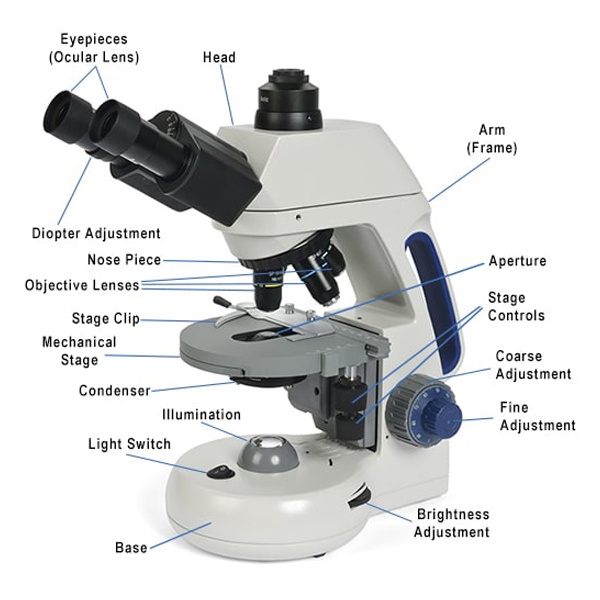
Objective lenses are the most critical components of any microscope’s imaging system. They are responsible for collecting light from the specimen and forming the initial, magnified intermediate image. Microscopes typically feature a revolving nosepiece holding multiple objective lenses with varying magnifications (e.g., 4x, 10x, 40x, 100x). Beyond simple magnification, objective lenses are engineering marvels designed to correct various optical aberrations.
They come in different levels of optical correction:
- Achromatic objectives correct for chromatic aberration (color fringing) in two colors (red and blue) and spherical aberration in one color (green).
- Plan achromatic objectives offer flat field correction, ensuring the entire field of view is in focus, not just the center.
- Apochromatic objectives provide the highest degree of correction, reducing chromatic aberration for three colors and spherical aberration for two, yielding exceptionally crisp and color-accurate images.
- Plan apochromatic objectives combine the superior chromatic and spherical correction of apochromats with flat field correction, representing the pinnacle of optical design for demanding applications.
The numerical aperture of an objective lens is inscribed on its barrel and is the primary determinant of its resolving power. High-magnification objectives, especially 100x objectives, are often designed for use with immersion oil, which has a refractive index similar to glass. This oil fills the air gap between the objective and the specimen, increasing the NA and significantly boosting resolution by preventing light from refracting away from the lens.
Eyepiece Lenses (Oculars): Refining the View
Eyepiece lenses, or oculars, are positioned at the top of the microscope tube, where the observer looks. Their primary function is to further magnify the intermediate image produced by the objective lens, presenting it as a comfortable, magnified virtual image to the eye. Like objectives, eyepieces also contribute to the overall optical quality.
Common types include:
- Huygenian eyepieces: Simple and inexpensive, with good chromatic correction but limited field of view.
- Ramsden eyepieces: Offer a wider field of view than Huygenian types.
- Widefield eyepieces: Designed for a broad, flat field of view, minimizing edge distortions and providing a more immersive viewing experience.
High-quality eyepieces are designed to correct for their own set of aberrations, ensuring that the final image is clear, sharp, and comfortable for prolonged viewing. They also define the field of view, determining how much of the magnified specimen is visible at once.
Condenser Lenses: Illuminating the Specimen
While not directly involved in image formation, condenser lenses are crucial for optimizing the illumination of the specimen. Located beneath the specimen stage, the condenser’s role is to collect light from the microscope’s illuminator and focus it into a uniform, narrow, high-intensity cone onto the specimen.
The quality of illumination directly impacts the resolution and contrast of the final image. A well-adjusted condenser ensures that the specimen is evenly illuminated across the field of view and that the angle of the light cone precisely matches the numerical aperture of the objective lens. This matching is critical for achieving optimal resolution. An adjustable iris diaphragm (aperture diaphragm) within the condenser allows control over the angle of the light cone, enabling the user to fine-tune the balance between resolution and contrast. Improper condenser adjustment can severely degrade image quality, even with the highest-quality objective lenses.
Correcting Optical Aberrations for Superior Imaging
The journey of light through multiple lens elements in a microscope is fraught with optical challenges. Lenses, by their very nature, can introduce distortions and imperfections known as aberrations. High-performance microscopy relies heavily on sophisticated lens designs that actively compensate for these aberrations, ensuring the captured image is as faithful a representation of the specimen as possible.
Spherical Aberration: Focusing Light Accurately
Spherical aberration occurs when light rays passing through different parts of a spherical lens converge at different focal points. Rays passing through the periphery of the lens focus closer to the lens than those passing near the center, resulting in a blurred image where no single sharp focal point exists.
To counteract spherical aberration, microscope objectives often employ multiple lens elements, some of which may be aspherical (having non-spherical surfaces). These elements are precisely shaped and combined to ensure that all parallel light rays converge at a single, sharp focal point. The careful arrangement and material selection of these elements are paramount in minimizing this pervasive aberration, especially at higher magnifications where it becomes more pronounced.
Chromatic Aberration: True Color Reproduction
Chromatic aberration is another significant challenge, arising from the fact that different wavelengths (colors) of light refract at slightly different angles as they pass through a lens. This causes different colors to focus at different points along the optical axis, leading to color fringes around objects and a general lack of color fidelity in the image.
The correction of chromatic aberration is a primary driver behind the complexity of modern objective lenses. Achromatic objectives address this by combining lens elements made from different types of glass with opposing dispersion characteristics, correcting for red and blue light. Apochromatic objectives take this a step further, using even more complex glass combinations and fluoride crystal elements to correct for three colors (red, green, and blue) and minimize spherical aberration for two colors, yielding images with exceptional color accuracy and sharpness across the visible spectrum.
Field Curvature and Astigmatism: Ensuring a Flat, Sharp Image
Beyond spherical and chromatic issues, other aberrations can affect image quality, particularly across the field of view:
- Field curvature manifests as a curved image plane even when the specimen is perfectly flat. This means that if the center of the image is in focus, the edges will be out of focus, and vice-versa. Plan objective lenses are specifically designed to correct for field curvature, ensuring a perfectly flat and uniformly focused image across the entire field of view, which is essential for digital imaging and quantitative analysis.
- Astigmatism occurs when the lens forms two separate focal lines for rays in different planes, rather than a single point. This results in an inability to sharply focus objects, particularly off-axis. High-quality objective lenses incorporate elements to correct for astigmatism, ensuring that points in the specimen are rendered as sharp points in the image, regardless of their position in the field.
The Evolution of Lenses and Future Directions in Microscopy
The role of lenses in microscopy has evolved dramatically since Antonie van Leeuwenhoek crafted his simple magnifying glasses in the 17th century. From solitary, hand-ground elements to sophisticated multi-element optical systems, lens technology has continuously pushed the boundaries of what microscopes can reveal.
From Simple Magnifiers to Complex Multi-Element Systems
Early microscopes relied on single convex lenses, limited in both magnification and resolution. The invention of the compound microscope, incorporating multiple lenses, marked a significant leap, but these early instruments suffered from severe aberrations. The 19th and 20th centuries witnessed an explosion in optical theory and manufacturing precision, leading to the development of achromatic, apochromatic, and plan objectives—each a testament to increasingly complex lens designs and the use of exotic glass types. Modern objective lenses can contain more than a dozen individual lens elements, each ground and polished to nanometer precision, and carefully assembled to achieve near-perfect optical performance. This intricate engineering represents the culmination of centuries of scientific and technological advancement in optics.
Integration with Digital Imaging and Computational Optics
The 21st century has seen the traditional role of lenses further enhanced by digital technology. While lenses remain indispensable for forming the primary image, digital cameras have largely replaced eyepieces in many research settings, capturing images and video directly. This integration has opened doors to computational microscopy, where sophisticated algorithms process and enhance images acquired through the lenses.
Techniques like deconvolution, for instance, can computationally remove blur caused by diffraction, effectively improving image clarity and resolution even beyond the optical limits. Super-resolution microscopy methods, while often involving complex illumination or fluorescent tagging, still fundamentally rely on high-quality objective lenses to gather the initial light signal. Adaptive optics, a technology borrowed from astronomy, is also finding its way into microscopy, using deformable mirrors to dynamically correct for aberrations introduced by the specimen itself or the imaging medium, effectively creating “perfect” lenses in real-time. Furthermore, advancements in meta-lenses and other novel optical materials promise even more compact, powerful, and aberration-free imaging systems in the future. The interplay between physical lens design and digital processing is continuously expanding the capabilities of microscopy, allowing scientists to visualize structures and processes with unprecedented detail and insight.
Conclusion
The role of lenses in microscopy is utterly foundational and multifaceted. They are not merely components but the very essence of how a microscope functions, directly dictating its ability to magnify, resolve, and render the microscopic world with clarity and accuracy. From the objective lenses that capture the initial specimen details to the eyepieces that present the final image, and the condenser lenses that optimize illumination, each lens type performs a specific, indispensable function. The relentless pursuit of aberration correction—tackling spherical, chromatic, field curvature, and astigmatism—has driven centuries of innovation in optical design and manufacturing. As microscopy continues to evolve, integrating with digital imaging and computational methods, the fundamental principles governing lens performance remain paramount. Lenses are the silent heroes of scientific discovery, continually pushing the boundaries of what we can see, enabling profound insights into the tiny worlds that govern our universe, and promising even more astonishing revelations in the future of technology and science.
aViewFromTheCave is a participant in the Amazon Services LLC Associates Program, an affiliate advertising program designed to provide a means for sites to earn advertising fees by advertising and linking to Amazon.com. Amazon, the Amazon logo, AmazonSupply, and the AmazonSupply logo are trademarks of Amazon.com, Inc. or its affiliates. As an Amazon Associate we earn affiliate commissions from qualifying purchases.