
Meiosis is a fundamental biological process responsible for sexual reproduction, enabling the creation of new life and the maintenance of genetic diversity within species. Unlike mitosis, which produces identical daughter cells, meiosis is a specialized type of cell division that generates genetically unique cells with half the number of chromosomes as the parent cell. Understanding the types of cells produced by meiosis is crucial for comprehending heredity, genetic variation, and the very foundation of life’s continuity.
The Essence of Meiosis: Generating Gametes for Reproduction
At its core, meiosis is about producing gametes. These are the specialized reproductive cells that, when they fuse during fertilization, combine their genetic material to form a zygote – the first cell of a new organism. In animals, the gametes are sperm in males and eggs (or ova) in females. In plants, the equivalent reproductive cells are also referred to as gametes, though their specific names and the structures they develop within can vary (e.g., pollen grains containing sperm in flowering plants, or ovules containing eggs).

The defining characteristic of gametes is their haploid nature. This means they contain only one set of chromosomes, denoted as ‘n’. The original parent cell that undergoes meiosis is diploid, meaning it contains two sets of chromosomes, denoted as ‘2n’. One set is inherited from each parent. Meiosis effectively halves this chromosome number, ensuring that when two haploid gametes fuse, the resulting diploid zygote has the correct number of chromosomes (n + n = 2n). This is vital for preventing aneuploidy – an abnormal number of chromosomes – which can lead to developmental issues or inviability.
The Two-Step Division Process of Meiosis
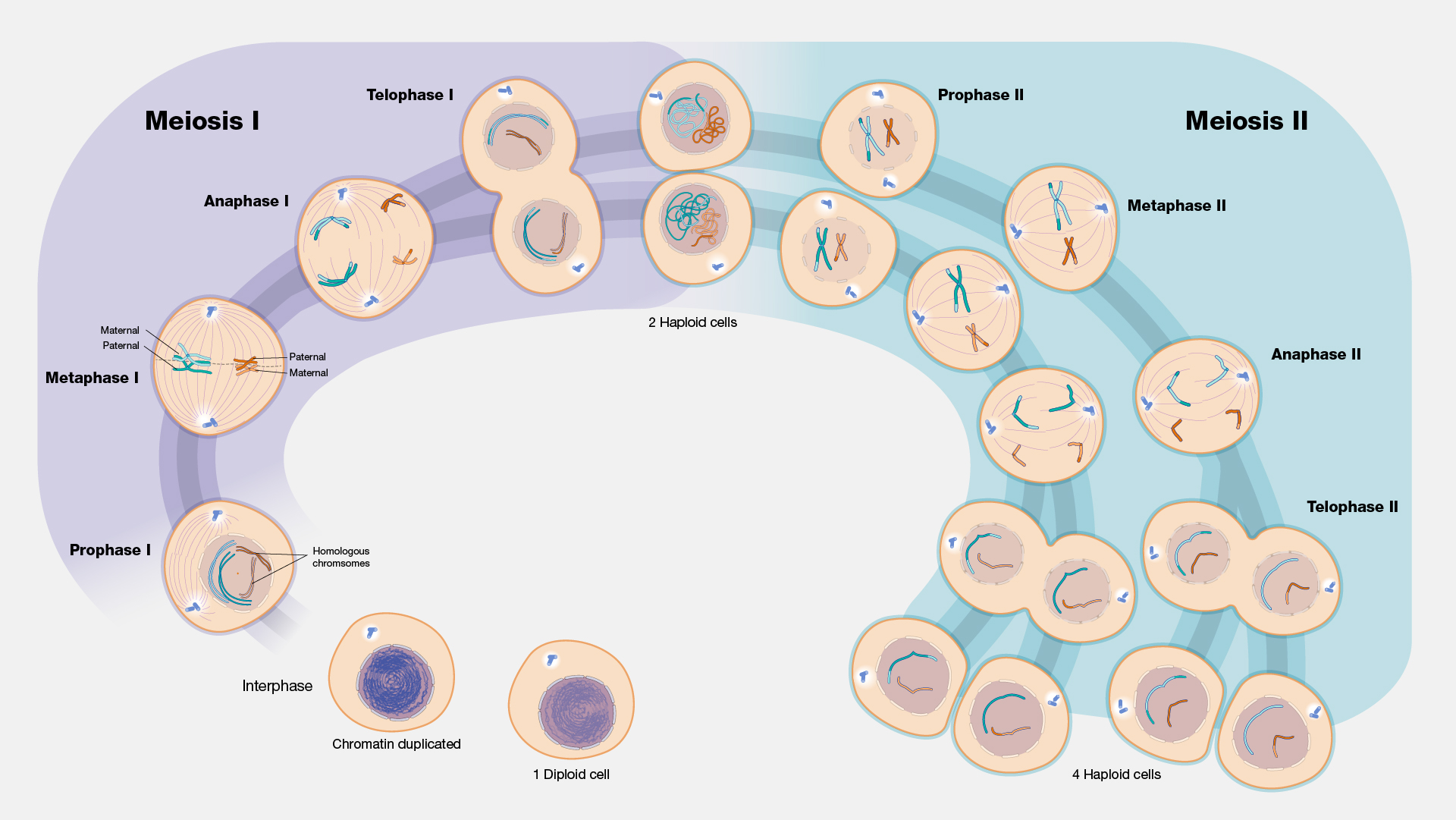
Meiosis is a complex, two-stage division process that involves two rounds of nuclear and cellular division, known as Meiosis I and Meiosis II. Each round is further divided into distinct phases.
Meiosis I: Separating Homologous Chromosomes
Meiosis I is the reductional division, where the homologous chromosome pairs are separated. Homologous chromosomes are pairs of chromosomes, one inherited from each parent, that carry genes for the same traits at the same loci (positions).
- Prophase I: This is the longest and most complex phase of meiosis. Key events include:
- Chromosomes condense: The chromatin coils and shortens, becoming visible as distinct chromosomes.
- Synapsis: Homologous chromosomes pair up closely to form structures called bivalents or tetrads. This close association is facilitated by a protein structure called the synaptonemal complex.
- Crossing Over (Recombination): This is a pivotal event unique to meiosis. During crossing over, segments of DNA are exchanged between non-sister chromatids of homologous chromosomes. This shuffling of genetic material creates new combinations of alleles on the chromosomes, significantly increasing genetic diversity. The points where crossing over occurs are called chiasmata.
- Metaphase I: The homologous chromosome pairs (tetrads) align at the metaphase plate, an imaginary plane equidistant from the two poles of the cell. Crucially, the orientation of each homologous pair is random, meaning either the maternal or paternal chromosome of a pair can face either pole. This is known as independent assortment, another major contributor to genetic variation.
- Anaphase I: The homologous chromosomes are pulled apart and move to opposite poles of the cell. Sister chromatids remain attached at their centromeres. This separation of homologous chromosomes is what reduces the chromosome number from diploid (2n) to haploid (n) in the resulting cells.
- Telophase I and Cytokinesis: The chromosomes reach the poles, and the cell divides into two daughter cells. Each daughter cell is now haploid (n), but each chromosome still consists of two sister chromatids.
Meiosis II: Separating Sister Chromatids
Meiosis II is the equational division, similar in many ways to mitosis. In this stage, the sister chromatids within each chromosome are separated.
- Prophase II: The chromosomes condense again (if they decondensed in Telophase I). The nuclear envelope breaks down, and spindle fibers form.
- Metaphase II: The chromosomes, each still composed of two sister chromatids, align at the metaphase plate in each of the two daughter cells.
- Anaphase II: The centromeres divide, and the sister chromatids are pulled apart to opposite poles of the cell. These separated chromatids are now considered individual chromosomes.
- Telophase II and Cytokinesis: The chromosomes reach the poles, decondense, and nuclear envelopes reform around them. The cytoplasm divides in both cells, resulting in a total of four haploid daughter cells.
The Products of Meiosis: Four Genetically Distinct Haploid Cells
The ultimate outcome of meiosis is the production of four haploid daughter cells. These cells are:
- Haploid: As established, they contain only one set of chromosomes.
- Genetically Unique: Due to crossing over and independent assortment, each of the four daughter cells possesses a unique combination of genes inherited from the original parent cell. This genetic individuality is the cornerstone of evolution and adaptation.
In males, these four haploid cells develop into sperm. This process is called spermatogenesis. It is a continuous process throughout a male’s reproductive life, producing millions of sperm daily.
In females, the outcome of meiosis is slightly different and more complex, known as oogenesis. While meiosis begins with a diploid germ cell, only one functional egg (ovum) is produced. The other three cells are small, non-functional cells called polar bodies. These polar bodies receive a small amount of cytoplasm during the unequal cytokinesis that occurs during Meiosis I and Meiosis II. They eventually degenerate. This unequal distribution of cytoplasm ensures that the single ovum receives abundant nutrients and organelles necessary to support the early development of an embryo after fertilization. The development of the ovum also involves significant cellular growth and preparation before meiosis begins.
The Significance of Meiosis in Genetic Diversity and Evolution

The primary biological importance of meiosis lies in its ability to generate genetic diversity. This diversity is the raw material upon which natural selection acts, driving evolutionary change.
Crossing Over: Shuffling the Genetic Deck
As mentioned, crossing over during Prophase I is a critical mechanism for creating new allele combinations. Imagine a chromosome carrying alleles for eye color, hair color, and height. Crossing over allows segments of this chromosome to be swapped with its homologous partner. This means a chromosome in the resulting gamete might carry the allele for blue eyes from the mother and the allele for brown hair from the father, along with a mix of other parental genes. This recombination ensures that offspring are not simply identical copies of their parents but possess novel genetic makeups.
Independent Assortment: Randomizing Chromosome Distribution
Independent assortment during Metaphase I further amplifies genetic diversity. Since each homologous pair of chromosomes can align in one of two ways at the metaphase plate, the number of possible combinations of chromosomes in the resulting gametes is enormous. For humans, with 23 pairs of chromosomes, there are 2^23 (over 8 million) possible combinations of chromosomes that can be passed down to a single gamete, even without considering crossing over. The combination of crossing over and independent assortment means that virtually every gamete produced is genetically distinct.
Advantages of Genetic Diversity
This vast genetic diversity has several key advantages for a species:
- Adaptation to Changing Environments: A genetically diverse population is more likely to contain individuals with traits that are advantageous in a particular environment. If the environment changes, some individuals will be better equipped to survive and reproduce, ensuring the continuation of the species.
- Resistance to Diseases: Genetic variation can confer resistance to diseases. If a population is genetically uniform, a single pathogen could wipe it out. However, with diverse genetic backgrounds, some individuals may possess immunity or resistance, allowing the population to survive outbreaks.
- Evolutionary Progress: Meiosis and sexual reproduction, by constantly generating new genetic combinations, provide the engine for evolution. It allows for the gradual refinement of traits over generations through natural selection, leading to the development of new species and complex life forms.
Meiosis in the Context of Technology and Biotechnology
While meiosis is a natural biological process, advancements in technology and biotechnology are increasingly allowing us to understand, manipulate, and even utilize the principles of meiosis.
Genetic Engineering and Gene Editing
Tools like CRISPR-Cas9, a revolutionary AI-powered tool, enable precise editing of DNA. While typically applied to somatic cells (body cells), the principles can theoretically extend to germline cells, though this raises significant ethical considerations. Understanding meiosis is fundamental to comprehending how genetic modifications in germ cells would be passed on to offspring, influencing future generations. Researchers can study gene expression patterns during meiosis, identify genes responsible for specific meiotic events, and explore ways to improve reproductive outcomes.
Assisted Reproductive Technologies (ART)
Apps and digital security in the handling of sensitive patient data are paramount in modern ART. Techniques like In Vitro Fertilization (IVF) rely heavily on our understanding of gamete formation and function. Meiosis is the process that produces the sperm and eggs used in IVF. Researchers are constantly working to improve the efficiency and success rates of ART by understanding the nuances of meiotic processes, identifying factors that can lead to chromosomal abnormalities in gametes, and developing methods to select for healthy eggs and sperm.
Understanding Heredity and Genetic Disorders
The study of meiosis is intrinsically linked to personal finance when considering the costs associated with genetic counseling and treatment for inherited disorders. Understanding how chromosomes segregate and recombine during meiosis helps geneticists identify the causes of many genetic diseases, such as Down syndrome (trisomy 21), cystic fibrosis, and Huntington’s disease. This knowledge facilitates genetic counseling for families, allowing them to understand their risk of passing on certain conditions. It also informs the development of diagnostic tests and potential therapeutic strategies.
Personal Branding and Identity in a Genetic Age
In a world increasingly aware of the genetic basis of life, personal branding and corporate identity are even becoming influenced by our understanding of genetics. While not directly produced by meiosis, the genetic makeup of an individual, a product, or even a brand can be analyzed and understood at a fundamental level. This knowledge can inform health decisions, lifestyle choices, and even the development of personalized products and services. The very concept of identity is being explored through the lens of our genetic inheritance, a legacy shaped by the meiotic processes of our ancestors.
Conclusion
In summary, meiosis is an essential biological process that produces four genetically unique haploid cells, primarily serving as gametes (sperm and eggs) for sexual reproduction. This intricate two-stage division, Meiosis I and Meiosis II, ensures the halving of chromosome number and the generation of immense genetic diversity through crossing over and independent assortment. This diversity is the driving force behind evolution, allowing species to adapt, resist disease, and flourish. As technology advances, our understanding and application of the principles of meiosis continue to expand, impacting fields from genetic engineering and reproductive medicine to our very conception of identity. The cells produced by meiosis are not just building blocks of life; they are carriers of evolutionary potential, each a unique testament to the power of biological innovation.
aViewFromTheCave is a participant in the Amazon Services LLC Associates Program, an affiliate advertising program designed to provide a means for sites to earn advertising fees by advertising and linking to Amazon.com. Amazon, the Amazon logo, AmazonSupply, and the AmazonSupply logo are trademarks of Amazon.com, Inc. or its affiliates. As an Amazon Associate we earn affiliate commissions from qualifying purchases.