
In the intricate world of financial markets, investors are constantly seeking an edge—a way to predict future price movements, identify undervalued assets, and ultimately, outperform the market. Yet, standing as a formidable counter-argument to many active trading strategies is one of the most significant and debated concepts in financial economics: the Efficient Market Hypothesis (EMH). Proposed by economist Eugene Fama in the 1960s, the EMH posits that financial markets are “informationally efficient,” meaning that all available information is fully and instantly reflected in asset prices. This profound idea has reshaped how academics and practitioners alike view market behavior, investment strategies, and even the very possibility of consistently “beating” the market.
At its core, the EMH suggests that because prices already incorporate all known information, it is impossible for investors to consistently achieve abnormal returns through fundamental analysis (examining financial statements) or technical analysis (studying past price patterns). Any perceived mispricings are quickly arbitraged away by rational investors, leaving no predictable patterns for profit. This leads to the famous “random walk” theory, where future price movements are unpredictable, much like a random walk, because they can only be influenced by new, unanticipated information. While controversial and continuously challenged by real-world events and behavioral finance, understanding the EMH is crucial for anyone navigating the complexities of investing, offering a critical lens through which to evaluate various strategies and the very nature of market efficiency.
Understanding the Core Tenets of the EMH
To grasp the full implications of the Efficient Market Hypothesis, it’s essential to dissect its fundamental building blocks. These tenets describe the idealized conditions under which market efficiency is expected to prevail, shaping our understanding of how information, rationality, and unpredictability interact in financial markets.
Information Efficiency
The bedrock of the EMH is the concept of information efficiency. This tenet states that asset prices, at any given time, fully reflect all available relevant information. This includes not only historical price data and publicly disclosed company financials but, in its strongest form, even private, inside information. The immediate and complete incorporation of information into prices means there are no systematic ways to profit from analyzing past data or readily accessible news. As soon as new information emerges, rational investors act upon it, pushing prices to their new equilibrium almost instantaneously. This rapid assimilation of information is what prevents arbitrage opportunities from persisting, effectively closing the window for easy profits based on existing knowledge.
Rational Investors
Another critical assumption underpinning the EMH is the prevalence of rational investors. Rationality, in this context, implies that investors act in their own self-interest, process information logically, and make decisions that maximize their expected utility. They are not swayed by emotions, cognitive biases, or herd mentality. Instead, they meticulously analyze all available data, correctly interpret its implications for asset values, and execute trades accordingly. In a market dominated by such rational participants, any temporary deviations from fundamental value would be swiftly corrected as these informed actors exploit mispricings, thereby ensuring that prices always reflect true value. While behavioral finance has since questioned the universal presence of such perfect rationality, it remains a crucial idealization within the EMH framework.
Random Walk Theory
A direct consequence of information efficiency and rational investors is the random walk theory. If prices instantly reflect all available information, then future price changes can only be driven by new information, which by its very nature is unpredictable. If new information were predictable, it would already be incorporated into current prices. Therefore, current prices already embody all known factors, and future price movements are essentially random and independent of past movements. This means that technical analysis—the study of historical price patterns and trading volumes to predict future prices—is rendered useless under the EMH. If prices follow a random walk, then observing past trends offers no statistical advantage in forecasting future direction, making each price movement akin to a coin flip.
The Three Forms of Market Efficiency
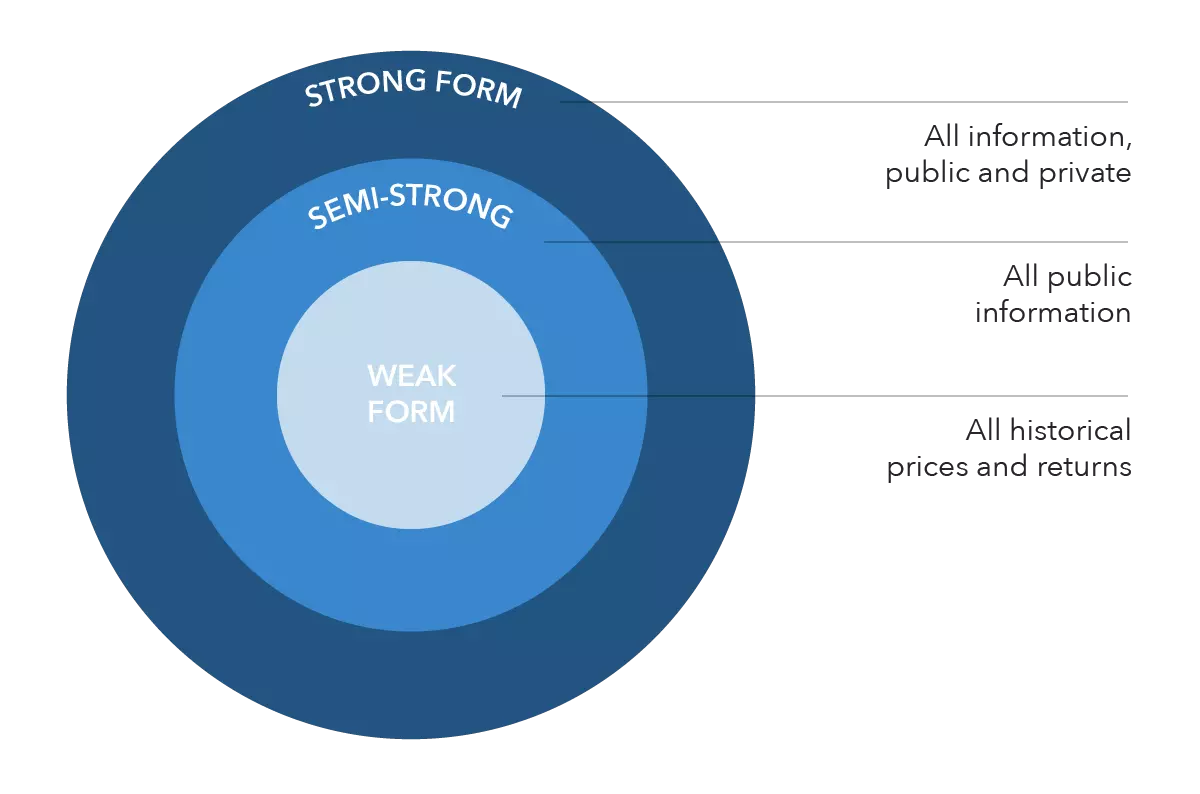
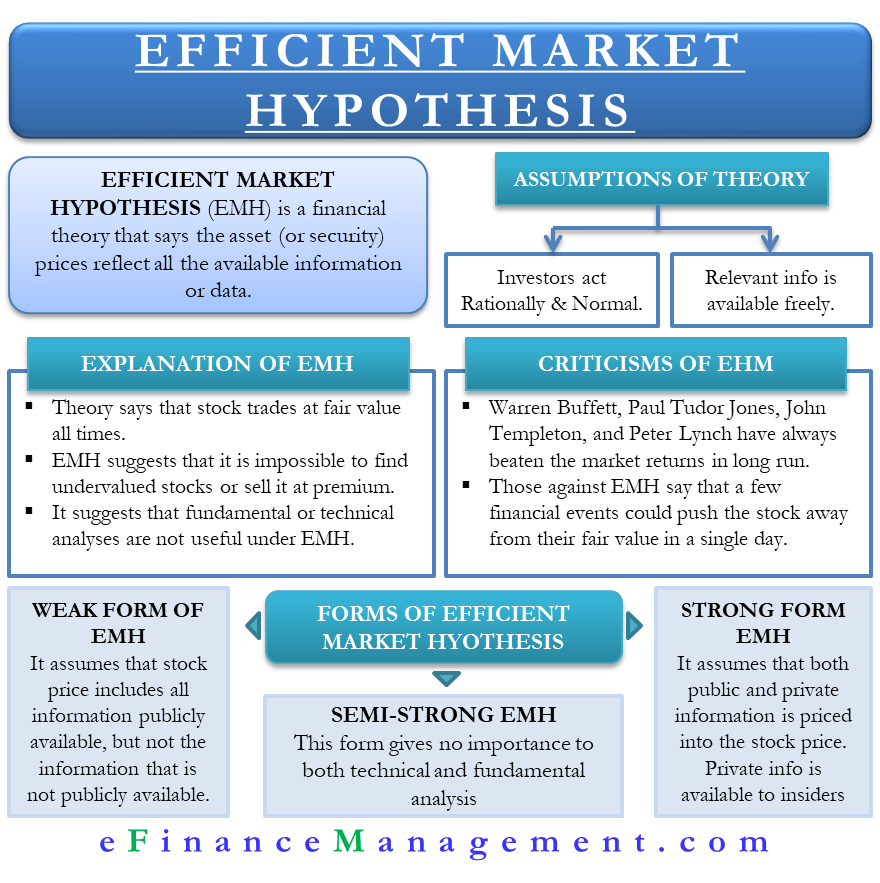
The EMH is not a monolithic concept; rather, Eugene Fama formalized it into three distinct forms, each progressively stricter in its assumptions about what constitutes “available information” and how quickly it’s reflected in prices. Understanding these forms helps to clarify the different levels of market efficiency and their implications for investment strategies.
Weak-Form Efficiency
The weakest form of the EMH posits that current asset prices fully reflect all historical price and trading volume information. This means that past price patterns, trends, and trading volumes provide no basis for predicting future price movements that would allow investors to consistently earn abnormal returns. In a weak-form efficient market, technical analysis—which relies exclusively on historical market data—is considered ineffective. If markets are weak-form efficient, then any observable patterns in historical prices are merely random occurrences, not reliable indicators of future performance. Investors relying on momentum, moving averages, or other technical indicators would be unable to consistently “beat” a simple buy-and-hold strategy after accounting for risk and transaction costs.
Semi-Strong Form Efficiency
Building upon weak-form efficiency, the semi-strong form hypothesis asserts that current asset prices fully reflect all publicly available information. This includes not only historical price data but also all information found in financial statements (earnings reports, balance sheets, income statements), news articles, analyst reports, economic forecasts, and any other data that is publicly disseminated. In a semi-strong efficient market, neither technical analysis nor fundamental analysis (which relies on publicly available financial information) can generate consistent abnormal returns. Any new public information is assumed to be instantaneously and unbiasedly incorporated into prices. Therefore, by the time an investor reads a news report or an earnings announcement, the market has already reacted, and the opportunity to profit from that information has vanished.
Strong-Form Efficiency
The most stringent and arguably least realistic form of the EMH is strong-form efficiency. This hypothesis states that current asset prices fully reflect all information, whether public or private (insider information). If markets were strong-form efficient, even those with privileged, non-public information—such as corporate executives or government officials—would be unable to consistently earn abnormal returns. This implies that no one, not even insiders, could profit from their informational advantage because even private information is somehow already factored into current prices. This form is often dismissed as unattainable in practice due to the existence of insider trading regulations, which implicitly acknowledge that private information can indeed be exploited for profit, making markets not strong-form efficient.
Implications for Investors and Financial Markets
The Efficient Market Hypothesis, in its various forms, has profound implications for how investors approach the market and for the broader structure and regulation of financial systems. It challenges many traditional beliefs about active management and offers a theoretical underpinning for certain investment philosophies.
Active vs. Passive Investing
Perhaps the most direct implication of the EMH lies in the debate between active and passive investing. If markets are efficient, particularly in their semi-strong form, then active investment strategies—where managers attempt to outperform the market by picking stocks or timing the market—are unlikely to succeed consistently after fees and transaction costs. The EMH suggests that the vast majority of active managers will, over the long run, underperform a passive strategy of simply tracking a broad market index. This provides a strong theoretical justification for the rise of passive investing vehicles like index funds and exchange-traded funds (ETFs), which aim to match market returns at minimal cost rather than trying to beat them. For individual investors, the EMH advises against expensive active management and encourages diversified, low-cost indexing as the most rational approach.

The Role of Financial Analysts
In an efficient market, the role of financial analysts—who spend their careers researching companies, forecasting earnings, and making buy/sell recommendations—is fundamentally questioned. If all publicly available information is already reflected in prices, then an analyst’s laborious research into public data would offer no predictive power for future outperformance. Their recommendations would merely confirm what the market already knows. While analysts still provide valuable services in terms of disseminating information, providing liquidity, and helping interpret complex financial reports, the EMH implies that their ability to consistently identify mispriced assets is severely limited. Any analyst who appears to consistently outperform might simply be lucky, or their “alpha” might be offset by the higher fees their clients pay.
Market Anomalies and Behavioral Finance
Despite the compelling logic of the EMH, real-world markets frequently exhibit “anomalies”—patterns or events that seem to contradict the hypothesis. These include phenomena like the “January effect” (stocks performing better in January), the “small-firm effect” (small-cap stocks outperforming large-caps), and various price momentum or reversal patterns. Such anomalies suggest that markets might not be perfectly efficient, at least not at all times or in all segments. The rise of behavioral finance directly addresses these inconsistencies, arguing that investor psychology, cognitive biases (e.g., overconfidence, herd behavior, loss aversion), and emotional decision-making can lead to persistent mispricings and deviations from rational behavior. Behavioral economists highlight that markets are made up of human beings, who are not always rational, and these irrationalities can create opportunities that an efficient market would otherwise quickly eliminate.
Criticisms and Challenges to the EMH
While undeniably influential, the EMH has been a continuous target of criticism and real-world challenges. Its stark implications often clash with market realities, leading to an ongoing debate about the true extent of market efficiency.
Market Bubbles and Crashes
One of the most significant challenges to the EMH comes from the recurring phenomena of market bubbles and subsequent crashes. Events like the Dot-com bubble of the late 1990s, the 2008 housing crisis, or the Tulip Mania of the 17th century demonstrate periods where asset prices soar far beyond any reasonable assessment of their intrinsic value, only to collapse dramatically. These events are difficult to reconcile with the EMH’s premise of rational investors and instantaneous information incorporation. If markets were truly efficient, such speculative excesses and irrational exuberance, which lead to severe mispricings, should be swiftly corrected by rational arbitrageurs long before they reach catastrophic levels. The existence of bubbles and crashes suggests that collective irrationality, herd behavior, and financial contagions can override the forces of efficiency.
Insider Trading and Information Asymmetry
The strong-form EMH, which posits that even private information is reflected in prices, faces an immediate and obvious challenge: insider trading. The very existence of laws against insider trading acknowledges that individuals with non-public information possess a significant advantage and can profit unfairly. If markets were strong-form efficient, insider trading would be impossible because the market would already know what the insider knows, making their information valueless for abnormal returns. The fact that insiders often make substantial profits from their privileged information is direct evidence that information asymmetry exists and that markets are not strong-form efficient. This also implies that even semi-strong efficiency might be compromised if private information subtly influences prices before it becomes public.
Behavioral Biases
Behavioral finance directly critiques the EMH’s assumption of purely rational investors. It provides extensive empirical evidence that human decision-making is rife with cognitive biases and emotional influences. Investors exhibit biases such as overconfidence (leading to excessive trading and risk-taking), anchoring (over-relying on initial pieces of information), herd mentality (following the crowd, often to their detriment), and loss aversion (feeling the pain of losses more acutely than the pleasure of equivalent gains). These systematic irrationalities can lead to predictable patterns of mispricing that are not quickly arbitraged away. When a significant portion of the market is influenced by similar biases, it can create persistent deviations from fundamental value, contradicting the core tenets of efficiency.
The Enduring Relevance of the EMH in Modern Finance
Despite its criticisms and challenges, the Efficient Market Hypothesis remains a cornerstone of modern financial theory. Its contributions have been immense, shaping not only academic research but also practical investment strategies and regulatory frameworks.
Guiding Investment Strategies
Even if markets are not perfectly efficient in their strongest forms, the EMH still provides invaluable guidance for investors. It encourages skepticism towards claims of consistent market outperformance and highlights the difficulty of “beating the market.” For most individual investors, the EMH strongly advocates for a diversified, low-cost, long-term passive investment approach, such as investing in index funds, rather than attempting to pick individual stocks or time the market. It underlines the importance of minimizing fees and transaction costs, as these are significant detractors from returns, especially in an efficient market where true alpha is scarce. The EMH also reinforces the principle that higher returns generally come with higher risk, as any seemingly “free lunch” in an efficient market is highly suspect.
Regulatory Frameworks
The EMH has also influenced the development of regulatory frameworks designed to enhance market fairness and efficiency. Regulations like those prohibiting insider trading, requiring timely and transparent disclosure of corporate information, and ensuring fair access to information for all investors are all implicitly aimed at pushing markets closer to the ideal of semi-strong or even strong-form efficiency. By minimizing information asymmetry and ensuring that public information is indeed public and promptly incorporated, regulators strive to create a level playing field where no single group has an unfair informational advantage, thereby fostering greater investor confidence and market integrity.
A Foundation for Further Research
Perhaps one of the EMH’s greatest legacies is its role as a fundamental hypothesis from which other theories have emerged and evolved. It provides a robust baseline against which market behavior can be measured and deviations analyzed. The very existence of behavioral finance, for instance, largely developed as a response to the EMH’s limitations, seeking to explain phenomena that the EMH could not. Similarly, research into market microstructure, algorithmic trading, and the speed of information dissemination continues to build upon or challenge aspects of the EMH. It remains a crucial theoretical foundation, driving ongoing academic inquiry into the mechanisms of financial markets and the rationality (or irrationality) of their participants.
Conclusion
The Efficient Market Hypothesis stands as one of the most provocative and enduring theories in financial economics. It asserts that market prices fully reflect all available information, making it impossible for investors to consistently achieve abnormal returns through active trading strategies. From its weak, semi-strong, to strong forms, the EMH paints a picture of rational investors, instant information processing, and unpredictable, random price movements.
While challenged by market anomalies, bubbles, and the insights of behavioral finance, the EMH’s core message—that consistently beating the market is extraordinarily difficult—remains profoundly relevant. It underpins the logic of passive investing, guides regulatory efforts to ensure market fairness, and serves as a vital theoretical benchmark for understanding market dynamics. For any investor, grappling with the EMH means recognizing the formidable power of collective market intelligence and adopting strategies that acknowledge its wisdom, even as the search for elusive alpha continues.
aViewFromTheCave is a participant in the Amazon Services LLC Associates Program, an affiliate advertising program designed to provide a means for sites to earn advertising fees by advertising and linking to Amazon.com. Amazon, the Amazon logo, AmazonSupply, and the AmazonSupply logo are trademarks of Amazon.com, Inc. or its affiliates. As an Amazon Associate we earn affiliate commissions from qualifying purchases.